
BVNK vs Fireblocks: Which Stablecoin Infrastructure Model Fits Your Business?
Compare BVNK and Fireblocks across payment rails, wallets, custody, stablecoin conversion, APIs, controls, geographic coverage and implementation requirements.

BVNK and Fireblocks are often considered for the same stablecoin project, but they emphasize different layers of the stack. BVNK is primarily oriented around moving money between fiat and stablecoins. Fireblocks is primarily wallet, custody and transaction infrastructure on which a business can build its own workflows.
The distinction is not absolute. Both providers have expanded their products, and available features depend on jurisdiction, contracting entity and implementation. The practical question is whether your company wants a more packaged payment service or greater control over the underlying wallet infrastructure.
BVNK vs Fireblocks at a glance
| Area | BVNK | Fireblocks |
|---|---|---|
| Primary emphasis | Stablecoin payments, fiat collection and payouts, conversion and settlement | Wallet infrastructure, key management, transaction policies and digital-asset connectivity |
| Fiat payment rails | More directly integrated into the payment proposition, subject to region and account eligibility | Usually accessed through connected banks, payment providers, exchanges or other partners |
| Wallet model | Payment-focused wallets and accounts managed as part of the service | Programmable vaults and wallets using multi-party computation, or MPC |
| Custody focus | Operational simplicity for receiving, converting and paying funds | Detailed control over key management, signing and asset movement |
| Best fit | Businesses prioritizing fiat-to-stablecoin payment flows | Businesses building broader digital-asset operations or embedded products |
This is a directional comparison rather than a substitute for current product documentation. Supported currencies, networks, limits and regulatory coverage can change, so request a corridor-by-corridor confirmation during procurement.
Payment and fiat rails
BVNK’s model is generally closer to a payment provider. Its proposition combines business payment accounts, stablecoin conversion, collection and payouts. That can reduce the number of separate banking, exchange and blockchain integrations required for flows such as receiving euros, converting to USDC and paying a supplier on-chain.
Before selecting it, confirm the exact mechanics for each corridor:
- Which local and international payment rails are available?
- Are accounts held in your company’s name, or are payments routed through pooled accounts?
- Can third-party funds be received and paid out?
- What beneficiary, reference and reconciliation data is available through the API?
- What are the cut-off times, limits, settlement windows and return procedures?
Fireblocks is more commonly used underneath the payment flow. A business can connect wallets to banks, liquidity venues, exchanges and payment providers, then define how transactions move between them. Fireblocks has payment-oriented products, but fiat access still depends on the providers and banking relationships enabled for the specific deployment.
This means Fireblocks may offer more architectural flexibility, while requiring more vendor relationships. If the main requirement is to send batch vendor or contractor payments without assembling that stack, a packaged stablecoin payout service may be easier to operate.
Wallet infrastructure, custody and key management
Custody answers a legal and operational question: who controls the assets and the cryptographic keys needed to move them? The product interface alone does not answer it. Finance and legal teams should review the customer agreement, wallet structure, recovery arrangements and the regulated entities involved.
Fireblocks is known for MPC wallet technology. MPC, or multi-party computation, divides the signing process across multiple key shares so that no complete private key must exist in one place. Businesses can create vault accounts, assign users and apply policy rules to transactions. Depending on the chosen product and service providers, the operating model may be self-custodial, managed or connected to a third-party custodian.
BVNK abstracts more of this wallet machinery into a payments service. That can be useful when the objective is reliable collection, conversion and payout rather than managing a large estate of blockchain wallets. The trade-off is that the customer may have less direct control over wallet architecture and transaction signing.
Ask both providers for written answers to these questions:
- Who legally controls the assets at each stage of a transaction?
- Who holds or participates in the signing keys?
- Can the provider move funds without customer approval?
- What happens if the provider, a signing device or an administrator becomes unavailable?
- How are blockchain fees charged and reconciled?
Stablecoin conversion and liquidity
BVNK places stablecoin conversion near the center of the product. A typical flow may involve receiving fiat, converting it into a supported stablecoin and paying to an external wallet, or receiving stablecoins and settling fiat to a bank account. The available pairs, spreads, transaction fees and settlement times should be confirmed for each legal entity and corridor.
Fireblocks provides the wallet and connectivity layer for moving assets to and from liquidity venues. Conversion may occur through a connected exchange, over-the-counter desk, market maker or payment provider. This gives treasury teams more choice over execution, but they must manage pricing, counterparty exposure, balances and reconciliation across those relationships.
Do not compare only the quoted conversion spread. Calculate the complete cost of a representative payment, including fiat transfer fees, conversion, blockchain gas, withdrawal charges and any minimum monthly platform commitment.
APIs and implementation requirements
BVNK implementation
A BVNK project is likely to center on payment APIs, account balances, quotes, beneficiaries, payouts and webhooks. The integration should map provider transaction IDs to invoices or customer records and handle failed, returned or delayed payments. Finance teams also need a process for reconciling fiat and blockchain balances into the general ledger.
Fireblocks implementation
A Fireblocks project usually requires more blockchain architecture. Teams must define vault structures, wallet addresses, signing policies, network support, fee management and connections to external providers. Developers also need to handle transaction states such as pending, confirmed, rejected and failed.
That additional work can be justified when wallet infrastructure is part of the company’s product or when the business needs detailed control across many assets, entities and counterparties. It may be excessive for a finance team that only needs to convert and pay USDC or USDT.
Controls and operational evidence
Fireblocks offers policy-based transaction controls, user roles and approval workflows at the wallet layer. These are valuable when a company needs to determine who may initiate, approve and sign transfers across a complex digital-asset operation.
BVNK’s controls are more closely tied to payment operations. Evaluate user permissions, beneficiary management, API authentication, wallet screening and exportable transaction records. In both cases, test whether the evidence is suitable for month-end close and audit—not merely visible in a dashboard.
For every provider, review allowlists, sanctions screening, approval thresholds, immutable activity records and the process for investigating a flagged wallet. A public wallet screening tool such as the Stablerail wallet checker can support initial checks, but it should not replace your company’s compliance process.
Geographic and network coverage
Coverage should be evaluated as a matrix, not a country count. Record the contracting entity, customer jurisdiction, fiat currency, payment rail, stablecoin, blockchain network and beneficiary location for every planned flow.
For example, support for USDC does not necessarily mean support for USDC on Ethereum, Base, Arbitrum, Polygon and Solana. Likewise, access to EUR does not automatically confirm SEPA Instant availability, named accounts or third-party payouts.
BVNK may be the more direct option where its supported payment corridors match your requirements. Fireblocks may be stronger where the priority is connecting many networks, exchanges, custodians and counterparties. In either case, obtain written confirmation of network and token contract support; sending an asset over the wrong network can result in permanent loss.
Which model fits your business?
Choose a BVNK-style model when:
- Your main requirement is collecting, converting and paying fiat and stablecoins.
- You want fewer banking and liquidity integrations.
- You prefer a payment API over building wallet operations.
- The provider’s available corridors cover your entities and counterparties.
Choose a Fireblocks-style model when:
- Wallet and transaction infrastructure is part of your product.
- You need granular signing policies and key-management controls.
- You already have, or plan to manage, banking and liquidity relationships.
- You need connectivity across multiple blockchain networks and digital-asset providers.
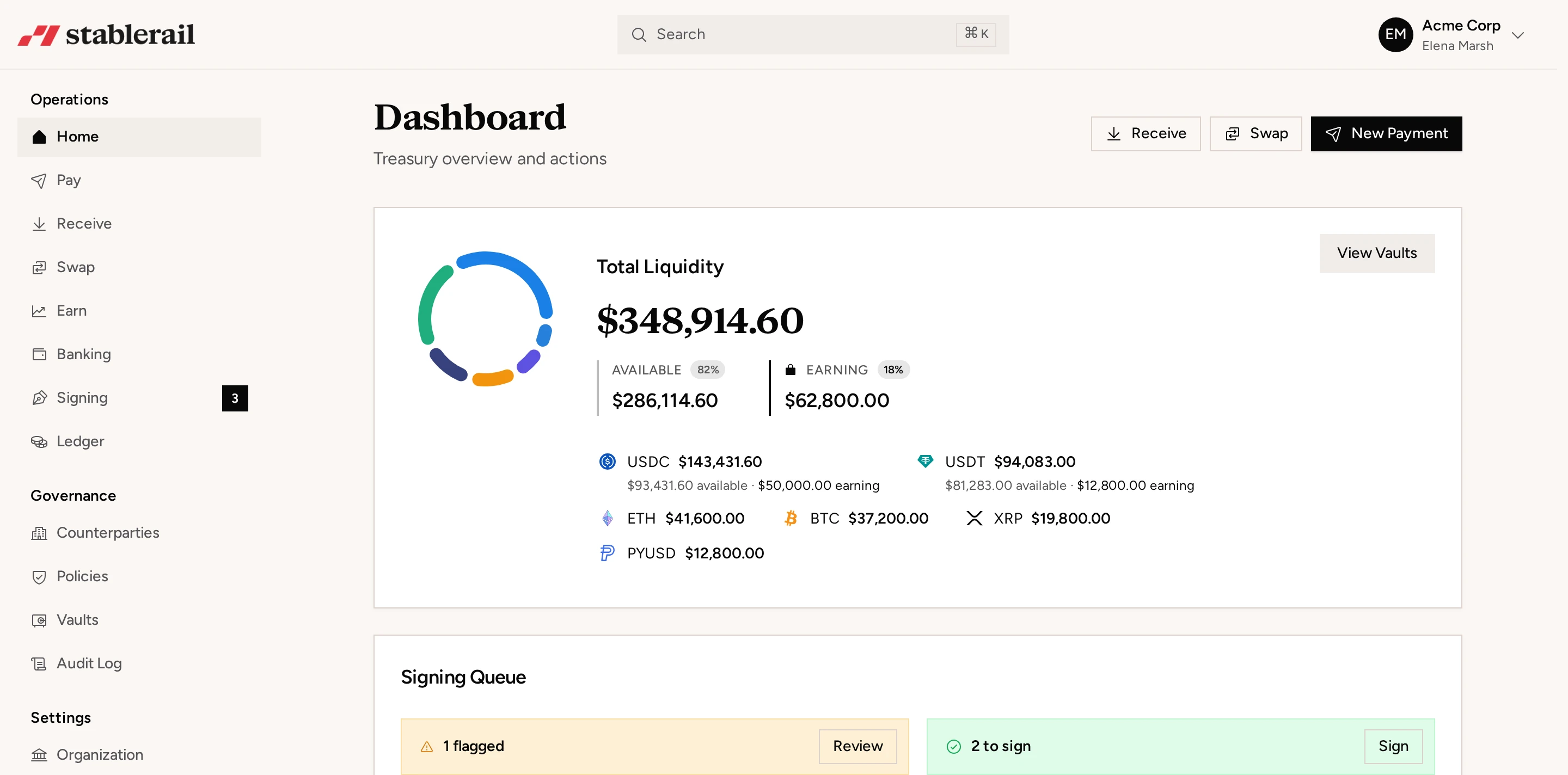
A third model is an integrated corporate treasury platform. Stablerail combines self-custodial MPC vaults and quorum signing with fiat rails, stablecoin on- and off-ramps, payouts, cards and treasury controls. This can suit finance teams managing their company’s own USDC or USDT without building a payment stack from separate components. Businesses considering USDC can review the USDC business account workflow.
Run a transaction-level proof of concept
Before signing, test complete flows using realistic amounts: receive fiat, convert it, make an on-chain payout, return funds to fiat and export the records. Measure total fees, time to beneficiary receipt, manual steps and reconciliation quality.
The deciding factor is not which provider has the longer feature list. It is which stablecoin infrastructure model gives your business the right balance of payment rails, custody control, integration effort and geographic coverage for the flows it actually runs.
Finance writers covering stablecoin treasury, payments, compliance, and risk controls.
More about the Stablerail team- Stablecoin treasury managementApprovals, limits, yield and reporting on one balance.
- Stablecoin payoutsBatch contractor and vendor payments with screening.
- USDT vs USDCWhich stablecoin your company should settle in.
- Stablecoin finance glossaryMPC, off-ramp, travel rule and the rest, in plain English.
- Product updatesEverything we ship, month by month.