
Best Tools for Managing Stablecoin Treasury at Scale
A practical guide to selecting stablecoin treasury tools for consolidated balances, custody, approvals, batch payouts, fiat conversion, reconciliation, screening and audit evidence.

Managing USDC or USDT through a few wallets and spreadsheets may work at low volume. It becomes harder when a finance team adds entities, networks, fiat currencies, payroll, vendor payments and multiple approvers.
The best stablecoin treasury setup is not necessarily the tool with the longest feature list. It is the one that gives finance a consolidated view of funds, supports routine payment operations and produces evidence that accounting, compliance and auditors can use.
This guide explains what growing teams should assess across wallets, custody, approvals, batch payouts, fiat rails, conversion, reconciliation and reporting.
Start with the operating model
Before comparing tools, document how money enters, moves through and leaves the company. At minimum, map:
- Legal entities and operating currencies.
- Expected monthly inflows and outflows.
- USDC and USDT balances by network.
- Fiat accounts used for EUR, USD and GBP.
- Vendor, contractor and payroll payment volumes.
- Who prepares, approves and releases transactions.
- Accounting systems and required export formats.
This prevents a common procurement mistake: selecting a secure wallet that cannot support treasury management workflows, or selecting a payment platform that provides weak custody and balance controls.
Compare the main tool categories
| Tool category | Best suited to | Typical limitation |
|---|---|---|
| Single-user wallets | Small balances and occasional transfers | Limited approvals, reporting and evidence |
| Institutional custody platforms | Secure asset storage and policy controls | May require separate fiat, payroll and accounting tools |
| Payment platforms | Vendor, contractor and customer transactions | May not provide consolidated custody or treasury reporting |
| Traditional treasury systems | Bank accounts, cash forecasting and enterprise workflows | Blockchain wallets and transaction data may require integrations |
| Corporate stablecoin treasury platforms | Managing fiat and stablecoins within one operating workflow | Coverage varies by jurisdiction, asset, network and fiat corridor |
Many companies use several tools. That can be appropriate, but each additional system creates another balance source, approval process and reconciliation feed. Finance should assess the complete workflow rather than each product in isolation.
1. Consolidated balances and transaction visibility
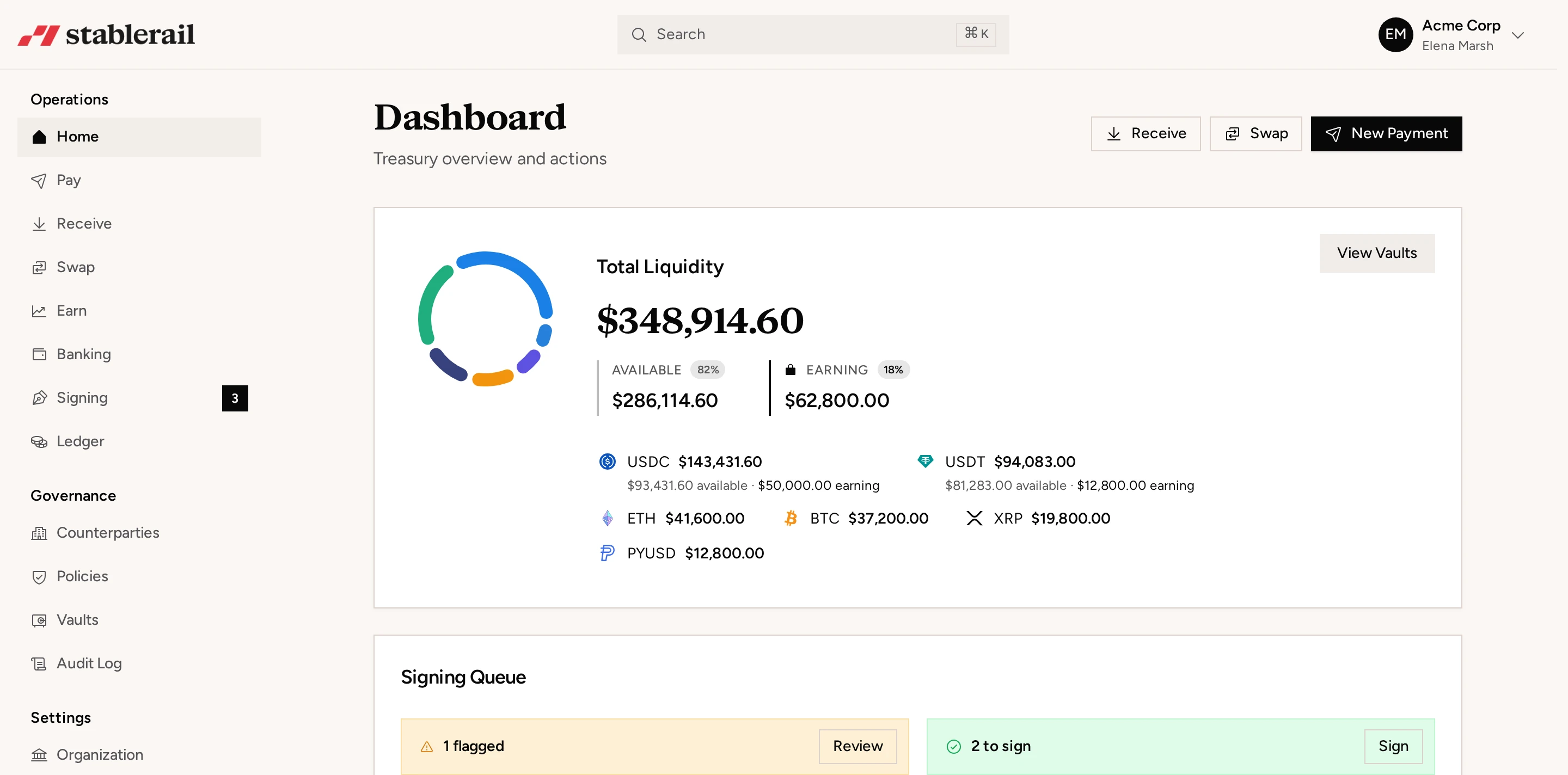
A treasury dashboard should show stablecoin and fiat positions without requiring staff to check each wallet, blockchain explorer and bank portal separately.
Look for balances segmented by:
- Legal entity and account.
- Asset, including USDC, USDT and fiat currencies.
- Network, such as Ethereum, Base, Arbitrum, Polygon, Tron, BNB Chain, Optimism and Solana.
- Available, pending and restricted funds.
- Operating, reserve and yield allocations.
Network labels matter. USDT on Tron and USDT on Ethereum are not interchangeable until they are transferred or converted through supported infrastructure. Sending an asset over an unsupported network can result in delayed or unrecoverable funds.
2. Wallets, custody and access
For corporate use, compare who controls the signing keys and what happens if an employee leaves or loses access.
Self-custodial MPC vaults are one option. MPC, or multi-party computation, distributes the signing process so that no single person holds a complete private key. A quorum policy can require, for example, two authorised signers before a transfer is released.
Ask vendors to demonstrate:
- How signers are added, removed and recovered.
- Whether one user can create and approve the same payment.
- How transaction limits and wallet allowlists work.
- What the platform can and cannot do without company approval.
- How emergency access or account recovery is handled.
The answers should be documented, not inferred from a generic security description.
3. Role-based approvals
Approvals should reflect the finance team’s existing authority matrix. Useful roles typically include viewer, payment preparer, approver and administrator.
Test whether policies can vary by amount, asset, destination, entity and payment type. A team might permit one approval for routine payments below a threshold while requiring two approvers for larger transfers or new beneficiaries.
Also check whether changes to sensitive settings—such as adding an approver or changing an allowlisted address—require separate approval.
4. Batch payouts and payroll
At scale, entering wallet addresses and amounts individually is slow and increases error risk. Batch payouts should support file upload or API submission, validation and a single approval workflow covering many recipients.
Evaluate the complete process:
- Recipient name, wallet address, network, asset and amount validation.
- Duplicate-payment warnings.
- Estimated network and platform fees before approval.
- Status tracking for every payment in a batch.
- Clear handling of failed or rejected transactions.
- Downloadable results for reconciliation.
Payroll requires additional data controls and predictable scheduling. Confirm whether the provider supports employee or contractor records, payment references and restricted visibility for compensation data. Teams evaluating these workflows can review stablecoin payroll and batch payout capabilities.
5. Fiat rails and conversion
A useful stablecoin treasury platform should connect blockchain balances to the fiat rails the business actually uses. Relevant coverage can include SEPA and SEPA Instant for EUR, ACH and Fedwire for USD, SWIFT for cross-border transfers, and Faster Payments, CHAPS and BACS for GBP.
Timings depend on the bank, corridor, cutoff and compliance review. As general market conventions, SEPA Instant can settle within seconds when both institutions participate, ACH often takes one to three business days, and international SWIFT payments may take one to five business days. These are not guaranteed delivery times.
For on- and off-ramp conversion, compare the full delivered cost rather than only the headline fee:
- Conversion spread.
- Platform or corridor fee.
- Blockchain network fee.
- Bank or intermediary charges.
- Minimum and maximum transaction sizes.
Prefer published corridor pricing or a quote that shows how much the recipient will receive. Also verify support for virtual IBANs, named accounts and multi-currency balances where these are operational requirements.
6. Reconciliation and accounting exports
Reconciliation is often the deciding factor between a wallet product and a finance-ready platform. Every transaction should have a unique reference connecting the internal payment record, blockchain transaction hash, beneficiary and accounting entry.
Check for CSV exports, API access and integrations with the company’s ledger or ERP. Exports should include fees separately from principal amounts, fiat values, timestamps, asset and network, transaction status, wallet addresses and internal references.
Ask how the system handles internal wallet transfers. Without correct classification, moving USDC between company-controlled wallets can appear as revenue or an expense.
7. Screening and audit evidence
Screening should fit into the payment workflow rather than operate as a disconnected manual check. Useful capabilities include sanctions screening, wallet risk checks, beneficiary allowlists and records showing the result available when a payment was approved.
An audit log should capture who created, reviewed, approved and released a transaction, along with timestamps and policy changes. Evidence packs should be downloadable for a defined period and include transaction records, approval history and screening results. A wallet screening tool such as Stablerail Checker can also help teams review addresses before payment.
A practical selection scorecard
Score each provider against real workflows, not presentation slides. Weight the categories according to transaction volume and risk.
| Area | Suggested weight | Proof to request |
|---|---|---|
| Custody and recovery | 20% | Live recovery and signer-change demonstration |
| Approvals and roles | 15% | Test payment through the full approval chain |
| Batch payouts and payroll | 15% | Sample batch with mixed validation outcomes |
| Fiat rails and conversion | 15% | Supported corridor list and itemised quote |
| Reconciliation and exports | 20% | Sample export imported into the ledger |
| Screening and evidence | 10% | Example audit and screening evidence pack |
| Onboarding and support | 5% | KYB document list and eligibility confirmation |
Run a pilot before migrating treasury
Use a limited balance and complete several representative transactions: a fiat deposit, stablecoin purchase, internal transfer, batch payout, off-ramp and accounting close. Include one failed validation and one signer change.
Before funding, confirm KYB requirements and whether the company’s jurisdiction and industry are eligible. Also document supported assets, networks, payment limits, settlement windows and escalation contacts.
The best tool for stablecoin treasury at scale is the one that reduces fragmentation across custody, payments, fiat conversion and reconciliation while preserving clear approvals and usable evidence. A structured pilot will reveal that more reliably than a feature checklist alone.
Finance writers covering stablecoin treasury, payments, compliance, and risk controls.
More about the Stablerail team- Stablecoin treasury managementApprovals, limits, yield and reporting on one balance.
- Stablecoin payoutsBatch contractor and vendor payments with screening.
- USDT vs USDCWhich stablecoin your company should settle in.
- Stablecoin finance glossaryMPC, off-ramp, travel rule and the rest, in plain English.
- Product updatesEverything we ship, month by month.