
BVNK vs Bridge vs Zero Hash: Which Stablecoin Infrastructure Fits a Payment Company?
BVNK fits operational business payment flows, Bridge emphasizes API-led stablecoin orchestration, and Zero Hash supports deeper embedded products. Compare them by use case, corridor, custody model, compliance roles and total operating cost.
BVNK generally fits payment companies seeking business collections, conversion and settlement; Bridge fits teams building API-led fiat-to-stablecoin and cross-border flows; Zero Hash fits companies embedding stablecoin or crypto capabilities into a customer-facing product. The best choice depends on who owns the funds, whether end users need accounts or wallets, required corridors, custody structure, compliance responsibilities and the operational work your team can support.

BVNK generally fits payment companies seeking business collections, conversion and settlement; Bridge fits teams building API-led fiat-to-stablecoin and cross-border flows; Zero Hash fits companies embedding stablecoin or crypto capabilities into a customer-facing product. The best choice depends on who owns the funds, whether end users need accounts or wallets, required corridors, custody structure, compliance responsibilities and the operational work your team can support.
These providers overlap, but they are not interchangeable. A strong solution for merchant settlement may be excessive for treasury-funded vendor payouts, while infrastructure designed for company funds may not support a platform holding money for customers. Product availability, banking relationships and supported corridors can change, so confirm every legal entity, rail, network and settlement commitment during diligence.
BVNK vs Bridge vs Zero Hash at a glance
| Decision area | BVNK | Bridge | Zero Hash |
|---|---|---|---|
| Typical orientation | Business payments, collections, conversion and settlement | API-led orchestration between fiat, stablecoins and payout endpoints | Embedded stablecoin and crypto capabilities for platforms and financial products |
| Likely starting use case | Accepting funds, converting balances and settling merchants or vendors | Building programmable cross-border collection and payout flows | Adding customer-facing accounts, funding, transfers or digital-asset functionality |
| Integration profile | Moderate for defined payment and settlement flows | Moderate for standard routes; higher when the company must build its own ledger and operations | Usually deeper because onboarding, balances and customer transaction states may sit inside the product |
| Fiat connectivity | Business payment accounts, collections, payouts and conversion where available | Virtual-account and fiat-to-stablecoin flows through supported routes | Fiat funding and withdrawal capabilities within an embedded program |
| Best fit signal | The main objective is operational payment acceptance and settlement | The main objective is programmable movement across currencies and endpoints | Stablecoins or crypto are a core feature presented to end users |
| Main diligence risk | Assuming every product is available through the same entity and corridor | Underestimating ledger, reconciliation and support responsibilities outside the movement API | Underestimating implementation and end-user compliance complexity |
This table is a selection framework, not a statement that every feature is available in every market. Ask each provider to demonstrate the exact flow using your contracting entity, customer type and destination countries.
Start with the operating model, not the feature list
The most important distinction is whether the payment company is moving its own corporate funds, settling merchants, or providing accounts and wallets to underlying customers. Those models create different legal, custody, ledger and compliance requirements.
- Corporate treasury: The company converts or sends its own USDC or USDT to vendors, subsidiaries or other corporate counterparties.
- Merchant settlement: The company receives value connected to payment activity and settles merchants or beneficiaries.
- Embedded product: End users see balances, wallets, funding or transfer functions inside the company’s application.
BVNK is commonly considered for the second model, although the available structure must be confirmed. Bridge is often considered when programmable movement between fiat and stablecoin endpoints is central. Zero Hash is generally evaluated for the third model, where infrastructure is embedded behind a customer-facing experience.
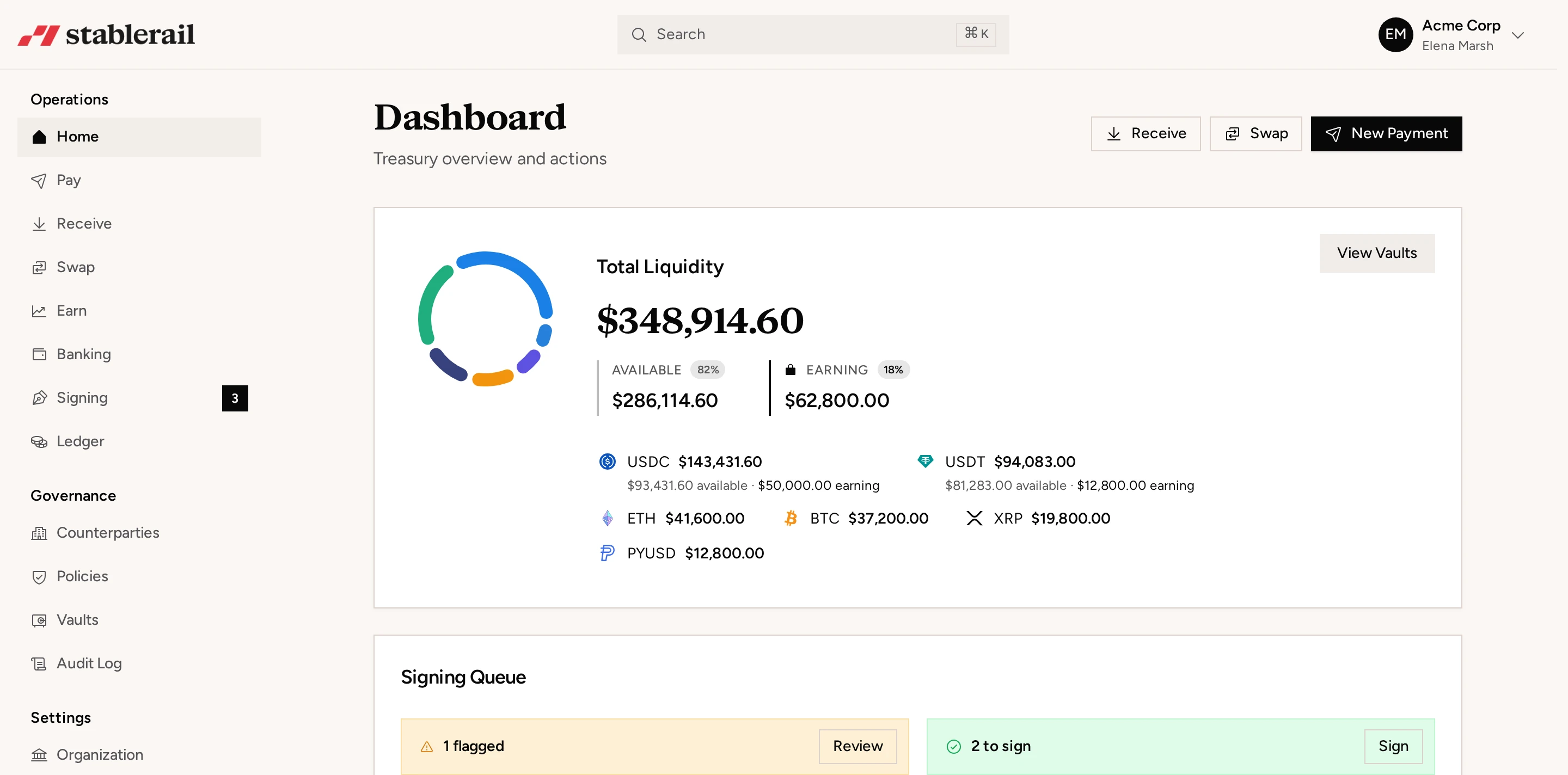
If the requirement is limited to managing the company’s own USDC or USDT, a corporate treasury platform may be more direct than an embedded infrastructure program. Stablerail, for example, supports approvals and signing quorum, sanctions and address screening before a send, global payouts, fiat conversion, corporate cards and exportable audit evidence for a company’s own funds.
Compare geographic coverage corridor by corridor
A country count does not show whether a provider can complete a specific payment. “Supported” might mean a stablecoin payout is available, while local fiat collection, customer onboarding or a named domestic account is not. Coverage can also differ by legal entity and customer category.
BVNK has UK and European roots and is often evaluated where GBP, EUR, USD, SEPA or UK payment flows matter. Bridge has a US-led orchestration model and is considered for virtual-account, conversion and international settlement flows. Zero Hash operates through a multi-entity embedded model in which availability depends on the relevant product, jurisdiction and banking arrangement.
For every material corridor, request a matrix containing:
- Contracting and service-providing legal entities.
- Origin currency, destination currency and payment rail.
- Permitted sender, customer and beneficiary types.
- Funding cutoff, processing window and beneficiary credit method.
- Return, recall, rejection and manual-review procedures.
- Exact stablecoin, token contract and blockchain network.
A domestic recipient credit is operationally different from an international wire, even if both appear as a fiat payout in an API response.
Map custody, control and ownership
Stablecoin infrastructure can include deposit addresses, fiat accounts, conversion, liquidity, wallet screening, blockchain submission and ledgering. Do not assume one provider is contractually responsible for all of them.
Provider-hosted wallets, fiat accounts and blockchain addresses may also have different legal ownership structures. Treasury and legal teams should determine whether balances belong to the payment company or its underlying customers, whether assets are pooled or individually identified, and which party controls transaction authorization.
| Question | Why it matters | Evidence to request |
|---|---|---|
| Which entity holds fiat and digital assets? | Determines the contractual claim and jurisdictional exposure | Account terms, entity chart and funds-flow diagram |
| Who controls blockchain keys and approvals? | Defines who can authorize or stop a transaction | Wallet-control description and approval workflow |
| Are balances corporate or customer funds? | Changes the suitability of the product and potential regulatory analysis | Written confirmation tied to the proposed use case |
| How are pooled balances reconciled? | Affects ledger accuracy, breaks and insolvency analysis | Sample statements, transaction identifiers and reconciliation exports |
| What happens if a partner is unavailable? | Shows whether funding, conversion or withdrawals can continue | Contingency process and partner-dependency map |
Understand the implementation burden
BVNK
A BVNK implementation for payments and settlement may cover payment instructions, account or wallet details, conversion, webhooks, reconciliation and exceptions. Complexity rises when the payment company serves underlying customers across several jurisdictions or needs different settlement configurations by merchant.
Bridge
Bridge is oriented toward defining routes between fiat accounts, stablecoins and recipient endpoints. The movement layer does not necessarily replace the payment company’s internal ledger, user interface, accounting logic, customer support procedures or treasury controls. Identify which transaction states are authoritative and how retries, reversals and delayed webhooks are handled.
Zero Hash
Zero Hash may require a deeper product integration because it can support customer-facing digital-asset functionality. Work may extend to onboarding, disclosures, account states, funding, withdrawals, balances and transaction monitoring responsibilities. That scope can be appropriate when stablecoins are part of the product rather than merely a settlement rail.
Licensing and compliance responsibilities do not disappear
Using a regulated provider does not automatically remove a payment company’s own licensing or compliance obligations. The outcome depends on the flow of funds, customer relationship, contractual roles, marketing and jurisdictions involved. Obtain advice for the proposed structure rather than relying on a provider’s general regulatory description.
Request a legal-entity and responsibility map showing who performs customer due diligence, sanctions screening, blockchain address screening, transaction monitoring, recordkeeping and regulatory reporting. Confirm whether the provider approves only your company or also requires information about each merchant, sender, recipient or beneficial owner.
A provider being able to process a corridor does not establish that your payment company is permitted to offer that corridor to its customers.
Test end-to-end settlement, not blockchain speed
A stablecoin transfer may confirm quickly, but total settlement time includes fiat receipt, compliance review, conversion, blockchain processing and beneficiary crediting. A fast network cannot compensate for a banking cutoff, missing beneficiary data or a manual review.
Run test cases that reflect real operations: fiat received and paid out as USDC; stablecoins received and settled as EUR; a cross-network requirement; a rejected fiat payout; a transfer placed into compliance review; and a return received after the original transaction was marked complete. Record the timestamps, identifiers, fees, ledger entries and support actions for each stage.
Confirm the exact token contract and network. Support for “USDC” or “USDT” alone is not specific enough because network compatibility, fees, confirmation rules and recipient acceptance differ.
Normalize pricing before comparing proposals
Enterprise pricing is generally quote-based and may combine implementation charges, platform fees, monthly minimums, fiat transfer fees, conversion spreads, account charges, blockchain fees and support terms. A low API transaction fee can be offset by foreign-exchange spread, minimum commitments or operational labor.
Model total cost for a representative month and at least one stress case. Use the same currencies, transaction sizes, networks, return rates and funding methods for every bidder. Separate provider revenue from pass-through banking and blockchain costs, and ask when quoted spreads are fixed, indicative or determined at execution.
A practical selection checklist
- Write one canonical funds flow showing sender, asset, account, conversion, beneficiary and every intermediary.
- Classify the funds as corporate, merchant or end-customer money.
- Validate five priority corridors with the actual legal entity, rail, token and network.
- Assign every control covering onboarding, screening, approvals, monitoring and reconciliation.
- Run exception tests for rejections, delayed webhooks, compliance reviews and returns.
- Normalize commercial terms into cost per completed flow and total monthly cost.
- Document exit mechanics for withdrawing fiat and stablecoins, exporting records and replacing the provider.
Which provider fits which payment company?
Choose BVNK for the shortlist when the primary need is operational business payments, fiat connectivity, conversion and settlement. Choose Bridge for the shortlist when API-controlled movement between fiat and stablecoin endpoints is the central product requirement. Choose Zero Hash for the shortlist when the company intends to embed stablecoin or broader digital-asset functions into an end-user product and can support the associated implementation.
The final decision should be based on a tested funds flow, not a generic product demo. The winning provider is the one that can document the required legal structure, complete the priority corridors, produce reconcilable records, handle exceptions and meet the payment company’s control model at an acceptable total cost.
Frequently asked questions
Is BVNK, Bridge or Zero Hash best for stablecoin payments?
BVNK is generally a strong candidate for business payment and settlement workflows, Bridge for API-led fiat and stablecoin orchestration, and Zero Hash for customer-facing embedded products. The best choice depends on the ownership of funds, required corridors, custody structure and compliance responsibilities.
What is the main difference between Bridge and Zero Hash?
Bridge is typically evaluated for orchestrating movement between fiat, stablecoins and payout endpoints. Zero Hash is typically evaluated for a broader embedded product in which users may interact with accounts, balances, funding or digital-asset functions inside another company’s application.
Does using a stablecoin infrastructure provider remove licensing requirements?
No. A provider’s regulatory status does not automatically cover the payment company’s activities. Licensing and compliance obligations depend on the jurisdictions, customer relationship, funds flow, marketing and contractual allocation of responsibilities.
How should a payment company compare stablecoin infrastructure pricing?
Model a representative month using identical transaction sizes, currencies, networks and corridors for each provider. Include platform fees, minimum commitments, fiat transfer charges, conversion spreads, blockchain costs, returns and the internal labor required for reconciliation and exception handling.
What should treasury teams verify about stablecoin custody?
Verify which legal entity holds each asset, whether funds belong to the company or its customers, whether balances are pooled, and who controls transaction authorization. Also request documentation covering reconciliation, withdrawals and what happens if a bank, custodian or liquidity partner becomes unavailable.
Finance writers covering stablecoin treasury, payments, compliance, and risk controls.
More about the Stablerail team- Stablecoin treasury managementApprovals, limits, yield and reporting on one balance.
- Stablecoin payoutsBatch contractor and vendor payments with screening.
- USDT vs USDCWhich stablecoin your company should settle in.
- Stablecoin finance glossaryMPC, off-ramp, travel rule and the rest, in plain English.
- Product updatesEverything we ship, month by month.