
Best Stablecoin Treasury Platforms for CFOs: Features and Trade-Offs
A practical framework for comparing stablecoin treasury platforms across custody, USDC and USDT conversion, fiat rails, approvals, payouts, cards, yield, reporting and jurisdictional eligibility.

The best stablecoin treasury platform is not necessarily the one with the longest feature list. For a CFO, the important question is whether the platform can safely support the company’s actual operating cycle: receiving fiat, converting it to USDC or USDT, holding funds, approving payments, paying counterparties and producing records for accounting and audit.
Vendor evaluation should therefore start with concrete workflows, currencies, networks, transaction sizes and jurisdictions. A company paying contractors in USDT on Tron has different requirements from one collecting USDC on Base and settling suppliers through SEPA.
Start by choosing the right platform model
Most treasury platforms fall into one of four categories. Some vendors combine several models, but the underlying trade-offs remain important.
| Platform model | Primary strength | Main trade-off |
|---|---|---|
| Corporate stablecoin treasury | Combines fiat accounts, stablecoin conversion, custody controls, payouts and reporting | Availability depends on jurisdiction, industry and banking coverage |
| Centralized exchange | Deep liquidity and broad asset trading | Assets are generally held in an exchange-controlled account; payment approvals and accounting workflows may be limited |
| Institutional custody platform | Strong wallet policy and asset-security tooling | Fiat rails, conversion and operational payments may require additional providers |
| Fintech or payment institution | Familiar fiat accounts and local payment rails | Stablecoin networks, self-custody and on-chain payout functions may be restricted |
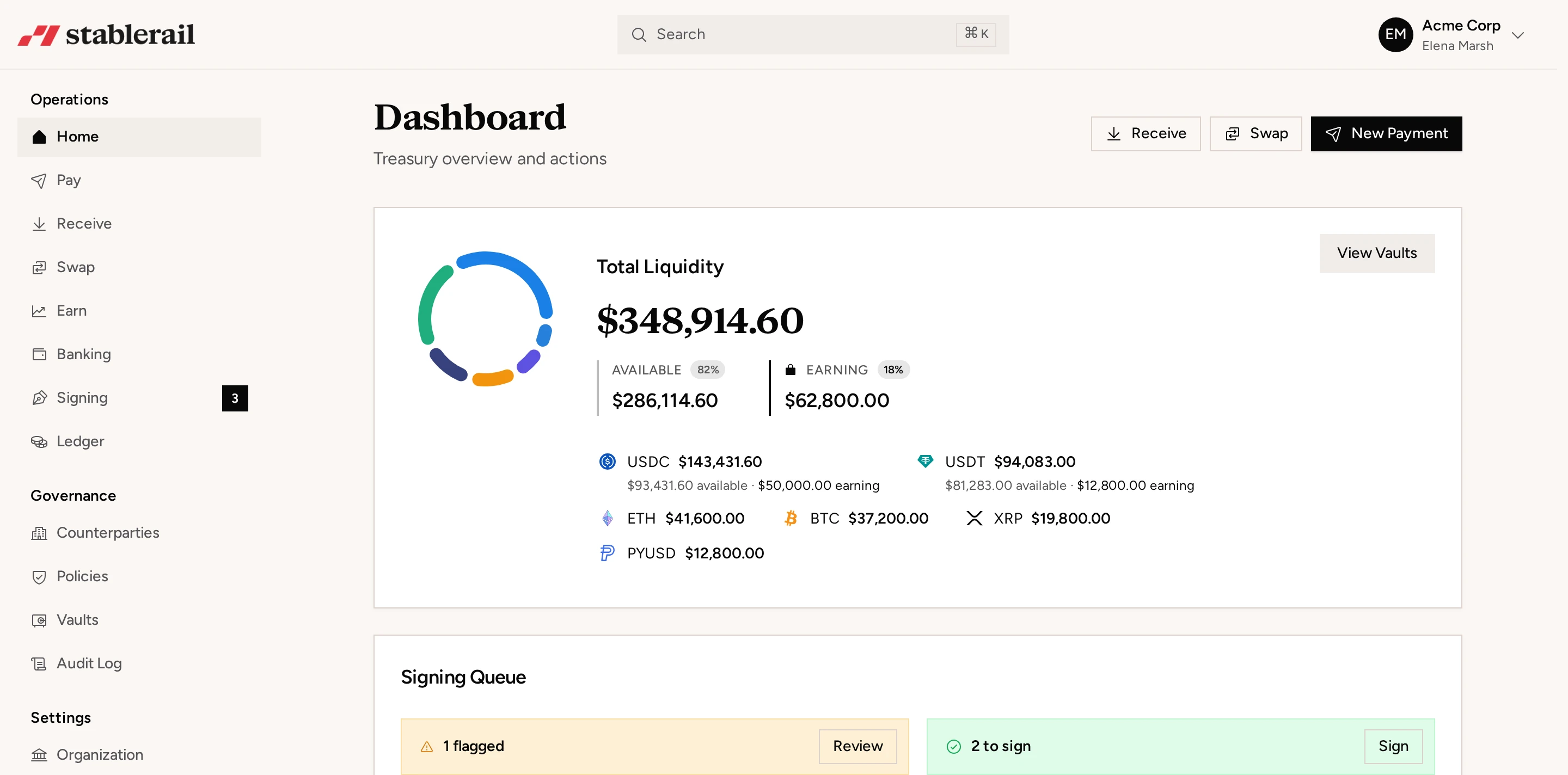
Stablerail is designed as a corporate stablecoin treasury: finance teams can manage USDC and USDT alongside fiat balances, conversion, payments, cards and treasury controls. It uses self-custodial MPC vaults with quorum signing rather than relying only on a conventional exchange account.
Compare custody and access to company funds
Custody determines who can technically move the assets. In a custodial account, the provider controls the blockchain keys and records the company’s balance internally. In a self-custodial arrangement, the company retains control through its wallet structure.
MPC, or multi-party computation, divides signing authority so that no single person or device holds a complete private key. Quorum signing requires a defined number of authorized parties to approve a transaction. For example, a company might require two of three designated signers, although the appropriate policy depends on its team and payment process.
When comparing custody models, ask:
- Who can move assets if the vendor’s application is unavailable?
- Can signers, approval thresholds and transaction limits be changed?
- How are lost devices and departing employees handled?
- Does the structure cover every supported network, not just Ethereum?
- Are network fees charged separately, passed through or bundled?
Self-custody provides stronger direct control, but it also creates operational responsibility. A CFO should confirm that recovery, signer replacement and incident procedures are documented before funding the account.
Check fiat rails, settlement times and account details
A stablecoin treasury is more useful when it connects directly to the company’s banking workflows. Evaluate whether the provider offers named corporate accounts, virtual IBANs, multi-currency balances and the local rails used by customers and suppliers.
| Rail | Currency | Typical timing | Common use |
|---|---|---|---|
| SEPA Instant | EUR | Usually seconds, subject to bank participation and screening | Urgent euro funding and settlement |
| SEPA Credit Transfer | EUR | Typically same or next business day | Routine European payments |
| ACH | USD | Often one to three business days | Lower-cost US transfers |
| Fedwire | USD | Same business day during operating hours | High-value or time-sensitive transfers |
| Faster Payments | GBP | Usually near real time | Everyday UK payments |
| CHAPS | GBP | Same business day before cut-off | High-value UK transfers |
| BACS | GBP | Generally a three-business-day cycle | Payroll and scheduled bulk payments |
| SWIFT | Multiple | Commonly one to five business days | Cross-border transfers |
These are market conventions, not guarantees. Intermediary banks, cut-off times, holidays, compliance reviews and beneficiary-bank processing can extend settlement.
Stablerail supports EUR rails including SEPA and SEPA Instant, USD rails including ACH and Fedwire, GBP rails including Faster Payments, CHAPS and BACS, plus SWIFT cross-border transfers, virtual IBANs and multi-currency balances. Eligibility and exact account capabilities should be confirmed during onboarding.
Calculate the full conversion cost
Do not compare on/off-ramp providers using only a headline fee. The total cost of converting fiat to USDC or USDT can include the quoted spread, platform fee, incoming bank charge, withdrawal charge and blockchain network fee.
Ask each vendor for a worked quote at representative sizes—for example, €50,000 to USDC and $250,000 to USDT—and compare the stablecoins delivered after all charges. Also test the reverse transaction, because off-ramp pricing can differ from on-ramp pricing.
Stablerail publishes corridor pricing for supported fiat and stablecoin routes. Finance teams should still review the applicable corridor, size, network and settlement method before approving a conversion.
Test payouts as an operating workflow
Network coverage matters only if it matches the wallets used by employees, vendors and customers. Sending a token to an unsupported network can result in delayed or permanently inaccessible funds.
A useful treasury platform should support individual and batch payments, beneficiary records, address allowlists and clear fee estimates. Stablerail supports payouts across Ethereum, Base, Arbitrum, Polygon, Tron, BNB Chain, Optimism and Solana. Available token and network combinations should be checked before each payout program.
For recurring operations, evaluate CSV or batch upload, payroll support, invoice references, payment links and downloadable payment status. Stablerail’s stablecoin payout tools cover vendor and contractor payments, while its crypto payroll workflow supports workforce disbursements.
Review approvals, records and reporting
Approvals should reflect payment risk without slowing routine work. Look for role-based limits, quorum approval, beneficiary allowlists, sanctions and wallet screening, and separation between payment creation and approval.
Audit records should show who created, changed, approved and executed each transaction, with timestamps, wallet addresses, network, transaction hash, fiat value and supporting reference. Evidence packs can help finance teams reconcile bank transfers, conversions and blockchain payments without assembling screenshots from several systems.
Reporting should also distinguish transaction fees from principal and record the exchange rate used at execution. Before selecting a vendor, export a sample month and confirm that the data can be mapped into the company’s ledger.
Evaluate cards and yield separately
Corporate cards can reduce the need to off-ramp stablecoins before every operating purchase. Compare virtual and physical availability, supported regions, card limits, merchant category code controls and how transactions are funded from the treasury balance.
Yield requires a separate risk review. Ask which assets generate the return, who the counterparties are, whether funds are lent or deployed on-chain, how often rates change and what liquidity terms apply. Yield is not equivalent to a bank deposit, and access may involve credit, smart-contract, market or lock-up risk. Stablerail provides access to yield on idle treasury with stated liquidity terms and risks; current conditions are available through Earn.
Confirm eligibility before detailed integration work
Corporate accounts are subject to KYB, or know-your-business, checks. Providers commonly request incorporation documents, ownership information, director identification, operating addresses, expected transaction volumes and source-of-funds evidence.
Jurisdiction and industry rules can exclude a company even when a feature is technically available. Ask for an initial eligibility assessment covering the incorporation country, operating countries, industry, beneficial owners, desired fiat rails and expected USDC or USDT activity before investing in technical work.
A practical CFO shortlist
Score each platform against the same operating scenarios rather than relying on a generic demo. A strong shortlist should answer:
- Can the company hold fiat, USDC and USDT under the required custody model?
- Are the required banking rails and blockchain networks available?
- What is the all-in cost for representative conversions and payouts?
- Can payment limits, quorum approvals and allowlists match internal policy?
- Are cards, payout batches and yield available in the company’s jurisdiction?
- Can the platform produce complete records for reconciliation and audit?
- What happens if a signer, banking partner or network becomes unavailable?
The best stablecoin treasury platform is the one that covers the company’s real money flows with acceptable custody, cost, liquidity and operational risk. For many CFOs, consolidating fiat rails, USDC and USDT conversion, controlled wallets, payouts, cards and reporting can reduce fragmented work. The final decision should still be based on documented eligibility, live pricing and a test transaction through every critical route.
Finance writers covering stablecoin treasury, payments, compliance, and risk controls.
More about the Stablerail team- Stablecoin treasury managementApprovals, limits, yield and reporting on one balance.
- Stablecoin payoutsBatch contractor and vendor payments with screening.
- USDT vs USDCWhich stablecoin your company should settle in.
- Stablecoin finance glossaryMPC, off-ramp, travel rule and the rest, in plain English.
- Product updatesEverything we ship, month by month.