
Best Stablecoin Treasury Automation Tools and Features
Compare stablecoin treasury automation tools for USDC and USDT, including approvals, batch payouts, screening, fiat conversion, reconciliation and audit evidence.
The best stablecoin treasury automation tools combine payment preparation, approval controls, address screening, batch payouts, fiat conversion and ledger-ready reconciliation. Finance teams should favor platforms that automate repetitive steps without automatically releasing company funds. The right choice supports the exact stablecoin and network required, shows fees before approval, tracks each payment individually and preserves complete evidence from instruction through settlement.

The best stablecoin treasury automation tools reduce data entry, status checking and reconciliation while preserving finance control over company funds. For businesses holding USDC or USDT, the decisive question is not whether a product can send tokens. It is whether the product can manage the full operating chain: funding, payment preparation, authorization, screening, execution, exception handling, conversion and accounting evidence.
A wallet can securely sign a transfer but still leave finance teams assembling payment files, checking addresses and matching transaction hashes manually. A payout tool may efficiently distribute funds but provide limited balance management or accounting context. An integrated treasury platform is usually the stronger fit when stablecoins form part of recurring corporate operations rather than an occasional payment method.
Which type of stablecoin automation tool is best?
The best category depends on what the finance team needs to control. Companies should first identify whether their main problem is custody, high-volume disbursement or end-to-end treasury operations.
| Tool category | Best suited to | Typical strengths | Important gaps to test |
|---|---|---|---|
| Wallet or custody tool | Securely holding and signing for digital assets | Key management, signing controls and on-chain visibility | Batch preparation, fiat conversion, beneficiary records and accounting exports |
| Stablecoin payout platform | Paying many vendors, contractors or other business recipients | Payment-file intake, recipient validation and payout tracking | Balance controls, treasury approvals, conversion evidence and ledger mapping |
| Exchange or conversion venue | Trading between fiat, USDC, USDT and other supported assets | Liquidity, quotes and trade execution | Payment approvals, business references, recipient workflows and reconciliation |
| Integrated stablecoin treasury platform | Managing a company’s own funds across stablecoin and fiat workflows | Approvals, payouts, conversion, controls and exportable evidence in one process | Exact network, corridor, entity and accounting-system support |
| Internally assembled stack | Companies with specialist engineering and digital-asset operations teams | Custom workflows and direct control over integrations | Maintenance burden, fragmented evidence, exception handling and key-person risk |
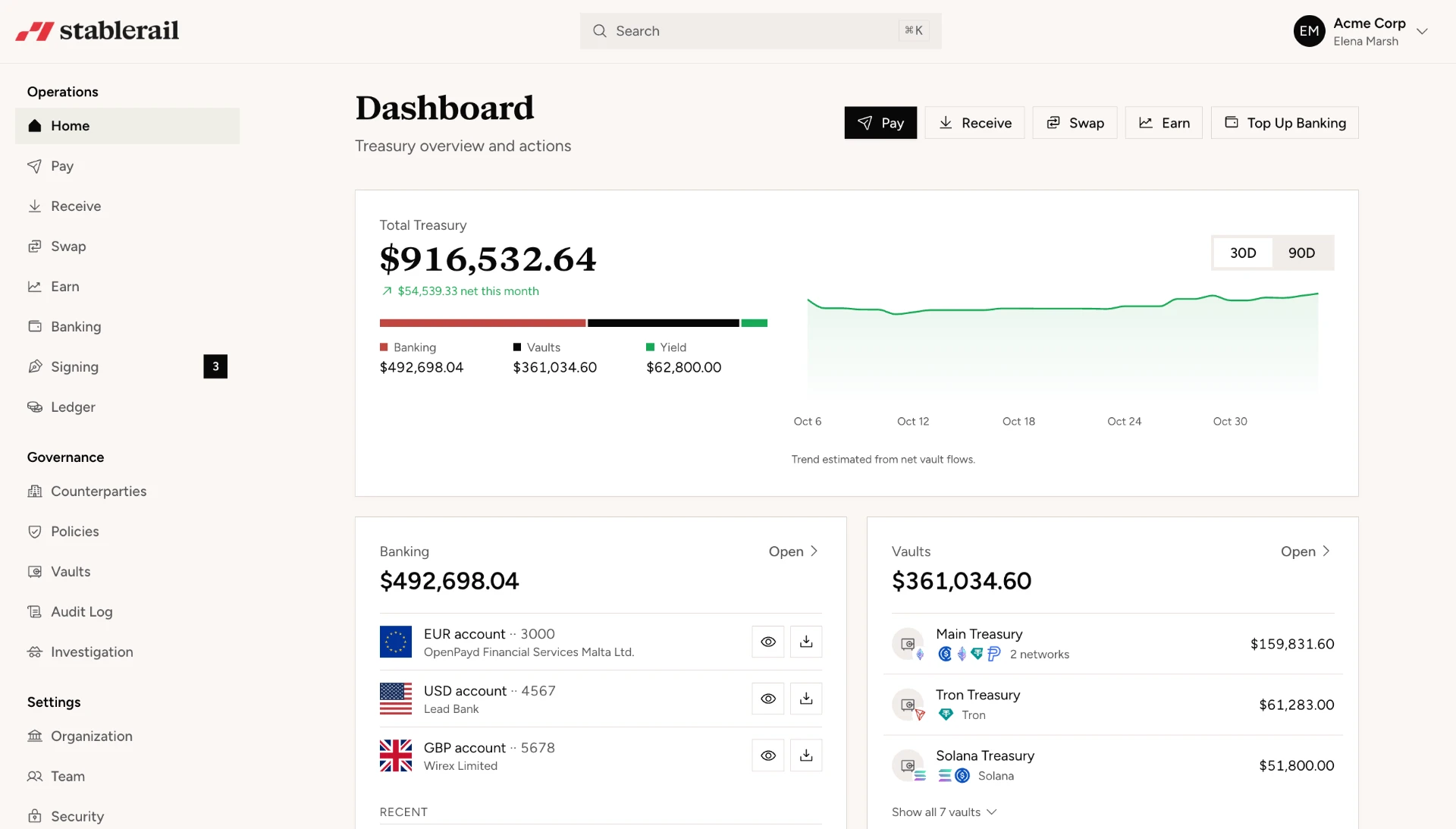
Stablerail falls into the integrated category: it is a corporate stablecoin treasury platform for managing a company’s own funds in USDC and USDT, with approvals and signing quorum, sanctions and address screening before send, global payouts, corporate cards, fiat conversion and exportable audit evidence.
Core features to compare
| Capability | What good looks like | Manual work reduced |
|---|---|---|
| Transfer preparation | Scheduled instructions, reusable payment details and validation before signing | Recreating recurring transactions |
| Balance management | Threshold alerts, reserve monitoring and separate visibility by asset and network | Repeated wallet and account checks |
| Approval controls | Role-based authority, amount limits, signing quorum and recorded decisions | Approvals collected through email or chat |
| Batch payouts | Row-level validation, batch totals and individual recipient statuses | Sending payments one at a time |
| Screening | Sanctions and address checks before funds are sent, with review evidence | Moving data between separate screening and payment systems |
| Reconciliation | Stable identifiers connecting instructions, approvals, transactions, fees and settlement | Matching blockchain records to invoices and ledger entries |
| Fiat conversion | Visible quotes, rates, fees and settlement references | Coordinating banks, conversion venues and wallets separately |
| Exception management | Actionable alerts and clear failed, rejected or pending states | Manually checking every transaction |
Automate preparation without surrendering authorization
Stablecoin automation should distinguish between preparing a payment and releasing funds. A system can calculate the amount, populate the destination, check the balance, screen the address and route the instruction for approval without executing it automatically. This separation is particularly valuable because a confirmed blockchain payment generally cannot be recalled through the banking procedures used for an erroneous bank transfer.
Common automation rules include notifying finance when an operating wallet falls below its reserve, preparing funding for an approved payment run, scheduling recurring transfers and warning when balances exceed an internal concentration threshold. The workflow should also check whether the wallet holds the network’s fee asset. Holding USDC or USDT alone may not be enough to transact: Ethereum uses ETH for gas, Solana uses SOL, and other networks have their own fee mechanisms.
Ask how the platform behaves when a rule is triggered but a prerequisite is missing. It should create a visible exception rather than silently skipping the instruction or repeatedly attempting a transaction that cannot succeed.
Approval workflows and signing controls
Approvals should happen inside the treasury record, not through screenshots or informal messages. The approver should see the legal entity, asset, amount, destination, blockchain network, expected fee and business reference before authorizing the transaction. A wallet address without its network is incomplete information because the same stablecoin can exist on multiple networks.
A practical approval structure may require one authorized person for routine low-value payments and a quorum for larger batches, new beneficiaries or unusual destinations. The exact thresholds should reflect the company’s delegation of authority rather than a vendor’s default settings.
Test whether the platform prevents one person from preparing and unilaterally releasing a material payment. Also verify what happens when an approver is unavailable, leaves the company or loses access. A sound process needs documented recovery and signer-replacement procedures without turning emergency access into a standing control bypass.
Batch payouts need recipient-level controls
Batch functionality should do more than combine multiple transfers under one approval button. Before authorization, the system should identify malformed addresses, unsupported asset-network combinations, duplicate references, missing beneficiary information and insufficient balances. Finance should be able to correct invalid rows without rebuilding the entire file.
The approval screen should display the number of recipients, total principal, estimated network costs and any conversion amounts. After release, every recipient needs an individual status and transaction hash. A batch-level “completed” label is insufficient if one transfer failed, remained pending or was rejected before submission.
For payroll, contractor or vendor runs, confirm whether the export can represent one batch header and multiple recipient-level entries. That structure allows the controller to tie the approved total back to the payment file while investigating individual exceptions.
Screening must occur before the send
Blockchain transparency does not eliminate counterparty risk. A treasury workflow should screen the destination before execution and retain the result with the payment record. If a check produces an alert, the system should stop or route the payment for review rather than leaving the initiator to notice it after funds have moved.
Finance teams should understand what causes re-screening. Relevant events can include adding a new address, changing the network, editing a beneficiary or resubmitting a previously rejected payment. They should also establish who can clear an alert and what evidence that reviewer must retain.
Reconciliation should connect business intent to settlement
The blockchain transaction hash is essential, but it is not a complete accounting record. A useful platform preserves the connection between the business instruction, approval history, on-chain movement, fee and related fiat conversion.
For each movement, the exportable record should contain:
- Internal payment, invoice or batch reference.
- Legal entity, beneficiary and initiator.
- Stablecoin, amount, blockchain network and destination address.
- Transaction hash and confirmation or failure status.
- Network fee and the asset used to pay it.
- Conversion rate, quoted amount and conversion cost where applicable.
- Creation, approval, submission and settlement timestamps.
- Approver identities and retained screening evidence.
Stable transaction identifiers matter more than a visually polished CSV. The same identifier should remain attached when a payment moves from prepared to approved, submitted, confirmed or failed. Finance should also be able to separate stablecoin principal, network fees and conversion costs for posting to different general-ledger accounts.
Fiat conversion and settlement require separate review
A complete treasury workflow must account for how money enters and leaves the stablecoin position. Compare the quoted exchange rate, explicit platform charge, blockchain fee and any banking costs rather than relying on a single advertised fee. The quote should identify what the company sends, what it receives and how long the quote remains valid.
Do not treat submission as settlement. Bank cut-off times, holidays, intermediary institutions, compliance reviews and returned payments can affect fiat timing. The platform should expose distinct states such as awaiting approval, conversion completed, bank payment submitted, settled, returned and failed. The terminology may vary, but finance needs enough detail to avoid recognizing cash in the wrong period.
Implementation checklist for finance teams
- Map the requirement: list every legal entity, stablecoin, blockchain network, fiat currency and payment corridor involved.
- Test authorization: confirm transaction and batch limits, signing quorum, segregation of duties and signer replacement.
- Use a mixed test batch: include valid, duplicate, malformed and unsupported rows to verify validation behavior.
- Review screening: check when addresses are screened, who can resolve alerts and what evidence is retained.
- Reconcile one full cycle: trace funding, conversion, payment, network fee and settlement into the ledger.
- Simulate exceptions: test insufficient gas, failed submission, delayed confirmation and returned fiat payments.
- Verify eligibility: confirm entity, jurisdiction and industry requirements before planning migration.
- Start with limited funds: complete a controlled end-to-end payment before moving a production treasury balance.
How to make the final decision
Score tools against the actual operating workflow rather than the longest feature list. A company making occasional transfers may prioritize signing security and straightforward exports. A business running recurring global payouts will place more weight on batch validation, beneficiary controls, conversion and recipient-level reconciliation.
Request evidence from a realistic test, not only a product demonstration. Prepare a payment, trigger an approval threshold, review the screening result, execute it with limited funds and post the export to a test ledger. The best stablecoin treasury automation tool is the one that removes repetitive work while making authorization, exceptions and accounting evidence clearer—not the one that automates the largest number of decisions.
Frequently asked questions
What is stablecoin treasury automation?
Stablecoin treasury automation uses software to prepare, approve, execute and reconcile corporate USDC or USDT transactions. It can also manage balance alerts, batch payouts, address screening, fiat conversion and exportable records while retaining human authorization over fund movements.
What should a CFO look for in a stablecoin treasury platform?
Prioritize approval controls, signing quorum, pre-send address screening, exact network support, fee visibility and recipient-level reconciliation. The platform should also preserve stable identifiers and evidence linking each business instruction to its approval, transaction hash, costs and settlement status.
Can stablecoin payments be fully automated?
They can be prepared automatically, but material payments should generally retain an authorization step based on the company’s delegation of authority. Separating preparation from execution reduces repetitive work without allowing a rule or compromised user to release funds unilaterally.
How do companies reconcile stablecoin payments?
Companies match the internal payment reference to the stablecoin amount, destination address, blockchain network, transaction hash and network fee. The record should also include approval identities, timestamps, conversion details and separate statuses for confirmed, failed or pending transactions.
What is the difference between a stablecoin wallet and a treasury platform?
A wallet primarily holds assets and signs blockchain transactions. A treasury platform adds operating workflows such as role-based approvals, batch payouts, screening, fiat conversion, exception handling and accounting evidence for a company’s funds.
Finance writers covering stablecoin treasury, payments, compliance, and risk controls.
More about the Stablerail team- Stablecoin treasury managementApprovals, limits, yield and reporting on one balance.
- Stablecoin payoutsBatch contractor and vendor payments with screening.
- USDT vs USDCWhich stablecoin your company should settle in.
- Stablecoin finance glossaryMPC, off-ramp, travel rule and the rest, in plain English.
- Product updatesEverything we ship, month by month.