
How AI Agents Can Support Corporate Treasury Without Controlling Funds
A practical guide to using AI agents for forecasting, reconciliation, exception detection, payment preparation and reporting—while keeping transaction authority with finance teams.

AI agents can reduce manual treasury work without receiving the authority to move money. The practical model is straightforward: an agent reads permitted data, prepares analysis or payment instructions, and sends its work to a finance team for review. Funds move only after the required people approve and sign.
This separation matters when a corporate treasury includes bank balances, USDC or USDT, vendor payouts, payroll and corporate cards. An AI agent may recommend how much liquidity to hold, identify an unreconciled transfer or prepare a payment batch. It should not hold signing keys, change an allowlist or bypass payment approvals.
What an AI agent can do in a treasury workflow
An AI agent is software that can evaluate information and complete a sequence of defined tasks. Unlike a simple rule that runs once, an agent may gather data from several approved sources, compare results with a policy and prepare a recommended action.
Useful inputs can include bank statements, stablecoin wallet activity, invoices, accounts payable records, exchange rates, payroll files and expected cash flows. Access should be limited to the data needed for each task.
| Use case | Agent output | Human-controlled action |
|---|---|---|
| Cash forecasting | Projected balances and funding gaps | Approve transfers or conversions |
| Reconciliation | Suggested matches and unmatched transactions | Confirm entries and investigate exceptions |
| Exception detection | Alerts for unusual value, timing, destination or fees | Release, reject or escalate the transaction |
| Payment preparation | Draft batch with recipients, amounts, networks and references | Review and complete payment approvals |
| Reporting | Daily position, variance and exposure summaries | Validate and distribute reports |
The boundary is consistent: the agent can recommend or prepare, while authorized people retain transaction authority.
Five practical applications
1. Cash and stablecoin forecasting
Forecasting is a good starting point because it does not require payment permissions. An agent can combine scheduled invoices, payroll dates, historical collections and recurring expenses to project balances by currency and account.
For a treasury holding EUR, USD, GBP, USDC and USDT, the output might show expected balances for the next 7, 30 and 90 days. It can also flag when a fiat account may need funding or when stablecoin reserves are likely to exceed an internal target.
The recommendation should include its assumptions. Finance teams need to see whether the forecast relies on confirmed invoices, historical payment behaviour or manually entered estimates. A recommendation to convert EUR into USDC is not an instruction to execute that conversion.
2. Reconciliation across fiat and blockchains
Reconciliation becomes more complicated when activity spans fiat rails and multiple blockchain networks. Bank records may reference an invoice number, while an on-chain transaction is identified by a wallet address and transaction hash.
An agent can suggest matches using amount, timestamp, counterparty, currency, network and payment reference. It can connect a USDC payout on Base or Ethereum to an accounts payable record, or associate an incoming bank transfer with an invoice.
Exact matches may be queued for quick confirmation. Partial or ambiguous matches should remain open. An agent should not silently write off a fee difference, classify an unknown wallet or mark an invoice as settled without an evidence trail.
3. Exception and anomaly detection
Treasury automation can monitor activity against normal patterns and explicit company policy. Useful exceptions include:
- A payout that is materially larger than the recipient's previous payments.
- A new wallet address or bank beneficiary.
- A stablecoin transfer using the wrong network.
- Duplicate invoices or repeated payment references.
- Unexpected network fees, conversion costs or timing delays.
- Activity outside the company's normal payment window.
An exception is a prompt for review, not proof of fraud. The system should explain why it raised the alert and show the underlying transaction data so that finance staff can decide what to do.
4. Payment preparation
AI agents can prepare payments while remaining outside the signing process. For example, an agent could read approved invoices, validate required fields and create a draft batch containing the recipient, amount, due date, currency, blockchain network and internal reference.
Before the batch reaches approvers, deterministic checks should still run. These can verify that a recipient is allowlisted, the selected token and network are supported, the amount is within policy, and sanctions or wallet screening has completed.
Stablerail supports batch vendor and contractor payouts across networks including Ethereum, Base, Arbitrum, Polygon, Tron, BNB Chain, Optimism and Solana. Finance teams can use a structured preparation and approval workflow rather than sharing wallet credentials or manually building every transfer. See stablecoin payouts for the operational flow.
5. Treasury reporting
An agent can assemble a daily treasury report from bank balances, multi-currency accounts, stablecoin vaults, pending payments and recent conversions. It can summarize changes and highlight items requiring attention.
A useful report separates confirmed balances from pending or estimated amounts. It should also preserve links to source records. Generated commentary may explain that a USDC balance fell because of a vendor batch, but finance should be able to verify the transactions behind that statement.
Keep recommendations separate from authority
The safest design places the AI agent outside the chain of transaction authority. This means it cannot independently sign a blockchain transaction, release a bank payment, add a beneficiary or change its own limits.
For stablecoins, self-custodial multiparty computation, or MPC, helps enforce this separation. MPC divides signing authority so that no single person or system holds a complete private key. A quorum policy can require approvals from multiple authorized team members before a transaction is signed.
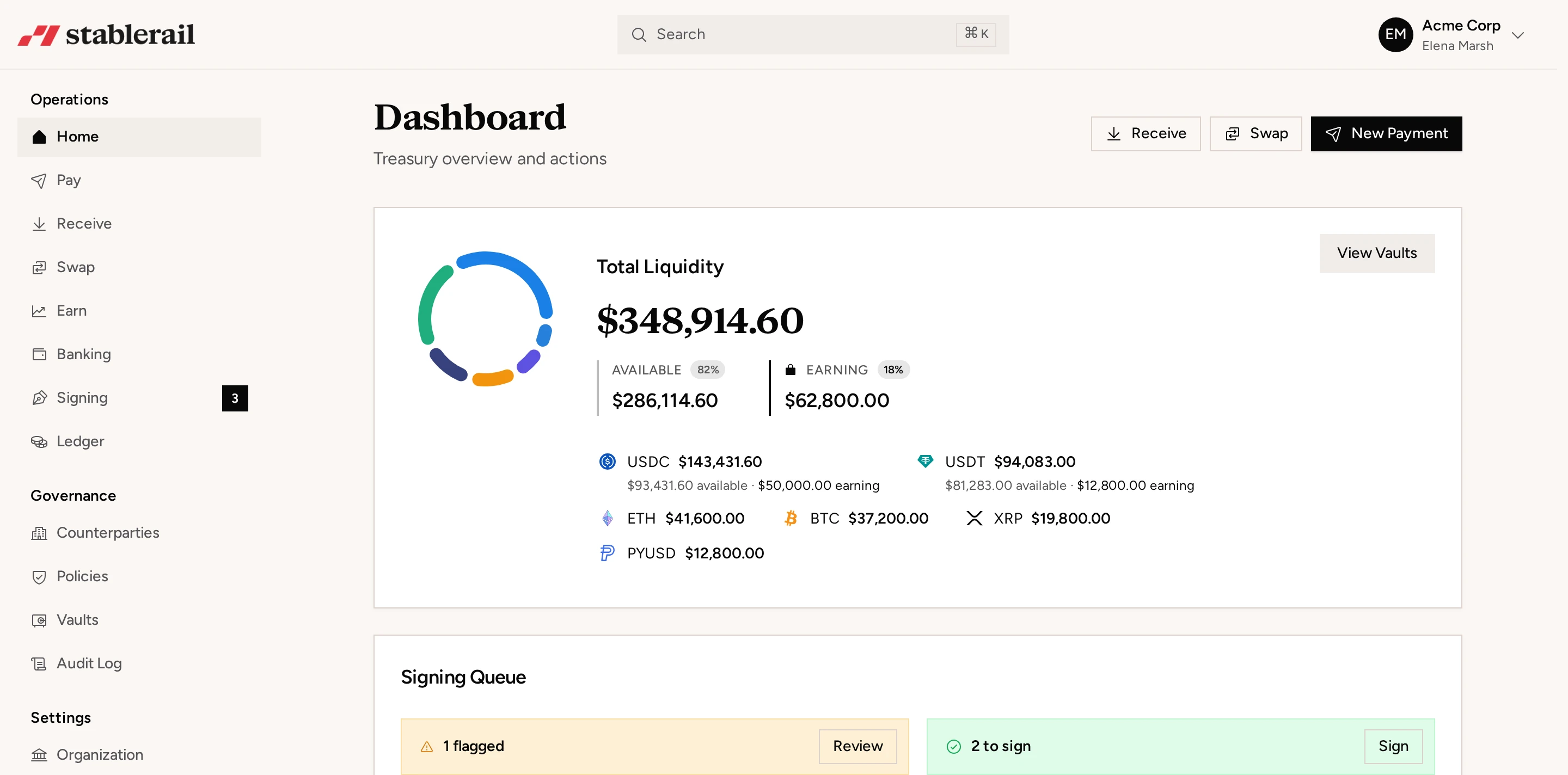
An agent may create a draft transaction for a self-custodial vault, but it should not count toward the signing quorum. Stablerail's corporate stablecoin treasury combines MPC vaults and quorum signing with fiat accounts, on/off-ramps and payment workflows. The finance team retains control of its funds and approval process.
Controls that should surround AI-assisted workflows
- Role-based access: Give the agent read access only where possible and narrowly scoped permission to create drafts.
- Approval limits: Route payments according to amount, currency, entity or risk level. Larger transactions can require additional approvers.
- Allowlists: Restrict payouts to approved bank beneficiaries and wallet addresses. Changes should require separate authorization.
- Policy checks: Validate token, network, recipient, purpose and amount using fixed rules rather than relying only on model output.
- Screening: Apply sanctions and wallet screening before release, including when the payment was prepared automatically.
- Audit logs: Record inputs, recommendations, changes, approvals, signatures and final transaction identifiers.
- Evidence packs: Preserve invoices, screening results, approval records and payment evidence for audit or review.
Corporate card controls follow the same principle. An agent can identify unusual spend or recommend a lower limit, but authorized users should approve limit changes and merchant category code restrictions. More information is available in the corporate cards overview.
A sensible implementation sequence
Start with a low-risk, read-only process such as daily reporting or cash forecasting. Measure how often the output is correct, what data is missing and how much review it requires.
Next, add reconciliation suggestions and exception alerts. Only after these workflows are reliable should the agent prepare payment drafts. Even then, preserve human payment approvals, quorum signing, allowlists and policy limits.
Finance teams should also define what happens when the agent is unavailable or uncertain. Staff need a documented manual process, and low-confidence outputs should be escalated rather than treated as complete.
AI agents can make corporate treasury faster and easier to monitor. The objective is not autonomous control of company funds. It is better preparation, earlier detection and clearer reporting—with transaction authority staying where it belongs: with the finance team.
Finance writers covering stablecoin treasury, payments, compliance, and risk controls.
More about the Stablerail team- Stablecoin treasury managementApprovals, limits, yield and reporting on one balance.
- Stablecoin payoutsBatch contractor and vendor payments with screening.
- USDT vs USDCWhich stablecoin your company should settle in.
- Stablecoin finance glossaryMPC, off-ramp, travel rule and the rest, in plain English.
- Product updatesEverything we ship, month by month.