
How AI Agents Can Support Corporate Treasury Without Controlling Funds
A practical operating model for using AI in treasury while keeping wallet keys, payment approvals and signing authority with accountable employees.
AI agents can support corporate treasury safely when they receive read-only data access and permission to prepare drafts, but no authority to approve, sign or release payments. They can forecast liquidity, reconcile transactions, detect exceptions and assemble payment instructions. Named employees should still verify beneficiaries, approve transactions and satisfy the required signing quorum, especially for USDC and USDT transfers that generally cannot be reversed after settlement.

Separate treasury assistance from transaction authority
AI agents can remove repetitive work from corporate treasury without controlling company funds. The operating boundary should be explicit: an agent may observe data, identify exceptions, recommend actions and prepare payment drafts, while accountable employees approve and sign transactions through the company’s existing payment controls.
This distinction is particularly important for USDC and USDT. A stablecoin transfer sent on the wrong network or to the wrong address generally has no recall or chargeback process after blockchain settlement. Recovery usually depends on the recipient voluntarily returning the funds or a service provider being able and willing to assist. Prevention is therefore more reliable than remediation.
An AI agent is software that interprets information and performs a sequence of tasks toward an objective. It may classify transactions, compare several data sources or explain why a forecast changed. That flexibility can improve treasury operations, but it is not a reason to grant the model payment authority.
| Activity level | Typical treasury tasks | Appropriate agent access | Required human control |
|---|---|---|---|
| Observe | Read balances, invoices, statements, wallet activity and rates | Read-only access to approved sources | Finance owns source access and reviews data quality |
| Prepare | Draft forecasts, reconciliation matches, reports and payment batches | Create drafts without submission or signing rights | An operator verifies inputs, assumptions and exceptions |
| Approve | Confirm amount, beneficiary, entity, asset, network and timing | No agent authority | Named approvers act under company policy |
| Sign and release | Sign a blockchain transaction or release a bank payment | No keys, signing share or release credentials | The required employee quorum completes the transaction |
An agent does not need private keys, an MPC signing share, wallet signing rights or bank release credentials to deliver most of its value. Excluding those permissions limits the impact of a model error, compromised account, malicious source document or instruction hidden in an invoice.
Five useful roles for AI agents in treasury
1. Cash and stablecoin forecasting
An agent can combine bank and stablecoin balances with accounts payable, payroll dates, expected receipts and historical spending. It can produce a daily or weekly forecast by currency, asset and legal entity, then highlight projected shortfalls or excess liquidity.
The useful output is not just a predicted closing balance. Treasury needs the assumptions behind it: which invoices were included, how receipt dates were estimated, whether balances are immediately available and which conversion or network costs were considered. Every material assumption should link to its source.
The agent may recommend converting USD into USDC or returning stablecoins to fiat, but a treasurer should decide whether and when to execute. Available liquidity, quoted conversion terms, banking cut-off times and the destination account should be checked when the transaction is approved rather than assumed from an earlier forecast.
2. Reconciliation
Stablecoin reconciliation requires more than matching amounts. An agent can compare ledger entries with wallet, conversion and payout records using the transaction hash, blockchain network, token, amount, destination, network fee, timestamp and internal payment reference. Where fiat is involved, it can also compare conversion confirmations and bank statement entries.
Exact matches can be proposed for bulk review, while partial or ambiguous matches remain open. A confidence score may help prioritize work, but it must not determine accounting treatment by itself. Finance should approve write-offs, fee classifications, foreign-exchange differences and unidentified transactions.
3. Exception detection
An agent can flag duplicate invoices, unusual amounts, changed payment details, new beneficiaries, unexpected networks and activity outside normal timing patterns. It can also explain which feature triggered the alert, helping an operator distinguish a genuine anomaly from routine business growth.
Probabilistic detection should supplement deterministic controls, not replace them. Beneficiary allowlists, payment limits, sanctions and address screening, required approval counts and signing quorum should operate regardless of whether the model considers a transaction normal. A low-risk model score is not authorization.
4. Payment preparation
An agent can extract details from an approved invoice, payroll file or internal request and prepare a draft containing the legal entity, beneficiary, amount, asset, network, due date and accounting reference. It should flag missing fields, conflicting instructions and changes from previously verified beneficiary details.
Network selection requires special care for USDC and USDT. A recipient may control a similarly formatted address on several compatible networks, but that does not prove it accepts the selected token on the intended network. Finance should independently confirm the recipient’s asset, network and address through an approved channel. A new or changed destination may also require callback verification using contact details already held on file.
The agent should never approve its own draft, add its proposed address to an allowlist or sign the resulting transaction. Those actions would collapse preparation and authorization into the same control point.
5. Treasury reporting and audit preparation
An agent can assemble daily position reports, weekly liquidity summaries and month-end evidence packs. It can explain balance movements, list unsettled transfers and group costs by bank rail, conversion or blockchain network.
A polished narrative is not evidence. Each material figure should trace back to a statement, ledger entry, transaction hash, approval record or conversion confirmation. Reports should distinguish facts taken directly from systems from explanations generated by the model, allowing reviewers to reproduce the result.
A controlled workflow for agent-prepared payments
A finance team can introduce AI assistance without changing who controls funds. The following workflow keeps the agent outside the authorization and signing boundary:
- Ingest: Provide read-only access to approved ERP records, invoices, bank statements and wallet transaction exports. Restrict the data by entity and task where practical.
- Validate: Check required fields, duplicate references, beneficiary status, address format, token and network compatibility. Treat text inside invoices and attachments as untrusted data rather than model instructions.
- Prepare: Create a draft payment batch and show source references, assumptions, validation results and unresolved exceptions.
- Review: A finance operator confirms the source document, amount, destination, asset, network, timing and legal entity. Changes to beneficiary details receive independent verification.
- Approve: Named employees approve according to the company’s transaction, entity and authority limits. The person reviewing a draft should be able to reject or edit it without involving the agent.
- Sign: The required signing quorum releases the transaction. Where an MPC design is used, signing authority can be distributed without giving the agent a signing share.
- Record: Retain the original draft, edits, approvals, signatures and settlement evidence with timestamps and actor identities.
For higher-risk payments, the company can require additional approvers, independent beneficiary verification or a small test transfer. These requirements should be enforced by the payment process, not left to the model’s judgment.
Controls that keep finance in control
Least privilege is the starting point: the agent should receive only the data and tools required for its defined task. Finance and security teams should document both permitted actions and actions that are technically blocked.
- No private keys, signing shares, wallet approval rights or bank release credentials.
- No ability to approve a payment the agent prepared.
- Separate roles for preparation, approval and signing.
- Transaction and daily limits appropriate to each entity and payment type.
- Independent verification of new or changed beneficiary details.
- Sanctions and blockchain address screening before a stablecoin payment is sent.
- Signing quorum for stablecoin transfers, with no single agent-controlled path to release.
- Access-controlled audit records covering source data, generated output, edits, approvals and settlement.
- A documented manual process if the model or a connected data source is unavailable.
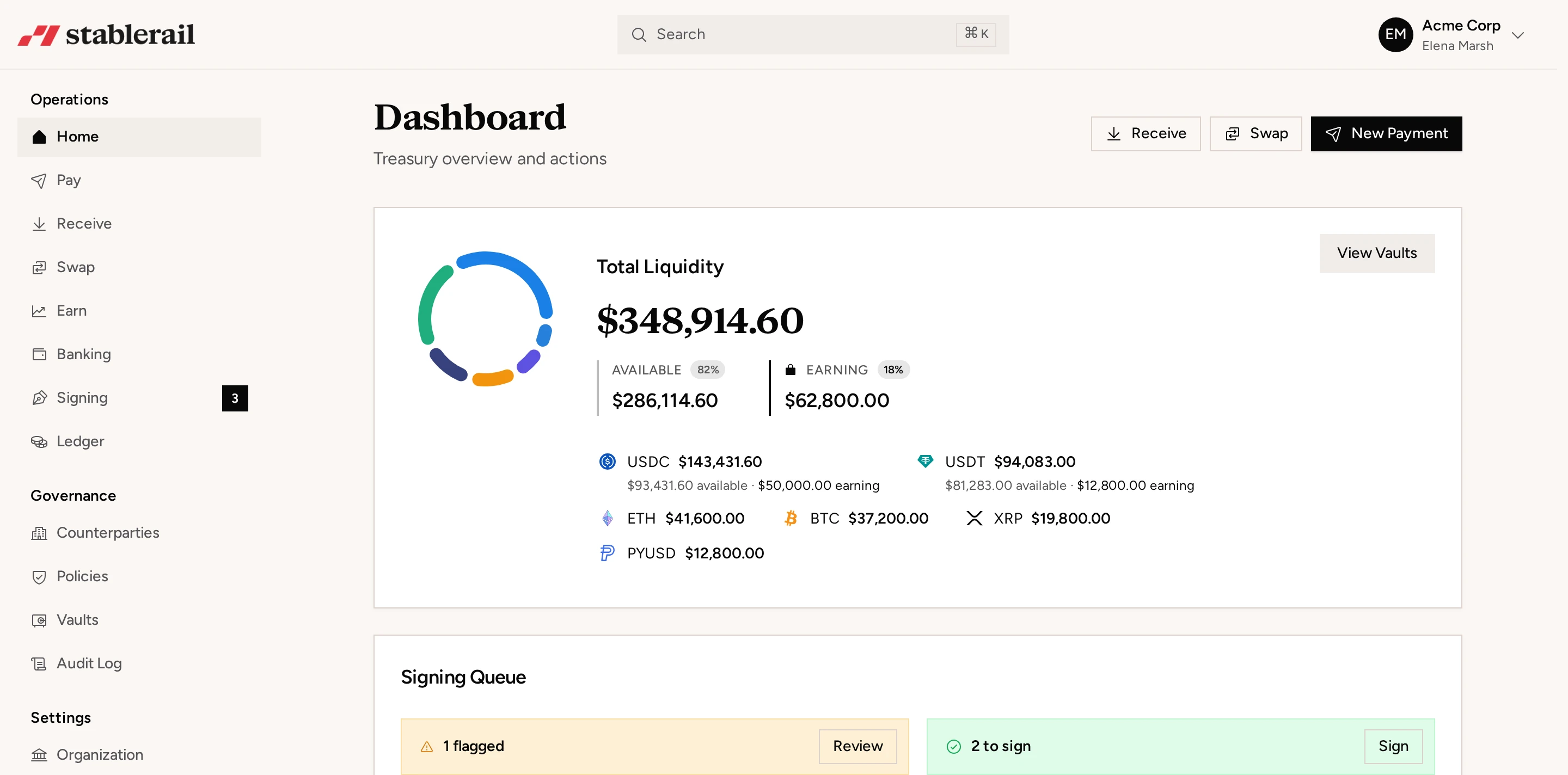
Stablerail can support this separation for companies managing their own USDC and USDT through approval workflows, signing quorum, sanctions and address screening before send, fiat conversion, global payouts and exportable audit evidence. An AI agent can prepare information for those workflows while remaining outside the signing boundary.
How to introduce treasury agents safely
Start with a narrow task whose output can be checked, such as proposing reconciliation matches or preparing a weekly liquidity report. Avoid beginning with payment release, beneficiary administration or unrestricted access across every legal entity.
Run the agent alongside the existing process before relying on its output. Compare proposed matches, forecasts and exceptions with the decisions made by treasury staff. Review results separately by currency, token, network, entity and payment type because reliable performance in routine USDC reconciliation does not demonstrate reliability for unfamiliar counterparties or cross-border payroll.
A practical implementation checklist is:
- Define the task, approved data sources and prohibited actions.
- Remove all signing, approval and credential-management permissions.
- Require source references for every recommendation or extracted payment field.
- Test malformed invoices, changed addresses, duplicate requests and unsupported networks.
- Measure corrections, unresolved exceptions and false alerts, not only time saved.
- Document the manual fallback and incident escalation route.
- Expand scope only after finance understands recurring failure modes.
The durable operating principle is simple: AI may observe, analyze and prepare; accountable employees approve and sign. That division captures much of the benefit of treasury automation without transferring control of company funds to a model.
Frequently asked questions
Can an AI treasury agent approve or send stablecoin payments?
It technically could if given wallet or bank permissions, but it should not receive them. The safer model allows the agent to prepare a draft while named employees approve and satisfy the required signing quorum.
What access should an AI agent have to a corporate crypto wallet?
Use read-only access when the agent needs balances and transaction history. It should not hold private keys, an MPC signing share, approval rights or permission to change beneficiary controls.
How can AI help reconcile USDC and USDT transactions?
An agent can compare ledger records with transaction hashes, networks, tokens, amounts, addresses, fees and internal references. It should propose matches for review while finance resolves ambiguous items and approves the accounting treatment.
How do you prevent prompt injection from invoices or payment requests?
Treat invoice and attachment text as untrusted data, constrain the agent to defined tasks and prevent it from invoking approval or signing tools. Require structured outputs, source references and human verification of beneficiary and payment details.
Who is responsible when an AI agent prepares an incorrect payment?
The company remains responsible for its payment controls and approval decisions. Named reviewers should verify the source, beneficiary, amount, asset and network before the required signers release any transaction.
Finance writers covering stablecoin treasury, payments, compliance, and risk controls.
More about the Stablerail team- Stablecoin treasury managementApprovals, limits, yield and reporting on one balance.
- Stablecoin payoutsBatch contractor and vendor payments with screening.
- USDT vs USDCWhich stablecoin your company should settle in.
- Stablecoin finance glossaryMPC, off-ramp, travel rule and the rest, in plain English.
- Product updatesEverything we ship, month by month.