
Best Crypto Cards for Companies in 2026: Features, Fees, and Controls to Compare
Compare crypto cards for business use in 2026, including stablecoin funding, fees, limits, employee controls, accounting exports and geographic availability.

The best crypto cards for companies are not necessarily the cards offering the highest retail rewards. Finance teams need corporate cards that connect to a company treasury, support employee-level controls and produce records that can be reconciled without rebuilding every transaction by hand.
For companies holding USDC or USDT, the central question is how a card turns stablecoin balances into ordinary card payments. Some programmes convert stablecoins into fiat before funds can be spent. Others perform the conversion when a transaction is authorised or settled. The model affects fees, liquidity, accounting and the risk of a payment being declined.
This guide explains what to compare in 2026, including availability, settlement assets, fees, limits, card controls, expense management and geographic coverage.
What makes a crypto card suitable for a company?
A business crypto card should be issued to a legal entity rather than an individual. It should support multiple cardholders, central funding and controls administered by the finance team.
At a minimum, evaluate these capabilities:
- Business onboarding: KYB checks for the company, directors and beneficial owners.
- Stablecoin funding: clear support for USDC, USDT or both, including the eligible blockchain networks.
- Corporate cards: virtual and, where needed, physical cards assigned to employees or teams.
- Card controls: limits, merchant category code restrictions, card freezing and role-based administration.
- Expense management: transaction exports, receipts, descriptions and accounting integrations.
- Geographic coverage: separate confirmation of where cards can be issued and where they can be used.
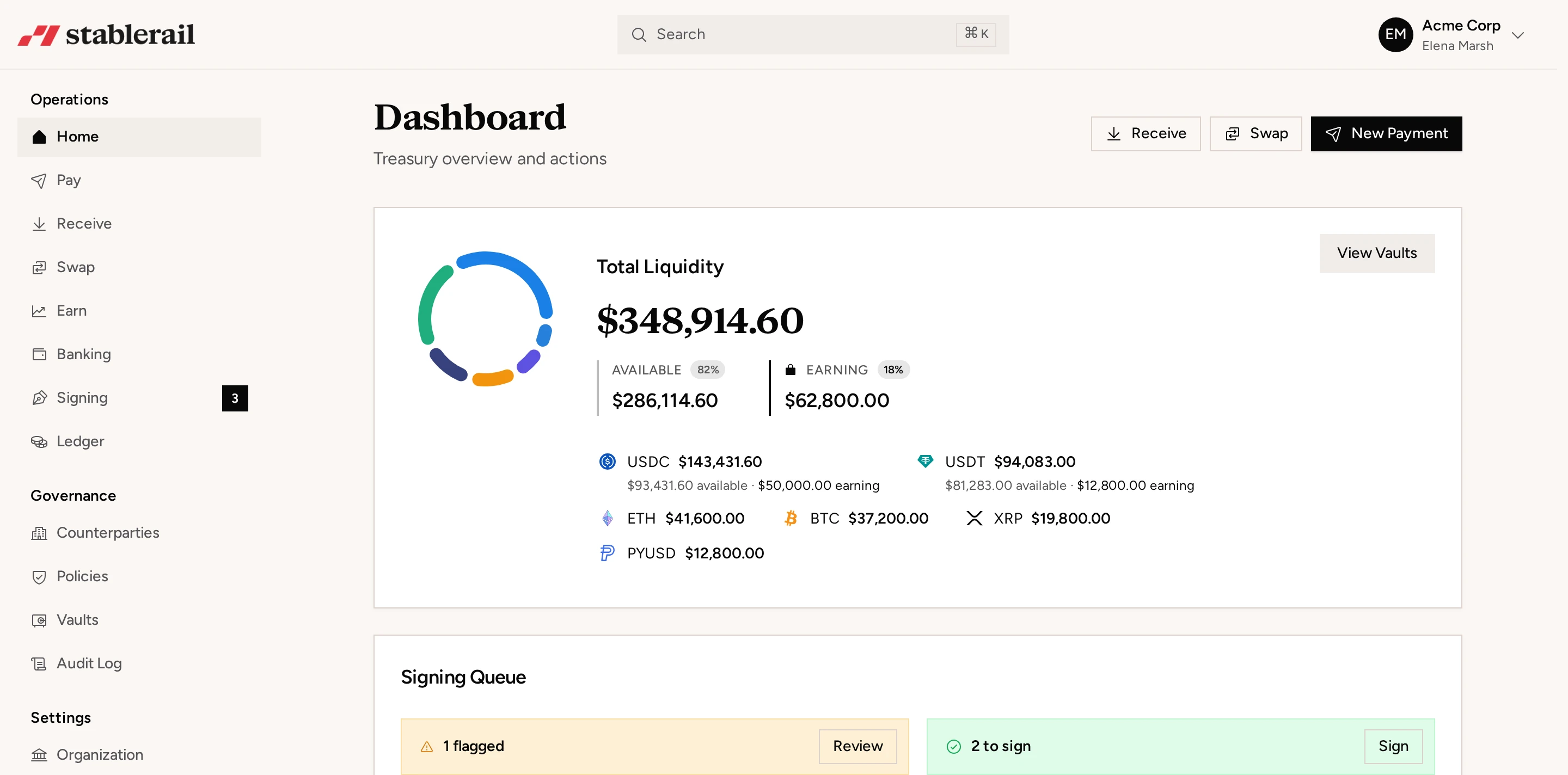
Stablerail provides virtual and physical corporate cards funded from a corporate treasury balance, with configurable limits and merchant category controls. Eligibility, supported functionality and commercial terms should be confirmed during onboarding.
Compare the stablecoin funding model
“Crypto card” can describe several materially different products. Finance teams should identify when conversion occurs and which balance is debited.
| Funding model | How it works | Main benefit | What to check |
|---|---|---|---|
| Pre-funded fiat card | USDC or USDT is converted into EUR, USD or GBP before spending. | Predictable available card balance. | Conversion fees, top-up timing and trapped fiat balances. |
| Automatic conversion | Stablecoins are converted when a card payment is authorised or settled. | Less manual balance management. | Exchange-rate methodology, liquidity and decline handling. |
| Credit facility | The issuer provides a credit line, potentially secured by company assets. | Stablecoins do not need to be sold for every purchase. | Interest, collateral terms, repayment currency and liquidation risk. |
Confirm the exact settlement asset and network. Support for USDC on Ethereum does not automatically mean support for USDC on Base, Arbitrum, Polygon or Solana. Likewise, a provider accepting USDT on one network may not accept it on Tron or other networks.
Sending an asset over an unsupported network can result in delayed or unrecoverable funds. A company should document the approved token, network and destination address for every treasury transfer.
Fees to include in the comparison
Headline card fees rarely show the complete cost of stablecoin spending. Request a full fee schedule and model a representative month of activity.
| Cost | How to compare it |
|---|---|
| Card issuance | Check separate prices for virtual cards, physical cards and replacements. |
| Platform fee | Identify monthly charges, minimum commitments and included cardholders. |
| Stablecoin conversion | Compare the quoted rate with a recognised market reference at the same time. |
| Foreign exchange | Check the markup when the purchase currency differs from the card’s settlement currency. |
| Cross-border fee | Ask whether the issuer adds a fee based on merchant or transaction location. |
| Network fee | Determine who pays blockchain transaction costs when funding the card balance. |
| ATM fee | Review provider charges, operator charges and withdrawal limits. |
| Operational fees | Look for charges covering declines, inactivity, refunds or chargebacks. |
For example, a card advertised with no transaction fee may still carry a conversion spread and foreign-exchange markup. On a €10,000 overseas purchase, a 1% combined markup would cost €100. The percentage applied to the transaction matters more than a small monthly card fee for high-spend teams.
Spending limits and card controls
Providers may impose limits per transaction, day, month, cardholder or company. Ask whether limits are fixed by the issuer or configurable by an administrator.
Useful card controls include:
- Per-transaction, daily and monthly spending limits.
- Separate limits for individual employees, departments or projects.
- Merchant category code controls, commonly called MCC controls.
- Restrictions for cash withdrawals, online payments or contactless use.
- Instant card freezing and termination.
- Single-use or purpose-specific virtual cards.
- Approval requirements for limit increases.
An MCC identifies the merchant’s primary business category. Blocking gambling or cash-like merchants can reduce unwanted spending, but MCC controls are not perfect: a merchant may be classified more broadly than expected. Finance teams should combine category restrictions with sensible limits and transaction review.
Expense management and accounting exports
Card issuance is only half the workflow. The finance team must also close the books, identify missing receipts and account for stablecoin conversions.
Compare whether the platform provides CSV exports, an API or direct integrations with your accounting system. Each record should ideally include the cardholder, merchant, purchase currency, local amount, settlement amount, fees, timestamps and transaction status.
Also test how the system records refunds, reversals and tips. A restaurant transaction, for example, may be authorised for one amount and settle later for another. Exports should distinguish pending, reversed and settled transactions to avoid duplicates.
Where stablecoins are converted for spending, the company may need to record both the card expense and the disposal of the stablecoin. The required treatment depends on the company’s accounting policy and jurisdiction, so transaction-level conversion records are important.
Availability and geographic coverage
A card’s payment network may be accepted globally while the underlying programme is available only to companies incorporated in specific countries. Separate these questions:
- Where can the company be incorporated?
- Where can individual cardholders reside?
- Where can physical cards be delivered?
- Which purchase currencies are supported?
- Which merchant countries or categories are restricted?
Availability can also depend on the company’s industry and ownership structure. Expect KYB documentation such as incorporation records, proof of address, ownership information and identification for directors or beneficial owners. Higher limits may require additional information about source of funds and expected transaction activity.
Which type of crypto card is best?
The best choice depends on the company’s operating model:
- Best for predictable budgets: a pre-funded card with a fixed fiat balance and strong employee limits.
- Best for stablecoin-native companies: automatic conversion from a central USDC or USDT treasury, with transparent conversion pricing.
- Best for distributed teams: virtual cards that can be issued quickly and controlled by employee, project or merchant category.
- Best for accounting teams: a programme with detailed exports, receipt collection and clean treatment of refunds and reversals.
- Best for frequent international spending: a card with broad issuance coverage and clearly disclosed FX and cross-border fees.
A retail rewards card is generally a poor substitute. It may be issued in an employee’s name, lack central limits and produce statements that do not meet the company’s expense management needs.
A practical vendor checklist
Before selecting a provider, request written answers to the following:
- Which legal entities and cardholder countries are eligible?
- Are the cards issued to the company or to individuals?
- Which stablecoins and blockchain networks can fund the programme?
- When does conversion occur, and how is the exchange rate calculated?
- What are all platform, card, conversion, FX, ATM and cross-border fees?
- What are the minimum and maximum transaction and programme limits?
- Can administrators set employee limits and MCC restrictions?
- Which accounting exports or integrations are available?
- How are refunds, disputes and chargebacks handled?
- How long do treasury funding and card settlement normally take?
Run a small pilot before broad deployment. Test funding, an online purchase, a foreign-currency payment, a refund, a declined transaction and the month-end export. The best crypto cards for companies are the ones that make these routine workflows understandable, controllable and easy to reconcile—not the ones with the loudest rewards offer.
Finance writers covering stablecoin treasury, payments, compliance, and risk controls.
More about the Stablerail team- Stablecoin treasury managementApprovals, limits, yield and reporting on one balance.
- Stablecoin payoutsBatch contractor and vendor payments with screening.
- USDT vs USDCWhich stablecoin your company should settle in.
- Stablecoin finance glossaryMPC, off-ramp, travel rule and the rest, in plain English.
- Product updatesEverything we ship, month by month.