
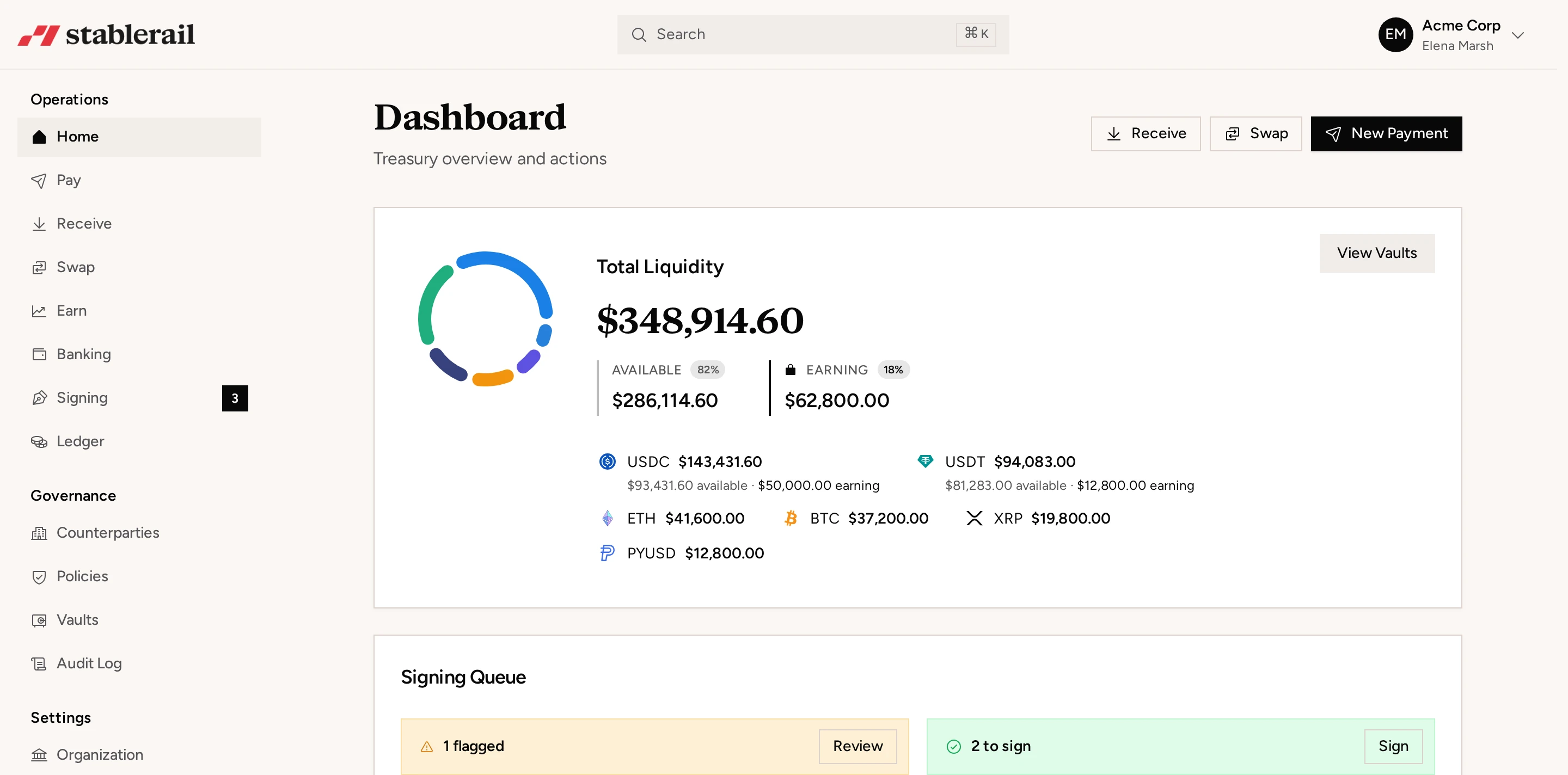
AI-Agent Treasury: How Autonomous Workflows Can Manage Cash and Stablecoins
A practical guide to using AI agents for cash positioning, reconciliation, stablecoin conversions, payouts and risk monitoring—without removing approval controls or human oversight.

An AI-agent treasury uses software agents to monitor balances, interpret treasury policies and initiate or recommend operational tasks. In practical terms, an agent might identify a projected EUR shortfall, prepare a USDC-to-EUR conversion, assemble a vendor payment batch and send it to an authorized employee for approval.
The important distinction is that an agent does not need unrestricted access to company funds. Most finance teams should begin with recommendations and transaction preparation. Autonomous execution can be introduced later for narrow, low-risk workflows governed by fixed limits, approved beneficiaries and quorum signing.
This approach is particularly relevant to companies managing both bank money and stablecoins. A stablecoin treasury may include USDC or USDT across several networks, EUR and USD bank balances, upcoming payroll, vendor invoices, card spending and cross-border conversions. AI can help process that information continuously, but the underlying treasury platform still needs enforceable controls.
What an AI treasury agent can do
An agent combines current treasury data with operating rules. It can review balances, expected receipts, payment deadlines, exchange rates, network fees and liquidity requirements. It then produces a recommendation or prepares an action.
Useful workflows generally fall into five categories:
- Cash positioning: Calculate available cash by currency, legal entity, account and blockchain network.
- Reconciliation: Match bank transfers and on-chain transactions to invoices, payroll records or internal ledger entries.
- Conversions: Identify when fiat should be converted into USDC or USDT, or when stablecoins should be off-ramped to fund bank payments.
- Payouts: Prepare payment batches, select an eligible rail or network and route the batch for approval.
- Risk monitoring: Flag unusual transactions, screened wallet alerts, concentration limits or projected liquidity shortfalls.
This is treasury automation with a decision layer. Traditional rules might say, “Alert finance when EUR falls below €100,000.” An agent can add context: “EUR will fall below the reserve on Thursday because payroll and two approved invoices are due, so convert a specified amount of USDC by Wednesday.”
Recommendations versus autonomous execution
AI-agent treasury designs should clearly separate analysis from authority. A model may be good at interpreting data while still being the wrong place to hold unconditional signing power.
| Operating mode | What the agent does | Suitable examples |
|---|---|---|
| Recommend | Produces a proposed action with supporting data | Cash forecasts, conversion suggestions and liquidity alerts |
| Prepare | Creates a draft transaction or payment batch | Vendor payouts, payroll files and transfers between treasury accounts |
| Execute within policy | Submits a transaction only when every predefined condition is satisfied | Low-value transfers to allowlisted accounts under a daily limit |
| Human-only | Cannot proceed without named approvers | New beneficiaries, large conversions, changes to policy and yield allocations |
A sensible rollout starts with recommendation mode. Finance teams can compare the agent’s proposals with actual decisions, identify weak data sources and refine policies before granting any execution authority.
Applying agents to daily treasury work
Cash positioning across fiat and stablecoins
A complete position should include available and pending balances. On the fiat side, that may cover EUR, USD and GBP accounts, including virtual IBANs and funds moving through SEPA, ACH, Fedwire, SWIFT, Faster Payments, CHAPS or BACS. On-chain, it should separate USDC and USDT by network and wallet rather than reporting one combined stablecoin number.
This matters because liquidity is not automatically interchangeable. USDC on Base cannot fund a USDT payment on Tron without conversion and potentially a cross-chain transfer. Similarly, USD arriving by ACH may take one or more business days, while Fedwire is generally a same-business-day rail when submitted during operating hours. Exact timing depends on banks, cutoffs and compliance review.
An agent can calculate the expected position after scheduled inflows and outflows, then recommend moving funds before a shortfall occurs. It should include estimated conversion charges, published corridor pricing where available and blockchain network fees rather than treating transfers as free.
Reconciliation
Stablecoin reconciliation relies on different identifiers from bank reconciliation. Bank transfers may have account references and remittance information. Blockchain transactions have wallet addresses, transaction hashes, token contracts and network identifiers.
An agent can match these records against invoices or payout instructions, flag duplicates and place uncertain matches into an exception queue. Finance staff should review low-confidence matches rather than allowing the agent to force a ledger classification.
Conversions and on/off-ramps
An agent can monitor when fiat-to-stablecoin or stablecoin-to-fiat conversions are required. Before execution, the workflow should capture the quoted rate, fees, expected settlement amount, destination account or vault and quote expiry.
Conversions should also be constrained by currency, corridor and amount. For example, an agent might prepare a USDC-to-EUR conversion to fund SEPA payouts, but a treasury approver confirms the quote before submission. This preserves speed without allowing the model to choose an unlimited trade size.
Payout preparation
Autonomous workflows are useful for repetitive vendor, contractor and payroll payments. An agent can validate invoice fields, detect duplicate payment requests, group recipients by currency or network and prepare a batch.
Stablerail supports stablecoin payouts across Ethereum, Base, Arbitrum, Polygon, Tron, BNB Chain, Optimism and Solana. The agent should verify that the selected token and network match the recipient’s instructions; sending a supported token to the wrong network may be irreversible. Finance teams can learn more about stablecoin payout workflows and stablecoin payroll.
Risk and liquidity monitoring
An agent can continuously review wallet-screening results, sanctions alerts, unusual payment sizes and changes to beneficiary details. It can also monitor idle balances and identify funds that may be eligible for yield products.
Yield should normally remain a recommendation rather than an unrestricted autonomous action. The decision depends on withdrawal terms, counterparty exposure and the risk that funds will not be available when needed. Any proposal should state the liquidity terms and relevant risks. See treasury earning options for further context.
Why approval controls still matter
AI models can use incomplete data, misunderstand an instruction or act on stale information. They may also be exposed to manipulated invoices or messages designed to influence their output. For that reason, natural-language instructions should not override treasury policy.
Approval controls should be enforced by the treasury platform, independently of the agent. Relevant controls include:
- Per-transaction and daily approval limits.
- Allowlists for verified bank accounts and blockchain wallets.
- Separate approval requirements for new beneficiaries.
- Sanctions and wallet screening before release.
- Quorum signing, requiring multiple authorized people to approve.
- Self-custodial MPC vaults, where signing authority is distributed rather than held as one private key.
- Immutable audit logs linking the recommendation, source data, approvals and final transaction.
These controls define what the agent is technically able to do. A prompt saying “pay immediately” should not bypass a payment limit, beneficiary check or quorum requirement.
A practical adoption sequence
- Start with visibility: Let the agent consolidate balances and produce daily cash-position reports.
- Add recommendations: Ask it to suggest conversions, funding transfers and payout timing, with assumptions shown.
- Enable transaction preparation: Allow draft batches but require human review and approval.
- Automate narrow cases: Permit execution only for low-value, repeat payments to allowlisted recipients.
- Review performance: Track rejected recommendations, reconciliation exceptions, policy breaches and manual overrides.
The goal is not to remove the finance team. It is to reduce repetitive work while keeping authority explicit. The strongest AI-agent treasury model combines continuous analysis and fast preparation with enforceable policies, human oversight and clear evidence of every decision.
Finance writers covering stablecoin treasury, payments, compliance, and risk controls.
More about the Stablerail team- Stablecoin treasury managementApprovals, limits, yield and reporting on one balance.
- Stablecoin payoutsBatch contractor and vendor payments with screening.
- USDT vs USDCWhich stablecoin your company should settle in.
- Stablecoin finance glossaryMPC, off-ramp, travel rule and the rest, in plain English.
- Product updatesEverything we ship, month by month.