
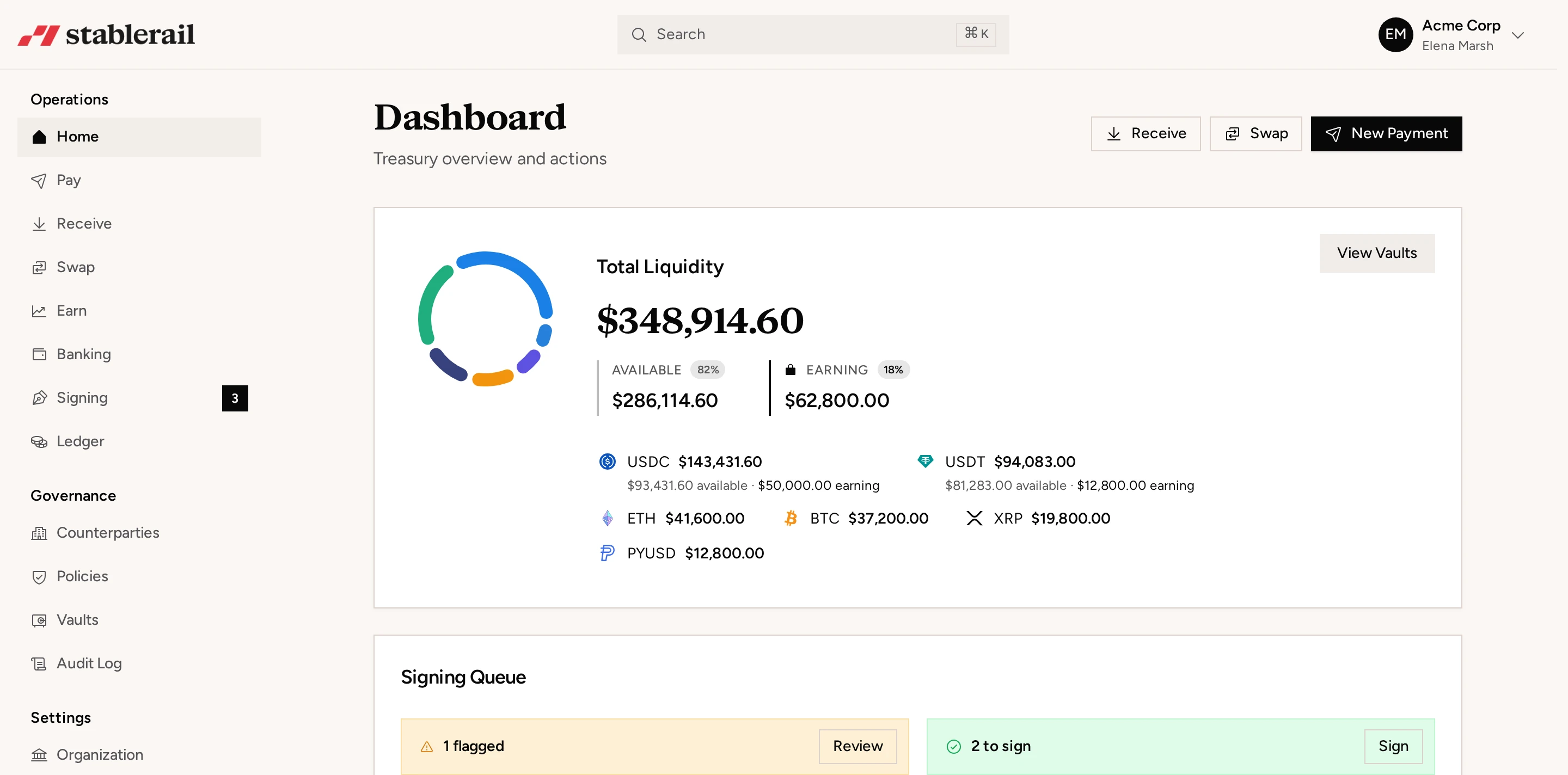
Best Tools for Managing Stablecoin Treasury at Scale
A practical guide to selecting stablecoin treasury tools for consolidated balances, custody, approvals, batch payouts, fiat conversion, reconciliation, screening and audit evidence.

Managing USDC or USDT through a single wallet can work when transaction volumes are low. At scale, finance teams also need approval workflows, batch payouts, fiat rails, payroll support, reconciliation and reliable audit evidence.
The best stablecoin treasury setup is therefore rarely just a wallet. It is either an integrated treasury platform or a carefully connected stack of custody, banking, payment and accounting tools. The right choice depends on where your company operates, which networks it uses and how many people participate in each payment process.
What a stablecoin treasury tool should cover
Start with the operational flow rather than a feature list. Map how money enters the business, where it is held, who can approve movements, how recipients are paid and how every transaction reaches the accounting ledger.
For a growing finance team, the core requirements usually include:
- Consolidated balances: one view of stablecoins, fiat accounts and funds allocated to cards, payouts or yield products.
- Wallets and custody: secure storage with controls that do not depend on one employee holding a private key.
- Role-based approvals: payment limits, multiple approvers and separation between preparation and release.
- Batch payouts and payroll: bulk payment creation, recipient validation and status reporting.
- Fiat rails and conversion: practical routes between bank money and USDC or USDT.
- Reconciliation: transaction references, fees, exchange rates and exports that can be matched to invoices and ledger entries.
- Screening and evidence: sanctions checks, wallet screening, approval history and audit-ready records.
Compare the main tool categories
| Tool category | Best suited to | Main limitation |
|---|---|---|
| Consumer or basic business wallet | Low transaction volume and simple transfers | Often lacks structured approvals, fiat rails and accounting workflows |
| Institutional custody platform | Secure asset storage and policy-based signing | Payments, banking and reconciliation may require separate providers |
| Bank and exchange stack | Fiat collection, trading and occasional conversion | Balances and evidence are fragmented across portals |
| Payment API provider | Embedded payouts and high-volume automated flows | May require engineering resources and a separate treasury interface |
| Integrated stablecoin treasury platform | Finance teams managing custody, fiat, conversion and payments together | Coverage still depends on jurisdiction, industry, currency and network eligibility |
An integrated platform can reduce handoffs, but it should not be selected solely for convenience. Confirm how assets are held, which legal entities provide fiat accounts, how conversion is priced and what happens if a payment fails.
Evaluate custody and wallet architecture
A scalable wallet setup should avoid a single point of approval. Self-custodial MPC vaults divide the signing process across multiple cryptographic shares. MPC, or multi-party computation, means no complete private key needs to exist in one place.
Quorum signing adds an operational rule, such as requiring two of three authorised signers. Finance teams should check whether the platform supports:
- Separate vaults for operating funds, reserves and payroll.
- Named user roles rather than shared credentials.
- Transaction limits by user, wallet or payment type.
- Recipient allowlists for frequently used addresses.
- Emergency procedures for replacing a signer or freezing activity.
- Clear support for required networks and token contracts.
Network coverage matters. USDC and USDT are available on multiple chains, but a token on Ethereum cannot be sent directly to a recipient expecting the same symbol on Tron or Solana. Stablerail supports payouts across Ethereum, Base, Arbitrum, Polygon, Tron, BNB Chain, Optimism and Solana, subject to asset and account availability.
Test approvals and batch payouts
Approval design should follow payment risk. A routine contractor payment may need one approval, while a large conversion or transfer to a new wallet may need two or more. Look for configurable limits rather than a single approval policy for every transaction.
For batch payouts, test the complete process with a sample file. Confirm the required columns, supported decimal precision, duplicate detection and treatment of invalid addresses. The system should show whether each transfer is drafted, approved, submitted, confirmed or failed.
Also check how network fees are handled. A batch containing 200 recipients may create many on-chain transactions, so the quoted payout amount is not necessarily the total treasury cost. Ask whether fees are estimated before approval and how actual fees appear in exports.
Payroll adds sensitive data and stricter timing requirements. Verify who can view employee details, whether amounts can be hidden from preparers or approvers, and how rejected payments are rerun. See Stablerail’s stablecoin payout tools and crypto payroll workflow for relevant operating models.
Check fiat rails and conversion routes
A stablecoin treasury still needs reliable connections to bank money. Build a corridor matrix showing the currencies, countries and settlement methods your company actually uses.
| Currency or route | Rails to assess | Questions to ask |
|---|---|---|
| EUR | SEPA, SEPA Instant, virtual IBANs | Are instant transfers available to every counterparty bank? What are the cut-offs and limits? |
| USD | ACH, Fedwire | What are the settlement windows, return risks and incoming payment requirements? |
| GBP | Faster Payments, CHAPS, BACS | Which rail is used for each payment size and urgency? |
| Cross-border | SWIFT | Are intermediary charges possible, and which payment references survive the route? |
For on-ramps and off-ramps, compare the full cost: platform fee, quoted conversion spread, network fee and any receiving-bank charge. Published corridor pricing is more useful than a generic “from” rate because costs can differ by currency, destination and settlement method.
Timings should also be stated by stage. Bank receipt, compliance review, conversion and blockchain confirmation are separate events. A fast network cannot compensate for a transfer delayed before conversion.
Make reconciliation a selection requirement
Reconciliation is where fragmented stacks create the most manual work. The treasury management system should provide a stable transaction identifier linking the original instruction, approval record, fiat movement, conversion and on-chain hash.
Before buying, export a month of test data and ask the accounting team to post it. Useful fields include:
- Transaction date, submission time and settlement time.
- Legal entity, account or wallet, asset and network.
- Sender, recipient and internal payment reference.
- Gross amount, fee, net amount and conversion rate.
- Blockchain transaction hash or bank reference.
- Approval status and named approvers.
- Invoice, payroll run or vendor identifier.
Confirm whether exports are available as CSV, through an API or via direct accounting integrations. Also establish how reversals, failed ACH payments, returned bank transfers and replaced blockchain transactions are represented. Clean success records are not enough; exception handling determines the real workload.
Review screening and audit evidence
Stablecoin tools should screen counterparties without making every payment a manual compliance project. Assess sanctions screening, wallet-risk checks, address allowlists and the process for reviewing a flagged transfer.
The audit log should record who created, edited, approved and released each payment. Evidence packs should combine approval history, screening results, bank references and blockchain records in a format that finance teams can retrieve later. Screening tools can assist decision-making, but they do not replace the company’s own legal and compliance assessment. Stablerail’s wallet checker can help teams review wallet exposure.
Use a practical selection scorecard
Score each provider using real workflows, not demonstrations alone. A reasonable weighting for a scaling finance team is:
- 20% custody and wallet controls
- 20% fiat rails and conversion coverage
- 15% approvals and user administration
- 15% batch payouts and payroll
- 15% reconciliation and accounting exports
- 10% screening and audit evidence
- 5% implementation and support
Adjust the weighting to your business. A global marketplace may prioritise payout corridors, while a company holding large reserves may place more weight on custody architecture and liquidity.
Finally, confirm onboarding eligibility early. KYB documentation, ownership information, jurisdiction and industry checks can determine whether a provider can support your company. The best stablecoin treasury tool is the one that covers your real entities, currencies, networks and approval process while giving finance a clear record of every movement.
Finance writers covering stablecoin treasury, payments, compliance, and risk controls.
More about the Stablerail team- Stablecoin treasury managementApprovals, limits, yield and reporting on one balance.
- Stablecoin payoutsBatch contractor and vendor payments with screening.
- USDT vs USDCWhich stablecoin your company should settle in.
- Stablecoin finance glossaryMPC, off-ramp, travel rule and the rest, in plain English.
- Product updatesEverything we ship, month by month.