
AI Agents for Treasury: How to Compare Tools, Controls, and Use Cases
A practical framework for comparing AI treasury agents across supported actions, integrations, approvals, stablecoin coverage, explainability and audit evidence.
Compare AI treasury agents by what they can read, recommend, prepare, approve and execute—not by the agent label. The strongest tool fits your bank and stablecoin workflows, operates with least-privilege access, keeps approvals outside the model, explains recommendations with source data and produces exportable evidence. Test it first in read-only or draft mode using duplicate payments, changed beneficiaries, stale data, failed screening and wrong-network scenarios.

AI treasury agents range from reporting assistants that answer cash questions to systems that can prepare or initiate payments. The right choice depends less on how autonomous a product sounds and more on its access, permitted actions and external controls. Finance teams should trace the entire workflow from source data through recommendation, approval, execution, reconciliation and audit evidence.
Define what the treasury agent can actually do
Many products described as AI agents are copilots. They summarize balances, explain variances or draft payment instructions, but they do not independently execute transactions. Other tools can submit instructions to banks, wallets or treasury platforms. That difference changes the operational and control risk.
Classify every capability using five verbs: read, recommend, prepare, submit and execute. A tool that recommends moving liquidity is materially different from one that creates a transfer, and both differ from a tool authorized to send it.
| Tool type | Typical capability | Primary value | Control question |
|---|---|---|---|
| Reporting copilot | Reads balances, summarizes cash flows and explains variances | Faster analysis | How fresh and complete is the source data? |
| Workflow assistant | Classifies transactions, prepares forecasts or drafts payment batches | Less manual preparation | Who validates inputs and approves the draft? |
| Monitoring agent | Flags liquidity gaps, exceptions, failed payments or wallet risk | Earlier intervention | How are false positives, missed events and escalations handled? |
| Execution agent | Submits transfers, conversions, payouts or rebalancing instructions | Faster operations | What limits and independent approvals prevent unintended execution? |
Ask the vendor to demonstrate each claimed action in the product. Phrases such as “manages liquidity” may mean sending an alert, drafting a recommendation or moving money. The supported action and permission level should be visible in product settings and contractual documentation, not only in a sales presentation.
Evaluate the complete operating path
A useful comparison follows a transaction from the original data to the accounting record. A polished chat interface is not enough if staff must manually reconstruct approvals or reconcile the resulting payment.
1. Data access and freshness
Document every source the agent can read: bank accounts, multi-currency accounts, wallets, enterprise resource planning systems, accounting ledgers and payment platforms. Record whether each connection is real-time, event-driven, periodic or dependent on manual file uploads.
Daily bank data may support reporting but be unsuitable for an intraday liquidity decision. Blockchain data can show an on-chain balance quickly, but it does not by itself identify the correct invoice, legal entity, counterparty or accounting treatment. The agent must expose timestamps and missing sources so users can recognize an incomplete cash position.
2. Integrations and operational coverage
Review native connections, file formats, manual handoffs and available integration methods. Confirm whether the tool works with your actual banks, wallets, accounting system and payout process rather than a sample environment.
For fiat operations, examine the specific rails and workflows required by the company, such as ACH, Fedwire, SEPA, SWIFT or local payment methods. For stablecoins, verify support by asset and blockchain network. USDC on Ethereum and USDC on Solana are operationally distinct, as are USDT transfers across its supported networks. The sender and recipient must use a compatible asset, network and address.
3. Explainability
A recommendation should include more than a natural-language rationale. If an agent proposes converting EUR to USDC, it should identify the source balance, forecasted requirement, timing assumption, destination, applicable constraints and data timestamp. Users should be able to trace calculations to source records and see which assumptions came from the model.
Confidence scores can be useful, but they do not replace evidence. Treasury reviewers need source links, calculation logic and a clear indication of missing or conflicting data.
4. Exception handling
Determine what happens when a bank rejects a payment, an address fails screening, a wallet lacks the required network fee token or a beneficiary record changes. The system should stop or route the item for review according to the configured workflow. It should not silently modify the instruction or repeatedly retry without creating a visible history.
Keep authority outside the AI model
The model may propose an action, but the treasury or payment system should enforce who can approve and execute it.
Approval thresholds, signing quorum, legal-entity segregation and beneficiary controls should operate independently of the model’s output. AI-generated text must not be treated as authorization. For self-custodial wallets, signing controls can require multiple authorized participants so that a prepared transaction cannot be completed by one user or device.
Apply least privilege by separating permissions across entity, account, asset, network and action. Transaction values and approved destinations should also be constrained where the underlying system supports those controls.
| Use case | Access normally required | Authority to avoid initially | Independent control |
|---|---|---|---|
| Cash reporting | Read balances and transactions | Create or submit payments | Source freshness and account coverage review |
| Payment preparation | Read invoices and create drafts | Add beneficiaries or approve its own drafts | Beneficiary validation and human approval |
| Liquidity rebalancing | Read positions and prepare transfers | Unrestricted movement to third parties | Limits, approved destinations and signing quorum |
| Stablecoin payouts | Prepare asset, network, address and amount | Bypass screening or signing requirements | Pre-send address screening and authorized signers |
| Card monitoring | Read transactions and flag anomalies | Change limits without review | Card administrator approval |
Require evidence suitable for reconciliation and audit
The activity record should distinguish between actions taken by users, rules, integrations and AI models. Ask whether it captures the instruction, source data, recommendation, user edits, approvals, rejection, execution result and timestamp. The team should be able to export this evidence according to its retention and review process.
For a stablecoin transfer, the evidence should connect the business purpose and accounting reference to the legal entity, asset, network, destination address, amount, approval record, screening result and transaction hash. A blockchain explorer confirms an on-chain transaction, but it does not prove that the transfer was properly authorized or posted to the correct expense, payable or intercompany account.
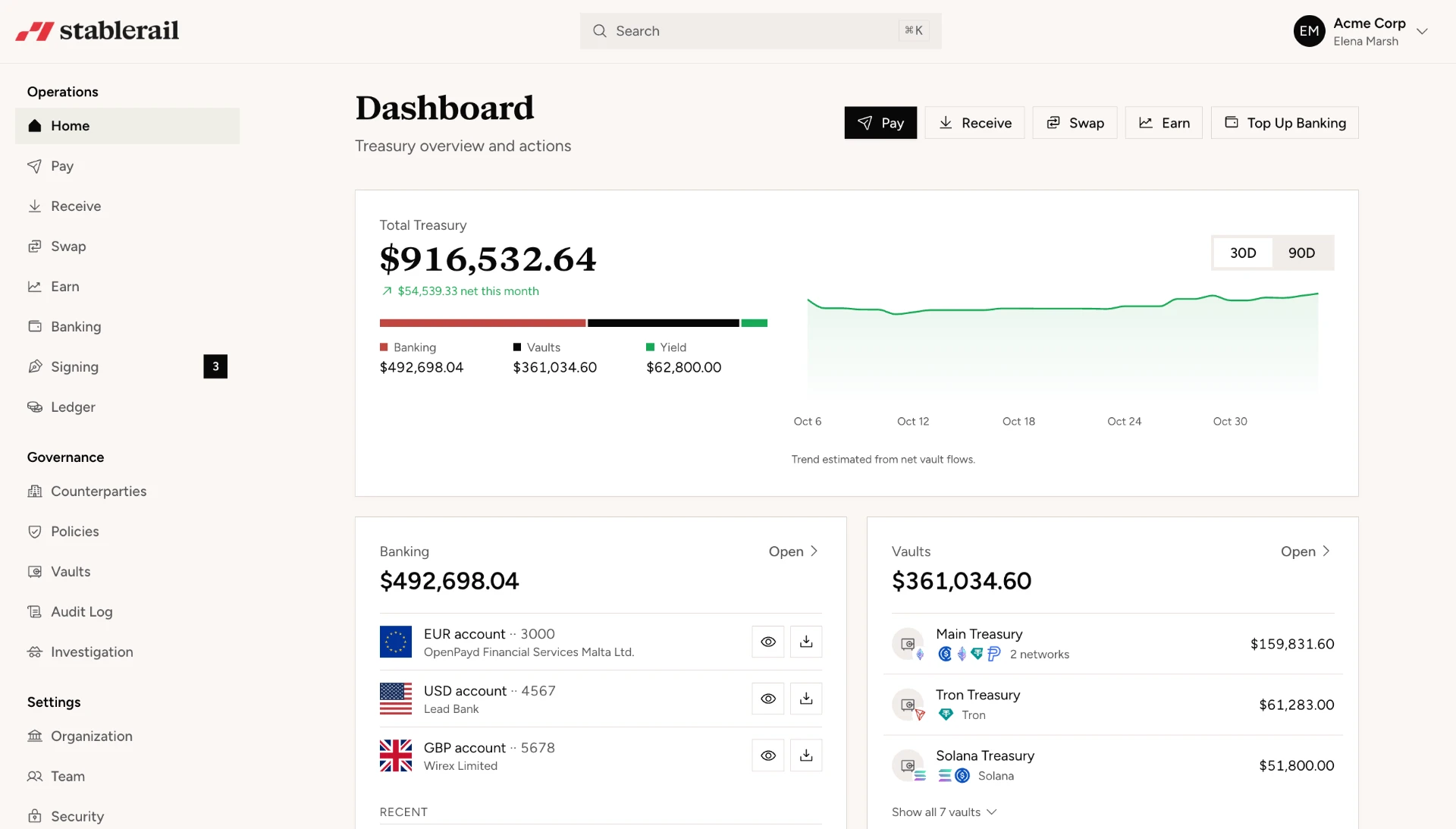
Stablerail can serve as a controlled operating layer for a company’s own USDC and USDT, with approvals and signing quorum, sanctions and address screening before send, global payouts, fiat conversion, corporate cards and exportable audit evidence. An AI tool can add analysis, preparation or monitoring without replacing those execution controls.
Test realistic failure cases before enabling execution
Start with read-only access or draft creation. Use representative but controlled scenarios and record whether the agent stops, warns, requests clarification or proceeds. Test both the expected workflow and recovery after rejection.
- A duplicate invoice with a slightly different reference.
- A recently changed beneficiary bank account or wallet address.
- A payment above the user’s authority or approval threshold.
- USDC or USDT prepared on a network the recipient does not support.
- A wallet without enough of the network’s fee token.
- An address that produces a sanctions or risk-screening alert.
- A bank instruction submitted after the relevant cut-off.
- A cash forecast based on stale, missing or duplicated account data.
- A rejected transfer followed by an attempted retry.
Verify that rejected actions remain visible and that a corrected instruction creates a traceable new version. Where a scenario requires human judgment, the tool should escalate rather than infer an approval from prior behavior.
Use a weighted scorecard, not a feature count
Set weights before product demonstrations so an impressive interface does not outweigh operational requirements. A company making frequent global payouts may emphasize rail coverage, beneficiary controls and exception handling. A centralized treasury focused on forecasting may give more weight to data completeness and explainability.
- List required workflows. Define the entities, accounts, assets, networks, rails and transaction types in scope.
- Assign evidence requirements. Request a live workflow, permission matrix, approval test, source-data view and sample audit export.
- Score control fit separately. Do not combine convenience and control quality into one rating.
- Estimate implementation work. Include integrations, data cleanup, role design, testing, training and reconciliation changes.
- Approve autonomy in stages. Move from read-only to draft preparation and then limited execution only after observed results support it.
The best AI treasury agent is not necessarily the one with the broadest autonomy. It is the tool that supports required workflows, uses current and traceable data, operates within narrow permissions, respects independent approvals and leaves enough evidence for finance teams to explain every action.
Frequently asked questions
What is an AI treasury agent?
An AI treasury agent is software that uses AI to analyze treasury data or assist with tasks such as forecasting, payment preparation, monitoring and liquidity management. Its authority can range from read-only reporting to submitting transactions, so finance teams should verify the exact actions it can perform.
How should a CFO compare AI treasury tools?
Compare them across supported actions, data freshness, integrations, permission scope, approvals, explainability, exception handling and audit evidence. Require demonstrations using your actual workflow patterns and score control quality separately from interface convenience.
Should an AI treasury agent be allowed to execute payments?
Execution access should follow successful testing in read-only and draft modes. If enabled, the agent should remain subject to independent transaction limits, beneficiary controls, human approvals and signing requirements enforced by the treasury or payment system.
Can AI treasury agents manage USDC and USDT?
Some can analyze or prepare stablecoin transactions, but support must be verified by asset and blockchain network. The operating workflow should also cover compatible destination addresses, network fees, pre-send screening, approvals, transaction hashes and accounting references.
What should an AI treasury audit log contain?
It should identify the source data, model recommendation, user edits, approvals, rejections, execution result and timestamps. For stablecoins, it should also connect the business instruction to the asset, network, wallet addresses, screening result and transaction hash.
Finance writers covering stablecoin treasury, payments, compliance, and risk controls.
More about the Stablerail team- Stablecoin treasury managementApprovals, limits, yield and reporting on one balance.
- Stablecoin payoutsBatch contractor and vendor payments with screening.
- USDT vs USDCWhich stablecoin your company should settle in.
- Stablecoin finance glossaryMPC, off-ramp, travel rule and the rest, in plain English.
- Product updatesEverything we ship, month by month.