
How B2B Treasury Orchestration Unifies Fiat and Digital Asset Operations
Learn how a unified treasury layer connects bank rails, stablecoin wallets, conversions, payouts, approvals and reconciliation for businesses managing fiat and digital assets.

Companies that operate with both fiat currency and stablecoins often manage two separate treasury systems. Bank accounts, payment files and FX sit on one side. Wallets, blockchain networks and token balances sit on the other. Finance teams then bridge the gap with spreadsheets, exchange accounts and manual reconciliations.
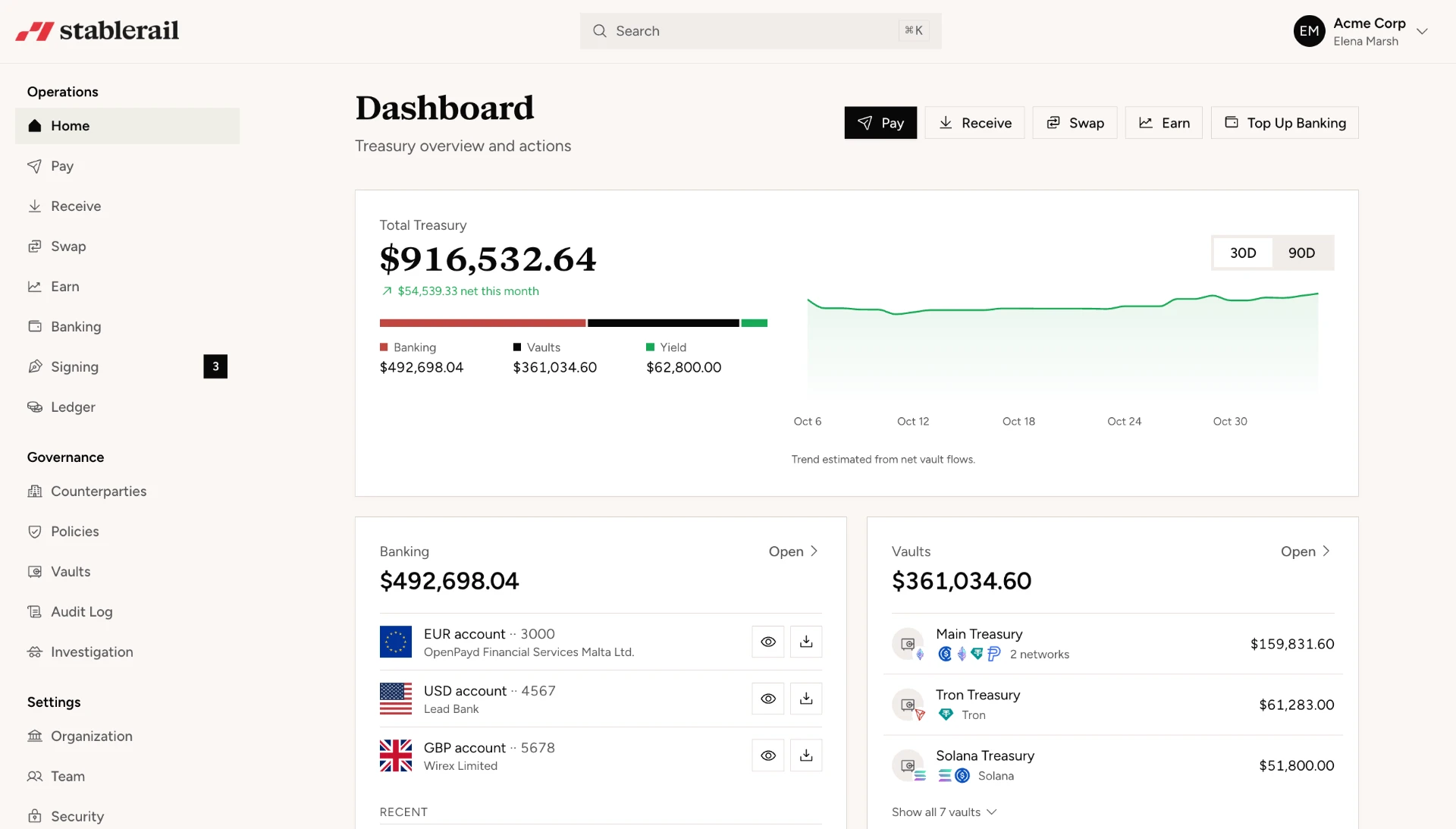
Treasury orchestration creates a common operating layer across those systems. It does not replace bank rails or blockchains. Instead, it coordinates balances, conversions, approvals, payments and records so a finance team can manage its own funds through one workflow.
For a business holding USDC or USDT, that can mean receiving EUR through a virtual IBAN, converting it into a stablecoin, paying vendors across several blockchain networks and reconciling each step without assembling records from multiple platforms.
What a unified treasury layer coordinates
A unified treasury connects the destinations where money is held with the rails used to move it. The core components are:
- Fiat accounts and balances: EUR, USD, GBP and other supported currencies, including virtual IBANs where available.
- Bank payment rails: SEPA and SEPA Instant, ACH, Fedwire, SWIFT, Faster Payments, CHAPS and BACS.
- Stablecoin vaults: self-custodial MPC wallets for USDC and USDT. MPC, or multi-party computation, divides signing authority so no single private key controls the funds.
- Conversions: on-ramps from fiat into stablecoins and off-ramps back into fiat, with the applicable corridor price shown before execution.
- Payouts: individual or batch transfers for vendors, contractors, payroll and invoices.
- Controls: approval thresholds, quorum signing, beneficiary allowlists, wallet screening and role-based access.
- Reconciliation: transaction references, fees, conversion records, wallet addresses and payment status in a consistent ledger or export.
The practical benefit is not simply seeing more accounts on one screen. It is being able to initiate and trace a transaction from its source balance to its final beneficiary, even when the transaction crosses between fiat operations and digital assets.
Rail selection is part of cash management
Different rails have different operating hours, settlement patterns and data requirements. Treasury orchestration should let finance teams select the route that fits the payment rather than forcing every transaction through the same channel.
| Rail | Typical use | Indicative timing |
|---|---|---|
| SEPA Instant | Urgent EUR payments within the supported SEPA area | Usually seconds, available continuously where both institutions participate |
| SEPA Credit Transfer | Routine EUR supplier and treasury transfers | Commonly same or next business day |
| ACH | US payroll, collections and routine vendor payments | Same-day or one to several business days, depending on service and cutoff |
| Fedwire | High-value or time-sensitive USD transfers | Same business day during operating hours |
| Faster Payments | Routine or urgent GBP payments | Usually seconds or minutes |
| CHAPS | High-value GBP payments | Same business day before cutoff |
| BACS | UK payroll and scheduled bulk payments | Typically a three-business-day cycle |
| SWIFT | Cross-border bank payments | Often one to five business days, depending on intermediaries |
| Stablecoin transfer | Always-on USDC or USDT settlement | Often seconds to minutes, depending on the network and confirmation policy |
These timings are indicative rather than guaranteed. Cutoff times, recipient banks, compliance reviews, network congestion and local holidays can all affect settlement.
A unified system makes the trade-offs visible. A finance team can compare the expected delivery time, network or bank fee, conversion cost and beneficiary requirements before approving a route.
How a fiat-to-stablecoin workflow operates
Consider a European company that collects EUR but pays international contractors in USDC.
- The company receives EUR into its named account or virtual IBAN.
- The incoming payment is matched using the sender information and bank reference.
- A user requests an EUR-to-USDC conversion and reviews the quoted amount, fees and destination network.
- The conversion enters the company’s approval workflow.
- Once approved, USDC is delivered to the company’s self-custodial treasury vault.
- The company creates a batch payout using approved contractor wallet addresses.
- Authorized signers meet the required quorum and broadcast the transactions.
- Bank, conversion and blockchain records are retained for reconciliation.
The reverse workflow supports off-ramping. USDC or USDT is sent from the treasury vault, converted into the required fiat currency and paid through an appropriate bank rail. Stablerail supports treasury workflows across Ethereum, Base, Arbitrum, Polygon, Tron, BNB Chain, Optimism and Solana, subject to the stablecoin and service availability for each route.
Finance teams evaluating this process should examine the full corridor price, not only the stated conversion fee. The relevant figure is the final amount delivered after conversion costs, bank charges and blockchain network fees. Published corridor pricing or an executable quote makes that comparison easier.
One balance view does not mean one pooled account
A consolidated dashboard can show fiat and stablecoin balances together without pretending they are legally or technically identical. EUR in a fiat account remains different from USDC in an on-chain vault. Each has different access methods, settlement risks and supporting records.
Good cash management therefore separates visibility from custody. The treasury layer should show where funds are held, who controls them, which payments are pending and how much is available after reserved or in-flight transactions.
For digital assets, self-custodial MPC vaults allow the company to retain transaction authority while using quorum signing. For example, a policy could require two authorized approvers for a transfer, although each company should set thresholds appropriate to its structure.
Payouts, cards and idle balances
Orchestration becomes more useful when the same treasury balance can fund several operating workflows.
- Vendor and contractor payouts: upload or create payment batches, validate beneficiary details and track each payment separately. See stablecoin payouts.
- Payroll: coordinate scheduled payments while preserving employee-level references and approval evidence. See crypto payroll.
- Corporate cards: issue virtual or physical cards funded from the treasury balance, with spending limits and merchant category controls.
- Invoices and payment links: accept stablecoin payments and associate receipts with the relevant customer or invoice.
- Earn: allocate eligible idle treasury balances to yield products with stated liquidity terms and risks. Yield is not the same as a bank deposit, and finance teams should assess counterparty, protocol, market and withdrawal risk. See treasury yield options.
Approvals and screening should sit inside the workflow
Controls are most effective when they are applied at the point of payment rather than checked retrospectively. A unified workflow can apply approval limits, allowlisted beneficiaries and sanctions or wallet screening before funds move.
For blockchain payments, screening can identify exposure indicators associated with a wallet. It does not prove who owns the address, so results may require review. For fiat payments, beneficiary and bank details still need validation, particularly when instructions have changed.
An audit log should record who created, reviewed and approved each transaction. Evidence packs can combine payment instructions, approval history, conversion details, bank references and blockchain transaction hashes for accounting or audit review.
What to evaluate in a treasury orchestration platform
Before selecting a platform, finance teams should test real operating scenarios rather than relying on a feature checklist:
- Which fiat currencies, local rails, stablecoins and blockchain networks are supported?
- Are conversion prices and all relevant fees visible before execution?
- Who controls the stablecoin wallets, and how are signing credentials protected?
- Can approval rules differ by entity, currency, amount and payment type?
- How are failed, returned or underpaid transactions handled?
- Can records be exported with bank references, wallet addresses, network fees and transaction hashes?
- What are the cutoff times, transaction limits and expected settlement windows for each rail?
- Which jurisdictions and industries are eligible after KYB checks?
The right model unifies operations without hiding the differences between banks and blockchains. For businesses managing their own funds, treasury orchestration provides a structured way to coordinate stablecoin treasury activity, fiat operations, payouts and reconciliation while preserving clear custody and approval boundaries.
Finance writers covering stablecoin treasury, payments, compliance, and risk controls.
More about the Stablerail team- Stablecoin treasury managementApprovals, limits, yield and reporting on one balance.
- Stablecoin payoutsBatch contractor and vendor payments with screening.
- USDT vs USDCWhich stablecoin your company should settle in.
- Stablecoin finance glossaryMPC, off-ramp, travel rule and the rest, in plain English.
- Product updatesEverything we ship, month by month.