
What Makes a Treasury Platform Adaptable to Fiat and Stablecoin Operations?
An adaptable treasury platform unifies fiat and stablecoin operations through consistent controls, transparent conversion, appropriate payment rails and audit-ready reporting.
An adaptable treasury platform lets finance teams add currencies, stablecoins, payment rails and entities without rebuilding approvals, reconciliation or reporting. It should distinguish accounts from wallets, support the required token-network combinations, show conversion costs before execution, apply consistent controls to fiat and stablecoin payments, and produce audit evidence that follows every transaction from initiation through settlement.

What adaptability means in treasury operations
An adaptable treasury platform does more than display USD, EUR, GBP, USDC and USDT in one interface. It supports the full operating cycle: receiving funds, converting balances, approving payments, executing on the appropriate rail, resolving exceptions, reconciling transactions and exporting evidence.
The practical test is whether finance can change how money moves without creating a parallel control environment. A company might begin with domestic bank payments, add USDC contractor payouts, introduce EUR collections, use USDT for selected vendors and later issue corporate cards. Each addition should fit the same approval, accounting and evidence model.
Adaptability does not mean supporting the largest possible list of currencies or blockchain networks. It means supporting the combinations the business needs while making ownership, costs, settlement status and control responsibilities clear.
Start with balances, ownership and access
A balance displayed on a dashboard is not necessarily a bank account, and a wallet address is not enough to explain custody. Finance teams should identify the legal and operational structure behind every balance before comparing convenience features.
For fiat, determine whether the company receives named account details, virtual account details or access to a pooled arrangement. Confirm which legal entity may use the details, whether third-party receipts are permitted, which payment types are accepted and how incoming funds are attributed.
For stablecoins, evaluate the token and network together. USDC on Ethereum and USDC on Solana represent the same named asset but use different addresses, fee mechanisms and transaction infrastructure. A platform should prevent or clearly flag incompatible token, network and destination combinations. Teams must also understand who controls signing, how access is recovered and what happens when an approver leaves.
| Evaluation area | Evidence to request | Operational risk to test |
|---|---|---|
| Fiat access | Supported currencies, account-detail type, eligible entities and permitted payment sources | A customer or vendor sends funds that the account cannot accept |
| Stablecoin support | Exact token-network pairs for USDC and USDT | A payout file specifies a supported token on an unsupported network |
| Control of funds | Custody structure, signing process, recovery procedure and access roles | A signer is unavailable or leaves the company |
| Conversion | Quote details, expiry, fees, settlement destination and transaction records | The final amount differs from the amount approved |
| Payments | Available bank rails, stablecoin networks, cutoffs and exception handling | An urgent payment misses a cutoff or remains pending |
| Approvals | Role matrix, value limits, signing quorum and change controls | One person can create, approve and execute a sensitive transfer |
| Compliance checks | Beneficiary, sanctions and blockchain address-screening workflow | A flagged destination reaches the signing stage |
| Reporting | Sample exports containing fees, references, approvers and settlement identifiers | Accounting cannot explain the difference between initiated and settled amounts |
Match each payment to the appropriate rail
An adaptable platform should not force every transaction through one rail. Treasury should choose based on destination, currency, urgency, operating hours, cost, reversibility and the recipient’s ability to receive funds.
| Rail type | Best suited to | Important constraint |
|---|---|---|
| Domestic batch bank rail | Routine supplier, payroll or collection activity | Cutoffs, business-day schedules and return processes apply |
| Domestic real-time or urgent rail | Time-sensitive local payments | Recipient-bank participation and transaction limits may vary |
| Cross-border bank transfer | Recipients that require conventional bank settlement | Intermediaries, compliance reviews and fee deductions can affect delivery |
| Stablecoin network | USDC or USDT transfers to a compatible wallet | Token, network and address must all match; transfers are generally difficult to reverse |
Delivery estimates should be treated as conditional rather than guaranteed. Bank holidays, cutoffs, intermediary institutions, compliance reviews, network congestion and the recipient’s own crediting policy can all change the outcome. The platform should show whether a payment is awaiting approval, submitted, confirmed, rejected, returned or otherwise unresolved.
Evaluate conversion as an end-to-end workflow
Fiat-to-stablecoin and stablecoin-to-fiat conversion is often where a unified treasury becomes fragmented. A platform can show both balances while still requiring finance to transfer funds to another provider, obtain a separate quote and manually reconstruct the accounting entry.
Follow a representative conversion from funding through settlement. Establish when funds become available, whether the displayed rate is executable or indicative, how long a quote remains valid, and where the converted balance settles. The approval screen should show the source amount, destination amount, currencies or tokens, and identifiable charges before confirmation.
Fees should be separated where possible. A conversion spread, platform charge, bank fee and blockchain network fee have different accounting and forecasting implications. Test both routine and larger transaction amounts because fixed charges and variable pricing affect them differently. Also verify whether the converted funds can proceed directly into a payout workflow or require another transfer and reconciliation step.
Apply consistent controls across fiat and stablecoins
A treasury platform is not truly adaptable if bank payments use dual approval while stablecoin transfers can be sent by one operator. The same control principles should cover fiat transfers, token transfers, batches, conversions and card funding, even if the execution technology differs.
At minimum, test separation between payment creation and approval, role-based access, approval or signing quorum, destination review and an immutable history of actions. The record should identify who created, reviewed, approved and executed an instruction, including timestamps and changes made after initial submission.
Stablecoin workflows need controls that reflect blockchain-specific risks. Address screening should occur before a transaction is sent, not only after settlement. A change to a previously approved wallet should trigger renewed review, and the interface should make the selected network unmistakable. For fiat beneficiaries, changes to bank details should receive comparable scrutiny.
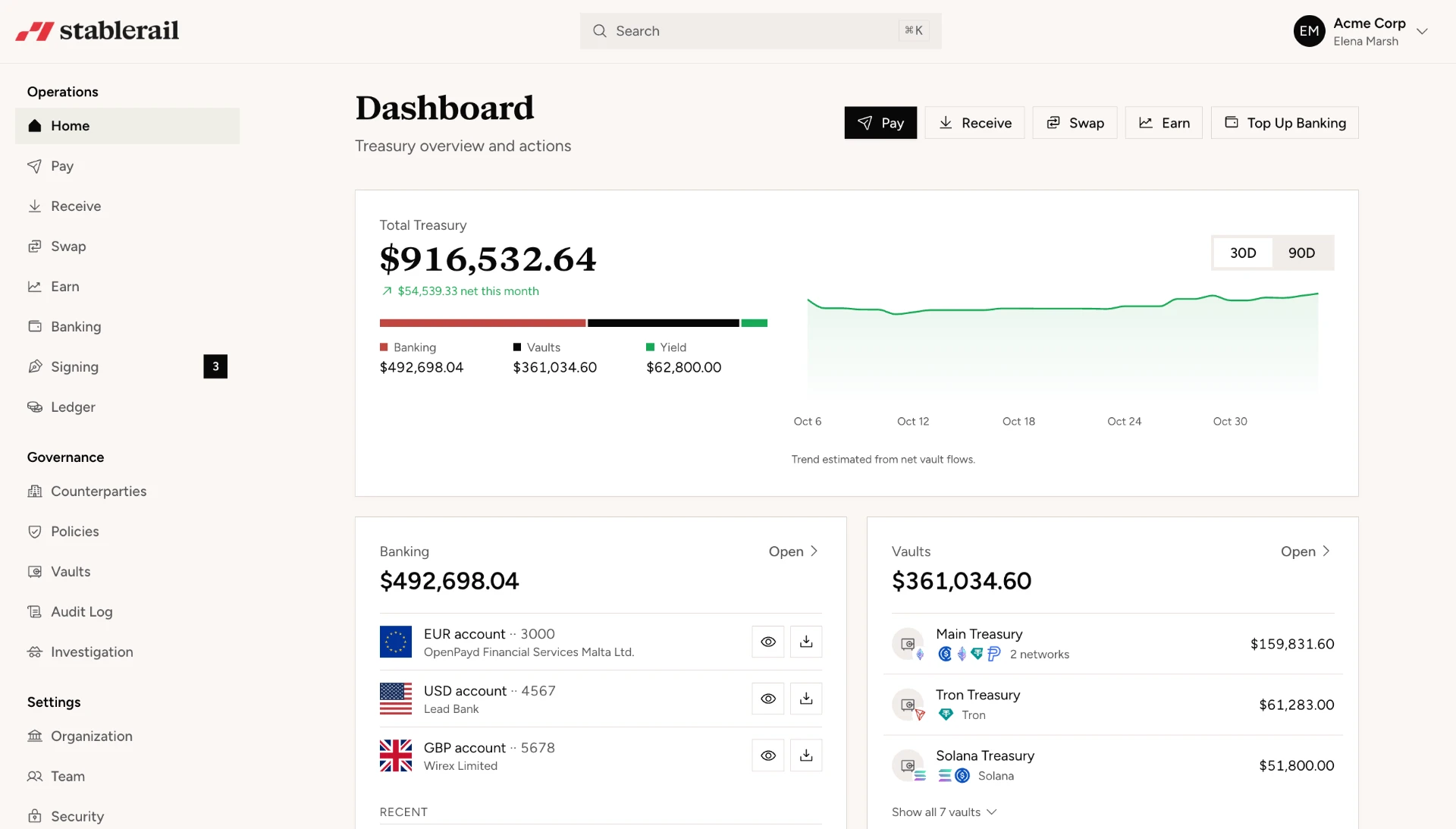
For example, Stablerail is designed for companies managing their own USDC and USDT treasury funds. Its supported operating capabilities include approvals and signing quorum, sanctions and address screening before send, fiat conversion, global payouts, corporate cards and exportable audit evidence.
Run scenario tests instead of relying on a demonstration
- Unavailable approver: Submit an urgent payment when one required signer cannot act and verify the documented escalation path.
- Invalid batch item: Include one incorrect bank or wallet destination and observe whether the entire batch or only that item stops.
- Changed destination: Edit a beneficiary account or wallet after approval and confirm that prior authorization is invalidated.
- Wrong network: Attempt to pair a supported token with an incompatible destination network and verify that execution is blocked.
- Returned or failed payment: Confirm how status, balances, fees and accounting exports are corrected.
Check automation without weakening review
Useful workflow automation removes repetitive handling while preserving human oversight. A finance team should be able to upload a payment batch, validate required fields, identify duplicate instructions, route it for approval and export completed results with consistent references.
Automation should also manage partial failure. If one payment in a batch is rejected, finance needs to know whether the valid items continue, how the failed item is resubmitted and whether a new approval is required. Simply labeling a batch “failed” is not enough for reconciliation.
Corporate cards provide another adaptability test. Card spending should fit treasury funding, approval and reporting processes rather than create an isolated balance. Finance should examine cardholder limits, merchant category restrictions, transaction evidence, card suspension and how refunds or disputed transactions appear in exports.
Inspect reconciliation and audit evidence before purchase
Request sample reports during evaluation. A platform may execute payments efficiently but still create substantial month-end work if its exports omit the details needed to match bank, blockchain and general-ledger records.
Each record should identify the initiating entity, source and destination, amount, asset, status, timestamps, reference and approvers. Stablecoin records should also include the token, network, wallet addresses and transaction hash. Fiat records should contain the available bank reference and enough status detail to distinguish submission from settlement.
Charges should not disappear into net amounts. Reports should separate principal from identifiable conversion, banking, platform and network costs. Finance should also test duplicate file submission, amended payments, returned funds, refunds and status changes. Exception records are often more revealing than successful transactions.
Use a change test before committing
A feature checklist describes the platform today; a change test shows whether it can support the company tomorrow. Model realistic additions such as a new operating entity, another settlement currency, a contractor group moving from bank payments to USDC, or a new card programme.
Then identify what must change in onboarding, eligibility, roles, approvals, accounting mappings and reporting. New entities and markets may require additional know-your-business review, while new stablecoin networks require address and operational testing. Adaptability means these changes can enter a consistent operating model, not that every change is automatic.
Finance team decision checklist
- Document required currencies, tokens, networks, countries and payment types.
- Map ownership and control for every fiat balance and stablecoin wallet.
- Test conversion quotes, charges and settlement destinations using representative transactions.
- Run approval, batch-failure, destination-change and signer-unavailability scenarios.
- Reconcile sample successful, failed and returned transactions from exported data.
- Model one future entity, currency or payout method before signing.
The best platform is not necessarily the one with the longest feature list. It is the one that lets treasury change currencies, rails and payment methods while retaining visible costs, appropriate approvals, controlled execution and evidence that finance can reconcile.
Frequently asked questions
What is a fiat and stablecoin treasury platform?
It is a system for managing conventional currency and stablecoins within a coordinated treasury workflow. The strongest platforms connect conversion, payments, approvals, screening and reporting rather than merely displaying bank and wallet balances together.
How should a CFO compare stablecoin treasury platforms?
Compare the exact USDC and USDT network combinations, custody or signing structure, approval controls, pre-send address screening, conversion process and accounting exports. Test failed transactions and changed wallet addresses as well as successful payments.
Can one treasury platform manage fiat and stablecoin payments?
Yes, but shared visibility does not guarantee shared controls or reconciliation. Verify that fiat transfers, stablecoin transactions, conversions, batches and cards use consistent approval principles and produce compatible audit evidence.
What information is needed to reconcile a stablecoin payment?
Finance generally needs the amount, token, network, source and destination addresses, transaction hash, timestamps, status, approvers and related fees. Internal invoice, vendor or batch references are also needed to connect the blockchain transaction to the accounting record.
Why does the blockchain network matter when sending USDC or USDT?
The token and network must be supported by both the sender and recipient. Selecting the wrong network or an incompatible address can delay access to funds or make recovery difficult, even when the token name is correct.
Finance writers covering stablecoin treasury, payments, compliance, and risk controls.
More about the Stablerail team- Stablecoin treasury managementApprovals, limits, yield and reporting on one balance.
- Stablecoin payoutsBatch contractor and vendor payments with screening.
- USDT vs USDCWhich stablecoin your company should settle in.
- Stablecoin finance glossaryMPC, off-ramp, travel rule and the rest, in plain English.
- Product updatesEverything we ship, month by month.