
Agent-Led Treasury: Where AI Can Act and Where Finance Should Stay in Control
A practical operating model for using AI to monitor balances, prepare transfers and reconcile transactions—without giving up human control over corporate funds.

Agent-led treasury is an operating model in which software agents monitor accounts, identify required actions and prepare transactions for execution. An agent might flag that a USDC balance is below target, propose moving USD through Fedwire, assemble a contractor payment batch or match an on-chain transfer to an invoice.
The important distinction is between preparing an action and authorising the movement of corporate funds. AI can remove substantial manual work from treasury operations without receiving unrestricted authority to send money. For most finance teams, the practical model is automated monitoring and preparation combined with policy-based approval workflows and human signing.
What an agent-led workflow looks like
A treasury agent can observe fiat accounts, stablecoin wallets, expected receipts, payment obligations and internal policies. It then turns those inputs into proposed actions. A typical daily cycle could include:
- Reading USD, EUR and GBP balances alongside USDC and USDT holdings.
- Comparing balances with minimum operating thresholds and upcoming liabilities.
- Identifying invoices, payroll or contractor payments due within a defined period.
- Preparing a fiat transfer, stablecoin conversion or payout batch.
- Checking beneficiaries against allowlists and screening results.
- Routing the proposed transaction to the required approvers.
- Matching completed transfers with invoices, ledger entries and transaction identifiers.
- Escalating exceptions such as an unknown wallet, duplicate invoice or unexpected fee.
For example, an agent might detect that a company needs 250,000 USDC on Base for Friday’s vendor run but holds only 190,000 USDC on that network. It could propose converting USD, estimate the amount required after known fees, select the intended network and prepare the payout batch. Finance would then review the funding source, rate, recipients and total before signing.
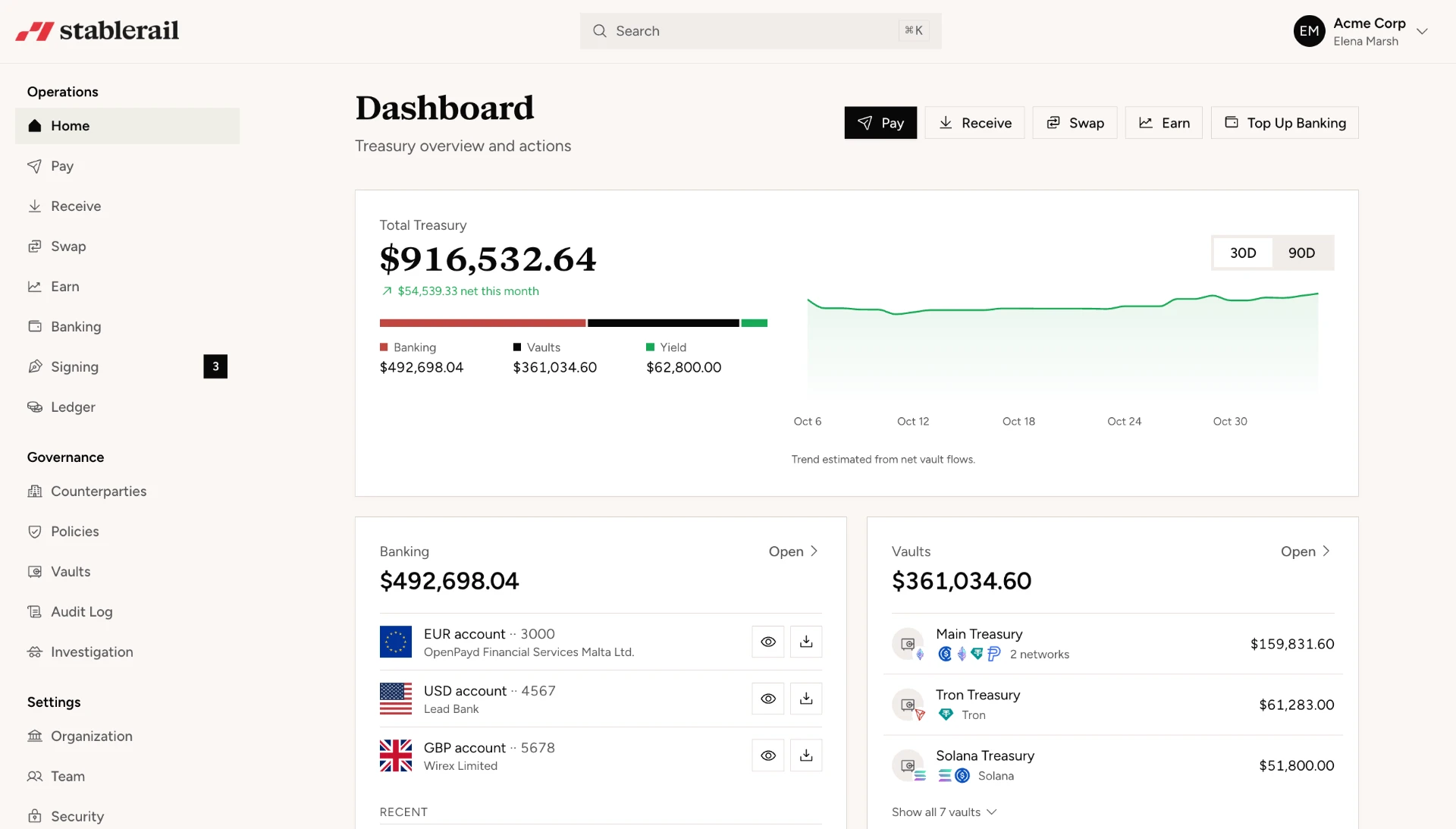
This model can sit across Stablerail’s fiat balances and payment rails, stablecoin vaults, on/off-ramps and stablecoin payout workflows. The agent coordinates the work; account permissions and vault signing rules determine what can actually execute.
Where AI automation is useful
Balance monitoring and forecasting
Agents are well suited to repetitive observation. They can check balances continuously, calculate runway and alert finance when a threshold is breached. Unlike a fixed alert, an agent can incorporate expected receipts, payroll dates, invoice due dates and settlement timing.
Thresholds should still be explicit. A policy might require at least five business days of payroll in fiat, limit the amount held on any one blockchain and trigger a funding proposal when a payout wallet falls below a stated level. These are management decisions translated into rules, not decisions the agent should invent.
Preparing transfers and conversions
An agent can prepare the details of an on/off-ramp transaction between fiat and USDC or USDT. It can identify the source account, destination vault, currency, network and expected amount. It can also compare a published corridor price with an internal tolerance before sending the proposal for approval.
Rail selection can be automated within policy. SEPA Instant may be appropriate for an eligible urgent EUR transfer, while regular SEPA may suit a non-urgent payment. USD funding might use ACH for lower urgency or Fedwire where same-day bank settlement is required. Availability, bank cut-off times, holidays, beneficiary eligibility and transaction limits still need to be checked at execution.
Payout preparation
For batch vendor payments, payroll and invoices, an agent can validate file structure, remove exact duplicates, identify missing wallet networks and group payments by asset and chain. Stablerail supports payouts across Ethereum, Base, Arbitrum, Polygon, Tron, BNB Chain, Optimism and Solana.
The agent should not infer a network from an address when the result is ambiguous. USDC sent on the wrong supported network may not arrive in the recipient’s expected wallet. Recipient, asset and network should be captured as separate payment instructions and confirmed before release. See the crypto payroll workflow for related payout considerations.
Routine reconciliation
Reconciliation is another strong use case for AI automation. An agent can match bank references, blockchain transaction hashes, invoice numbers, beneficiary details and expected amounts. High-confidence matches can be posted automatically if finance policy permits. Partial payments, unexplained differences and many-to-one matches should move to an exception queue.
What should remain under human control
| Activity | Agent role | Recommended control |
|---|---|---|
| Monitor balances | Act automatically | Finance defines thresholds and data sources |
| Draft transfers | Prepare automatically | Human reviews destination, amount, asset and network |
| Release low-risk recurring payments | Only within an approved policy | Use allowlists, limits and quorum requirements |
| Add or change a beneficiary | Collect and validate information | Independent human approval |
| Large or unusual fund movement | Explain and escalate | Mandatory multi-person approval |
| Change approval rules | Recommend changes | Authorised administrators approve and record them |
| Resolve reconciliation exceptions | Suggest a match | Human decides when evidence is incomplete |
Movement of corporate funds deserves the clearest boundary. An AI agent should not have unilateral power to change a beneficiary and release a payment to that beneficiary. It should also not be able to raise its own limit, modify an allowlist or weaken the approval policy that governs its actions.
With a self-custodial MPC vault, signing authority is distributed rather than concentrated in one private key. Quorum signing can require more than one authorised approval before a stablecoin transaction is executed. The agent can create the transaction request, but the vault policy should determine who signs it.
Design approval workflows around risk
Requiring CFO approval for every transaction defeats much of the benefit of automation. A better approach is to assign approval requirements according to payment risk. Factors can include value, beneficiary status, asset, network, urgency and whether the transaction matches prior behaviour.
An illustrative policy could allow an agent to prepare all payments, route established-beneficiary payments below a defined limit to one approver, and require two approvers for larger amounts. First-time beneficiaries, changed wallet addresses and transactions outside normal operating hours could always require enhanced review. The actual limits should reflect the company’s liquidity, loss tolerance and delegation policy.
Risk controls should be enforced by the treasury system rather than left inside an AI prompt. Useful controls include:
- Per-transaction and daily approval limits.
- Beneficiary and wallet allowlists.
- Sanctions and wallet screening before execution.
- Separation between beneficiary creation and payment approval.
- Quorum signing for stablecoin vaults.
- Immutable audit logs covering proposals, edits, approvals and execution.
- Evidence packs containing invoices, screening results and transaction records.
Measure the agent by exceptions, not conversation quality
An agent can sound confident and still prepare the wrong transaction. Finance teams should assess operational results: proposal accuracy, duplicate detection, reconciliation match rate, exception volume, approval turnaround and the number of transactions stopped by policy.
Start in observation mode, where the agent makes recommendations but cannot create executable instructions. Next, allow it to prepare drafts for human review. Only after measured performance should the company consider limited execution for repetitive, low-risk activity under fixed limits.
Agent-led treasury should make routine work faster while preserving clear accountability. AI can watch, calculate, organise and propose. Finance should continue to define policy, approve material movements, control signing authority and resolve ambiguity. That division provides useful automation without treating corporate funds as an AI experiment.
Finance writers covering stablecoin treasury, payments, compliance, and risk controls.
More about the Stablerail team- Stablecoin treasury managementApprovals, limits, yield and reporting on one balance.
- Stablecoin payoutsBatch contractor and vendor payments with screening.
- USDT vs USDCWhich stablecoin your company should settle in.
- Stablecoin finance glossaryMPC, off-ramp, travel rule and the rest, in plain English.
- Product updatesEverything we ship, month by month.