
How to Compare Stablecoin Orchestration Platforms for Corporate Treasury
A practical framework for comparing stablecoin orchestration platforms across custody, fiat rails, USDC and USDT networks, approvals, payouts, reporting and cost.
Compare stablecoin orchestration platforms against your company’s actual money flows, not a generic feature list. Confirm the operating model, legal account ownership, custody and signing structure, fiat rails, exact USDC and USDT network combinations, conversion costs, payout workflows, approval controls and audit exports. Then run a controlled transaction from fiat receipt through conversion, payment and reconciliation before choosing a provider.

Start with the operating model, not the feature list
Stablecoin orchestration platforms connect functions that finance teams would otherwise manage separately: fiat accounts, USDC and USDT wallets, conversions, blockchain transfers, payouts, cards, approvals and reconciliation. The category is broad, however, and similar marketing language can describe materially different products.
A corporate treasury platform is designed for a company managing its own funds. An infrastructure provider supplies APIs and wallet components to developers building a financial product for customers. A hybrid may support both use cases. None is inherently better, but selecting the wrong model can leave finance dependent on engineering for approvals, exception handling and reporting.
| Operating model | Primary user | Typical strengths | Potential treasury gap |
|---|---|---|---|
| Corporate treasury platform | CFO, controller or treasury operations | Balances, approvals, payouts, statements and audit evidence | May offer less flexibility for building customer-facing products |
| Infrastructure platform | Engineering and product teams | APIs for wallets, transfers, conversions and embedded payments | Finance workflows may need to be built internally |
| Hybrid platform | Finance and engineering | Operational interface plus integration tools | Confirm which features are available without custom development |
Ask who legally owns each fiat account, who controls each wallet and whose funds the provider is designed to handle. Also establish which entity contracts with your company and which banks, custodians, exchanges or liquidity providers participate in the flow.
Map the required money flows
Document requirements before requesting demonstrations. List each legal entity, funding currency, payment currency, country, beneficiary type, stablecoin, blockchain network and expected transaction size. Separate essential routes from future possibilities.
For example, “support for USDC” is not a complete requirement. A useful route might be: receive EUR by SEPA, convert EUR to USDC, send USDC on Base to a named vendor, and export the transaction with its exchange rate, fee, approval record and blockchain hash.
Compare fiat accounts and payment rails
Currency support does not necessarily mean that a company receives local account details or can make payments over every relevant rail. Confirm whether accounts are named for your company, virtual, pooled or provided through a banking partner. Ask separately about inbound and outbound support.
| Rail | Normal settlement pattern | Questions to verify |
|---|---|---|
| SEPA | Generally processed on business days | Are incoming and outgoing EUR payments supported, and which entity provides the account? |
| SEPA Instant | Near real time when participating institutions and limits permit | Is it available continuously, and are per-payment limits applied? |
| ACH | Same-day or standard processing, depending on the service | Are credits, debits or both supported? What are the return procedures? |
| Fedwire | Same-day processing during operating hours | What are the cut-off time, incoming fee and beneficiary requirements? |
| SWIFT | Timing varies with banks and route | Which intermediary charges can arise, and can payment status be traced? |
| Faster Payments | Usually near real time | What GBP limits and beneficiary checks apply? |
These are scheme-level patterns rather than provider guarantees. Bank holidays, cut-offs, intermediary banks, onboarding restrictions and compliance reviews can change availability or timing. Test the routes your company will actually use.
Understand custody, signing and recovery
Custody determines who can authorize movement of the stablecoins. In a custodial arrangement, a provider or custodian controls the keys and executes the company’s instructions. In a self-custodial arrangement, the company retains signing authority. Some structures distribute signing authority among multiple parties.
Multi-party computation can divide cryptographic signing across participants so that one device does not hold a complete private key. Quorum signing requires a defined number of authorized signers. These mechanisms do not automatically create a sound control environment; finance still needs clear roles, approval thresholds, access reviews and recovery procedures.
- Who can create, approve and sign a transaction?
- Can one person change beneficiaries and release payment?
- What quorum applies, and how are signers replaced?
- What happens if a signer loses access or leaves the company?
- Can wallets be recovered or migrated without the provider?
- Who supplies network fees, and from which balance?
Request a diagram showing legal ownership, asset custody, signing authority and the path taken by both fiat and stablecoins. Review that diagram with legal, security, finance and accounting stakeholders.
Verify every token and network combination
Treat every stablecoin-network pairing as a distinct payment route. A platform may support USDC on Ethereum but not on Solana, or USDT on Tron but not on another network. Deposit support also does not guarantee withdrawal, conversion or payout support on the same chain.
Confirm the official token contract, supported transaction direction, minimums, maximums and required network-fee asset. Ask how the platform handles an unsupported chain, an incorrect contract, delayed blockchain confirmation or a deposit below its minimum. Network cost matters, but recipient compatibility matters more: the beneficiary’s wallet, exchange or off-ramp must accept the exact token on the selected network.
Compare conversion by all-in outcome
For each corridor, request an executable quote or a complete cost illustration at representative transaction sizes. The comparison should include the exchange rate, spread or markup, platform fee, bank charge, blockchain fee and any minimum charge. A low advertised percentage can be outweighed by fixed costs, minimums or a weaker exchange rate.
Ask whether the rate is fixed before approval, how long the quote remains valid and whether approval delays cause requoting. Confirm order limits, settlement timing, available liquidity and what happens if only part of a conversion can be completed. Compare the final amount delivered, not just one line item.
Test payouts as an operating workflow
A blockchain send button is not a complete payout process. Finance teams may require saved beneficiaries, batch uploads, payment references, approval routing, duplicate detection, status tracking and exception handling. Determine whether one failed item blocks a batch or can be corrected separately.
Test invalid wallet addresses, unsupported networks, insufficient network fees, expired conversion quotes and returned fiat transfers. For each exception, identify who is notified, who can repair it and what appears in the audit record. If payroll or contractor payments are involved, confirm how employee or vendor details, payment statements and jurisdictional obligations are handled outside the transfer itself.
Inspect controls and audit evidence
Core treasury controls should separate initiation from approval and signing. Evaluate role-based access, approval thresholds, signing quorum, beneficiary controls, sanctions or address screening and the treatment of unusual transactions. Screening should occur before funds are sent, with a documented process for reviewing alerts.
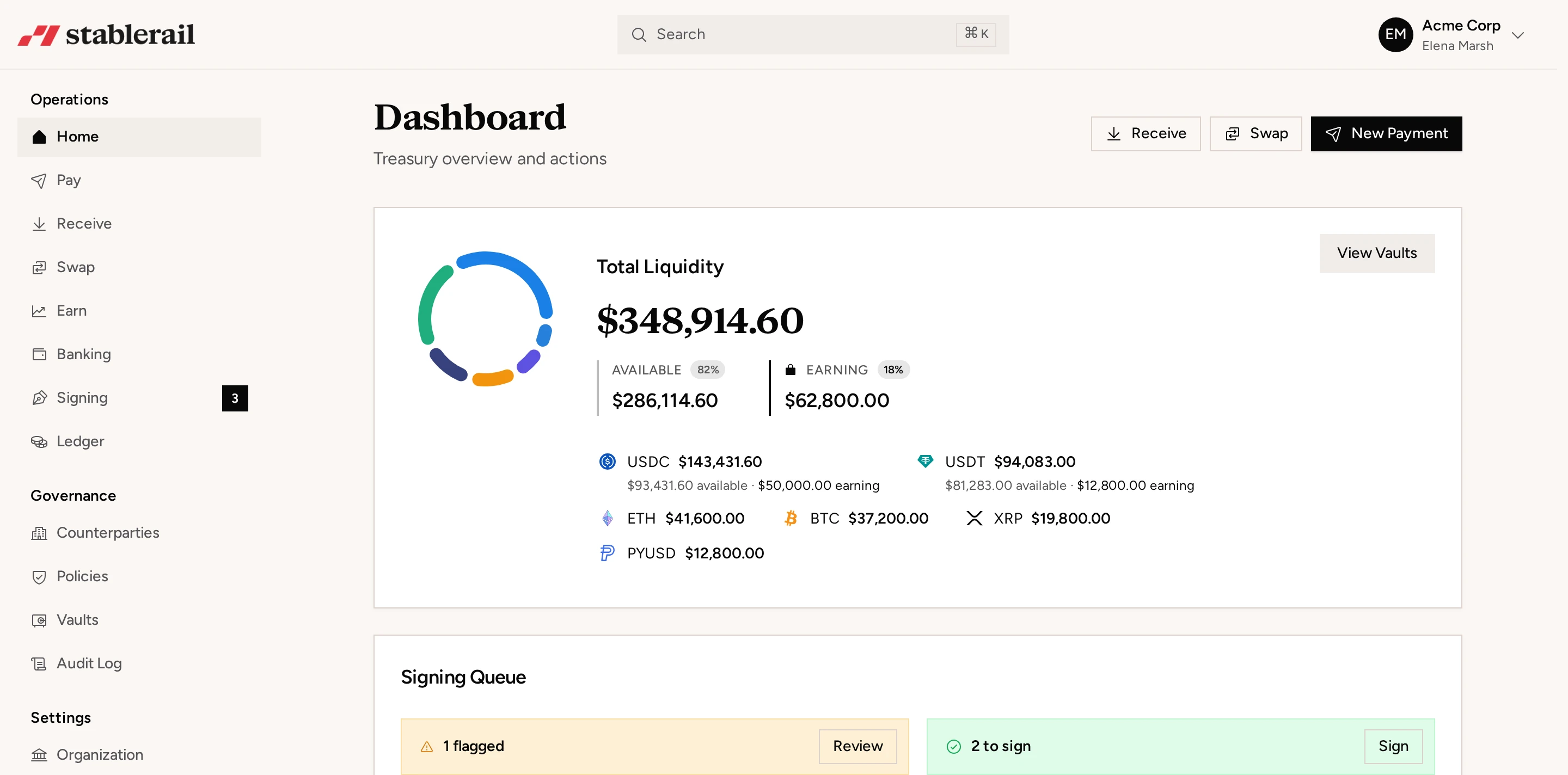
Stablerail, for example, is designed for companies managing their own USDC and USDT treasury and includes approvals and signing quorum, sanctions and address screening before send, fiat conversion and exportable audit evidence. It also supports global payouts and corporate cards. Regardless of provider, test whether the evidence is sufficient for your own auditors and control owners.
Reconcile one complete transaction lifecycle
Exports should connect the economic event to its operational approvals and settlement records. Look for timestamps, fiat and token amounts, exchange rates, fees, transaction hashes, counterparties, references, status changes and approval history. A common transaction identifier across the fiat, conversion and blockchain legs reduces manual matching.
- Receive fiat into the designated account.
- Convert it into the required USDC or USDT route.
- Create and approve a payment using normal role separation.
- Verify the recipient amount and blockchain transaction.
- Export all records and reconcile the closing balances.
- Repeat with a failed or rejected transaction to test exception evidence.
If completing this sequence requires manually combining several reports, include that recurring work in the cost assessment.
Build a total-cost and fit scorecard
Model costs using expected monthly activity rather than headline pricing. Include subscriptions, account fees, conversion spreads, banking charges, payout fees, blockchain gas, card charges, failed-payment costs, implementation work and ongoing reconciliation effort.
| Decision area | Evidence to request | Reason to reject |
|---|---|---|
| Operating fit | Live finance workflow without custom development | Routine treasury tasks depend on engineers |
| Coverage | Written confirmation for each currency, rail, token and network | A required route is only planned or partially supported |
| Control design | Role, approval, signing and recovery demonstration | One user can create and release material payments |
| Reconciliation | Sample exports from an end-to-end transaction | Fiat and blockchain records cannot be linked reliably |
| Economics | All-in delivered amount at representative sizes | Fees or exchange rates cannot be established before execution |
| Onboarding | Entity eligibility and complete KYB document list | Your jurisdiction, industry or expected activity is unsupported |
KYB commonly requires incorporation records, ownership and director information, business activity, expected volumes and source-of-funds evidence. Obtain the document list early, but do not mistake onboarding acceptance for permanent route availability. Banking partners, token support and geographic coverage can change.
The strongest selection process combines written route confirmation, legal and custody review, a control walkthrough, representative pricing and an end-to-end reconciliation test. That produces a defensible decision based on how the platform will operate, rather than how many features appear on its website.
Frequently asked questions
What is a stablecoin orchestration platform?
A stablecoin orchestration platform connects fiat accounts, stablecoin wallets, conversions, blockchain transfers, payouts and operational controls. For corporate treasury, it should also support approvals, reconciliation and evidence showing how company funds were authorized and moved.
How do treasury platforms differ from stablecoin infrastructure APIs?
Treasury platforms give finance teams an operating interface for managing the company’s own money. Infrastructure APIs are generally intended for developers embedding wallets or payments into another product, so approval workflows, reporting and exception handling may require custom development.
What should a CFO check before choosing a USDC or USDT platform?
Check legal account ownership, custody, signing authority, exact token-network support, fiat rails, conversion economics, approval controls and audit exports. The finance team should also complete and reconcile a representative transaction before committing.
How should stablecoin platform costs be compared?
Compare the final amount delivered for representative transactions. Include the exchange-rate spread, platform and account fees, banking charges, blockchain fees, minimum charges, failed-payment costs and the internal effort required for integration and reconciliation.
Is support for USDC or USDT enough to confirm compatibility?
No. Each stablecoin and blockchain combination is a separate route, and deposit, withdrawal, conversion and payout support may differ. Confirm the exact token contract, network, transaction direction, limits and recipient compatibility.
Finance writers covering stablecoin treasury, payments, compliance, and risk controls.
More about the Stablerail team- Stablecoin treasury managementApprovals, limits, yield and reporting on one balance.
- Stablecoin payoutsBatch contractor and vendor payments with screening.
- USDT vs USDCWhich stablecoin your company should settle in.
- Stablecoin finance glossaryMPC, off-ramp, travel rule and the rest, in plain English.
- Product updatesEverything we ship, month by month.