
Best Stablecoin Treasury Platforms for CFOs: Features and Trade-Offs
A CFO’s guide to comparing stablecoin treasury platforms across custody, fiat rails, conversion costs, approvals, payouts, reporting and implementation risk.
The best stablecoin treasury platform is the one that matches your company’s custody policy, payment corridors, approval structure and accounting process—not the one with the most features. CFOs should compare platform models, legal control of funds, USDC and USDT network support, all-in conversion costs, transaction approvals, sanctions screening, payout operations and exportable audit evidence. Verify eligibility first, then run a controlled end-to-end transaction before committing.

The best stablecoin treasury platform is the one that can move company funds through the complete treasury cycle with clear control and evidence. It should support the required fiat and stablecoin corridors, enforce the company’s approval structure, screen transactions before execution and produce records that finance can reconcile. Jurisdictional eligibility, custody structure and recovery procedures should be tested before secondary features such as cards are considered.
Start with the right platform model
Stablecoin treasury products generally fall into four models. Some providers overlap categories, but the underlying model still determines who controls assets, how payments are approved and whether finance teams need additional systems.
| Platform model | Usually strongest at | Main trade-off to examine | Best fit |
|---|---|---|---|
| Crypto exchange | Trading liquidity and asset conversion | Corporate approvals, payment workflows and audit exports may be limited | Companies primarily buying, selling or hedging digital assets |
| Payments infrastructure provider | Embedding stablecoin collections or payouts into a product | May require engineering resources and may not offer a complete treasury interface | Companies building stablecoin functionality for their own users |
| Institutional custody platform | Wallet security, transaction governance and asset safekeeping | Fiat accounts, conversion, cards and operational payouts may require separate providers | Treasuries prioritising asset control and wallet governance |
| Integrated corporate treasury platform | Combining stablecoins, approvals, fiat conversion, payouts and reporting | Coverage depends on jurisdiction, banking partners, currencies and payment corridors | Finance teams managing their company’s own operating funds |
A company that only needs to acquire USDC once a month may be adequately served by an exchange plus a controlled wallet. A company making frequent international payments will usually place more value on approvals, beneficiary management, status tracking and reconciliation. Define the operating model before comparing feature lists.
Confirm eligibility before evaluating features
Begin with a know-your-business pre-screen rather than a lengthy product demonstration. Give each provider the incorporation country, operating locations, industry, ownership structure, source of funds, expected transaction volume and intended use of USDC or USDT.
Ask which legal entity will contract with the company and which entity provides each material service. Fiat accounts, stablecoin custody, conversion and cards may be delivered by different providers even when they appear in one interface. Eligibility can also differ by currency, destination country and payment type.
Finance should obtain written confirmation of relevant restrictions. A platform-level approval does not necessarily mean every desired banking rail, blockchain network or payout corridor is available.
Understand custody and transaction authority
“Business account” is not a precise description of how funds are held. For fiat balances, determine whether an account is issued in the company’s name, whether balances are pooled and which institution legally holds the money. For stablecoins, establish who controls the signing process and what happens if the platform, a signer or a service provider becomes unavailable.
In a custodial structure, the provider generally controls the private keys and executes approved withdrawal requests. In a self-custodial structure, the company retains transaction authority, but it also assumes greater responsibility for signer access, recovery and operational security. Technologies such as multi-party computation can distribute signing authority, but the implementation and recovery process matter more than the label.
Ask providers to demonstrate the following controls rather than confirming them through a questionnaire alone:
- Creation, removal and replacement of authorised users
- Approval and signing quorum for a realistic transaction
- Recovery when a signer loses access or leaves the company
- Separation between payment preparation and final approval
- Restrictions on new recipients, assets and blockchain networks
- Emergency suspension and escalation procedures
Compare fiat rails and conversion by corridor
Headline currency coverage can conceal important operational differences. Supporting USD does not automatically mean a provider supports ACH, wire transfers and every international USD route. For each corridor, document the originating account, payment rail, beneficiary requirements, cut-off rules, expected settlement process and possible intermediary deductions.
Conversion should be assessed using the amount delivered, not a single advertised fee. Request a live or indicative quote for a representative transaction and record the benchmark rate, spread, service charge, bank fees, blockchain fee, quote expiry and final amount received. Repeat the test in both directions because fiat-to-stablecoin and stablecoin-to-fiat pricing may differ.
A useful comparison asks, “How much USDC reaches the approved wallet?” and “How much fiat reaches the company’s bank account?” It does not stop at the stated platform fee.
Also confirm when the company takes stablecoin price risk. A quoted conversion may be firm immediately, become firm only after fiat arrives or remain subject to review. Finance teams should know how rejected, delayed or partially completed conversions are handled.
Verify the exact stablecoin and network
USDC and USDT exist on multiple blockchain networks, and support for the asset does not imply support for every network or contract. Record the exact token contract and destination network for each workflow. Sending an otherwise valid stablecoin to an unsupported network can delay recovery or make it impossible.
Network selection also affects destination compatibility, transaction fees, confirmation time and operational risk. A low network fee is not useful if the recipient, exchange or off-ramp cannot accept that version of the token. Use approved address records that include the beneficiary, wallet address, network, token contract and evidence of verification.
Test approvals, screening and audit evidence
A consumer wallet or basic exchange login is insufficient for material company funds. The platform should support the company’s delegation-of-authority structure and preserve evidence of each decision. During evaluation, have a preparer create a payment, require the appropriate reviewers to approve it and then export the completed record.
The evidence should identify the requester, approvers, timestamps, destination address, asset, network, amount, fees and blockchain transaction hash. It should also show the result of any sanctions or address screening performed before the transaction was sent. Confirm whether later changes to user roles, beneficiary details or approval settings are recorded.
Export format matters. A polished dashboard does not replace data that accounting can retain and reconcile. Test whether exports contain stable identifiers for matching bank entries, conversion records, blockchain transactions, invoices and general-ledger postings.
Evaluate payouts as an operating process
Network coverage alone does not make a platform suitable for accounts payable. Review beneficiary onboarding, batch creation, approval routing, duplicate detection, status monitoring, failed-payment handling and downloadable reports. For recurring payments, determine whether templates reduce manual entry without allowing an operator to bypass approval.
Ask what happens when a recipient supplies the wrong network or address. Blockchain transfers are generally irreversible after confirmation, so beneficiary verification and approval controls must operate before sending. Finance should also establish who investigates a transaction that is confirmed on-chain but not credited by the recipient’s service provider.
Review cards separately from treasury transfers
Corporate cards solve a different problem from bank and blockchain payments. Compare virtual and physical availability, supported cardholder countries, settlement currency, foreign-exchange treatment, spending limits, merchant category restrictions, refunds and evidence available for reconciliation.
Determine whether card spending draws from fiat or stablecoins and whether conversion occurs at funding, authorisation or settlement. This affects both cost analysis and accounting. Card availability should not outweigh weaknesses in custody, approvals or core liquidity access.
Use a weighted CFO scorecard
| Category | Example weight | Evidence to request |
|---|---|---|
| Custody, signing and recovery | 20% | Control demonstration and documented recovery flow |
| Fiat rails and conversion | 20% | Corridor matrix and representative all-in quotes |
| Approvals and audit evidence | 15% | Completed workflow with exported records |
| Payout and network coverage | 15% | Supported asset-network pairs and failed-payment process |
| Reporting and reconciliation | 10% | Sample exports mapped to accounting requirements |
| Jurisdictional eligibility | 10% | Written confirmation for entities, currencies and corridors |
| Cards and other operating tools | 10% | Country coverage, controls and settlement explanation |
Adjust the weights to match actual activity. A company making hundreds of contractor payments may assign more weight to batch controls and reconciliation. A business holding a material stablecoin balance may prioritise custody, recovery and access to liquidity.
Run an end-to-end pilot before selection
A controlled pilot reveals problems that questionnaires miss. Finance teams should complete this checklist with a non-material test amount:
- Complete KYB and confirm the required entity, currency and corridor are eligible.
- Fund the account using the intended fiat or stablecoin route.
- Convert funds and calculate the all-in amount delivered.
- Create a recipient using the exact asset, contract and network.
- Execute the normal preparer, reviewer and signer workflow.
- Confirm screening occurs before the transaction is sent.
- Pay a controlled destination and verify receipt.
- Export evidence and reconcile the complete transaction chain.
- Test user removal, signer replacement and recovery procedures.
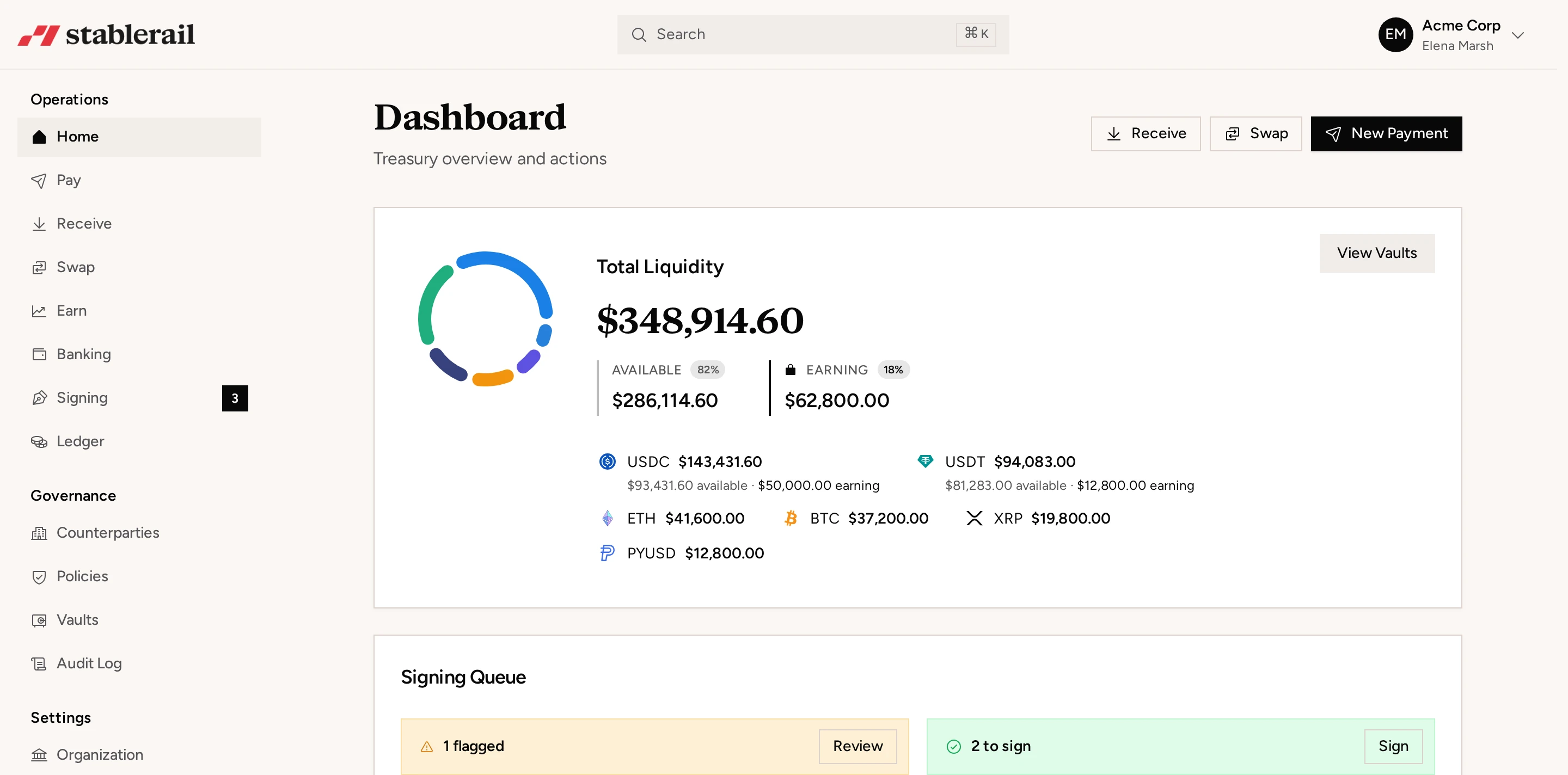
Stablerail is one integrated option for companies managing their own USDC or USDT. It combines approvals and signing quorum, sanctions and address screening before send, fiat conversion, global payouts, corporate cards and exportable audit evidence. As with any provider, availability should be confirmed for the company’s entity, currencies and intended corridors.
The final decision should be based on demonstrated control and operational fit. A shorter feature list with reliable funding, approvals, recovery and reconciliation is more valuable than broad coverage that finance cannot safely operate.
Frequently asked questions
What is a stablecoin treasury platform?
A stablecoin treasury platform helps a company receive, hold, convert and pay funds using stablecoins such as USDC or USDT. Corporate platforms may also provide approvals, signing controls, transaction screening, fiat conversion and records for accounting and audit.
How should a CFO compare stablecoin treasury platforms?
Compare custody and recovery, fiat corridors, all-in conversion costs, asset-network support, approvals, transaction screening, payouts and accounting exports. Confirm jurisdictional eligibility first, then test the complete workflow with a controlled transaction.
Should a company use a crypto exchange or a treasury platform for USDC?
An exchange may be suitable when the primary need is buying, selling or trading USDC. A treasury platform is generally a better operational fit when the company also needs structured approvals, recurring payments, beneficiary controls and exportable transaction evidence.
What records are needed to audit stablecoin payments?
Retain the requester and approvers, timestamps, beneficiary details, wallet address, asset, network, amount, fees and blockchain transaction hash. Finance should also preserve conversion records, screening results, invoices and a consistent identifier connecting the transaction to the general ledger.
What is the biggest risk when choosing a stablecoin treasury provider?
The largest risk depends on the operating model, but common failures include unclear custody, inadequate recovery, unsupported networks and weak approval evidence. Eligibility or banking coverage can also prevent a platform from supporting the required corridor even if its general feature list appears suitable.
Finance writers covering stablecoin treasury, payments, compliance, and risk controls.
More about the Stablerail team- Stablecoin treasury managementApprovals, limits, yield and reporting on one balance.
- Stablecoin payoutsBatch contractor and vendor payments with screening.
- USDT vs USDCWhich stablecoin your company should settle in.
- Stablecoin finance glossaryMPC, off-ramp, travel rule and the rest, in plain English.
- Product updatesEverything we ship, month by month.