
What Makes Onchain Data Audit-Grade for Corporate Treasury?
Learn how to turn wallet activity into audit-grade treasury records through complete wallet coverage, transaction attribution, consistent valuation, reconciliation and linked evidence.
Onchain data becomes audit-grade when it is complete, attributable, consistently valued and linked to approvals, business records and general-ledger entries. A transaction hash proves network activity, but not ownership, purpose or accounting treatment. Finance teams need a controlled wallet inventory, transaction-level source data, documented valuation and cut-off rules, balance roll-forwards, change history and reproducible evidence that connects each ledger entry to blockchain settlement.

A transaction hash is evidence, not the full audit trail
A blockchain explorer can show that an address transferred a token at a particular block. It cannot, by itself, establish that the address belonged to the company, explain why the payment was made, identify who approved it or show how the transaction entered the general ledger.
Audit-grade onchain data closes those gaps. A controller or auditor should be able to start with a balance-sheet account, move to the journal and treasury record, inspect the authorization and supporting document, and verify the resulting transaction on the relevant network. The same chain should work in reverse, from a transaction hash back to its business purpose and accounting treatment.
This requires controlled data collection rather than a one-time download from a block explorer. The process must cover all company wallets, networks, token contracts, native assets, fees and relevant transaction types for the reporting period.
The minimum record for an onchain transaction
Finance should preserve the raw network facts while adding operational and accounting context. Symbols alone are not reliable identifiers: tokens with the same or similar names can exist on multiple networks, and a single transaction can contain several transfer events.
| Record element | What it establishes | Control consideration |
|---|---|---|
| Transaction hash, network and block number | Where the activity can be independently verified | Record the network explicitly because a hash is not a universal identifier |
| From and to addresses | The addresses involved in the transaction | Link addresses to a controlled wallet inventory or documented counterparty record |
| Token contract, native asset and decimals | The specific asset and its unit of account | Do not rely only on a ticker such as USDC or USDT |
| Raw amount and display amount | The transferred quantity without losing precision | Retain the raw value and decimal convention used to calculate the readable amount |
| Transfer events and transaction status | What moved and whether execution succeeded | Distinguish the outer transaction from token events produced by contract execution |
| Network fee and fee asset | The cost of submitting or executing the transaction | Account for fees separately when paid in ETH, TRX, BNB, POL, SOL or another asset |
| Block time and confirmation status | When the network recorded the activity | Apply a documented finality and accounting cut-off convention |
| Business and accounting references | Why the transaction occurred and where it was posted | Link the payment request, invoice, journal ID, entity and reconciliation status |
Failed transactions and non-transfer activity may also matter. A failed transaction can consume a network fee, while token approvals, contract interactions, bridging steps and exchange deposits may affect risk or explain later movements even when they are not ordinary vendor payments.
Completeness begins with a controlled wallet inventory
A reconciliation cannot be complete if finance does not know which addresses and accounts the company controls. The wallet register should identify the owning legal entity, network, treasury purpose, custody arrangement, operating status, date added and expected accounting treatment.
Include primary treasury wallets, payout wallets, exchange and conversion accounts, deposit addresses, card-funding balances, on-ramp and off-ramp addresses, and legacy wallets that still hold assets or incur activity. Each network deployment should be recorded separately, even when the same address format or token symbol appears elsewhere.
Maintain external counterparties in a separate address book. A label such as “contractor payments” is useful operational metadata, but it is not an onchain fact. The record should preserve who created or changed the label, when it changed and which document or verification supported the attribution.
Separate source facts from finance enrichment
Blockchain data may be resistant to alteration after sufficient network finality, but internal labels and classifications are not made immutable merely because they point to a transaction. A durable data model separates three layers:
- Source layer: transaction hash, addresses, block data, token contract, transfer events, quantities, fees and execution status.
- Operational layer: wallet ownership, counterparty, payment purpose, request, approval history, screening result and supporting documents.
- Accounting layer: reporting-currency value, legal entity, account code, cost centre, journal reference and reconciliation status.
Corrections should leave a visible history. If finance changes a wallet label, reporting value or account code, the retained record should show the previous value, revised value, user, timestamp and reason. Silent overwrites make it difficult to reproduce a prior close or explain what an auditor originally reviewed.
Define timestamps, finality and valuation before period-end
An onchain payment can have initiation, approval, broadcast, block and confirmation times. A related fiat conversion may also have a trade time, settlement time and bank value date. Finance must document which event determines recognition and period cut-off for each transaction type.
For example, a policy may use confirmed block time for completed wallet transfers and bank value date for the fiat leg of an off-ramp. The appropriate treatment depends on the company’s accounting policy and transaction terms; the audit control is that the rule is defined, approved and applied consistently, particularly near month-end and year-end.
Stablecoins also require a documented valuation method. A holding of 100,000 USDC does not, without further analysis, prove a reporting value of exactly USD 100,000. The record should identify the reporting currency, approved price or foreign-exchange source, valuation timestamp, rate convention and treatment of fees, spreads and differences from the reference currency.
A EUR-functional entity, for example, generally needs both the token quantity and an approved USD-to-EUR translation under its accounting policy. The stored rate should be reproducible rather than copied into a journal without its source and timestamp.
Reconcile quantities before reconciling fiat values
For each wallet, network and asset, calculate a quantity roll-forward: opening balance plus inflows minus outflows minus fees paid in that asset equals closing balance. Then value the reconciled quantities according to the approved accounting method.
Do not combine assets solely because they share a ticker. USDT on Ethereum and USDT on Tron are distinct network-level balances with different transaction records and fee assets. Native network fees usually require their own roll-forward because the stablecoin transfer and its gas expense affect different assets.
Common exceptions need explicit handling:
- Internal transfers: Match the sending company wallet to the receiving company wallet so the movement is not classified as revenue or expense.
- Batch payouts: Preserve the relationship between the approved batch, each beneficiary and each resulting transfer event.
- Contract transactions: Retain both the parent transaction and the individual token events it generated.
- Conversions and off-ramps: Link the outgoing token, conversion record, fees and resulting fiat receipt rather than treating them as unrelated entries.
- Bridges: Connect the source-network outflow and destination-network receipt, including any fee or quantity difference.
Unmatched items should remain visible as exceptions. They should not disappear because a reviewer inserted an unsupported plug or aggregated several assets into a single fiat total.
Link authorization and screening to settlement
The evidence package should explain both control execution and financial outcome. Depending on the transaction, it may contain the payment request, invoice or payroll file, initiator, approvers, signing quorum, beneficiary verification, sanctions or address-screening result, transaction details, valuation support, journal ID and reconciliation sign-off.
Screening is not a substitute for transaction evidence. Its purpose is to show what address was checked, when the check occurred and what result the company considered before sending. The retained result must be linked to the exact beneficiary address rather than only to a counterparty name.
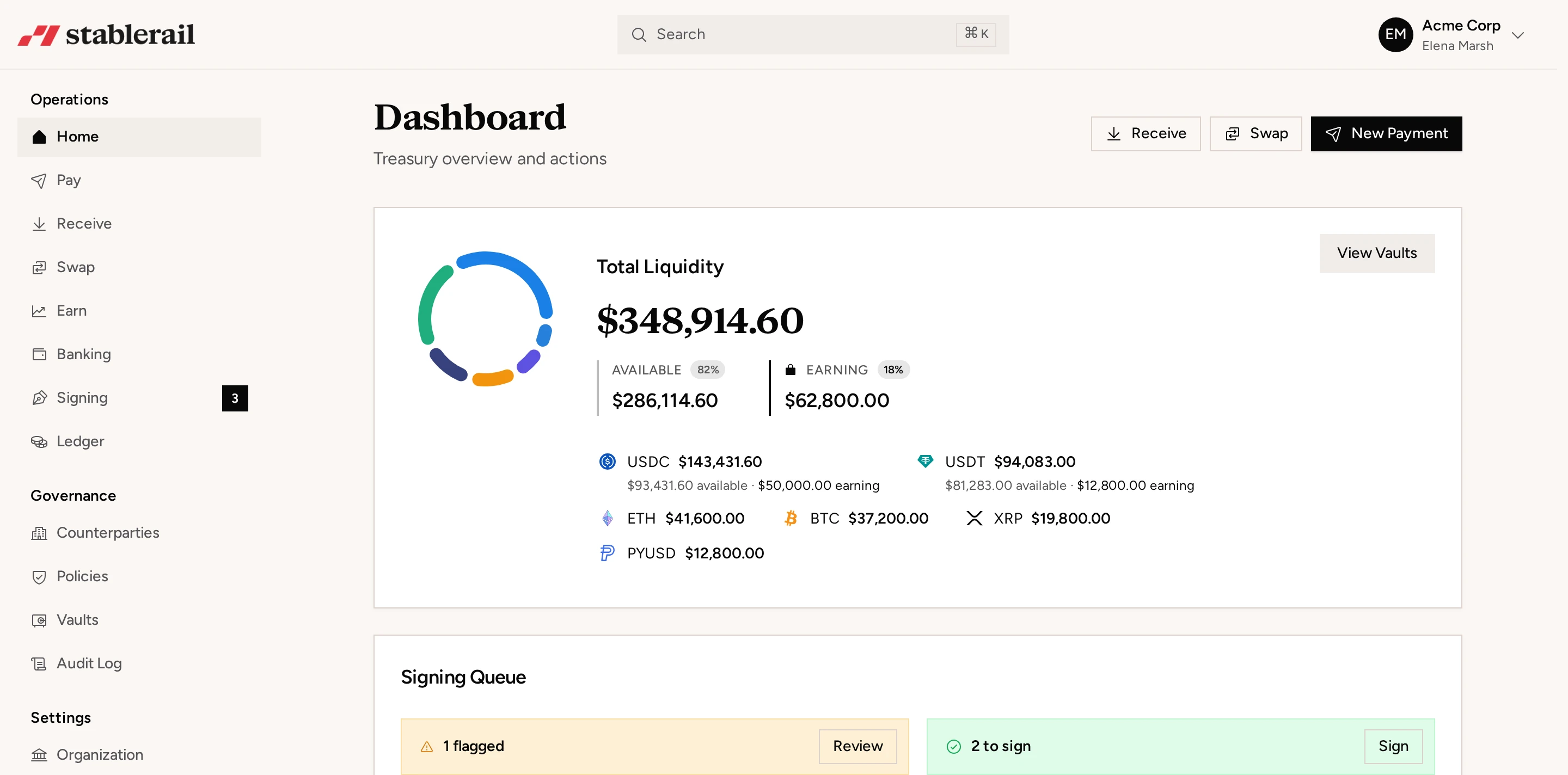
Stablerail can retain exportable audit evidence alongside approvals, signing quorum, pre-send sanctions and address screening, global payouts and fiat conversion activity for a company’s own USDC and USDT treasury. Regardless of system, the key requirement is a durable link among authorization, blockchain settlement and accounting.
Make every reporting package reproducible
Exports should contain transaction-level data in a format finance can retain and reprocess, with supporting evidence available alongside it. A reporting package should identify the period, time zone, included legal entities, wallet population, networks, tokens, report generation time, valuation convention and unresolved exceptions.
Reproducibility also means preserving the version reviewed at close. If metadata changes later, finance should still be able to reconstruct the prior report and explain subsequent adjustments.
Month-end audit-readiness checklist
- Confirm that the wallet register includes every active, legacy, exchange, conversion and funding address.
- Import all transactions, transfer events and fees for the period and investigate missing network coverage.
- Reconcile opening balances, movements and closing balances by wallet, network and asset.
- Match internal transfers, batches, conversions, bridges and fiat legs across both sides.
- Apply documented cut-off and valuation rules, retaining sources and timestamps.
- Link each material item to approvals, business support, screening evidence and its journal entry.
- Review unresolved exceptions, record sign-off and retain the exact export used for close.
The objective is not to force blockchain activity into a bank-statement format. It is to preserve the network-level detail while presenting a controlled treasury subledger that finance and auditors can follow. When completeness, attribution, valuation, reconciliation and evidence links are repeatable, onchain records become defensible accounting evidence rather than a collection of unexplained hashes.
Frequently asked questions
Is a blockchain transaction hash enough for an audit?
No. A hash can support verification that network activity occurred, but it does not prove wallet ownership, business purpose, authorization or accounting treatment. It should be linked to the company’s wallet register, approvals, supporting documents, valuation and journal entry.
How do you reconcile stablecoin wallets at month-end?
Reconcile opening balance plus inflows minus outflows and applicable fees to the closing balance for each wallet, network and asset. Match internal transfers on both sides, reconcile native fee assets separately and investigate every unexplained difference before applying fiat valuation.
What data should a stablecoin audit trail include?
Retain the network, transaction hash, block information, addresses, token contract, amount, decimals, transfer events, fees, status and timestamps. Add wallet ownership, counterparty, business purpose, approvals, screening evidence, valuation support, journal ID and reconciliation status.
How should stablecoins be valued for financial reporting?
Use a documented method consistent with the company’s accounting policy, including the reporting currency, approved price or FX source, valuation timestamp and rate convention. The process should also define how fees, spreads and differences from the stablecoin’s reference currency are treated.
How should internal transfers between company wallets be recorded?
Link the source-wallet outflow to the destination-wallet inflow and identify both addresses as belonging to the appropriate company entities. The movement should not be treated as external revenue or expense, although network fees and intercompany accounting may require separate entries.
Finance writers covering stablecoin treasury, payments, compliance, and risk controls.
More about the Stablerail team- Stablecoin treasury managementApprovals, limits, yield and reporting on one balance.
- Stablecoin payoutsBatch contractor and vendor payments with screening.
- USDT vs USDCWhich stablecoin your company should settle in.
- Stablecoin finance glossaryMPC, off-ramp, travel rule and the rest, in plain English.
- Product updatesEverything we ship, month by month.