
How to Choose a Business Account That Supports USDC and Fiat
Compare business accounts for holding, receiving, converting and sending USDC and fiat, including account details, payment rails, custody, fees, limits and reconciliation.

A business account that supports both USDC and fiat should let your finance team receive customer funds, pay suppliers, convert balances and reconcile every movement without relying on several disconnected providers.
The important distinction is that “supports USDC” can mean very different things. Some providers only let you buy or sell USDC. Others provide a full operating account with fiat account details, stablecoin wallets, payment rails and treasury controls. Before opening an account, confirm exactly how funds are held, which entities can use the service and what each transaction will cost.
Start with the transactions you need to make
Map the account against your real treasury flows rather than comparing feature lists in isolation. A typical business may need to:
- Receive EUR from customers through SEPA or SEPA Instant.
- Receive USD through ACH, Fedwire or SWIFT.
- Hold USDC on one or more blockchain networks.
- Convert fiat into USDC, or redeem USDC into fiat.
- Pay vendors in fiat, USDC or USDT.
- Move USDC between networks used by customers and suppliers.
- Export transaction data for accounting and month-end close.
Write down the currencies, countries, networks, monthly volumes and typical payment sizes involved. This exposes practical gaps early. For example, an account may support USD conversion but not provide dedicated USD receiving details, or accept USDC only on Ethereum when your suppliers use Base or Solana.
Check the fiat account structure
Good fiat accounts should provide clear receiving instructions and explain whether account details are dedicated to your company. For EUR, this may include a virtual IBAN. For USD or GBP, it may involve local account details or payment instructions assigned to your business.
Ask whether the beneficiary name shown to senders matches your company’s legal name. Also establish whether the account is legally held in your company’s name or whether funds are received through a safeguarded or pooled account with a unique reference. These structures are not equivalent, even if both produce dedicated-looking details.
The relevant rails depend on where counterparties bank:
| Currency | Common rails | Typical use | Timing to verify |
|---|---|---|---|
| EUR | SEPA, SEPA Instant | European collections and payouts | SEPA commonly one business day; SEPA Instant can arrive in seconds when supported |
| USD | ACH, Fedwire | US domestic receipts and payments | ACH may be same-day or take several business days; Fedwire is generally same business day before cutoff |
| GBP | Faster Payments, CHAPS, BACS | UK collections, payroll and suppliers | Faster Payments is usually near-real-time; CHAPS is same-day; BACS normally follows a three-business-day cycle |
| Multiple | SWIFT | Cross-border bank payments | Often one to five business days, depending on currencies and intermediary banks |
These are rail-level norms, not guaranteed delivery times. Cutoff times, weekends, beneficiary banks, intermediary banks and transaction reviews can all affect settlement.
Confirm how USDC is held and transferred
For stablecoins, check both the custody model and supported networks. In a custodial model, the provider controls the private keys. In a self-custodial model, your company controls transaction approval and signing.
Stablerail uses self-custodial MPC vaults with quorum signing. MPC, or multi-party computation, distributes the signing process so that no single person holds a complete private key. Quorum signing requires the configured number of approvers before a transfer can be executed.
Network support matters because USDC sent on one blockchain cannot simply be credited to an address intended for another. Relevant networks may include Ethereum, Base, Arbitrum, Polygon, Optimism, Solana and BNB Chain. If you also use USDT, Tron may be important. Verify token, network and contract support before sharing deposit instructions.
A useful USDC business account should show balances and transaction status by network rather than presenting every USDC balance as interchangeable.
Examine stablecoin conversion mechanics
Stablecoin conversion is not just a headline exchange rate. The total cost may include a conversion spread, platform fee, bank payment fee and blockchain network fee.
Before approving a provider, request a quote for representative transactions such as EUR 25,000 to USDC, USD 100,000 to USDC and USDC 50,000 to EUR. For each quote, check:
- The amount of fiat debited and USDC delivered.
- Whether the rate is fixed for a quoted period or calculated at execution.
- Any minimum or maximum conversion size.
- Blockchain fees and withdrawal fees.
- Settlement time and daily cutoff.
- Whether pricing changes by corridor, volume or payment rail.
Published corridor pricing makes comparisons easier, but confirm the final executable quote before sending funds. Also ask whether conversions settle directly into your treasury vault or require a separate withdrawal step.
Compare fees and limits using total cost
Do not compare accounts using only the monthly subscription. Build a monthly estimate based on your expected activity.
| Cost or limit | What to check |
|---|---|
| Account fee | Setup, monthly and additional-user charges |
| Fiat payments | Inbound and outbound fees by rail and currency |
| Conversion | Quoted spread, fixed fee and volume tiers |
| Blockchain transfers | Network fees, withdrawal fees and minimum amounts |
| Limits | Per-transaction, daily and monthly thresholds |
| Operational changes | Cost and timing for raising limits or adding currencies |
Limits should match peak activity, not just average monthly volume. Ask what documentation is needed to raise them and whether a large incoming payment can be pre-cleared.
Review eligibility before integration
Business account eligibility normally depends on the company’s jurisdiction, industry, ownership structure and expected transaction activity. KYB, or “know your business,” commonly requires incorporation documents, registered address evidence, director and beneficial owner information, and a description of source of funds.
Providers may also request recent bank statements, contracts, invoices, financial statements or wallet addresses. Restricted industries and unsupported countries should be disclosed before you spend time on technical integration. Ask whether subsidiaries need separate accounts and whether users must reside in eligible jurisdictions.
Make reconciliation part of the buying decision
An account is difficult to operate if finance cannot connect deposits, conversions and payouts to the underlying invoice or counterparty. Look for downloadable statements and transaction records containing:
- Unique transaction and payment references.
- Sender or beneficiary information.
- Gross amount, fee and net amount.
- Conversion rate and timestamp.
- Blockchain network and transaction hash.
- Status changes, approvals and rejection reasons.
Batch payouts should preserve an individual reference for each recipient. Audit logs should show who created, approved and executed a payment. Evidence packs can then combine payment records, approvals and screening results for auditors or internal review.
A practical selection checklist
Before choosing a provider, confirm the following in writing:
- Your required fiat currencies and local payment rails are available.
- Receiving details are dedicated and the legal account structure is clear.
- Your required USDC networks are supported for deposits and withdrawals.
- The custody and approval model fits your finance team.
- Conversion quotes disclose spreads, fees and settlement timing.
- Transaction and monthly limits cover peak volumes.
- Your jurisdiction and industry are eligible.
- Statements and exports contain enough detail for reconciliation.
- Sanctions and wallet screening are applied without obscuring payment status.
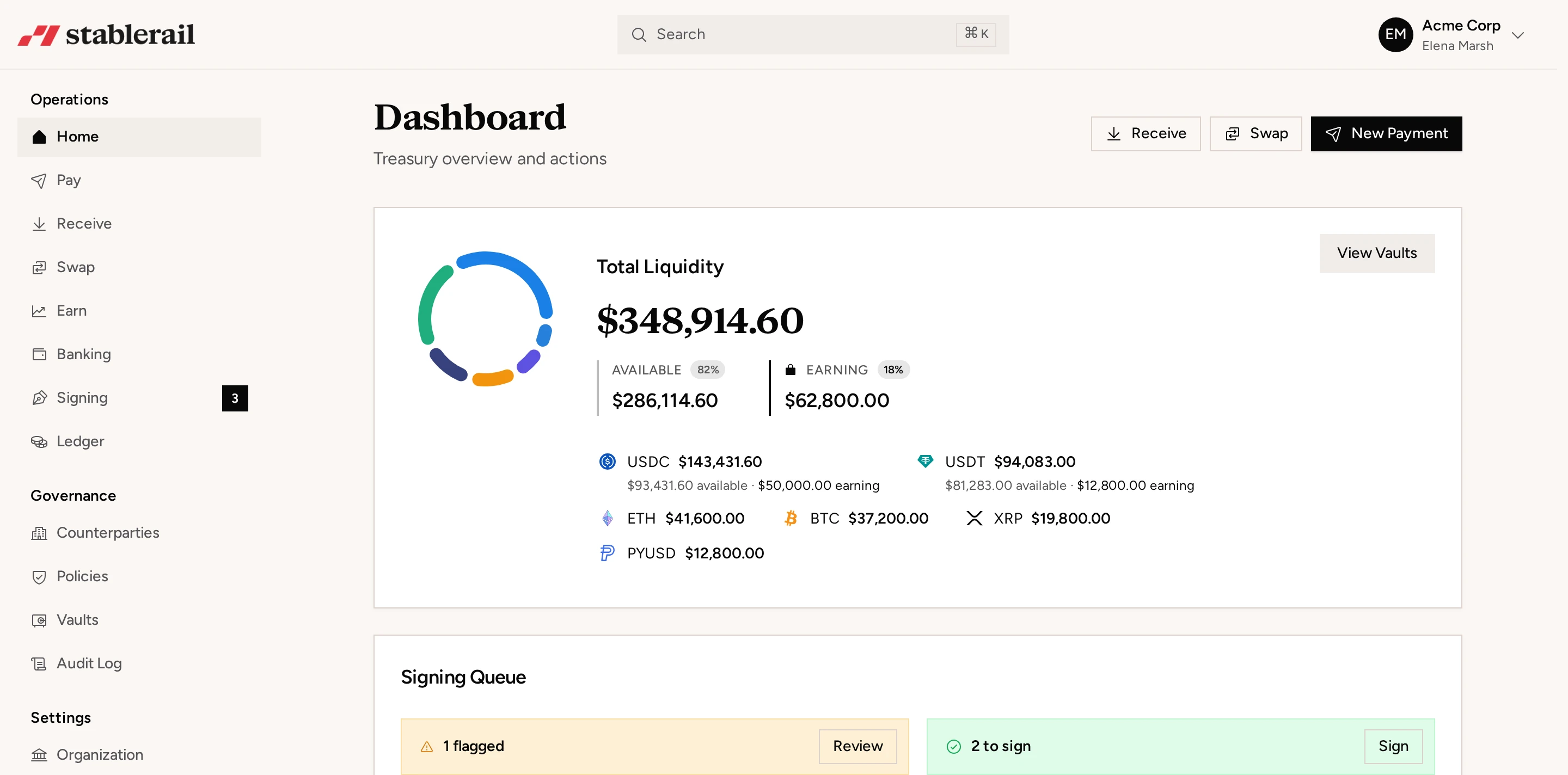
Stablerail combines multi-currency fiat balances and payment rails with USDC and USDT treasury vaults, conversions and payouts. Businesses can also use batch payment workflows through stablecoin payouts. Availability, account details, limits and pricing depend on the company, corridor and onboarding review, so these should be confirmed against your specific operating profile.
Finance writers covering stablecoin treasury, payments, compliance, and risk controls.
More about the Stablerail team- Stablecoin treasury managementApprovals, limits, yield and reporting on one balance.
- Stablecoin payoutsBatch contractor and vendor payments with screening.
- USDT vs USDCWhich stablecoin your company should settle in.
- Stablecoin finance glossaryMPC, off-ramp, travel rule and the rest, in plain English.
- Product updatesEverything we ship, month by month.