
What Is Bridge Orchestration for Stablecoin Payments?
Bridge orchestration can mean coordinating an end-to-end stablecoin payment or routing tokens between blockchains. Finance teams must identify the exact flow before comparing costs, timing, controls and risk.
Bridge orchestration has two possible meanings in stablecoin payments. It can describe software that coordinates fiat funding, stablecoin conversion, wallets, payment routing, payouts and reconciliation around Bridge’s infrastructure. It can also mean routing tokens through blockchain bridges between networks. Treasury teams should distinguish these workflows because their costs, failure modes, custody arrangements and accounting consequences are materially different.

Bridge orchestration has two possible meanings in stablecoin payments. It can describe a software layer coordinating fiat funding, stablecoin conversion, wallets, transfers and payouts around Bridge’s infrastructure. It can also mean routing crypto assets through blockchain bridges. The first manages an end-to-end payment; the second moves tokens between blockchain networks. Finance teams should establish which definition applies before comparing costs, settlement times or risks.
Two meanings of bridge orchestration
The term is not standardized. A capitalized reference to Bridge generally points to the stablecoin infrastructure provider, while a lowercase bridge usually refers to technology for transferring value between blockchains. Product descriptions do not always follow this convention, so the name alone is insufficient.
| Meaning | What it coordinates | Typical use | Primary risks |
|---|---|---|---|
| Orchestration around Bridge infrastructure | Fiat funding, conversion, wallets, transfers, payout instructions and payment status | Cross-border collections or payouts using stablecoins as a settlement layer | Corridor coverage, provider dependencies, account restrictions and incomplete failure handling |
| Blockchain bridge orchestration | Token transfers or liquidity routes between separate networks | Moving USDC or USDT from one blockchain to another | Smart-contract exposure, wrapped assets, liquidity constraints and cross-chain delays |
Ask the provider to diagram one representative transaction from the company’s funding account to the beneficiary’s final wallet or bank account. The diagram should name every currency, stablecoin, network, custodian, conversion step and payout rail involved.
What stablecoin payment orchestration does
A stablecoin payment can pass through several systems even when the user experiences it as one transfer. A company might fund in euros, convert into USDC, settle over a supported blockchain and deliver US dollars to a beneficiary’s bank account. The stablecoin may be invisible to the recipient, but it remains a distinct treasury and accounting event.
An orchestration layer coordinates these stages and connects them to a common payment record:
- Fund the transaction. The business sends fiat through an available bank rail or uses an existing fiat or stablecoin treasury balance.
- Validate the instruction. The system checks the amount, currency, beneficiary details, destination address or bank account, and applicable account limits.
- Screen the destination. Where applicable, sanctions and address screening takes place before the stablecoin transfer is signed and broadcast.
- Create a quote. The quote identifies the conversion rate, fees, expected delivery amount and expiry time.
- Select the route. Routing determines the stablecoin, blockchain network, liquidity path and destination payout method.
- Execute each leg. Funds are converted, transferred and, where required, converted back into fiat for delivery.
- Track status and exceptions. The payment progresses through defined states, with failed or delayed legs sent for review.
- Reconcile the payment. Bank references, quotes, fees, blockchain transaction hashes and payout references are attached to one record.
This coordination is especially valuable for cross-border payments because the sender and recipient may use different currencies, banking systems and settlement hours. However, orchestration does not eliminate the constraints of the underlying rails. A blockchain leg may operate continuously while a destination bank payout waits for banking hours or compliance review.
How a payment route should be selected
The cheapest blockchain is not necessarily the cheapest or safest payment route. Treasury teams should evaluate the complete path from the original funding account to the beneficiary’s requested form of payment.
Funding and payout rail availability
The available rails determine when fiat can enter or leave the workflow. Standard bank transfers can depend on business days, cutoff times, participating institutions and intermediary reviews. Even instant-payment schemes require both institutions and the specific account to be eligible. A provider should therefore distinguish the estimated time for the blockchain leg from the estimated time for final beneficiary delivery.
Stablecoin and network compatibility
USDC and USDT exist on multiple networks, but balances on different chains are not automatically interchangeable. A recipient requesting USDT on Tron cannot receive tokens sent to an Ethereum address. The sender must use the requested network, arrange a supported cross-chain route or ask the recipient to accept another combination.
Network names should be displayed alongside the token on payment instructions and approval screens. Address formats can overlap across some networks, so validating an address format alone does not prove that the beneficiary supports the intended chain.
Total route cost
The relevant figure is the amount the beneficiary receives compared with the amount the company spends. Depending on the route, the total can include fiat deposit or withdrawal charges, foreign-exchange spread, stablecoin conversion fees, blockchain network fees, swap or bridge costs, and beneficiary or intermediary bank deductions.
Request a corridor-level quote that shows the input amount, each disclosed charge, expected output amount and quote validity period. Separating fees from exchange-rate spread makes competing routes easier to compare.
Why cross-chain bridging is a separate treasury decision
If a treasury holds USDC on one network but needs to pay USDC on another, the orchestrator may use an issuer-supported transfer method, source destination-chain liquidity, execute a swap, use a third-party bridge or require the company to fund the correct network first. These methods are not operationally equivalent.
A third-party bridge can add smart-contract and counterparty exposure. Some routes deliver a wrapped representation of an asset rather than the issuer-native token. A wrapped token depends on the mechanism or entity holding or controlling the corresponding underlying asset and may have different liquidity, redemption and accounting characteristics.
| Cross-chain approach | Operational benefit | Treasury question |
|---|---|---|
| Pre-fund the destination network | Avoids bridging each individual payment | How much working capital and native gas balance must be maintained? |
| Issuer-supported transfer | Can preserve issuer-native asset treatment where supported | Are both the source and destination networks supported for this token? |
| Swap through available liquidity | May reach networks not covered by a direct mechanism | What are the spread, liquidity limit and execution counterparty? |
| Third-party blockchain bridge | Provides a direct cross-chain path in supported cases | Is the output native or wrapped, and who bears a failed-route loss? |
Before authorizing a cross-chain route, confirm the exact bridge or liquidity source, token received, transaction sequence, expected finality, failure procedure and ledger treatment. Maintaining a funded balance on a frequently used destination network is often simpler to reconcile than bridging every payment, although it creates an additional balance to monitor.
Controls finance teams should evaluate
Entity eligibility and corridor coverage
Confirm which company entities can use the service. Approval of a parent company does not necessarily cover every subsidiary. Document supported funding currencies, payout currencies, stablecoins, networks, countries, beneficiary types and bank rails for each planned corridor.
Custody and authorization
Establish who controls funds at every stage, including while a payment is pending or an exception is being resolved. Determine whether the provider, the company or another custodian holds signing authority. For company-controlled treasury workflows, approvals and signing quorum can prevent one user from moving funds alone, while separate creator and approver roles reduce error and fraud risk.
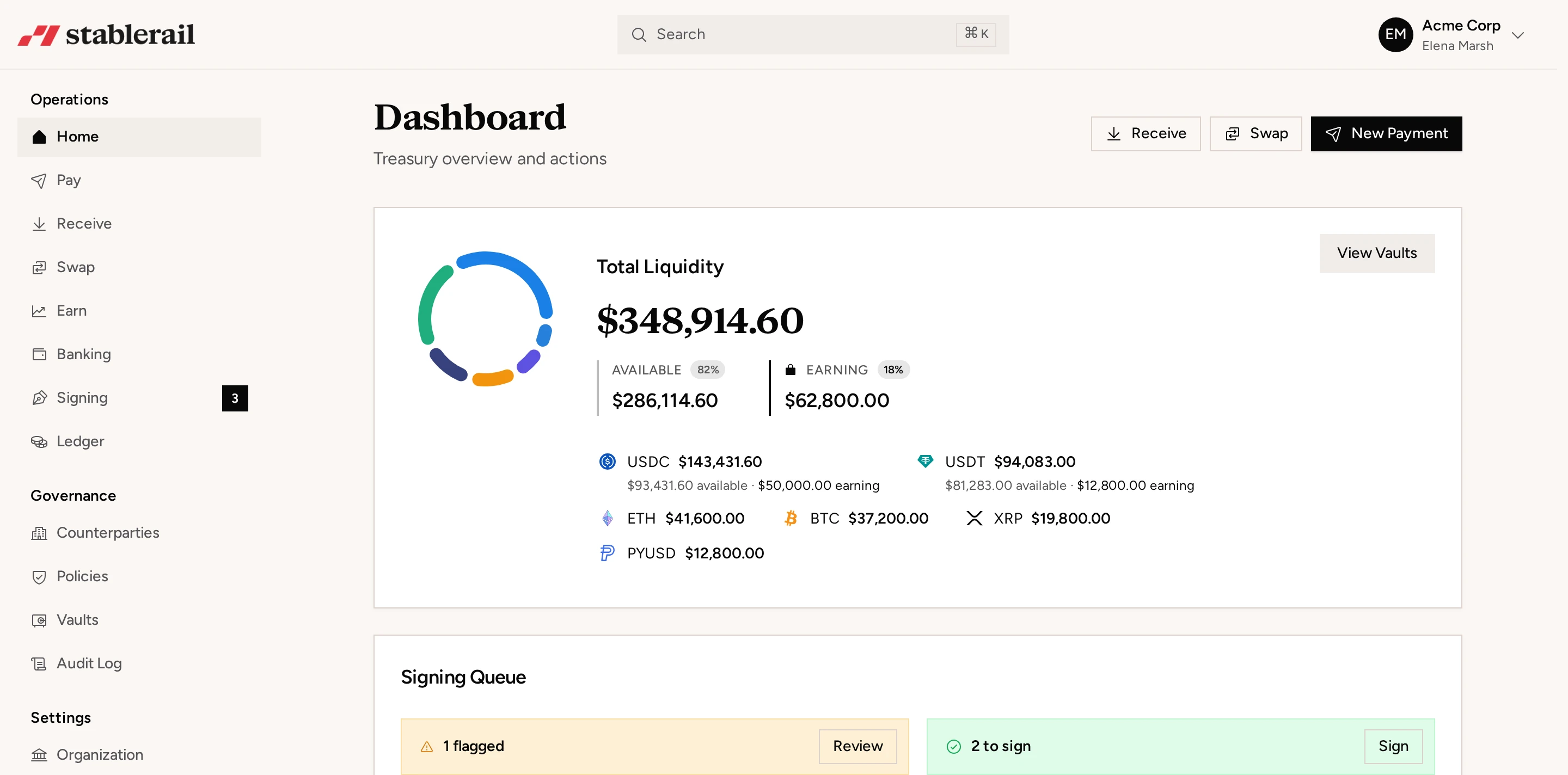
Stablerail, for example, supports corporate USDC and USDT treasury workflows with approvals and signing quorum, sanctions and address screening before send, global payouts, fiat conversion and exportable audit evidence. Those controls address authorization and recordkeeping, but the finance team must still approve the underlying corridor and asset strategy.
Failure handling
Ask what happens if one leg succeeds and the next fails. A platform might convert fiat into a stablecoin but then be unable to complete the bank payout. The company needs to know whether funds remain in stablecoin, are returned to fiat, are retried automatically or require manual intervention—and who bears any additional conversion or network cost.
Status labels should also be precise. A blockchain transaction marked confirmed does not prove that a beneficiary received fiat. The final state should correspond to the recipient outcome, with intermediate settlement states retained for audit purposes.
Reconciliation evidence
A complete record should preserve the funding reference, approved quote, exchange rate, each fee, token and network, source and destination addresses, transaction hash, payout reference, timestamps, approvers and final status. Finance teams should test exports against their general ledger process before production use, including rejected beneficiaries, partial batches, refunds and fee adjustments.
Pre-production checklist
- Write down the complete route for each currency and payout corridor.
- Confirm whether any cross-chain step creates a native or wrapped token.
- Identify who has custody and signing authority at every stage.
- Compare total spend with expected beneficiary receipt, not only network fees.
- Document the outcome for failed conversion, transfer and payout legs.
- Test approval, screening, status tracking and accounting exports.
- Send a small payment using the exact currency, network and payout method planned for production.
The practical definition for treasury teams
For corporate treasury, bridge orchestration should mean a controlled workflow connecting funding, conversion, wallets, networks, payouts, status tracking and reconciliation. Access to Bridge infrastructure or a blockchain bridge is only one component.
The decisive question is whether finance can understand the route, approve it under appropriate authority, see the full cost, monitor each state and reconcile the result through final delivery. If a provider cannot clearly explain the assets, counterparties and failure outcomes at every step, the route is not ready for production funds.
Frequently asked questions
What does bridge orchestration mean in stablecoin payments?
It can mean coordinating an end-to-end payment around Bridge’s stablecoin infrastructure, including fiat funding, conversion, wallets and payouts. It can also mean routing tokens through blockchain bridges between networks, which is a separate operation with different risks.
Is Bridge the same as a blockchain bridge?
No. Bridge with a capital B generally refers to the stablecoin infrastructure provider. A blockchain bridge is a protocol or service that moves value or token representations between separate blockchain networks.
What should a CFO ask a stablecoin orchestration provider?
Ask for the complete transaction route, custody model, approval process, total corridor cost and failure procedure. The provider should also identify every stablecoin, network, conversion counterparty, payout rail and reconciliation record involved.
Can USDC or USDT be sent directly between different blockchains?
Not as an ordinary token transfer. The company needs a supported cross-chain mechanism, a liquidity-based swap or an existing balance on the destination network. Finance should confirm whether the resulting token is issuer-native or wrapped.
When is a stablecoin payment considered complete?
Completion depends on the promised recipient outcome. Blockchain confirmation may complete a wallet-to-wallet payment, but it does not complete a fiat payout until the destination payment is delivered or reaches the provider’s defined final state.
Finance writers covering stablecoin treasury, payments, compliance, and risk controls.
More about the Stablerail team- Stablecoin treasury managementApprovals, limits, yield and reporting on one balance.
- Stablecoin payoutsBatch contractor and vendor payments with screening.
- USDT vs USDCWhich stablecoin your company should settle in.
- Stablecoin finance glossaryMPC, off-ramp, travel rule and the rest, in plain English.
- Product updatesEverything we ship, month by month.