
How Cobre Supports Stablecoin Payments—and What Businesses Should Compare
A practical review of Cobre’s stablecoin-related offering, plus a checklist for comparing markets, currencies, custody, conversion, payout rails, settlement times, fees and availability.

Cobre is a business payments and treasury platform focused on Latin America. Its public materials position stablecoins as infrastructure for moving value across borders and connecting local payment systems, rather than simply as assets for businesses to buy and hold.
For a finance team, the important question is not whether a provider “supports stablecoins.” It is which legal entities can use the service, where money can be sent, how conversion works, who controls the assets, and what the complete transaction costs.
This guide explains Cobre’s stablecoin-related offering based on publicly available product information. Product coverage can change, and some details—particularly fees, limits, supported networks and settlement commitments—may only be available during onboarding or through a commercial proposal.
What Cobre’s stablecoin offering is designed to do
Cobre publicly presents itself as a platform for business payments, treasury operations and cross-border money movement in Latin America. Its stablecoin-related proposition connects local currencies and payment rails with dollar-denominated stablecoins.
The practical use case is typically a transaction with three parts:
- Funding: A business sends local currency or another supported currency to the provider.
- Stablecoin conversion: The funds are converted into a stablecoin, generally to transfer value or provide dollar-denominated settlement.
- Delivery: The recipient receives either stablecoins or local fiat after another conversion.
This structure can support supplier payments, intercompany transfers, collections and other cross-border business payments. Stablecoins may operate in the background, so the payer and recipient do not necessarily need to manage blockchain wallets themselves.
Businesses should confirm the exact flow for each corridor. A provider may support fiat-to-stablecoin conversion in one market but only stablecoin-to-fiat settlement in another.
What public information does—and does not—establish
Cobre’s public positioning establishes a focus on corporate treasury, local payments and cross-border transactions in Latin America. It also indicates that stablecoins form part of its infrastructure for international money movement.
Website-level information does not always provide every operational detail required for treasury approval. Before relying on Cobre for a specific corridor, request written confirmation of:
- The countries in which your legal entity is eligible to onboard.
- The countries where Cobre can collect or pay out local currency.
- Supported fiat currencies and stablecoins.
- Supported blockchain networks for wallet deposits and withdrawals.
- Whether balances are custodial, self-custodial or held through a third party.
- Minimum and maximum transaction amounts.
- Conversion spreads, payment fees and third-party banking charges.
- Cut-off times, weekend availability and expected settlement windows.
This distinction matters because “available in a country” may refer to local payouts, not necessarily onboarding, accounts or stablecoin withdrawals for companies incorporated there.
How to compare Cobre with another stablecoin payment provider
| Area | What to establish for Cobre | What to compare |
|---|---|---|
| Markets | Eligible company jurisdictions and available payout countries | Whether both your entity and recipient markets are covered |
| Currencies | Supported local currencies, USD balances, USDC and USDT availability | Whether each currency can be held, converted, sent and withdrawn |
| Fiat rails | Local bank transfer methods and cross-border routes for each market | Named rails, cut-off times, return handling and beneficiary requirements |
| Custody | Who legally holds fiat and stablecoins and who controls wallet keys | Custodial accounts versus self-custodial wallets with corporate approvals |
| Conversion | Available fiat-to-stablecoin and stablecoin-to-fiat pairs | Quoted rate, spread, price-lock period, minimum size and slippage policy |
| Payouts | Bank, wallet, batch and API-based payout options | Beneficiary coverage, bulk upload, status tracking and reconciliation data |
| Settlement | Expected time for each funding, conversion and delivery stage | Business-day versus 24/7 processing and what happens after cut-off |
| Fees | Platform, conversion, payout, network and correspondent-bank fees | Total delivered cost rather than the headline transfer fee |
| Availability | KYB eligibility, industry restrictions and transaction limits | Whether the service is operational for your entity and intended use case |
Examine the complete payment route
Settlement speed should be measured from the moment money leaves the payer until it becomes usable by the recipient. A blockchain transfer may complete in seconds or minutes, but bank funding, compliance review and local payout can extend the full process.
Ask the provider to map each stage:
- How long incoming fiat takes to be credited.
- Whether conversion is automatic or manually requested.
- When the exchange rate becomes binding.
- Which blockchain and wallet address are used.
- How long local off-ramp and bank delivery take.
- What status information is available if a payment is delayed or returned.
Also distinguish estimated timings from contractual service levels. Public descriptions such as “instant” or “real time” may apply only to an internal ledger or a specific local payment rail.
Compare fees using the amount delivered
Stablecoin conversion costs can appear in several places. A provider may charge an explicit conversion fee, incorporate a spread into its exchange rate, or apply different pricing by corridor and transaction size.
Request a worked quote showing:
- The amount debited from the payer.
- The exchange rate and reference rate used.
- Any stablecoin conversion spread.
- Blockchain network fees.
- Local payout or banking fees.
- The exact amount expected by the recipient.
For a fair test, give each provider the same scenario—for example, converting the equivalent of $100,000 from local currency into USDC and paying a supplier’s bank account. Compare both the delivered amount and the expected delivery time.
Custody and network support need explicit answers
Custody determines who controls the stablecoins while they are held or transferred. In a custodial model, the provider or its partner controls the wallets. In a self-custodial model, the business controls transaction approval through its own wallet setup.
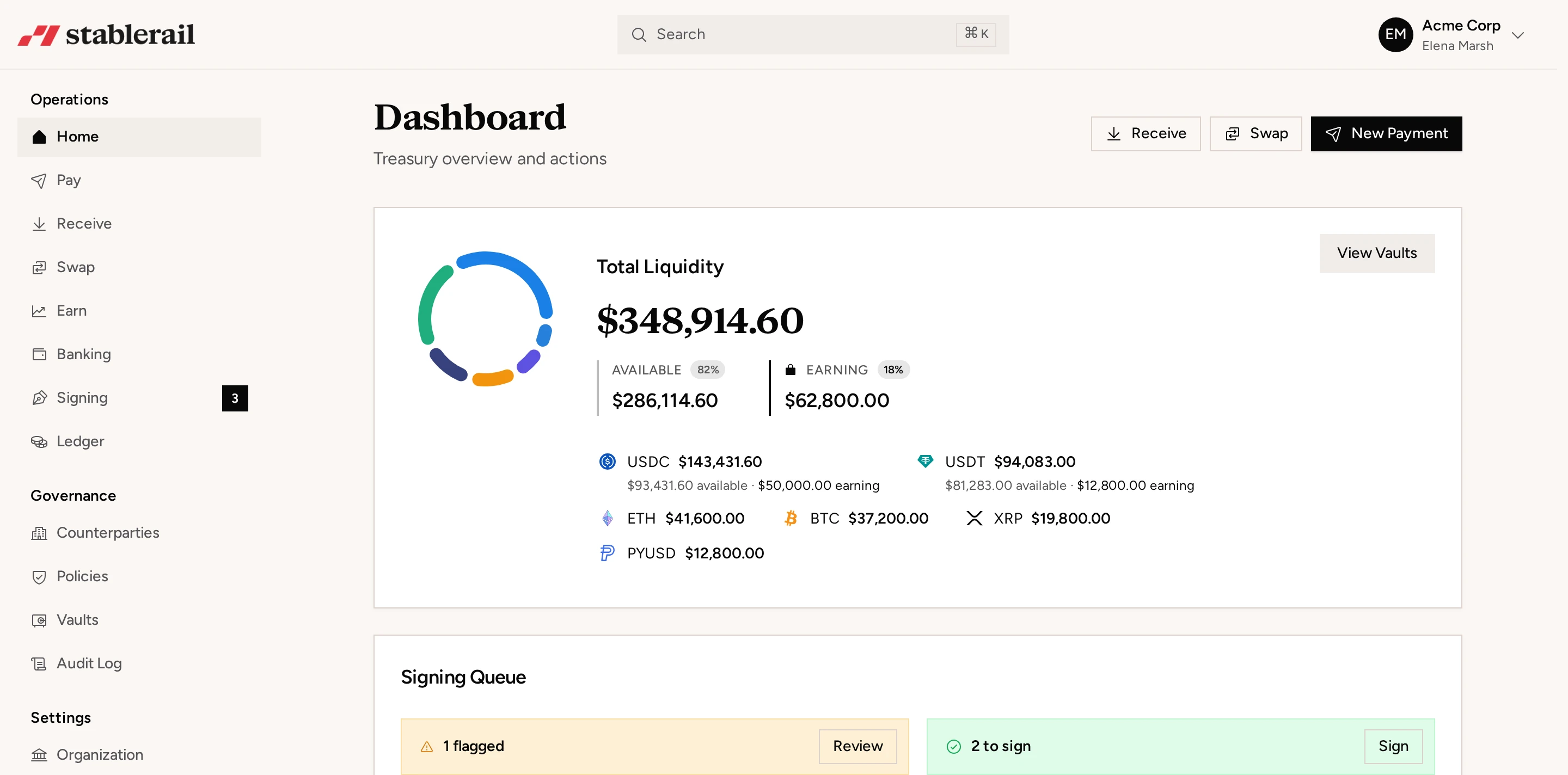
Stablerail, for example, provides self-custodial MPC vaults. MPC, or multi-party computation, divides signing authority so that no single person holds a complete private key. Quorum signing can require several authorized employees to approve a transfer.
Network support must also be checked separately from stablecoin support. USDC or USDT on one network cannot automatically be sent to an address on another. Stablerail supports payouts across Ethereum, Base, Arbitrum, Polygon, Tron, BNB Chain, Optimism and Solana. Finance teams can review the operational model for stablecoin payouts and batch payments on the payout product page.
For Cobre, request the current network list and confirm whether external wallet deposits and withdrawals are enabled. Do not infer network coverage solely from a statement that USDC or USDT is supported.
Availability and onboarding
Stablecoin payment services are normally subject to know-your-business checks, commonly called KYB. Providers may review incorporation records, ownership, directors, business activity, expected volumes and the source of funds.
Prepare the following before requesting access:
- Certificate of incorporation and company registry extract.
- Articles of association or equivalent formation documents.
- Director and beneficial-owner identification.
- Ownership chart where the structure has multiple entities.
- Business address and operating website.
- Expected currencies, corridors, transaction sizes and monthly volumes.
- Contracts, invoices or other evidence supporting the payment purpose.
Ask whether regulated industries, particular jurisdictions or payments involving third-party funds are restricted. Approval for ordinary supplier payments does not automatically cover remittance, marketplace or customer-funds activity.
A practical decision checklist
Before selecting Cobre or another stablecoin payments provider, finance teams should obtain a corridor-specific proposal and complete a small operational test. The final review should answer:
- Can our legal entity onboard, and under which contracting entity?
- Can we fund and settle in the currencies our counterparties use?
- Do we control the stablecoins, or does a provider hold them for us?
- Which networks, wallet types and local banking rails are supported?
- What is the total cost for a representative payment?
- What happens if a conversion, blockchain transfer or bank payout fails?
- Can we download transaction records for accounting and reconciliation?
- Are batch approvals, user limits and API access available?
- Which timings apply on weekends and local bank holidays?
Cobre may be a relevant option for businesses prioritizing Latin American treasury and payment corridors. The decision should still rest on confirmed corridor coverage, stablecoin conversion mechanics, custody, delivered cost and operational availability—not on a general claim of stablecoin support.
Finance writers covering stablecoin treasury, payments, compliance, and risk controls.
More about the Stablerail team- Stablecoin treasury managementApprovals, limits, yield and reporting on one balance.
- Stablecoin payoutsBatch contractor and vendor payments with screening.
- USDT vs USDCWhich stablecoin your company should settle in.
- Stablecoin finance glossaryMPC, off-ramp, travel rule and the rest, in plain English.
- Product updatesEverything we ship, month by month.