
How to Compare BVNK Alternatives for Stablecoin Infrastructure
A practical framework for comparing BVNK alternatives across treasury fit, fiat corridors, custody, stablecoin conversion, payouts, controls, costs and onboarding.
To compare BVNK alternatives, first decide whether you need embedded payment infrastructure for customers or treasury infrastructure for your company’s own funds. Then evaluate eligible providers corridor by corridor, testing fiat rails, custody, conversion, payouts, controls, reconciliation and total cost as one workflow. Use mandatory requirements and representative transactions before applying a weighted scorecard; a long feature list cannot compensate for an unsuitable operating model.

To compare BVNK alternatives, first decide whether you need embedded payment infrastructure for customers or treasury infrastructure for your company’s own funds. Then evaluate eligible providers corridor by corridor, testing fiat rails, custody, conversion, payouts, controls, reconciliation and total cost as one workflow. Use mandatory requirements and representative transactions before applying a weighted scorecard; a long feature list cannot compensate for an unsuitable operating model.
Start with the infrastructure model
Providers that appear similar on a stablecoin feature list may solve different problems. An API platform helps a business add stablecoin functionality to its product. A treasury platform helps a finance team hold, convert and move corporate funds. Exchanges, custodians and banking providers cover narrower parts of the workflow.
| Provider model | Primary use case | Typical buyer | Main operating requirement |
|---|---|---|---|
| API and embedded-payment infrastructure | Add stablecoin collection, conversion or payouts to a customer-facing product | Fintech, marketplace, payment company or software platform | APIs, customer ledgers, webhooks, compliance flows and exception handling |
| Corporate treasury platform | Manage the company’s own fiat and stablecoin funds | CFO, controller, treasurer or finance operations team | Approvals, signing controls, conversion, payouts and accounting evidence |
| Exchange or broker | Buy and sell stablecoins | Treasury or trading desk | Account funding, trade execution and withdrawals |
| Custodian | Safeguard digital assets | Institution holding material on-chain balances | Wallet governance, signing, recovery and external transfers |
| Bank or electronic money provider | Hold fiat and access payment schemes | Finance team needing bank transfers | Account setup, beneficiaries and reconciliation |
If customers will buy or receive stablecoins inside your application, prioritize integration depth, sub-ledgers, webhook reliability and customer compliance responsibilities. If finance is managing the company’s own USDC or USDT, prioritize access to funds, approvals, conversion, beneficiary payments and audit evidence.
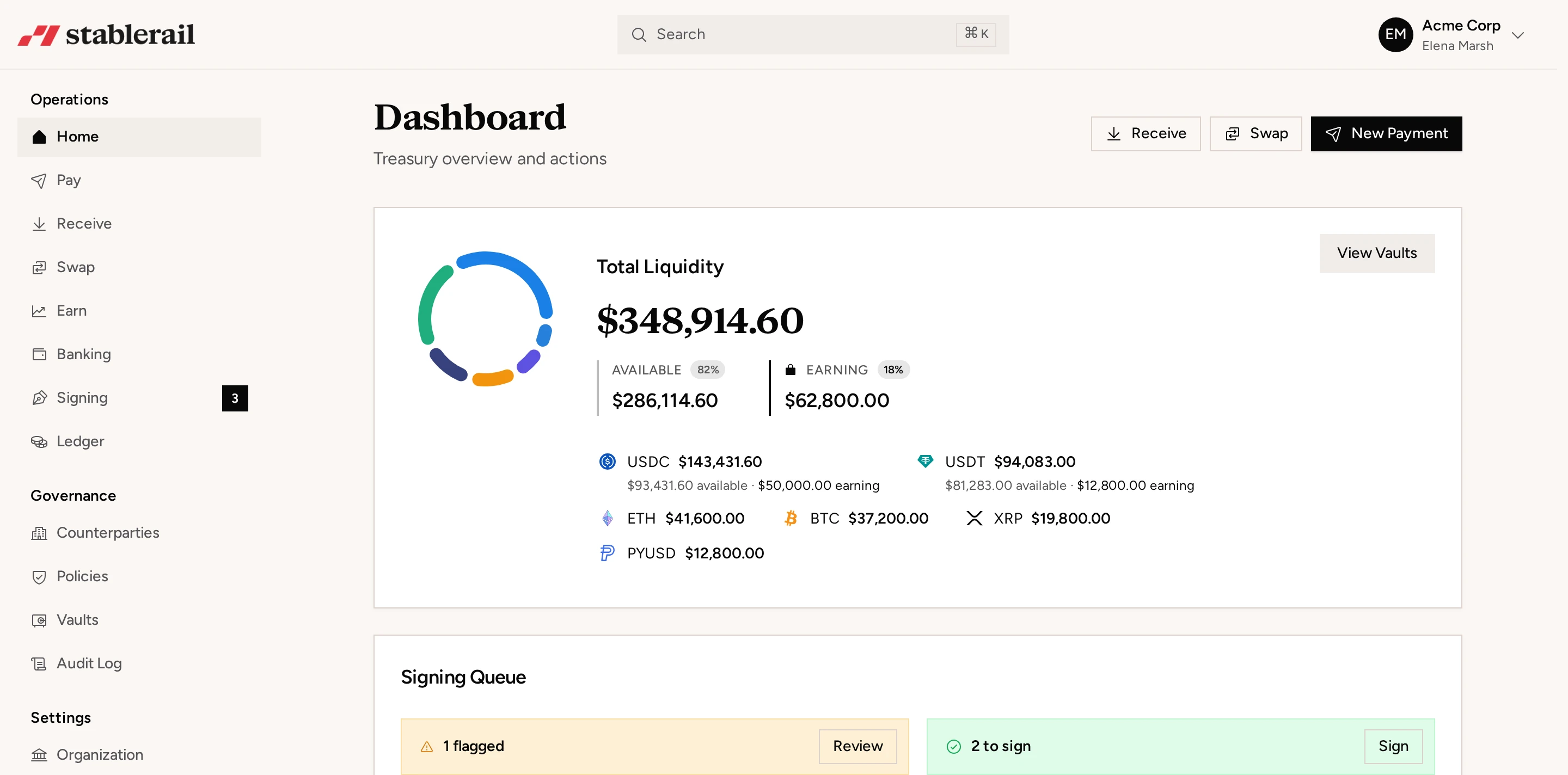
Stablerail belongs to the second category: it is a corporate stablecoin treasury platform for a company’s own funds, with approvals and signing quorum, sanctions and address screening before send, fiat conversion, global payouts, corporate cards and exportable audit evidence.
Turn business needs into mandatory workflows
Do not begin with a vendor demo. Document the transactions the company must complete, including currency, asset, network, originating entity, destination country, beneficiary type, frequency and typical amount. Separate mandatory requirements from useful extras.
A practical requirements list might include receiving EUR, converting it to USDC, paying approved supplier wallets, converting incoming USDT to USD and exporting evidence that links each payment to its approval and fees. This exposes gaps that broad claims such as global coverage conceal.
Compare fiat access corridor by corridor
A provider may support a currency without supporting every inbound and outbound route. Build a matrix for the corridors you actually use and obtain written confirmation that your legal entity, industry and transaction purpose are eligible.
| Rail | Typical purpose | Points to verify |
|---|---|---|
| SEPA | Routine EUR transfers within the SEPA area | Inbound and outbound support, account structure, cutoffs, references and return handling |
| SEPA Instant | Time-sensitive EUR transfers | Sending and receiving bank participation, availability and transaction limits |
| ACH | Routine USD collections and payments | Debit or credit support, settlement option, returns, reversals and same-day availability |
| Fedwire | Urgent or high-value domestic USD payments | Cutoff time, beneficiary fields, fee treatment and payment tracking |
| SWIFT | Cross-border bank transfers | Correspondent banks, intermediary charges, payment tracking and returned-funds process |
| Faster Payments, BACS or CHAPS | Domestic GBP payments | Supported payment type, operating window, limits and bulk-payment process |
Ask whether account details are dedicated, virtual or pooled; whose legal name appears to counterparties; how incoming funds are identified; and how balances are legally held. A virtual IBAN can improve payment identification, but it should not automatically be treated as a bank account held directly in the company’s name.
Examine custody, signing and access to funds
Custody determines who can authorize a blockchain transfer and what happens if a vendor, signer or device is unavailable. Provider custody means the provider controls the keys and processes withdrawals following an instruction. Self-custody puts key security and recovery on the company. Multi-party computation can distribute signing so that authorization does not depend on one complete private key.
For each model, ask who can move assets, whether the provider can act unilaterally, how many approvals are required, how signers are replaced and how recovery works. Confirm whether the company can transfer assets directly to an external wallet and what happens to access if the commercial relationship ends.
Network support must be checked by token and route, not by blockchain name alone. Confirm the exact stablecoin contract, deposit network, withdrawal network and destination wallet. Sending a supported token over the wrong network can create a difficult or impossible recovery process.
Test conversion and payouts as one workflow
A conversion quote does not reveal the complete cost or operating burden. Test the sequence from original funding through final beneficiary receipt. Representative scenarios could include:
- Receive EUR by bank transfer, convert it to USDC and pay 20 approved supplier wallets.
- Receive USDT on the required network, convert it to USD and pay a supplier through a domestic bank rail.
- Fund a batch of contractor payments on two approved networks and reconcile failures separately.
For each test, record the amount sent, amount received, quoted rate, conversion charge, blockchain fee, payout charge, bank deductions, elapsed time, manual actions and failed-payment process. Check whether the transaction record gives finance one traceable chain from funding and conversion to approval, payout and accounting export.
Evaluate controls in the real payment flow
A list of security features is less useful than seeing when each control acts. Run a controlled payment with a new beneficiary, a changed wallet address and an unavailable approver. Finance and security should observe the workflow together.
| Control | Evidence to request | Operational question |
|---|---|---|
| Role separation | User and permission export | Can preparation, approval and signing be assigned to different people? |
| Approval or signing quorum | Approval history for a test payment | Can one user bypass the required quorum? |
| Beneficiary management | Record of beneficiary creation and edits | Does changing an address trigger review? |
| Sanctions and address screening | Screening result linked to the transfer | Does screening occur before funds are sent? |
| Audit and reconciliation | Downloadable payment, conversion and fee records | Can accounting trace the ledger entry to its approvers and transaction identifier? |
Measure integration and operating effort honestly
An API-first provider may be right when stablecoin payments are part of the product, but production work can extend beyond making an API call. The company may need customer ledgers, webhook processing, reconciliation logic, retry handling, transaction monitoring and a support process.
A treasury platform may require less engineering but still needs finance configuration: entities, users, approvers, signing quorum, beneficiaries, wallets and accounting procedures. Request an implementation plan that identifies every dependency, owner and acceptance test. Distinguish mandatory work from optional customization and vendor work from internal work.
Calculate total cost by representative route
Compare the total economic cost of completing a transaction, not one advertised fee. Include account or platform charges, inbound rail fees, conversion spread or fee, blockchain fees, payout fees, intermediary bank deductions and internal operating effort.
Request written pricing for each representative route. Ask whether rates change with volume, asset, network, payment method or settlement speed. Confirm minimum commitments, prefunding requirements, failed-payment charges and the treatment of returned funds. Where spreads apply, compare the executed exchange rate with the provider’s stated benchmark at the same timestamp and under the same route assumptions.
Confirm eligibility before scoring features
Coverage does not prove that a particular company can be onboarded. Restrictions can depend on incorporation, operating countries, beneficial ownership, industry, source of funds, counterparties and intended transaction type.
Complete a pre-eligibility review using the real legal entities and anticipated activity. Prepare incorporation records, ownership information, director identification, business model evidence, source-of-funds material, currencies, assets, networks and expected volumes. Ask whether approval covers every required rail and stablecoin route or whether separate banking or liquidity partners must approve them.
Use gates before a weighted scorecard
Apply pass-or-fail gates first: eligibility, required corridor, acceptable custody model, access to funds and essential controls. A provider that fails a mandatory requirement should not win because it has a higher aggregate feature score.
| Category | Illustrative weight | What earns a high score |
|---|---|---|
| Fiat accounts and rails | 20% | Required inbound and outbound corridors are confirmed for the relevant entity |
| Custody and access | 20% | Clear signing, recovery, withdrawal and provider-exit procedures |
| Conversion and payouts | 20% | Representative routes complete with predictable handling and traceable records |
| Controls and evidence | 20% | Approvals, screening and exports work within the payment flow |
| Implementation and operations | 10% | Defined ownership, manageable manual work and tested exception handling |
| Total cost | 10% | Transparent all-in cost for the company’s actual routes |
Weights should reflect the company’s risk and transaction profile. Score each category consistently, attach evidence to every score and record unresolved assumptions rather than treating them as confirmed capabilities.
Finance-team evaluation checklist
- Define whether the use case is embedded payments or management of corporate funds.
- List required entities, currencies, stablecoins, networks, corridors and beneficiaries.
- Set mandatory gates for eligibility, custody, access and controls.
- Run representative funding, conversion and payout tests.
- Reconcile each test from source funds to beneficiary receipt.
- Calculate all-in cost and document pricing assumptions.
- Test approvals, screening, failed payments and recovery procedures.
- Complete security, legal, accounting and implementation reviews before selection.
The strongest BVNK alternative is therefore not necessarily the provider with the most currencies, networks or API endpoints. It is the eligible provider whose operating model completes the company’s real transactions with acceptable control, access, evidence and total cost. For teams focused specifically on managing their own USDC or USDT, Stablerail can be evaluated within that treasury category rather than as customer-facing payment infrastructure.
Frequently asked questions
What are the main alternatives to BVNK?
The relevant alternatives depend on the operating model: embedded-payment API providers, corporate treasury platforms, exchanges, custodians and banking providers solve different parts of the stablecoin workflow. Start with whether you are serving customers or managing your company’s own money before comparing vendors.
How should a company compare BVNK with other stablecoin providers?
Compare providers using your actual legal entities, fiat corridors, stablecoins, networks and beneficiary types. Apply pass-or-fail gates for eligibility, custody, fund access and required controls, then test complete funding, conversion, payout and reconciliation workflows.
What is the difference between stablecoin infrastructure and a treasury platform?
Stablecoin infrastructure often refers to APIs used to embed collections, conversion or payouts into a customer-facing product. A treasury platform is designed for a finance team managing the company’s own balances, approvals, conversions, payments and accounting evidence.
How do I calculate the total cost of a stablecoin payment provider?
Include platform or account charges, fiat rail fees, conversion spreads or fees, blockchain fees, payout charges, intermediary bank deductions and internal operating effort. Calculate these costs for representative routes because pricing can vary by currency, asset, network, payment method and volume.
What stablecoin controls should a corporate treasury team require?
Core controls include role separation, approval or signing quorum, controlled beneficiary changes, sanctions and wallet-address screening before send, and traceable activity records. Finance should also require exports that connect funding, conversion, fees, approvals and payout identifiers to accounting entries.
Finance writers covering stablecoin treasury, payments, compliance, and risk controls.
More about the Stablerail team- Stablecoin treasury managementApprovals, limits, yield and reporting on one balance.
- Stablecoin payoutsBatch contractor and vendor payments with screening.
- USDT vs USDCWhich stablecoin your company should settle in.
- Stablecoin finance glossaryMPC, off-ramp, travel rule and the rest, in plain English.
- Product updatesEverything we ship, month by month.