
USDT business account: what your company needs beyond an exchange login
Learn what a company needs to operate USDT safely: network support, custody, payment approvals, address screening, fiat conversion and audit-ready records.
A USDT business account should do more than hold or trade tokens. It should define the company’s custody model, support the exact USDT networks it uses, separate payment preparation from approval, screen destination addresses, provide a workable fiat off-ramp and export records for reconciliation and audit. An exchange login can still serve trading needs, but it is usually a weak operating system for payroll, vendor payments, collections and treasury control.
%22%20x1%3D%220%22%20y1%3D%220%22%20x2%3D%221%22%20y2%3D%221%22%3E%0A%20%20%20%20%20%20%20%20%3Cstop%20offset%3D%220%25%22%20stop-color%3D%22%23450B10%22%20%2F%3E%0A%20%20%20%20%20%20%20%20%3Cstop%20offset%3D%2250%25%22%20stop-color%3D%22%23681A1F%22%20%2F%3E%0A%20%20%20%20%20%20%20%20%3Cstop%20offset%3D%22100%25%22%20stop-color%3D%22%238A2A2D%22%20%2F%3E%0A%20%20%20%20%20%20%3C%2FlinearGradient%3E%0A%20%20%20%20%20%20%3CradialGradient%20id%3D%22glow%22%20cx%3D%22922%22%20cy%3D%22226%22%20r%3D%22520%22%20gradientUnits%3D%22userSpaceOnUse%22%3E%0A%20%20%20%20%20%20%20%20%3Cstop%20offset%3D%220%25%22%20stop-color%3D%22%23FF7A59%22%20stop-opacity%3D%220.45%22%20%2F%3E%0A%20%20%20%20%20%20%20%20%3Cstop%20offset%3D%2255%25%22%20stop-color%3D%22%23FF7A59%22%20stop-opacity%3D%220.08%22%20%2F%3E%0A%20%20%20%20%20%20%20%20%3Cstop%20offset%3D%22100%25%22%20stop-color%3D%22%23FF7A59%22%20stop-opacity%3D%220%22%20%2F%3E%0A%20%20%20%20%20%20%3C%2FradialGradient%3E%0A%20%20%20%20%20%20%3ClinearGradient%20id%3D%22glass%22%20x1%3D%220%22%20y1%3D%220%22%20x2%3D%221%22%20y2%3D%221%22%3E%0A%20%20%20%20%20%20%20%20%3Cstop%20offset%3D%220%25%22%20stop-color%3D%22%23F8D6D2%22%20stop-opacity%3D%220.26%22%20%2F%3E%0A%20%20%20%20%20%20%20%20%3Cstop%20offset%3D%22100%25%22%20stop-color%3D%22%23FFFFFF%22%20stop-opacity%3D%220.08%22%20%2F%3E%0A%20%20%20%20%20%20%3C%2FlinearGradient%3E%0A%20%20%20%20%20%20%3ClinearGradient%20id%3D%22accent%22%20x1%3D%220%22%20y1%3D%220%22%20x2%3D%221%22%20y2%3D%221%22%3E%0A%20%20%20%20%20%20%20%20%3Cstop%20offset%3D%220%25%22%20stop-color%3D%22%23FF7A59%22%20%2F%3E%0A%20%20%20%20%20%20%20%20%3Cstop%20offset%3D%22100%25%22%20stop-color%3D%22%23C73128%22%20%2F%3E%0A%20%20%20%20%20%20%3C%2FlinearGradient%3E%0A%20%20%20%20%20%20%3Cfilter%20id%3D%22soft%22%3E%3CfeGaussianBlur%20stdDeviation%3D%2210%22%20%2F%3E%3C%2Ffilter%3E%0A%20%20%20%20%3C%2Fdefs%3E%0A%20%20%20%20%3Crect%20width%3D%221600%22%20height%3D%22900%22%20fill%3D%22url(%23bg)%22%20%2F%3E%0A%20%20%20%20%3Crect%20width%3D%221600%22%20height%3D%22900%22%20fill%3D%22url(%23glow)%22%20%2F%3E%0A%20%20%20%20%3Cline%20x1%3D%22262%22%20y1%3D%22331%22%20x2%3D%22262%22%20y2%3D%22487%22%20stroke%3D%22%23F8D6D2%22%20stroke-opacity%3D%220.6%22%20stroke-width%3D%223%22%2F%3E%0A%20%20%20%20%20%20%3Crect%20x%3D%22240%22%20y%3D%22371%22%20width%3D%2244%22%20height%3D%2276%22%20fill%3D%22%23F8D6D2%22%20opacity%3D%220.5%22%2F%3E%3Cline%20x1%3D%22362%22%20y1%3D%22326%22%20x2%3D%22362%22%20y2%3D%22503%22%20stroke%3D%22%23FF8E72%22%20stroke-opacity%3D%220.6%22%20stroke-width%3D%223%22%2F%3E%0A%20%20%20%20%20%20%3Crect%20x%3D%22340%22%20y%3D%22366%22%20width%3D%2244%22%20height%3D%2297%22%20fill%3D%22url(%23accent)%22%20opacity%3D%221%22%2F%3E%3Cline%20x1%3D%22462%22%20y1%3D%22353%22%20x2%3D%22462%22%20y2%3D%22571%22%20stroke%3D%22%23FF8E72%22%20stroke-opacity%3D%220.6%22%20stroke-width%3D%223%22%2F%3E%0A%20%20%20%20%20%20%3Crect%20x%3D%22440%22%20y%3D%22393%22%20width%3D%2244%22%20height%3D%22138%22%20fill%3D%22url(%23accent)%22%20opacity%3D%221%22%2F%3E%3Cline%20x1%3D%22562%22%20y1%3D%22366%22%20x2%3D%22562%22%20y2%3D%22575%22%20stroke%3D%22%23F8D6D2%22%20stroke-opacity%3D%220.6%22%20stroke-width%3D%223%22%2F%3E%0A%20%20%20%20%20%20%3Crect%20x%3D%22540%22%20y%3D%22406%22%20width%3D%2244%22%20height%3D%22129%22%20fill%3D%22%23F8D6D2%22%20opacity%3D%220.5%22%2F%3E%3Cline%20x1%3D%22662%22%20y1%3D%22343%22%20x2%3D%22662%22%20y2%3D%22517%22%20stroke%3D%22%23F8D6D2%22%20stroke-opacity%3D%220.6%22%20stroke-width%3D%223%22%2F%3E%0A%20%20%20%20%20%20%3Crect%20x%3D%22640%22%20y%3D%22383%22%20width%3D%2244%22%20height%3D%2294%22%20fill%3D%22%23F8D6D2%22%20opacity%3D%220.5%22%2F%3E%3Cline%20x1%3D%22762%22%20y1%3D%22332%22%20x2%3D%22762%22%20y2%3D%22518%22%20stroke%3D%22%23FF8E72%22%20stroke-opacity%3D%220.6%22%20stroke-width%3D%223%22%2F%3E%0A%20%20%20%20%20%20%3Crect%20x%3D%22740%22%20y%3D%22372%22%20width%3D%2244%22%20height%3D%22106%22%20fill%3D%22url(%23accent)%22%20opacity%3D%221%22%2F%3E%3Cline%20x1%3D%22862%22%20y1%3D%22356%22%20x2%3D%22862%22%20y2%3D%22578%22%20stroke%3D%22%23FF8E72%22%20stroke-opacity%3D%220.6%22%20stroke-width%3D%223%22%2F%3E%0A%20%20%20%20%20%20%3Crect%20x%3D%22840%22%20y%3D%22396%22%20width%3D%2244%22%20height%3D%22142%22%20fill%3D%22url(%23accent)%22%20opacity%3D%221%22%2F%3E%3Cline%20x1%3D%22962%22%20y1%3D%22368%22%20x2%3D%22962%22%20y2%3D%22608%22%20stroke%3D%22%23FF8E72%22%20stroke-opacity%3D%220.6%22%20stroke-width%3D%223%22%2F%3E%0A%20%20%20%20%20%20%3Crect%20x%3D%22940%22%20y%3D%22408%22%20width%3D%2244%22%20height%3D%22160%22%20fill%3D%22url(%23accent)%22%20opacity%3D%221%22%2F%3E%3Cline%20x1%3D%221062%22%20y1%3D%22374%22%20x2%3D%221062%22%20y2%3D%22593%22%20stroke%3D%22%23FF8E72%22%20stroke-opacity%3D%220.6%22%20stroke-width%3D%223%22%2F%3E%0A%20%20%20%20%20%20%3Crect%20x%3D%221040%22%20y%3D%22414%22%20width%3D%2244%22%20height%3D%22139%22%20fill%3D%22url(%23accent)%22%20opacity%3D%221%22%2F%3E%3Cline%20x1%3D%221162%22%20y1%3D%22347%22%20x2%3D%221162%22%20y2%3D%22526%22%20stroke%3D%22%23FF8E72%22%20stroke-opacity%3D%220.6%22%20stroke-width%3D%223%22%2F%3E%0A%20%20%20%20%20%20%3Crect%20x%3D%221140%22%20y%3D%22387%22%20width%3D%2244%22%20height%3D%2299%22%20fill%3D%22url(%23accent)%22%20opacity%3D%221%22%2F%3E%3Cline%20x1%3D%221262%22%20y1%3D%22333%22%20x2%3D%221262%22%20y2%3D%22522%22%20stroke%3D%22%23F8D6D2%22%20stroke-opacity%3D%220.6%22%20stroke-width%3D%223%22%2F%3E%0A%20%20%20%20%20%20%3Crect%20x%3D%221240%22%20y%3D%22373%22%20width%3D%2244%22%20height%3D%22109%22%20fill%3D%22%23F8D6D2%22%20opacity%3D%220.5%22%2F%3E%3Cline%20x1%3D%221362%22%20y1%3D%22357%22%20x2%3D%221362%22%20y2%3D%22551%22%20stroke%3D%22%23FF8E72%22%20stroke-opacity%3D%220.6%22%20stroke-width%3D%223%22%2F%3E%0A%20%20%20%20%20%20%3Crect%20x%3D%221340%22%20y%3D%22397%22%20width%3D%2244%22%20height%3D%22114%22%20fill%3D%22url(%23accent)%22%20opacity%3D%221%22%2F%3E%0A%20%20%20%20%3Crect%20x%3D%2226%22%20y%3D%2226%22%20width%3D%221548%22%20height%3D%22848%22%20rx%3D%2218%22%20fill%3D%22none%22%20stroke%3D%22%23F2D0C8%22%20stroke-opacity%3D%220.12%22%2F%3E%0A%20%20%3C%2Fsvg%3E)
A USDT business account should do more than hold or trade tokens. It should define the company’s custody model, support the exact USDT networks it uses, separate payment preparation from approval, screen destination addresses, provide a workable fiat off-ramp and export records for reconciliation and audit. An exchange login can still serve trading needs, but it is usually a weak operating system for payroll, vendor payments, collections and treasury control.
Exchange login versus a USDT business account
“USDT business account” is not a single legal or technical account type. It describes an operating setup built for company funds. Depending on the provider, custody may remain with a third party, sit in a company-controlled wallet or combine several arrangements. Finance should establish who legally holds the assets, who can authorize transfers and what happens if access is lost or an account is restricted.
Centralized exchanges are primarily designed for trading and conversion. Some provide institutional roles and withdrawal controls, but the exchange generally controls the wallet keys and records the customer’s balance on an internal ledger. A treasury account should instead be assessed against the full payment lifecycle: receipt, approval, on-chain transfer, conversion, bank payout and accounting evidence.
| Requirement | Typical exchange login | Business USDT operating setup |
|---|---|---|
| Primary use | Trading and asset conversion | Collections, treasury and operating payments |
| Custody | Usually exchange-controlled | Explicit custodial or company-controlled model |
| Approvals | Login security and provider withdrawal controls | Separate preparers and approvers, with signing quorum where available |
| Payments | Individual withdrawals | Referenced, recurring or batch payments |
| Fiat access | Supported deposit and withdrawal routes | Planned conversion and bank-payout workflow |
| Evidence | Trade and transfer history | Approval history, transaction references and exportable audit evidence |
The distinction becomes material when USDT is working capital. A process that is acceptable for an occasional conversion may not support hundreds of contractor payments, month-end reconciliation or a controlled treasury release.
Confirm the USDT network before moving funds
USDT is issued on multiple blockchains. The ticker and nominal unit may be the same, but each network has its own transaction rules, fees and token contract. USDT on Tron, commonly called USDT-TRC20, is not interchangeable with USDT on Ethereum. Sending through an unsupported network may lead to a lengthy recovery process or permanent loss.
Some EVM-compatible networks can display the same hexadecimal wallet address. That does not mean a recipient or provider will credit every network. Finance should therefore treat the destination as a pair: wallet address plus network. It should also verify the official token contract rather than relying only on a token symbol, which can be copied by unrelated tokens.
| Network check | What finance must verify | Operational consequence |
|---|---|---|
| Recipient support | The wallet, exchange or account credits USDT on the selected network | An otherwise valid address may not produce a credited deposit |
| Fee asset | Which native asset or resource pays transaction costs | Ethereum transfers require ETH for gas; Tron transfers may require TRX or network resources |
| Confirmations | The recipient’s required confirmation count | On-chain inclusion may occur before the deposit becomes available |
| Provider coverage | Deposits, payouts and conversion all support the same route | A supported deposit network may not be available for withdrawal or off-ramp |
| Limits | Minimums, maximums and any per-transaction controls | A route may be unsuitable for small batches or large treasury movements |
Maintain an approved network for every counterparty and store it in the vendor or customer record beside the address. For a new or changed destination, confirm the details through a separate communication channel. A small test transfer can expose formatting or compatibility errors, but it does not replace network verification.
Choose a custody and signing model for company funds
With exchange custody, the provider controls the blockchain keys and the company holds a contractual claim reflected in its account. This can simplify key management, but access depends on the provider’s controls, withdrawal process and continued availability. Finance should understand account recovery, authorized-user changes and the treatment of assets if the account is reviewed or restricted.
A company-controlled wallet reduces reliance on an exchange login, but it transfers important responsibilities to the business. The company needs a documented signing quorum, recovery process and current register of authorized signers. No employee should retain sole control simply because that person established the wallet.
A workable design separates payment preparation from release. For example, an operations user can enter the destination, network, amount and invoice reference, while designated approvers verify those details before signing. The quorum should remain usable during holidays or staff departures without allowing one person to bypass review.
Build controls around each USDT payment
Controls should apply before a transaction becomes irreversible. A finance team should verify the counterparty’s legal name, payment purpose, wallet address and network; compare the request with the underlying invoice or payroll record; and screen the destination address before sending. Screening results require interpretation: a match or risk indicator may need escalation rather than automatic payment.
- Approval thresholds: require additional review for larger or unusual transfers.
- Address controls: use reviewed address books or allowlists where available, and reverify changes independently.
- Sanctions and address screening: check the destination before release and retain the result.
- Batch review: reconcile the batch total and item count to the approved payment file.
- Execution evidence: retain the transaction hash, network, initiator, approvers and timestamps.
USDT transfers generally cannot be recalled in the way some bank payments can. Token issuers and service providers may have separate controls, but finance should not treat them as a routine recovery mechanism. Prevention, independent verification and clear incident escalation are more reliable controls.
Design the fiat off-ramp before accepting USDT
If USDT will fund salaries, taxes or fiat-denominated suppliers, confirm the complete off-ramp before collecting it. The relevant cost is not only the quoted conversion spread. Finance should consider network fees, provider fees, the exchange rate, bank-rail charges and any intermediary or beneficiary-bank deductions.
Timing also has several stages. A blockchain transfer may be confirmed while the provider is still completing its required checks, converting the asset or waiting for a bank cut-off. The receiving bank may perform its own review. “Fast on-chain” therefore does not necessarily mean “fiat available immediately.”
For each corridor, document:
- The supported USDT network and required confirmations.
- The conversion pair, quote validity and all disclosed charges.
- Transaction and account limits.
- The destination currency, beneficiary requirements and bank rail.
- Cut-off times, expected processing sequence and escalation route.
USDT is designed to track the US dollar, but finance should not assume that every venue will convert it at exactly one dollar or that liquidity is identical across networks and corridors. Compare the actual fiat proceeds presented before confirmation.
Prepare onboarding and accounting records
Business onboarding commonly requires incorporation documents, ownership and director information, operating addresses, a business description and evidence concerning the expected source and use of funds. Requirements vary by provider, jurisdiction, industry and transaction profile. Keep ownership records current so a corporate change does not interrupt a time-sensitive treasury workflow.
For accounting, connect each blockchain movement to its commercial purpose. The record should include the invoice or payroll entry, counterparty, wallet address, network, token amount, transaction hash, approval history and any network or conversion fee. It should also record the functional-currency value using the company’s documented accounting method and a consistent valuation timestamp.
Reconciliation should distinguish between a transaction being broadcast, confirmed on-chain, credited by a provider, converted and paid to a bank account. These events can occur at different times and may fall into different accounting periods. Exportable evidence is preferable to screenshots because it can be matched systematically to the general ledger and bank statement.
A practical USDT business account checklist
- Map every required USDT network, counterparty and payment corridor.
- Document who controls the assets and how signer access is recovered.
- Separate payment creation, approval and signing where staffing permits.
- Test address verification, screening and batch reconciliation.
- Run a controlled deposit, payout and fiat off-ramp before scaling volume.
- Confirm that accounting and audit records can be exported.
- Review permissions immediately after role, device or employment changes.
When a dedicated business account is the better fit
An exchange may remain useful for trading and occasional conversion. A dedicated operating account is the better fit when USDT is used for collections, treasury, payroll or supplier payments and finance needs repeatable approvals, payout tools, fiat access and evidence.
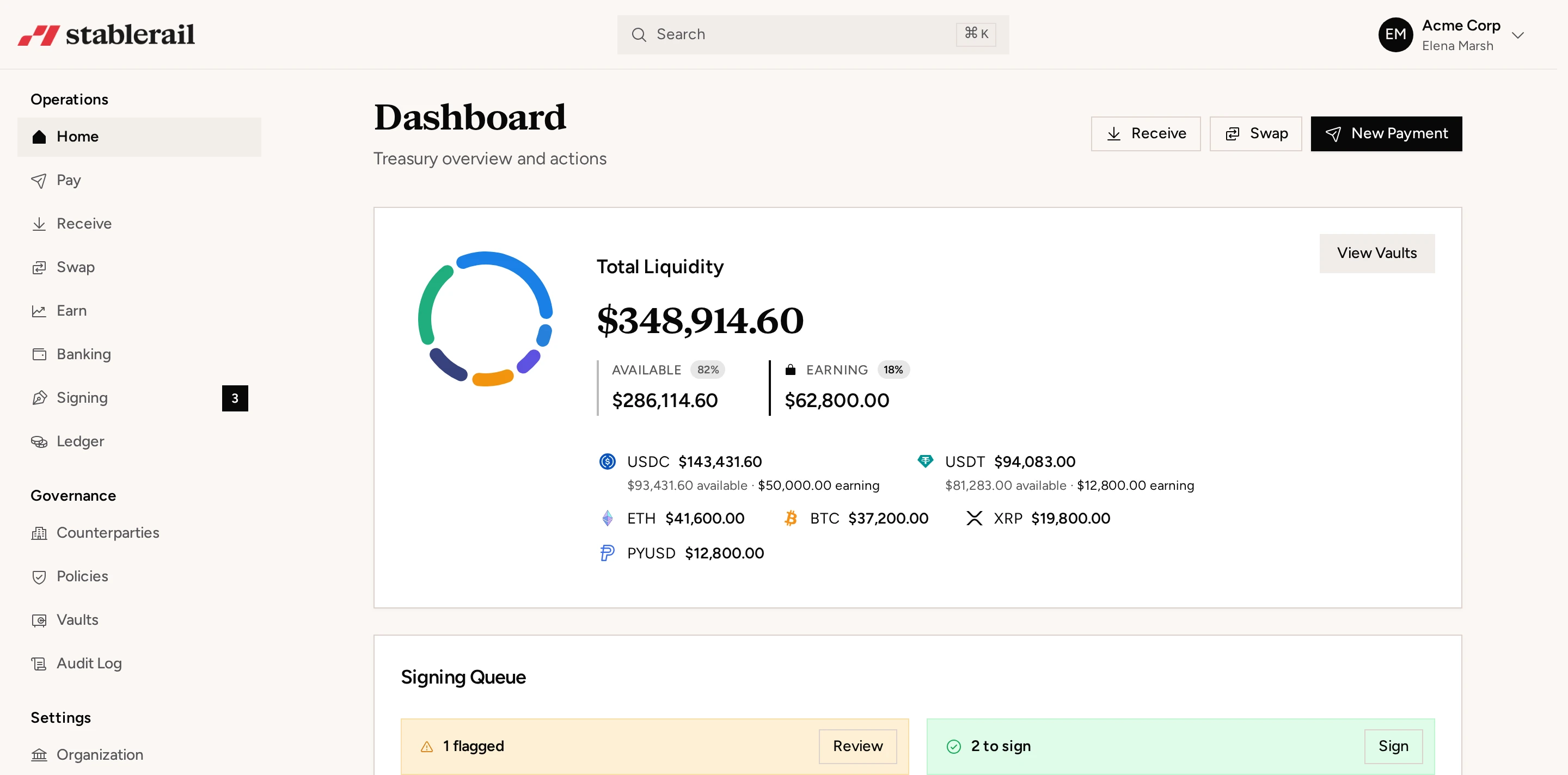
Stablerail provides one business account for USDC and USDT treasury, with approvals and signing quorum, sanctions and address screening before send, corporate cards, global payouts, a fiat off-ramp and exportable audit evidence. As with any provider, availability should be checked against the company’s jurisdiction, transaction profile, required network and intended corridor before funds are committed.
Frequently asked questions
Can a company hold USDT in a business account?
Yes, subject to the provider’s onboarding requirements, jurisdictional coverage and industry eligibility. The company should document the custody arrangement, authorized signers, accounting treatment and approved uses before treating USDT as working capital.
Is a USDT business account safer than an exchange account?
It can provide stronger treasury controls, but the label alone does not make it safer. Compare custody, approval separation, signing quorum, address screening, recovery procedures and exportable evidence rather than relying on the account name.
What is the difference between Tron USDT and Ethereum USDT?
Tron USDT, or USDT-TRC20, runs on Tron, while Ethereum USDT runs on Ethereum as an ERC-20 token. They use different networks and fee mechanisms, so the sender must confirm that the recipient supports the exact network selected.
How do businesses convert USDT to a bank account?
A business sends supported USDT to an off-ramp provider, accepts a conversion quote and instructs a fiat payout over an available bank rail. Total timing includes blockchain confirmations, provider checks, conversion, banking cut-offs and the receiving bank’s processing.
What records should a company keep for USDT payments?
Keep the invoice or payroll record, counterparty, wallet address, network, token amount, transaction hash, approval history, fees and functional-currency valuation. The records should link the blockchain transaction to the general ledger and any later fiat conversion or bank payout.
Finance writers covering stablecoin treasury, payments, compliance, and risk controls.
More about the Stablerail team- Stablecoin treasury managementApprovals, limits, yield and reporting on one balance.
- Stablecoin payoutsBatch contractor and vendor payments with screening.
- USDT vs USDCWhich stablecoin your company should settle in.
- Stablecoin finance glossaryMPC, off-ramp, travel rule and the rest, in plain English.
- Product updatesEverything we ship, month by month.