
USDC Business Account: Setup, Controls and Reporting
A practical guide to USDC business accounts, covering KYB, blockchain networks, fiat funding, payment approvals, conversion costs and month-end reconciliation.
A USDC business account should combine secure USDC receipt and payment capabilities with fiat conversion, role-based approvals, address screening and exportable accounting records. Before going live, finance teams should complete KYB, document approved networks and token contracts, test funding routes, configure signing quorum and payment limits, and establish a month-end process that reconciles account records, blockchain transactions, fees and fiat valuations.
%22%20x1%3D%220%22%20y1%3D%220%22%20x2%3D%221%22%20y2%3D%221%22%3E%0A%20%20%20%20%20%20%20%20%3Cstop%20offset%3D%220%25%22%20stop-color%3D%22%23360A0E%22%20%2F%3E%0A%20%20%20%20%20%20%20%20%3Cstop%20offset%3D%2250%25%22%20stop-color%3D%22%23551217%22%20%2F%3E%0A%20%20%20%20%20%20%20%20%3Cstop%20offset%3D%22100%25%22%20stop-color%3D%22%237A1D20%22%20%2F%3E%0A%20%20%20%20%20%20%3C%2FlinearGradient%3E%0A%20%20%20%20%20%20%3CradialGradient%20id%3D%22glow%22%20cx%3D%22268%22%20cy%3D%22-96%22%20r%3D%22520%22%20gradientUnits%3D%22userSpaceOnUse%22%3E%0A%20%20%20%20%20%20%20%20%3Cstop%20offset%3D%220%25%22%20stop-color%3D%22%23FFA587%22%20stop-opacity%3D%220.45%22%20%2F%3E%0A%20%20%20%20%20%20%20%20%3Cstop%20offset%3D%2255%25%22%20stop-color%3D%22%23FFA587%22%20stop-opacity%3D%220.08%22%20%2F%3E%0A%20%20%20%20%20%20%20%20%3Cstop%20offset%3D%22100%25%22%20stop-color%3D%22%23FFA587%22%20stop-opacity%3D%220%22%20%2F%3E%0A%20%20%20%20%20%20%3C%2FradialGradient%3E%0A%20%20%20%20%20%20%3ClinearGradient%20id%3D%22glass%22%20x1%3D%220%22%20y1%3D%220%22%20x2%3D%221%22%20y2%3D%221%22%3E%0A%20%20%20%20%20%20%20%20%3Cstop%20offset%3D%220%25%22%20stop-color%3D%22%23F8D6D2%22%20stop-opacity%3D%220.26%22%20%2F%3E%0A%20%20%20%20%20%20%20%20%3Cstop%20offset%3D%22100%25%22%20stop-color%3D%22%23FFFFFF%22%20stop-opacity%3D%220.08%22%20%2F%3E%0A%20%20%20%20%20%20%3C%2FlinearGradient%3E%0A%20%20%20%20%20%20%3ClinearGradient%20id%3D%22accent%22%20x1%3D%220%22%20y1%3D%220%22%20x2%3D%221%22%20y2%3D%221%22%3E%0A%20%20%20%20%20%20%20%20%3Cstop%20offset%3D%220%25%22%20stop-color%3D%22%23FFA587%22%20%2F%3E%0A%20%20%20%20%20%20%20%20%3Cstop%20offset%3D%22100%25%22%20stop-color%3D%22%23DC4A38%22%20%2F%3E%0A%20%20%20%20%20%20%3C%2FlinearGradient%3E%0A%20%20%20%20%20%20%3Cfilter%20id%3D%22soft%22%3E%3CfeGaussianBlur%20stdDeviation%3D%2210%22%20%2F%3E%3C%2Ffilter%3E%0A%20%20%20%20%3C%2Fdefs%3E%0A%20%20%20%20%3Crect%20width%3D%221600%22%20height%3D%22900%22%20fill%3D%22url(%23bg)%22%20%2F%3E%0A%20%20%20%20%3Crect%20width%3D%221600%22%20height%3D%22900%22%20fill%3D%22url(%23glow)%22%20%2F%3E%0A%20%20%20%20%3Crect%20x%3D%22260%22%20y%3D%22648%22%20width%3D%2292%22%20height%3D%2272%22%20rx%3D%228%22%20fill%3D%22url(%23accent)%22%20stroke%3D%22%23F4CDC5%22%20stroke-opacity%3D%220.45%22%2F%3E%3Crect%20x%3D%22400%22%20y%3D%22702%22%20width%3D%2292%22%20height%3D%2218%22%20rx%3D%228%22%20fill%3D%22url(%23glass)%22%20stroke%3D%22%23F4CDC5%22%20stroke-opacity%3D%220.45%22%2F%3E%3Crect%20x%3D%22540%22%20y%3D%22896%22%20width%3D%2292%22%20height%3D%22-176%22%20rx%3D%228%22%20fill%3D%22url(%23glass)%22%20stroke%3D%22%23F4CDC5%22%20stroke-opacity%3D%220.45%22%2F%3E%3Crect%20x%3D%22680%22%20y%3D%22854%22%20width%3D%2292%22%20height%3D%22-134%22%20rx%3D%228%22%20fill%3D%22url(%23glass)%22%20stroke%3D%22%23F4CDC5%22%20stroke-opacity%3D%220.45%22%2F%3E%3Crect%20x%3D%22820%22%20y%3D%22844%22%20width%3D%2292%22%20height%3D%22-124%22%20rx%3D%228%22%20fill%3D%22url(%23glass)%22%20stroke%3D%22%23F4CDC5%22%20stroke-opacity%3D%220.45%22%2F%3E%3Crect%20x%3D%22960%22%20y%3D%22661%22%20width%3D%2292%22%20height%3D%2259%22%20rx%3D%228%22%20fill%3D%22url(%23glass)%22%20stroke%3D%22%23F4CDC5%22%20stroke-opacity%3D%220.45%22%2F%3E%3Crect%20x%3D%221100%22%20y%3D%22706%22%20width%3D%2292%22%20height%3D%2214%22%20rx%3D%228%22%20fill%3D%22url(%23glass)%22%20stroke%3D%22%23F4CDC5%22%20stroke-opacity%3D%220.45%22%2F%3E%3Crect%20x%3D%221240%22%20y%3D%22807%22%20width%3D%2292%22%20height%3D%22-87%22%20rx%3D%228%22%20fill%3D%22url(%23glass)%22%20stroke%3D%22%23F4CDC5%22%20stroke-opacity%3D%220.45%22%2F%3E%3Cline%20x1%3D%22240%22%20y1%3D%22724%22%20x2%3D%221430%22%20y2%3D%22724%22%20stroke%3D%22%23F0BBAF%22%20stroke-opacity%3D%220.4%22%20stroke-width%3D%223%22%2F%3E%0A%20%20%20%20%3Crect%20x%3D%2226%22%20y%3D%2226%22%20width%3D%221548%22%20height%3D%22848%22%20rx%3D%2218%22%20fill%3D%22none%22%20stroke%3D%22%23F2D0C8%22%20stroke-opacity%3D%220.12%22%2F%3E%0A%20%20%3C%2Fsvg%3E)
A USDC business account should be operated as treasury infrastructure, not treated as a standalone wallet. The finance team needs defined funding routes, controlled payment approvals, verified network details and records that connect every blockchain transaction to its commercial purpose. The account should also support reconciliation across USDC balances, fiat movements, fees and the general ledger.
What a USDC business account should include
A business account for USDC should bring together functions that otherwise sit across wallets, exchanges, banks and payment platforms. The essential capabilities are:
- USDC treasury: receive, hold and send USDC on approved blockchain networks.
- Fiat access: fund the account from supported bank rails and convert USDC back to fiat where available.
- Payment controls: separate payment creation from approval and require an appropriate signing quorum.
- Counterparty checks: screen wallet addresses before sending and document how new beneficiaries are approved.
- Operational payments: make vendor, contractor, payroll or treasury transfers individually or in batches.
- Finance records: export transactions, approval evidence and supporting data for reconciliation and audit.
USDC is issued by Circle, but a USDC business account provider is not necessarily the issuer. A company comparing options should distinguish direct issuer services from an operating account that combines stablecoin treasury, fiat rails, payouts and finance controls. The relevant choice depends on custody requirements, jurisdiction, transaction corridors and internal control design.
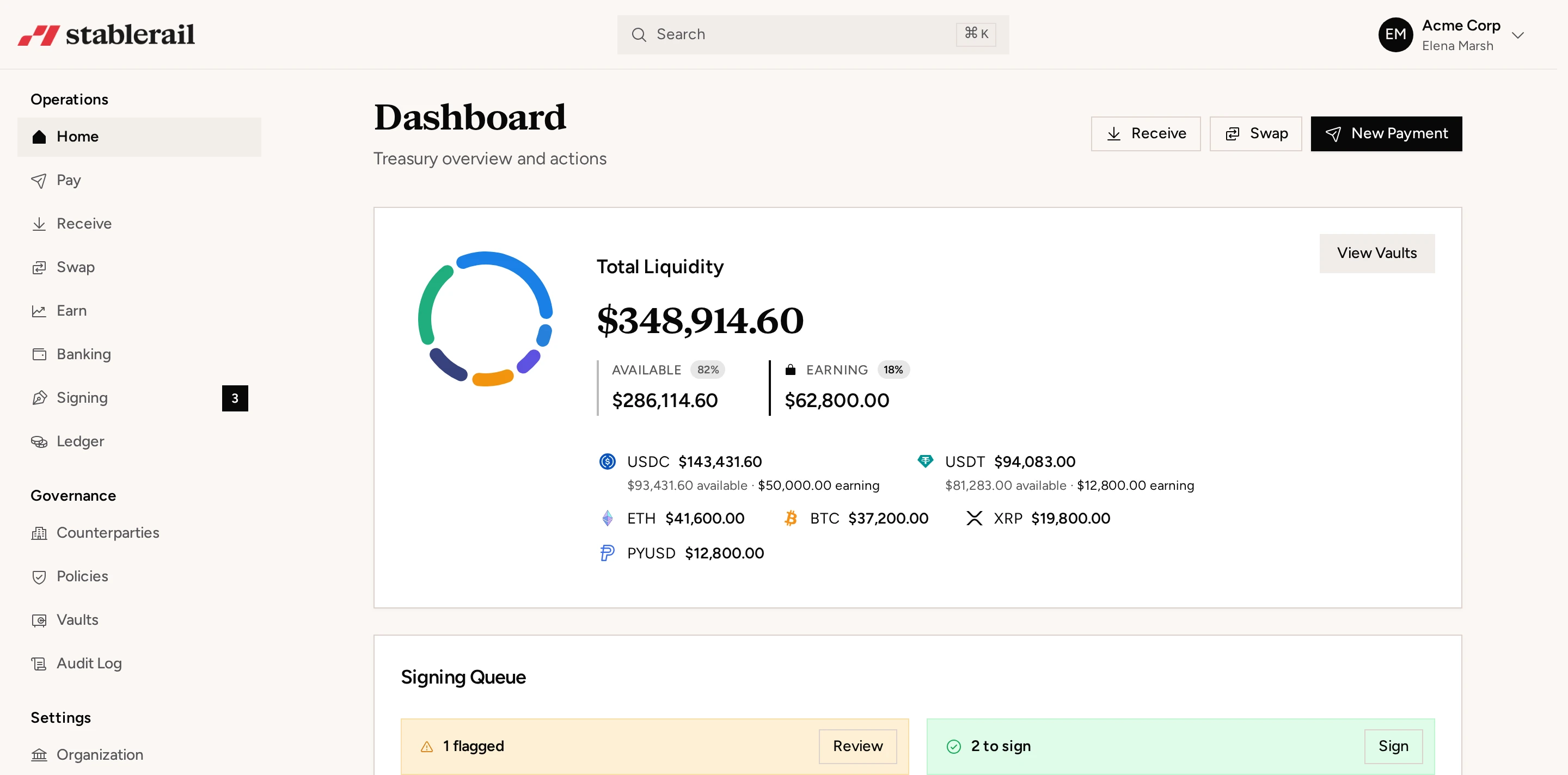
Stablerail provides one business account for USDC and USDT treasury, with approvals and signing quorum, sanctions and address screening before send, corporate cards, global payouts, fiat off-ramp and exportable audit evidence.
1. Complete KYB before planning migration
Opening an account generally starts with know-your-business checks. The scope depends on the company’s jurisdiction, ownership structure, activities, expected transaction profile and counterparties. Finance teams should prepare a complete package rather than submitting documents one at a time.
- Certificate of incorporation or current registry extract.
- Registered office and principal operating address.
- Articles of association or equivalent constitutional documents.
- Ownership chart identifying ultimate beneficial owners.
- Identity and address evidence for directors, owners and account operators.
- Description of the business model, customers, suppliers and expected payment corridors.
- Expected transaction sizes, monthly volumes and source of funds.
- Licences or registrations relevant to regulated activities.
Review time is not determined by document count alone. Layered ownership, missing registry information, regulated activities or exposure to higher-risk jurisdictions can prompt follow-up questions. Confirm account, currency and corridor eligibility before setting a migration date or issuing new payment instructions to customers.
2. Document networks, assets and funding routes
“Send USDC” is not a complete payment instruction. USDC exists on multiple blockchains, and addresses, token contracts and transaction costs vary by network. A sender must use the exact network and supported form of USDC specified by the receiving account.
For each approved route, document the asset name, blockchain, token contract, destination address, required memo or reference, confirmation requirements and responsible owner. Do not assume a bridged representation of USDC will be accepted because its ticker also says USDC. An unsupported asset or network can require manual recovery and may be unrecoverable.
| Funding route | Typical scheme timing | Finance checks |
|---|---|---|
| USDC on-chain transfer | Often seconds to minutes after required confirmations | Confirm network, token contract, address, network fee and screening status |
| SEPA Instant | Usually seconds when both institutions participate | Check participation, transaction limits and beneficiary details |
| SEPA Credit Transfer | Commonly one business day | Check cut-off times, holidays and payment reference |
| ACH | Typically one to three business days | Allow for settlement windows, returns and bank processing |
| Fedwire or CHAPS | Generally same business day before cut-off | Confirm business-hour cut-offs, fees and beneficiary instructions |
| Faster Payments | Often seconds or minutes | Check participant and transaction limits |
| BACS | Typically three working days | Use for scheduled GBP payments rather than urgent funding |
| SWIFT | Often one to five business days | Allow for intermediary banks, compliance checks, FX and lifting fees |
These are payment-scheme conventions, not guaranteed provider settlement times. Compliance reviews, banking partners, weekends, holidays, incorrect details and intermediary institutions can extend delivery. Complete a small deposit and withdrawal on every production route before moving a material balance.
3. Configure treasury controls before funding
The control structure should prevent one person from creating, approving and completing a material payment alone. It should also preserve access if an approver is unavailable without making emergency access routine.
| Control | Purpose | Implementation question |
|---|---|---|
| User roles | Separate administration, payment preparation, approval and reporting | Can an administrator also approve their own payment? |
| Approval thresholds | Add scrutiny as payment value or risk increases | Which payments require a finance manager, CFO or director? |
| Signing quorum | Prevent a single signer from moving treasury funds | How many authorised participants must sign? |
| Address screening | Identify sanctions exposure and relevant blockchain risk indicators before send | What happens when a screening result requires review? |
| Beneficiary approval | Reduce address-substitution and invoice fraud | Who verifies a new address through an independent channel? |
| Payment limits | Constrain operational and fraud exposure | Are limits appropriate for payroll, vendors and treasury transfers? |
Thresholds should reflect actual cash flows. A routine contractor payment, a new beneficiary and a large transfer between treasury wallets do not have the same risk, even if they use the same asset. Define who may approve exceptions and require a written reason that remains attached to the transaction record.
Address screening is a decision input rather than proof that a counterparty is safe. Screening depends on available attribution and blockchain data. Finance and compliance teams still need procedures for false positives, indirect exposure, changed address ownership and requests to replace beneficiary details.
Use an independent address-verification process
Wallet addresses are difficult to inspect visually, and a compromised email or invoice can substitute a valid-looking address. Verify new or changed addresses through a known contact using a separate communication channel. Then send a small test transaction where practical and confirm receipt before releasing the full amount.
4. Calculate the complete conversion cost
The cost of moving from fiat to USDC or from USDC to fiat is broader than the displayed transaction fee. Compare the net amount delivered after every component:
- The quoted conversion rate or spread.
- Corridor or transaction fees.
- Originating, receiving or intermediary bank charges.
- Blockchain network fees.
- FX costs when the settlement currency differs from the functional currency.
- Operational costs from returned, failed or incorrectly routed payments.
Before accepting a quote, record its expiry time, supported settlement currency, minimum or maximum amount, expected completion route and treatment of third-party bank fees. Compare providers using the same source amount and destination currency. A narrow conversion spread can still produce a worse outcome if banking charges or settlement delays reduce the amount received.
5. Build accounting and audit records into the workflow
A transaction hash proves that an on-chain transfer was recorded, but it does not explain why the company made the payment. Accounting evidence must connect the blockchain event to the legal counterparty, invoice, approval and ledger entry.
Retain the following for each USDC transaction:
- Date, time and reporting time zone.
- USDC amount and applicable fiat value.
- Blockchain network, sending and receiving addresses, and transaction hash.
- Counterparty legal name and beneficiary record.
- Invoice, payroll run, intercompany reference or payment purpose.
- Network, conversion and banking fees separated from principal.
- Conversion rate, valuation source and quote reference where applicable.
- Payment creator, approvers, signers and timestamps.
- Screening result, review notes and any approved exception.
Exports should be tested before month-end. Confirm that stable identifiers link transaction records, approvals and source documents, and that reports can be retrieved by more than one authorised person. Evidence should not depend on screenshots or an administrator manually rebuilding the payment history.
Month-end reconciliation for USDC
Reconcile three records: the business account transaction export, the relevant on-chain address balance and the general ledger. Differences may arise from pending confirmations, unsupported deposits, network fees, returned fiat payments, internal transfers or transactions initiated near the reporting cut-off.
- Fix the reporting cut-off and time zone.
- Reconcile opening balance, receipts, payments, fees and closing balance by asset and network.
- Match each transaction hash to its business purpose and ledger entry.
- Investigate pending, failed, returned or unidentified transactions.
- Apply the approved valuation source and timestamp consistently.
- Archive statements, exports, approvals and exception evidence for the period.
USDC is designed to track the US dollar, but finance teams should not assume that one USDC always equals one dollar for accounting purposes. Market value can vary, and classification, tax treatment and financial statement presentation depend on the jurisdiction and the company’s accounting policy. Obtain professional advice for the applicable reporting framework.
Go-live checklist
- KYB approved and product, currency and corridor eligibility confirmed.
- Approved USDC networks and token contracts documented.
- Fiat funding and off-ramp routes tested with small amounts.
- User roles, approval thresholds, limits and signing quorum configured.
- New-beneficiary verification and address-screening procedures assigned.
- Conversion quotes, fees and settlement steps tested.
- Accounting exports and audit evidence reviewed by finance.
- Backup approvers, incident contacts and escalation paths recorded.
A reliable USDC business account should make treasury operations predictable. The strongest setup is one in which finance can identify who authorised every movement, confirm which network and address were used, calculate the complete cost and reconcile the closing balance without reconstructing evidence from emails or blockchain explorers.
Frequently asked questions
What is a USDC business account?
A USDC business account is an operating account that lets a company receive, hold, send and often convert USDC while applying business payment controls. Unlike a basic wallet, it should provide approvals, counterparty checks, transaction exports and evidence for accounting and audit.
What documents are needed to open a USDC business account?
Companies typically need incorporation records, constitutional documents, an ownership chart, beneficial-owner details and identity documents for directors and operators. Providers may also request expected volumes, payment corridors, source-of-funds evidence and licences relevant to regulated activities.
How should a company account for USDC transactions?
Each transaction should be recorded with its USDC amount, fiat valuation, network, transaction hash, counterparty, purpose, fees and approvals. The company should apply a documented valuation source consistently and obtain professional advice on classification, tax and financial statement presentation.
How do businesses safely send USDC?
The sender should confirm the exact blockchain, token contract and beneficiary address, then screen and independently verify the address before payment. Material transfers should use separated roles, multiple approvals or signing quorum, and a small test transaction where practical.
Can a USDC business account convert USDC to fiat?
Some business accounts provide fiat off-ramps and bank payment rails, but availability depends on the company, jurisdiction, currency and corridor. Finance teams should compare the conversion rate, transaction and bank fees, quote expiry, settlement route and net amount delivered.
Finance writers covering stablecoin treasury, payments, compliance, and risk controls.
More about the Stablerail team- Stablecoin treasury managementApprovals, limits, yield and reporting on one balance.
- Stablecoin payoutsBatch contractor and vendor payments with screening.
- USDT vs USDCWhich stablecoin your company should settle in.
- Stablecoin finance glossaryMPC, off-ramp, travel rule and the rest, in plain English.
- Product updatesEverything we ship, month by month.