
Earning Yield on Idle Stablecoin Treasury: Sources, Risks and Liquidity Terms
A practical guide to stablecoin yield for finance teams, covering return sources, net APY, redemption terms, allocation sizing, due diligence and treasury controls.
Idle USDC or USDT can earn yield through government securities, lending, credit or protocol incentives, but the return is not equivalent to insured bank interest. Finance teams should trace the economic source of yield, calculate the net return after all costs, confirm the full path and timing of redemption, and identify who bears losses if a stablecoin, borrower, custodian, intermediary or smart contract fails.
%22%20x1%3D%220%22%20y1%3D%220%22%20x2%3D%221%22%20y2%3D%221%22%3E%0A%20%20%20%20%20%20%20%20%3Cstop%20offset%3D%220%25%22%20stop-color%3D%22%232E0709%22%20%2F%3E%0A%20%20%20%20%20%20%20%20%3Cstop%20offset%3D%2250%25%22%20stop-color%3D%22%234A0F14%22%20%2F%3E%0A%20%20%20%20%20%20%20%20%3Cstop%20offset%3D%22100%25%22%20stop-color%3D%22%236B181C%22%20%2F%3E%0A%20%20%20%20%20%20%3C%2FlinearGradient%3E%0A%20%20%20%20%20%20%3CradialGradient%20id%3D%22glow%22%20cx%3D%22866%22%20cy%3D%22222%22%20r%3D%22520%22%20gradientUnits%3D%22userSpaceOnUse%22%3E%0A%20%20%20%20%20%20%20%20%3Cstop%20offset%3D%220%25%22%20stop-color%3D%22%23FFB199%22%20stop-opacity%3D%220.45%22%20%2F%3E%0A%20%20%20%20%20%20%20%20%3Cstop%20offset%3D%2255%25%22%20stop-color%3D%22%23FFB199%22%20stop-opacity%3D%220.08%22%20%2F%3E%0A%20%20%20%20%20%20%20%20%3Cstop%20offset%3D%22100%25%22%20stop-color%3D%22%23FFB199%22%20stop-opacity%3D%220%22%20%2F%3E%0A%20%20%20%20%20%20%3C%2FradialGradient%3E%0A%20%20%20%20%20%20%3ClinearGradient%20id%3D%22glass%22%20x1%3D%220%22%20y1%3D%220%22%20x2%3D%221%22%20y2%3D%221%22%3E%0A%20%20%20%20%20%20%20%20%3Cstop%20offset%3D%220%25%22%20stop-color%3D%22%23F8D6D2%22%20stop-opacity%3D%220.26%22%20%2F%3E%0A%20%20%20%20%20%20%20%20%3Cstop%20offset%3D%22100%25%22%20stop-color%3D%22%23FFFFFF%22%20stop-opacity%3D%220.08%22%20%2F%3E%0A%20%20%20%20%20%20%3C%2FlinearGradient%3E%0A%20%20%20%20%20%20%3ClinearGradient%20id%3D%22accent%22%20x1%3D%220%22%20y1%3D%220%22%20x2%3D%221%22%20y2%3D%221%22%3E%0A%20%20%20%20%20%20%20%20%3Cstop%20offset%3D%220%25%22%20stop-color%3D%22%23FFB199%22%20%2F%3E%0A%20%20%20%20%20%20%20%20%3Cstop%20offset%3D%22100%25%22%20stop-color%3D%22%23E85D3A%22%20%2F%3E%0A%20%20%20%20%20%20%3C%2FlinearGradient%3E%0A%20%20%20%20%20%20%3Cfilter%20id%3D%22soft%22%3E%3CfeGaussianBlur%20stdDeviation%3D%2210%22%20%2F%3E%3C%2Ffilter%3E%0A%20%20%20%20%3C%2Fdefs%3E%0A%20%20%20%20%3Crect%20width%3D%221600%22%20height%3D%22900%22%20fill%3D%22url(%23bg)%22%20%2F%3E%0A%20%20%20%20%3Crect%20width%3D%221600%22%20height%3D%22900%22%20fill%3D%22url(%23glow)%22%20%2F%3E%0A%20%20%20%20%0A%20%20%3Crect%20x%3D%22480%22%20y%3D%22200%22%20width%3D%22640%22%20height%3D%22500%22%20rx%3D%2232%22%20fill%3D%22url(%23glass)%22%20stroke%3D%22%23F4CDC5%22%20stroke-opacity%3D%220.6%22%20stroke-width%3D%223%22%2F%3E%0A%20%20%3Ccircle%20cx%3D%22800%22%20cy%3D%22450%22%20r%3D%22180%22%20fill%3D%22none%22%20stroke%3D%22%23F4CDC5%22%20stroke-opacity%3D%220.6%22%20stroke-width%3D%226%22%2F%3E%0A%20%20%3Ccircle%20cx%3D%22800%22%20cy%3D%22450%22%20r%3D%22130%22%20fill%3D%22url(%23glass)%22%20stroke%3D%22%23F4CDC5%22%20stroke-opacity%3D%220.5%22%2F%3E%0A%20%20%3Ccircle%20cx%3D%22800%22%20cy%3D%22450%22%20r%3D%2236%22%20fill%3D%22url(%23accent)%22%2F%3E%0A%20%20%3Crect%20x%3D%22924.0741765389851%22%20y%3D%22546.8103300733387%22%20width%3D%2216%22%20height%3D%2236%22%20rx%3D%223%22%20fill%3D%22%23F4CDC5%22%20opacity%3D%220.7%22%20transform%3D%22rotate(41%20932.0741765389851%20564.8103300733387)%22%2F%3E%3Crect%20x%3D%22804.207382905222%22%20y%3D%22606.5737087954692%22%20width%3D%2216%22%20height%3D%2236%22%20rx%3D%223%22%20fill%3D%22%23F4CDC5%22%20opacity%3D%220.7%22%20transform%3D%22rotate(86%20812.207382905222%20624.5737087954692)%22%2F%3E%3Crect%20x%3D%22677.1896699266612%22%20y%3D%22564.0741765389851%22%20width%3D%2216%22%20height%3D%2236%22%20rx%3D%223%22%20fill%3D%22%23F4CDC5%22%20opacity%3D%220.7%22%20transform%3D%22rotate(131%20685.1896699266612%20582.0741765389851)%22%2F%3E%3Crect%20x%3D%22617.4262912045308%22%20y%3D%22444.20738290522195%22%20width%3D%2216%22%20height%3D%2236%22%20rx%3D%223%22%20fill%3D%22%23F4CDC5%22%20opacity%3D%220.7%22%20transform%3D%22rotate(176%20625.4262912045308%20462.20738290522195)%22%2F%3E%3Crect%20x%3D%22659.9258234610149%22%20y%3D%22317.1896699266612%22%20width%3D%2216%22%20height%3D%2236%22%20rx%3D%223%22%20fill%3D%22%23F4CDC5%22%20opacity%3D%220.7%22%20transform%3D%22rotate(221%20667.9258234610149%20335.1896699266612)%22%2F%3E%3Crect%20x%3D%22779.792617094778%22%20y%3D%22257.4262912045308%22%20width%3D%2216%22%20height%3D%2236%22%20rx%3D%223%22%20fill%3D%22%23F4CDC5%22%20opacity%3D%220.7%22%20transform%3D%22rotate(266%20787.792617094778%20275.4262912045308)%22%2F%3E%3Crect%20x%3D%22906.8103300733387%22%20y%3D%22299.92582346101483%22%20width%3D%2216%22%20height%3D%2236%22%20rx%3D%223%22%20fill%3D%22%23F4CDC5%22%20opacity%3D%220.7%22%20transform%3D%22rotate(311%20914.8103300733387%20317.92582346101483)%22%2F%3E%3Crect%20x%3D%22966.5737087954692%22%20y%3D%22419.79261709477817%22%20width%3D%2216%22%20height%3D%2236%22%20rx%3D%223%22%20fill%3D%22%23F4CDC5%22%20opacity%3D%220.7%22%20transform%3D%22rotate(356%20974.5737087954692%20437.79261709477817)%22%2F%3E%0A%0A%20%20%20%20%3Crect%20x%3D%2226%22%20y%3D%2226%22%20width%3D%221548%22%20height%3D%22848%22%20rx%3D%2218%22%20fill%3D%22none%22%20stroke%3D%22%23F2D0C8%22%20stroke-opacity%3D%220.12%22%2F%3E%0A%20%20%3C%2Fsvg%3E)
Stablecoin yield can put surplus USDC or USDT to work, but the headline APY is only one part of the decision. A treasury team must understand what produces the return, which entities and contracts control the assets, how quickly the position can become spendable money, and what could prevent full repayment. Funds needed for payroll, taxes, vendors or near-term conversions should not be allocated solely because a product advertises a higher rate.
How stablecoin yield works
A company typically transfers stablecoins from an operating wallet or business account into a separate earning product. Depending on its structure, the provider may convert the stablecoins into fund shares, issue an interest-bearing token, lend the assets to borrowers or deposit them into an onchain market.
The displayed annual percentage yield is usually variable and annualized. It is not a promise that the same rate will remain available for a full year. Ignoring compounding, a $1 million position held for 90 days at a constant 5% annual rate would earn approximately $12,329 before provider fees, network costs, taxes and changes in asset value. The basic calculation is principal multiplied by annual rate multiplied by days held, divided by 365.
Finance teams should calculate an expected net yield rather than compare gross APYs. Relevant deductions can include subscription or redemption fees, management fees, blockchain transaction costs, stablecoin conversion spreads, bank charges and the cost of idle time during settlement. Token incentives should be valued conservatively using the amount that can realistically be sold, not merely the displayed token price.
Where stablecoin yield comes from
| Yield source | How the return is generated | Typical liquidity constraints | Principal risks |
|---|---|---|---|
| Short-term US Treasury bills | Interest and the difference between purchase price and face value | Direct holdings mature on set dates; funds and tokens have cut-offs and settlement rules | Interest-rate, custody, intermediary and product-structure risk |
| Government money market funds | Income from short-dated government securities and repurchase agreements | Usually governed by business-day processing and fund redemption terms | Fund, custodian, settlement and stablecoin-conversion risk |
| Onchain lending | Interest paid by borrowers using a lending pool | Withdrawal depends on unborrowed pool liquidity, not just blockchain speed | Smart-contract, oracle, collateral, liquidation and liquidity risk |
| Centralized lending or private credit | Interest paid by institutional or commercial borrowers | May include notice periods, fixed terms or early-redemption restrictions | Credit, counterparty, concentration and insolvency risk |
| Protocol incentives | Tokens distributed to attract deposits or liquidity | Tokens may be claimable but difficult to sell in size at the quoted price | Token-price, market-depth, governance and incentive-reduction risk |
Treasury-backed and money market products
Short-term US Treasury bills are obligations of the US government, but a product described as Treasury-backed is not necessarily equivalent to owning a Treasury bill directly. The structure may involve an issuer, fund manager, broker, custodian, bank and token administrator. Each layer can add legal, operational and settlement risk.
Determine whether the company owns a regulated fund share, a token representing a claim on assets, or only a contractual balance owed by the provider. Review the identity of the legal issuer, asset segregation, transfer restrictions, eligible investor requirements, fees and insolvency treatment. Also establish whether redemptions are processed only during US business hours and what happens on weekends or market holidays.
Onchain lending
Onchain lending pools allow suppliers of stablecoins to earn interest paid by borrowers. Rates often rise as pool utilization increases and fall as additional supply enters the pool. The current rate may be observable onchain, but it remains variable unless a separate agreement fixes it.
Blockchain settlement speed should not be confused with economic liquidity. A withdrawal transaction might confirm quickly, yet the full position may be unavailable if most assets have been borrowed. In a highly utilized pool, lenders may need to wait for borrower repayments, liquidations or new deposits. Teams should examine utilization, collateral types, oracle design, liquidation mechanics, administrative permissions and any withdrawal queue.
Centralized lending and private credit
Centralized products may lend stablecoins or converted fiat to trading firms, market makers or commercial borrowers. Their return is fundamentally credit income. Ask whether loans are secured, what collateral is accepted, how collateral is valued, whether claims rank ahead of or behind other creditors, and how much exposure is concentrated in the largest borrowers.
A fixed term or stable-looking rate does not eliminate risk. It can instead make deterioration less visible while limiting the treasury's ability to exit. Contractual withdrawal rights, financial reporting and default provisions matter more than the convenience of the interface.
Liquidity terms matter as much as APY
Compare products using the time required to return spendable USDC, USDT or fiat to the operating account. The ability to submit a request immediately does not mean the company can immediately use the proceeds.
| Liquidity term | What it generally means | Treasury question to resolve |
|---|---|---|
| On demand | A request can be made at any time, subject to available liquidity, screening and network operation | Is the entire position redeemable during market stress? |
| Same day | Requests received before a cut-off may settle that business day | Which time zone, business calendar and cut-off apply? |
| T+1 or T+2 | Proceeds settle one or two business days after the redemption date | Can weekends, holidays or conversion steps extend elapsed time? |
| Notice period | Advance notice is required before redemption begins | Can the provider extend, suspend or reject a request? |
| Fixed term | Principal is committed until a stated maturity | Is early exit possible, and at what cost or discount? |
Confirm minimum redemption sizes, daily limits, fees, supported networks and the asset returned. A product that accepts USDC but redeems only to bank dollars creates conversion and banking dependencies. A tokenized position that must first be sold on a secondary market introduces market depth, spread and price risk.
Risks to include in the treasury review
Counterparty, custody and legal risk
Map every party that can control, invest, lend or hold the assets. Review whether customer property is segregated, which agreement governs the claim, the relevant jurisdiction and the described treatment if a provider, borrower, broker or custodian becomes insolvent. Contractual language should be reviewed by qualified counsel; labels such as secured or custodial are not substitutes for examining the documents.
Stablecoin and conversion risk
The underlying investment can perform as intended while USDC or USDT trades below its target value. Moving among stablecoins, bank dollars and interest-bearing tokens can add spreads, fees, settlement gaps and exposure to multiple issuers. The redemption plan should therefore cover both the yield product and the stablecoin used to enter or exit it.
Smart-contract and network risk
Onchain products depend on code, price feeds, governance controls, administrators and blockchain infrastructure. Security audits can provide useful evidence but cannot eliminate software or governance risk. Teams should identify upgrade permissions, emergency controls and supported networks. Bridging treasury assets solely to reach a higher APY adds another smart-contract and liquidity dependency.
Rate and concentration risk
Variable rates can fall after funds are committed. Model expected income at a lower rate and do not depend on variable yield to fund a fixed operating obligation. Set limits by provider, protocol, stablecoin, network, custodian and underlying yield source so apparently different products do not create hidden concentration in the same borrower or asset pool.
How much treasury should earn yield?
Start with forecast cash needs rather than a target allocation percentage. Divide balances into three liquidity tiers:
- Operating balance: payroll, taxes, vendors, cards and expected conversions over approximately the next 30 days. Keep this immediately accessible.
- Liquidity reserve: a buffer for forecast errors, delayed receivables, stablecoin conversion problems and unexpected payments. If invested, use terms aligned with the stress horizon.
- Strategic balance: funds not expected to be required for several months. This is the more suitable pool for notice-period or fixed-term products.
Suppose a company holds $5 million in stablecoins, forecasts $1.2 million of net outflows over 30 days and applies a $300,000 operating buffer. It would ring-fence at least $1.5 million for immediate needs. If another $1 million may be required during the following 60 days, that amount should remain liquid or use a short-redemption product. The remaining $2.5 million is only the maximum candidate for longer-term allocation, not an automatic investment amount. Forecast uncertainty, concentration limits and stress tests may reduce it further.
A pre-allocation checklist for finance teams
- Trace the funds from the treasury account to the final asset, borrower or smart contract.
- Record gross APY, all fees, conversion costs and the expected net annualized return.
- Identify the issuer, custodian, manager, borrowers, governing entity and jurisdictions.
- Document normal, stressed and maximum redemption timelines, including cut-offs and holidays.
- Test a small subscription and full redemption using the intended wallet, stablecoin and network.
- Set allocation and concentration limits, with approval required for increases or term extensions.
- Confirm accounting classification, valuation, income recognition, reconciliation and tax treatment with advisers.
- Monitor rates, utilization, stablecoin prices, contract changes and provider communications.
Keep yield separate from operating controls
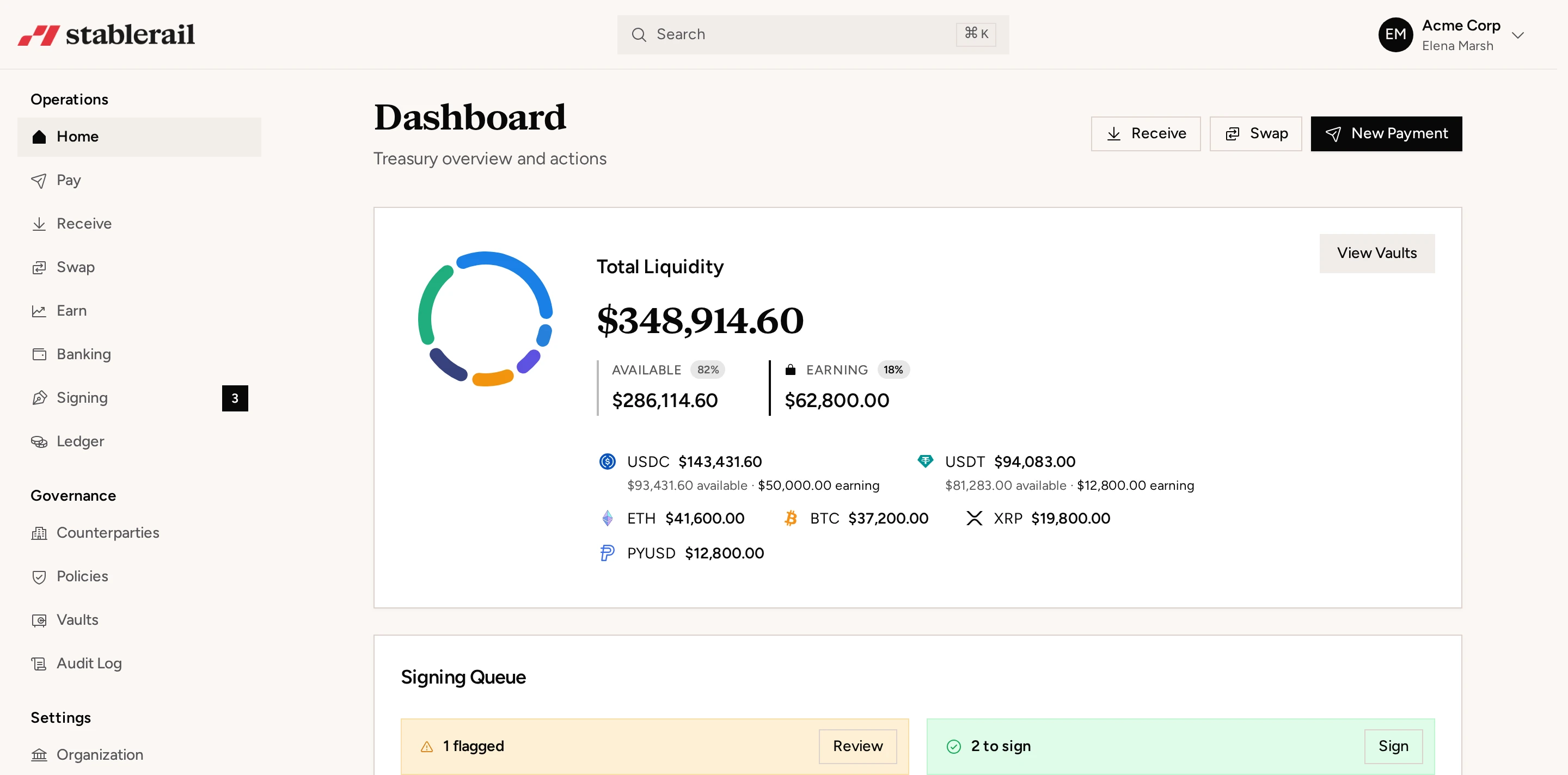
The earning position should remain visible within the wider treasury process. Reconcile principal, accrued income, fees and redemptions independently, and retain agreements, approvals, wallet records and transaction evidence. Stablerail can support the operating side of stablecoin treasury with USDC and USDT accounts, approval and signing quorum, address screening before sends, global payouts, fiat off-ramp and exportable audit evidence.
Yield is most useful when it follows the company's liquidity plan rather than driving it. Preserve enough immediately accessible funds for normal and stressed operations, then compare the remaining net return with the additional credit, custody, technology, conversion and withdrawal risks.
Frequently asked questions
Is stablecoin yield the same as interest on a bank deposit?
No. Stablecoin yield may come from securities, lending, private credit or token incentives, and it can expose the company to custody, credit, smart-contract and liquidity risks. Finance teams should identify the underlying source and legal claim rather than treating the quoted APY as deposit interest.
How should a treasury compare USDC yield products?
Compare the expected net return after fees and conversions, the underlying yield source, legal structure, counterparties and time to receive spendable funds. Also assess stressed withdrawal conditions, stablecoin exposure, network risk and concentration across providers or borrowers.
Can an onchain lending position always be withdrawn immediately?
No. A blockchain transaction can settle quickly, but withdrawal still depends on unborrowed liquidity in the lending pool. High utilization may force a lender to wait for borrower repayments, liquidations or new deposits.
How much idle stablecoin should a company invest for yield?
The amount should be based on cash forecasts and stress scenarios, not a standard percentage. Ring-fence operating needs and a liquidity reserve first, then apply concentration limits and risk tolerances to the remaining longer-horizon balance.
What documents should finance teams retain for a stablecoin yield allocation?
Retain approvals, agreements, subscription and redemption records, wallet transactions, fee calculations, valuations and reconciliations. Teams should also document the accounting treatment, yield source, counterparties, liquidity terms and evidence supporting periodic risk reviews.
Finance writers covering stablecoin treasury, payments, compliance, and risk controls.
More about the Stablerail team- Stablecoin treasury managementApprovals, limits, yield and reporting on one balance.
- Stablecoin payoutsBatch contractor and vendor payments with screening.
- USDT vs USDCWhich stablecoin your company should settle in.
- Stablecoin finance glossaryMPC, off-ramp, travel rule and the rest, in plain English.
- Product updatesEverything we ship, month by month.