
What Happens If a Team Member Loses Access? A Company Recovery Plan
A practical recovery plan for stablecoin finance teams covering lost devices, unavailable signers, quorum design, employee offboarding, payment continuity and audit evidence.
If a team member loses access, first determine whether the failure affects their device, account login or transaction-signing authority. Contain any suspected compromise, confirm the remaining team can satisfy the signing quorum and activate a trained backup signer. If quorum is unavailable, follow the documented recovery process. Preserve logs, protect critical payment deadlines and replace—not merely disable—departing signers before removing their access.
%22%20x1%3D%220%22%20y1%3D%220%22%20x2%3D%221%22%20y2%3D%221%22%3E%0A%20%20%20%20%20%20%20%20%3Cstop%20offset%3D%220%25%22%20stop-color%3D%22%232A0608%22%20%2F%3E%0A%20%20%20%20%20%20%20%20%3Cstop%20offset%3D%2250%25%22%20stop-color%3D%22%23420D12%22%20%2F%3E%0A%20%20%20%20%20%20%20%20%3Cstop%20offset%3D%22100%25%22%20stop-color%3D%22%23621619%22%20%2F%3E%0A%20%20%20%20%20%20%3C%2FlinearGradient%3E%0A%20%20%20%20%20%20%3CradialGradient%20id%3D%22glow%22%20cx%3D%221364%22%20cy%3D%22579%22%20r%3D%22520%22%20gradientUnits%3D%22userSpaceOnUse%22%3E%0A%20%20%20%20%20%20%20%20%3Cstop%20offset%3D%220%25%22%20stop-color%3D%22%23FF9577%22%20stop-opacity%3D%220.45%22%20%2F%3E%0A%20%20%20%20%20%20%20%20%3Cstop%20offset%3D%2255%25%22%20stop-color%3D%22%23FF9577%22%20stop-opacity%3D%220.08%22%20%2F%3E%0A%20%20%20%20%20%20%20%20%3Cstop%20offset%3D%22100%25%22%20stop-color%3D%22%23FF9577%22%20stop-opacity%3D%220%22%20%2F%3E%0A%20%20%20%20%20%20%3C%2FradialGradient%3E%0A%20%20%20%20%20%20%3ClinearGradient%20id%3D%22glass%22%20x1%3D%220%22%20y1%3D%220%22%20x2%3D%221%22%20y2%3D%221%22%3E%0A%20%20%20%20%20%20%20%20%3Cstop%20offset%3D%220%25%22%20stop-color%3D%22%23F8D6D2%22%20stop-opacity%3D%220.26%22%20%2F%3E%0A%20%20%20%20%20%20%20%20%3Cstop%20offset%3D%22100%25%22%20stop-color%3D%22%23FFFFFF%22%20stop-opacity%3D%220.08%22%20%2F%3E%0A%20%20%20%20%20%20%3C%2FlinearGradient%3E%0A%20%20%20%20%20%20%3ClinearGradient%20id%3D%22accent%22%20x1%3D%220%22%20y1%3D%220%22%20x2%3D%221%22%20y2%3D%221%22%3E%0A%20%20%20%20%20%20%20%20%3Cstop%20offset%3D%220%25%22%20stop-color%3D%22%23FF9577%22%20%2F%3E%0A%20%20%20%20%20%20%20%20%3Cstop%20offset%3D%22100%25%22%20stop-color%3D%22%23D03B2D%22%20%2F%3E%0A%20%20%20%20%20%20%3C%2FlinearGradient%3E%0A%20%20%20%20%20%20%3Cfilter%20id%3D%22soft%22%3E%3CfeGaussianBlur%20stdDeviation%3D%2210%22%20%2F%3E%3C%2Ffilter%3E%0A%20%20%20%20%3C%2Fdefs%3E%0A%20%20%20%20%3Crect%20width%3D%221600%22%20height%3D%22900%22%20fill%3D%22url(%23bg)%22%20%2F%3E%0A%20%20%20%20%3Crect%20width%3D%221600%22%20height%3D%22900%22%20fill%3D%22url(%23glow)%22%20%2F%3E%0A%20%20%20%20%3Crect%20x%3D%22260%22%20y%3D%22386%22%20width%3D%22100%22%20height%3D%22114%22%20rx%3D%226%22%20fill%3D%22url(%23accent)%22%20stroke%3D%22%23F4CDC5%22%20stroke-opacity%3D%220.4%22%2F%3E%3Crect%20x%3D%22420%22%20y%3D%22260%22%20width%3D%22100%22%20height%3D%22126%22%20rx%3D%226%22%20fill%3D%22url(%23accent)%22%20stroke%3D%22%23F4CDC5%22%20stroke-opacity%3D%220.4%22%2F%3E%3Crect%20x%3D%22580%22%20y%3D%22131%22%20width%3D%22100%22%20height%3D%22129%22%20rx%3D%226%22%20fill%3D%22url(%23accent)%22%20stroke%3D%22%23F4CDC5%22%20stroke-opacity%3D%220.4%22%2F%3E%3Crect%20x%3D%22740%22%20y%3D%2247%22%20width%3D%22100%22%20height%3D%2284%22%20rx%3D%226%22%20fill%3D%22url(%23accent)%22%20stroke%3D%22%23F4CDC5%22%20stroke-opacity%3D%220.4%22%2F%3E%3Crect%20x%3D%22900%22%20y%3D%2247%22%20width%3D%22100%22%20height%3D%2252%22%20rx%3D%226%22%20fill%3D%22url(%23glass)%22%20stroke%3D%22%23F4CDC5%22%20stroke-opacity%3D%220.4%22%2F%3E%3Crect%20x%3D%221060%22%20y%3D%2299%22%20width%3D%22100%22%20height%3D%2266%22%20rx%3D%226%22%20fill%3D%22url(%23glass)%22%20stroke%3D%22%23F4CDC5%22%20stroke-opacity%3D%220.4%22%2F%3E%3Crect%20x%3D%221220%22%20y%3D%22165%22%20width%3D%22100%22%20height%3D%22114%22%20rx%3D%226%22%20fill%3D%22url(%23glass)%22%20stroke%3D%22%23F4CDC5%22%20stroke-opacity%3D%220.4%22%2F%3E%3Cline%20x1%3D%22240%22%20y1%3D%22720%22%20x2%3D%221400%22%20y2%3D%22720%22%20stroke%3D%22%23F0BBAF%22%20stroke-opacity%3D%220.4%22%20stroke-width%3D%223%22%2F%3E%0A%20%20%20%20%3Crect%20x%3D%2226%22%20y%3D%2226%22%20width%3D%221548%22%20height%3D%22848%22%20rx%3D%2218%22%20fill%3D%22none%22%20stroke%3D%22%23F2D0C8%22%20stroke-opacity%3D%220.12%22%2F%3E%0A%20%20%3C%2Fsvg%3E)
If a team member loses access, first determine whether the failure affects their device, account login or transaction-signing authority. Contain any suspected compromise, confirm the remaining team can satisfy the signing quorum and activate a trained backup signer. If quorum is unavailable, follow the documented recovery process. Preserve logs, protect critical payment deadlines and replace—not merely disable—departing signers before removing their access.
Identify exactly what access has been lost
A lost phone, inaccessible email account or sudden employee departure should not stop payroll, vendor payouts or treasury operations. For companies moving USDC or USDT, however, “lost access” can describe several different failures. Resetting a login will not necessarily restore the authority required to sign a blockchain transaction.
Account recovery restores a person’s ability to enter the platform. Signing or key recovery restores or replaces the authority needed to approve transactions. Business continuity is broader: it ensures the company can keep making authorised payments while an individual user is unavailable.
| Incident | Likely effect | Immediate action | Continuity route |
|---|---|---|---|
| Lost phone or laptop | One signer may be unable to approve, and the device may be exposed | Revoke or disable affected access, preserve evidence and assess compromise | Use the remaining quorum or an approved backup signer |
| Lost login credentials | The user cannot enter the business account | Start identity-verified account recovery | Allow other authorised users to prepare and approve urgent payments |
| Unavailable signing share | Login may work, but transactions cannot receive that signer’s approval | Determine whether the share is inaccessible or potentially compromised | Use backup signers or the documented signing-recovery process |
| Employee departure | A former employee may retain account, card or signing authority | Coordinate removal across finance, IT and HR | Install and test a replacement before removing the departing signer where possible |
| Multiple unavailable signers | The company cannot satisfy quorum | Pause non-essential transfers and invoke formal recovery | Use a pre-approved alternative payment route for critical obligations |
| Suspected compromise | An unauthorised person may control a login or device | Restrict outgoing activity, revoke access and review recent changes | Resume only after authority, recipients and balances have been verified |
Do not treat a suspected compromise as a routine password reset. Containment comes first: restrict outgoing payments where possible, review recent approvals and recipient changes, and preserve logs before evidence is overwritten or scattered across systems.
Design the signing quorum for absence
Multi-party computation, or MPC, can distribute signing authority so that one person does not hold a complete private key. A signing quorum defines how many authorised participants must approve a transaction. The operational benefit depends on the quorum and signer roster, not the MPC label alone.
A two-of-three arrangement, for example, can continue when one signer is unavailable. A three-of-five arrangement can tolerate two unavailable signers. These are design examples, not universal recommendations: the right structure depends on payment values, frequency, staffing, time zones and the separation required between preparation and approval.
| Quorum design question | Why it matters | Evidence to review |
|---|---|---|
| Can operations continue without the CFO? | Executive travel, illness or device loss should not block routine payments | Signer roster and completed recovery test |
| Are signers in separate failure domains? | People using the same office, identity provider or device-management system may become unavailable together | Locations, authentication dependencies and contact methods |
| Can one person prepare and execute a payment? | Excess authority weakens segregation of duties | User roles, approval records and transaction workflow |
| Does every vault retain coverage after offboarding? | Removing one signer may break a less frequently used vault | Vault-by-vault quorum map |
| Can urgent payments meet external cut-offs? | Access may be restored after the applicable fiat payment window | Payroll dates, bank cut-offs and supplier deadlines |
A larger signer group can improve redundancy but also increases administration and the number of identities that must be secured. A lower threshold can accelerate payments but may reduce separation of duties. Finance and security teams should document the trade-off rather than choosing a quorum solely for convenience.
Appoint backup signers who can actually act
A backup signer should be a trained participant, not a name added to an access list and forgotten. Suitable backups may include a controller, another executive or an authorised director. They need an active, tested access path and a clear understanding of which payments they may approve.
Each backup should be able to verify the payment request, legal entity, recipient address, token and blockchain network. USDC or USDT can exist on multiple networks, and an address alone does not prove that the recipient can accept the selected asset and network. Screening and recipient verification should still occur during recovery; urgency is not a reason to bypass controls.
Avoid placing all backups behind the same failure point. If every signer relies on one company email tenant, one office or one identity administrator, an outage can defeat apparently adequate signer redundancy. Alternative contact routes should be company-approved, protected and maintained without relying on personal accounts as the permanent control system.
Create a recovery runbook finance can use under pressure
The runbook should be short, role-based and available to authorised staff even when the primary email or identity system is unavailable. It should explain where protected recovery material is held, but it should not contain passwords, signing secrets or recovery credentials.
- Name the incident owner. Assign the role responsible for containment, decisions, communications and closure.
- Maintain a signer and quorum map. List primary and backup signers for every vault, account and approval workflow.
- Document verification requirements. Identify the corporate records, officer authority and internal approvals needed to change access.
- Define payment priorities. Rank payroll, tax, critical suppliers, customer obligations and treasury transfers.
- Record escalation routes. Include finance, security, legal, HR and provider contacts through independently verified channels.
- Specify evidence to retain. Capture the incident timeline, access changes, approvals, transaction records and remediation decisions.
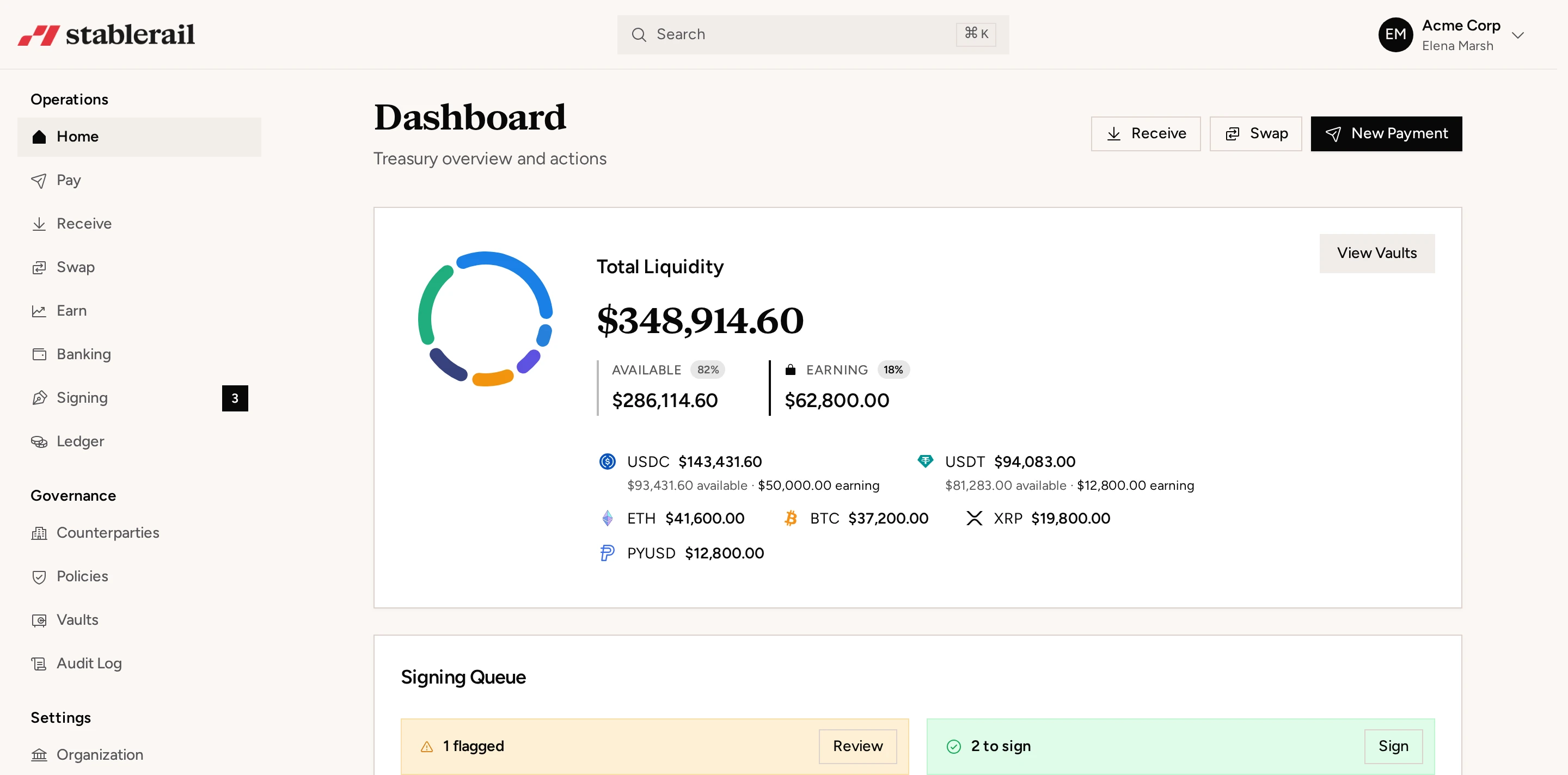
Stablerail provides one business account for USDC and USDT treasury with approvals and signing quorum, sanctions and address screening before send, corporate cards, global payouts, fiat off-ramp and exportable audit evidence. A recovery runbook should map each relevant function to an owner and fallback rather than treating wallet access as the only dependency.
Set recovery targets around real payment deadlines
A recovery time objective is the maximum acceptable period before a critical process is restored. Set internal targets by process and work backward from payroll files, tax due dates, supplier commitments and treasury funding needs. Targets should be company decisions, not assumptions about a provider’s response time.
| Process | Planning trigger | Fallback to document |
|---|---|---|
| Contain a lost or exposed device | As soon as loss or compromise is confirmed | Security escalation and restriction of outgoing activity |
| Restore routine quorum coverage | Before the next scheduled approval window | Activate an approved backup signer |
| Replace a departing signer | Before the final working day when circumstances permit | Increase monitoring and use remaining authorised signers temporarily |
| Resume critical payouts | Before the applicable payroll, tax or supplier cut-off | Use an approved alternative fiat or stablecoin route |
Blockchain networks may operate continuously, but related fiat rails do not share one schedule. ACH, Fedwire, SEPA, CHAPS and SWIFT have different operating windows, holidays and settlement mechanics. Restoring platform access after a relevant cut-off may still make the payment late, so the plan must cover execution as well as authentication.
Treat employee offboarding as a recovery event
Offboarding is predictable access loss. Before a planned departure, identify every vault, fiat balance, card, recipient list, payment workflow and approval rule connected to the employee. Add and test the replacement signer before removal, then revoke sessions, remove permissions, cancel or reassign cards and preserve evidence of each change.
For an immediate or involuntary departure, HR, finance and IT should agree on the sequence in advance. Access may need to be disabled before notification. Before completing removal, confirm that every vault and workflow still has enough authorised signers to meet quorum; checking only the main treasury account can leave a secondary account unusable.
Test recovery without weakening controls
Run a recurring tabletop exercise and repeat it after material changes to signers, vaults, payment routes or identity systems. The exercise can simulate an unavailable signer without moving production funds.
- Locate the current runbook and independently verify contact details.
- Confirm the remaining signers can satisfy every relevant quorum.
- Trace a payment from request through recipient checks and approvals.
- Check the alternative route for the next critical payout.
- Export or preserve the expected access and approval evidence.
- Assign an owner and deadline to every gap discovered.
The test is successful only if operations can resume without bypassing identity checks, quorum requirements, recipient verification or recordkeeping. A strong company recovery plan produces three outcomes: one unavailable person cannot stop essential payments, a former employee cannot retain authority, and the team can recover through a documented process rather than improvisation.
Frequently asked questions
What should a company do first when a stablecoin signer loses access?
Determine whether the problem affects the device, platform login or signing authority, because each requires a different recovery route. If compromise is possible, restrict outgoing activity, revoke affected access and preserve logs before attempting routine recovery.
Is account recovery the same as private key or signing recovery?
No. Account recovery restores access to the platform, while signing or key recovery restores or replaces the authority required to approve blockchain transactions. A company should document and test both processes separately.
How should a company choose an MPC wallet signing quorum?
Choose a quorum that preserves segregation of duties while tolerating realistic absences, departures and technology outages. Test whether the company can continue if one or more signers, an office or a shared identity system becomes unavailable.
Should a departing employee be removed before a replacement signer is added?
For a planned departure, add and test the replacement first so every vault retains quorum coverage. For an immediate departure, disable access according to the coordinated HR and security plan, then verify remaining coverage and invoke formal recovery where necessary.
How often should a stablecoin account recovery plan be tested?
Test it on a recurring schedule and after material changes to signers, vault structures, identity systems or payment routes. The exercise should confirm quorum coverage, escalation contacts, critical-payment fallbacks and the availability of audit evidence.
Finance writers covering stablecoin treasury, payments, compliance, and risk controls.
More about the Stablerail team- Stablecoin treasury managementApprovals, limits, yield and reporting on one balance.
- Stablecoin payoutsBatch contractor and vendor payments with screening.
- USDT vs USDCWhich stablecoin your company should settle in.
- Stablecoin finance glossaryMPC, off-ramp, travel rule and the rest, in plain English.
- Product updatesEverything we ship, month by month.