
Can Fireblocks Enforce Multi-Party Approvals for Transactions Over $1 Million?
Yes, Fireblocks can require multiple approvals for transfers above a defined threshold. Here is how transaction policies, signer quorums, exceptions and audit evidence should be configured and tested.

Yes. Fireblocks can be configured to require multi-party approval for transactions over $1 million. Finance teams typically implement this through Fireblocks transaction policies that evaluate factors such as transaction amount, asset, source vault, destination and initiating user. A matching rule can then require approval from a defined number of authorized users or groups before the transaction proceeds.
However, this is not necessarily a default control. Enforcement depends on the Fireblocks products and plan enabled for the workspace, user roles, policy configuration, transaction type and how the $1 million threshold is measured. The setup should be tested with the exact assets, networks and workflows the company intends to use.
How threshold-based approval works
A high-value transaction policy generally contains three elements:
- Scope: Which transactions the rule covers, such as withdrawals from specified vaults, transfers of particular assets or payments to external wallets.
- Threshold: The amount at which enhanced approval applies, such as transactions greater than or equal to $1 million.
- Authorization requirement: The users or groups that must approve, and how many approvals are required.
For example, a policy might allow a treasury operator to initiate a USDC payment below $100,000, require one additional approver from $100,000 to $999,999, and require two authorized approvers for transactions of $1 million or more.
| Transaction amount | Illustrative requirement | Typical participants |
|---|---|---|
| Below $100,000 | Initiator plus automated policy checks | Treasury operator |
| $100,000–$999,999 | One additional approval | Operator and treasury manager |
| $1 million or more | Two or more independent approvals | Operator, treasury manager and CFO or controller |
These are examples, not Fireblocks defaults. Each company must set its own approval thresholds and signer requirements.
What the $1 million threshold actually means
The most important configuration question is whether the threshold is based on a specific token quantity or a converted fiat value.
For USDC and USDT, teams may assume that one token always equals one US dollar. In practice, market prices can move away from $1, and policy valuation methods may differ. A rule for 1,000,000 USDC is not automatically identical to a rule based on a $1 million valuation.
Finance teams should confirm:
- Whether the amount field uses token units or a fiat-equivalent valuation.
- Which price source and valuation time are used for converted thresholds.
- Whether network fees are included or excluded.
- Whether the operator is inclusive, such as “greater than or equal to,” or only “greater than.”
- How the policy handles assets for which a reliable converted price is unavailable.
Boundary tests matter. A team should test transactions at $999,999, exactly $1 million and just above $1 million rather than checking only one high-value example.
Approval is different from MPC signing
Fireblocks uses multi-party computation, or MPC, to protect cryptographic signing. MPC distributes the signing process so that a complete private key is not held in one place.
MPC signing and business approval are related but separate controls. A transaction can be cryptographically signed using MPC while still having an approval workflow that is too permissive. Conversely, a transaction can collect several user approvals before the required MPC signing process is completed.
When assessing multi-party approval, ask two different questions:
- How many people must authorize the business transaction?
- What devices, key shares or signing components must participate in the cryptographic signature?
The phrase “multi-party approval” should not be used as shorthand for every part of the signing architecture.
How transaction policies select approvers
Depending on the Fireblocks configuration, transaction policies can use attributes such as the source, destination, asset, amount, initiator and transaction operation. The action for a matching rule may allow, block or require authorization from designated users or groups.
A strong high-value rule generally requires approval from people outside the payment preparation role. For example, an operator may initiate a transfer, but the required approval group could consist of the CFO, controller and treasury director, with any two required to authorize it.
Finance teams should verify whether the initiator can also count as an approver. They should also check what happens when a required approver is unavailable, suspended or removed from the workspace.
Exceptions and policy gaps to check
The headline threshold is only useful if transactions cannot avoid it through another path. Common gaps include:
- Uncovered transaction types: A policy may cover external withdrawals but not internal vault transfers, contract calls or another operation.
- Asset exclusions: The rule may apply to USDC but not USDT, wrapped assets or a token deployed on another network.
- Source exclusions: A newly created vault or account may sit outside the original rule.
- Destination exceptions: Transfers to allowlisted counterparties may follow different approval requirements.
- User exceptions: Administrators, API users or service accounts may have different permissions.
- Rule precedence: A broader rule may match before the intended high-value rule, depending on the policy engine’s evaluation logic.
- Transaction splitting: Several payments below $1 million may avoid a per-transaction threshold unless cumulative exposure is monitored separately.
Policy logic and rule ordering can change as products evolve. Administrators should confirm current behavior in Fireblocks documentation and validate it in their own workspace rather than relying on an old screenshot or implementation guide.
Does this apply to Fireblocks Payments?
Fireblocks Payments workflows may use Fireblocks infrastructure and policy controls, but teams should not assume every payment flow automatically inherits the same approval rule. Coverage can depend on the payment product, workspace setup, account structure, API integration and transaction operation generated by the workflow.
Before relying on a $1 million threshold, submit a representative payment through the same interface or API used in production. Confirm that it creates the expected transaction type and reaches the intended approval group.
What approval evidence should be retained?
For each high-value transfer, the evidence pack should show more than the final blockchain transaction hash. Useful records include:
- Transaction ID, asset, network, amount and fiat-equivalent value.
- Source vault and destination address or account.
- Initiator identity and initiation time.
- Applicable policy rule and approval threshold.
- Approver identities, decisions and timestamps.
- Any rejection, cancellation, policy edit or administrative override.
- Final signing, broadcast and blockchain confirmation status.
Confirm how long Fireblocks retains these records, which fields can be exported through the console or API, and whether the export meets the company’s audit requirements. Access to edit policies should itself be restricted and logged.
Plan and configuration dependencies
Policy features, API access, reporting options and payment workflows may depend on the Fireblocks product package, contract and workspace configuration. Specific limits can also change over time. Finance teams should obtain written confirmation from Fireblocks covering the required transaction types, approver logic, audit history and administrative controls.
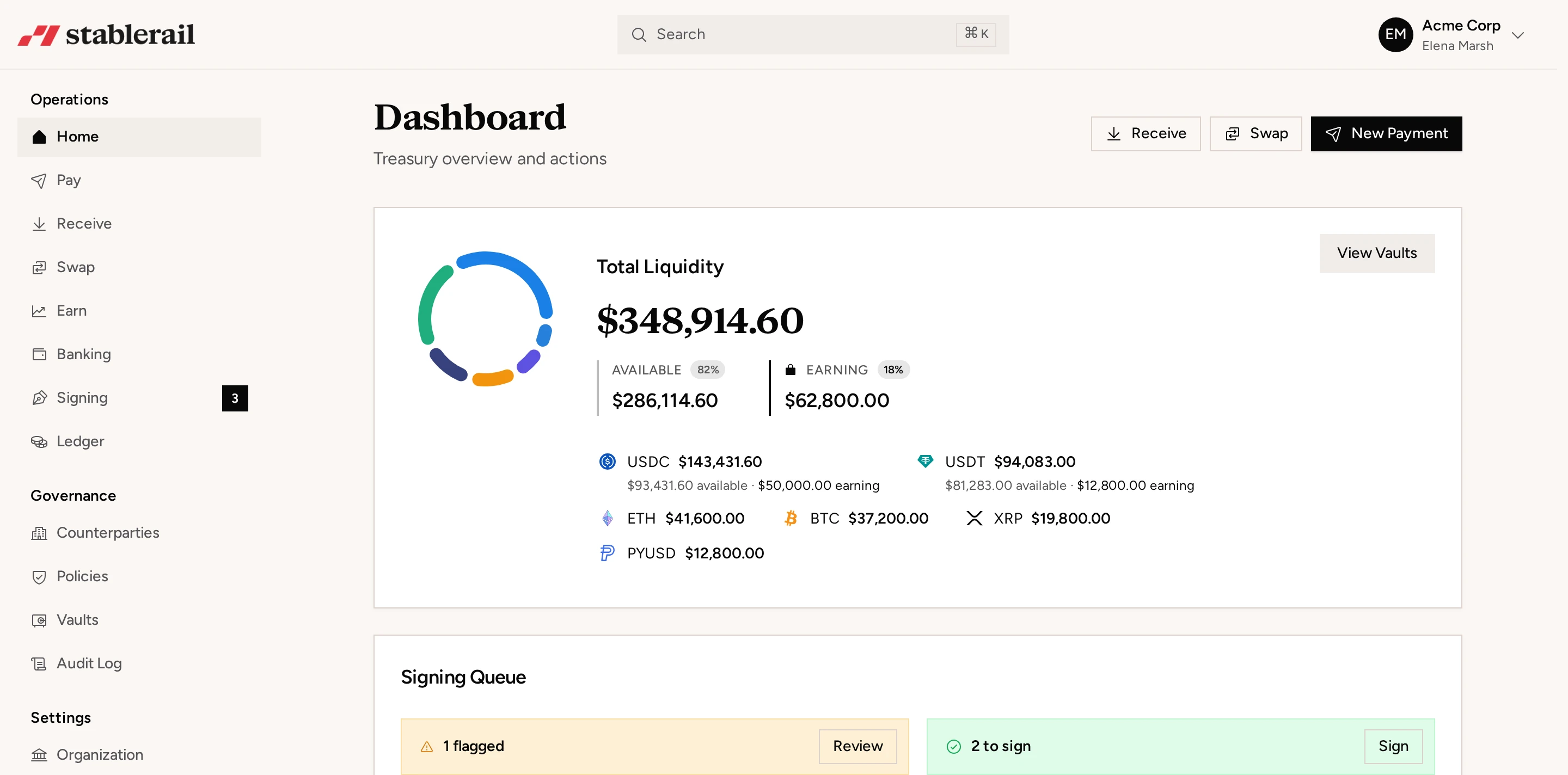
If the company uses another platform alongside Fireblocks, controls must also be mapped across that system. Stablerail, for example, supports self-custodial MPC vaults, quorum signing, approval limits, allowlists, wallet screening and audit evidence for corporate USDC and USDT treasury operations. Teams can review the operational flow for stablecoin payouts or consult the help centre when comparing configurations.
Verification checklist before a high-value transfer
- Confirm that the policy covers the correct vaults, assets, networks and transaction operations.
- Verify whether $1 million means token quantity or fiat-equivalent value.
- Test transactions below, at and above the threshold.
- Ensure the initiator cannot satisfy an approval requirement unintentionally.
- Test Fireblocks Payments, API and console flows separately if all are used.
- Review allowlist, administrator and service-account exceptions.
- Confirm rule precedence and the default outcome when no specific rule matches.
- Export a sample approval record and check it with internal audit.
- Establish a process for approver absence without creating an uncontrolled bypass.
- Monitor split transactions and cumulative daily exposure outside the single-payment rule.
The practical answer is therefore yes, with conditions. Fireblocks can enforce approval thresholds and require several authorized participants for transactions over $1 million, but the control is only as reliable as its scope, ordering, user configuration and evidence trail. A finance team should treat the setup as a testable payment control—not as a capability implied simply by using MPC custody.
Finance writers covering stablecoin treasury, payments, compliance, and risk controls.
More about the Stablerail team- Stablecoin treasury managementApprovals, limits, yield and reporting on one balance.
- Stablecoin payoutsBatch contractor and vendor payments with screening.
- USDT vs USDCWhich stablecoin your company should settle in.
- Stablecoin finance glossaryMPC, off-ramp, travel rule and the rest, in plain English.
- Product updatesEverything we ship, month by month.