
Coinbase Prime vs Fireblocks, BitGo, Taurus and Dfns: Institutional Crypto Infrastructure Compared
A practical comparison of Coinbase Prime, Fireblocks, BitGo, Taurus and Dfns for institutional custody, wallet infrastructure, trading and stablecoin treasury operations.
Coinbase Prime is best suited to institutions wanting custody and execution in one platform. Fireblocks and Dfns emphasize wallet and signing infrastructure, BitGo combines custody with wallet and institutional services, and Taurus targets banks and regulated financial institutions deploying broader digital asset infrastructure. The right choice depends first on whether your company needs third-party custody, technology for operating wallets, or an end-to-end treasury workflow spanning stablecoins, fiat and payments.
%22%20x1%3D%220%22%20y1%3D%220%22%20x2%3D%221%22%20y2%3D%221%22%3E%0A%20%20%20%20%20%20%20%20%3Cstop%20offset%3D%220%25%22%20stop-color%3D%22%23360A0E%22%20%2F%3E%0A%20%20%20%20%20%20%20%20%3Cstop%20offset%3D%2250%25%22%20stop-color%3D%22%23551217%22%20%2F%3E%0A%20%20%20%20%20%20%20%20%3Cstop%20offset%3D%22100%25%22%20stop-color%3D%22%237A1D20%22%20%2F%3E%0A%20%20%20%20%20%20%3C%2FlinearGradient%3E%0A%20%20%20%20%20%20%3CradialGradient%20id%3D%22glow%22%20cx%3D%221013%22%20cy%3D%22282%22%20r%3D%22520%22%20gradientUnits%3D%22userSpaceOnUse%22%3E%0A%20%20%20%20%20%20%20%20%3Cstop%20offset%3D%220%25%22%20stop-color%3D%22%23FFA587%22%20stop-opacity%3D%220.45%22%20%2F%3E%0A%20%20%20%20%20%20%20%20%3Cstop%20offset%3D%2255%25%22%20stop-color%3D%22%23FFA587%22%20stop-opacity%3D%220.08%22%20%2F%3E%0A%20%20%20%20%20%20%20%20%3Cstop%20offset%3D%22100%25%22%20stop-color%3D%22%23FFA587%22%20stop-opacity%3D%220%22%20%2F%3E%0A%20%20%20%20%20%20%3C%2FradialGradient%3E%0A%20%20%20%20%20%20%3ClinearGradient%20id%3D%22glass%22%20x1%3D%220%22%20y1%3D%220%22%20x2%3D%221%22%20y2%3D%221%22%3E%0A%20%20%20%20%20%20%20%20%3Cstop%20offset%3D%220%25%22%20stop-color%3D%22%23F8D6D2%22%20stop-opacity%3D%220.26%22%20%2F%3E%0A%20%20%20%20%20%20%20%20%3Cstop%20offset%3D%22100%25%22%20stop-color%3D%22%23FFFFFF%22%20stop-opacity%3D%220.08%22%20%2F%3E%0A%20%20%20%20%20%20%3C%2FlinearGradient%3E%0A%20%20%20%20%20%20%3ClinearGradient%20id%3D%22accent%22%20x1%3D%220%22%20y1%3D%220%22%20x2%3D%221%22%20y2%3D%221%22%3E%0A%20%20%20%20%20%20%20%20%3Cstop%20offset%3D%220%25%22%20stop-color%3D%22%23FFA587%22%20%2F%3E%0A%20%20%20%20%20%20%20%20%3Cstop%20offset%3D%22100%25%22%20stop-color%3D%22%23DC4A38%22%20%2F%3E%0A%20%20%20%20%20%20%3C%2FlinearGradient%3E%0A%20%20%20%20%20%20%3Cfilter%20id%3D%22soft%22%3E%3CfeGaussianBlur%20stdDeviation%3D%2210%22%20%2F%3E%3C%2Ffilter%3E%0A%20%20%20%20%3C%2Fdefs%3E%0A%20%20%20%20%3Crect%20width%3D%221600%22%20height%3D%22900%22%20fill%3D%22url(%23bg)%22%20%2F%3E%0A%20%20%20%20%3Crect%20width%3D%221600%22%20height%3D%22900%22%20fill%3D%22url(%23glow)%22%20%2F%3E%0A%20%20%20%20%3Cline%20x1%3D%22200%22%20y1%3D%22250%22%20x2%3D%221400%22%20y2%3D%22250%22%20stroke%3D%22%23F4CDC5%22%20stroke-opacity%3D%220.12%22%2F%3E%3Cline%20x1%3D%22200%22%20y1%3D%22340%22%20x2%3D%221400%22%20y2%3D%22340%22%20stroke%3D%22%23F4CDC5%22%20stroke-opacity%3D%220.12%22%2F%3E%3Cline%20x1%3D%22200%22%20y1%3D%22430%22%20x2%3D%221400%22%20y2%3D%22430%22%20stroke%3D%22%23F4CDC5%22%20stroke-opacity%3D%220.12%22%2F%3E%3Cline%20x1%3D%22200%22%20y1%3D%22520%22%20x2%3D%221400%22%20y2%3D%22520%22%20stroke%3D%22%23F4CDC5%22%20stroke-opacity%3D%220.12%22%2F%3E%3Cline%20x1%3D%22200%22%20y1%3D%22610%22%20x2%3D%221400%22%20y2%3D%22610%22%20stroke%3D%22%23F4CDC5%22%20stroke-opacity%3D%220.12%22%2F%3E%3Cpolyline%20points%3D%22200%2C267%20350%2C296%20500%2C230%20650%2C257%20800%2C225%20950%2C221%201100%2C431%201250%2C492%201400%2C394%22%20fill%3D%22none%22%20stroke%3D%22url(%23accent)%22%20stroke-width%3D%2210%22%20stroke-linejoin%3D%22round%22%20stroke-linecap%3D%22round%22%2F%3E%3Ccircle%20cx%3D%22200%22%20cy%3D%22267%22%20r%3D%229%22%20fill%3D%22%23F8D6D2%22%2F%3E%3Ccircle%20cx%3D%22350%22%20cy%3D%22296%22%20r%3D%229%22%20fill%3D%22%23F8D6D2%22%2F%3E%3Ccircle%20cx%3D%22500%22%20cy%3D%22230%22%20r%3D%229%22%20fill%3D%22%23F8D6D2%22%2F%3E%3Ccircle%20cx%3D%22650%22%20cy%3D%22257%22%20r%3D%229%22%20fill%3D%22%23F8D6D2%22%2F%3E%3Ccircle%20cx%3D%22800%22%20cy%3D%22225%22%20r%3D%229%22%20fill%3D%22%23F8D6D2%22%2F%3E%3Ccircle%20cx%3D%22950%22%20cy%3D%22221%22%20r%3D%229%22%20fill%3D%22%23F8D6D2%22%2F%3E%3Ccircle%20cx%3D%221100%22%20cy%3D%22431%22%20r%3D%229%22%20fill%3D%22%23F8D6D2%22%2F%3E%3Ccircle%20cx%3D%221250%22%20cy%3D%22492%22%20r%3D%229%22%20fill%3D%22%23F8D6D2%22%2F%3E%3Ccircle%20cx%3D%221400%22%20cy%3D%22394%22%20r%3D%229%22%20fill%3D%22%23F8D6D2%22%2F%3E%0A%20%20%20%20%3Crect%20x%3D%2226%22%20y%3D%2226%22%20width%3D%221548%22%20height%3D%22848%22%20rx%3D%2218%22%20fill%3D%22none%22%20stroke%3D%22%23F2D0C8%22%20stroke-opacity%3D%220.12%22%2F%3E%0A%20%20%3C%2Fsvg%3E)
Coinbase Prime is best suited to institutions wanting custody and execution in one platform. Fireblocks and Dfns emphasize wallet and signing infrastructure, BitGo combines custody with wallet and institutional services, and Taurus targets banks and regulated financial institutions deploying broader digital asset infrastructure. The right choice depends first on whether your company needs third-party custody, technology for operating wallets, or an end-to-end treasury workflow spanning stablecoins, fiat and payments.
These providers overlap, but they are not interchangeable. Product coverage, supported networks, contracting entities and geographic availability change frequently. Use this comparison to define a shortlist, then verify current capabilities and legal terms directly with each provider.
First, decide which operating model you need
The most important distinction is not MPC versus multisignature technology. It is who has legal and operational control over the assets, who can authorize a transaction, and what happens when a signer or provider becomes unavailable.
- Third-party custody: A custodian safeguards assets under a custody agreement and processes withdrawals according to its controls. This can simplify key management, but creates custodian exposure and may introduce withdrawal procedures or delays.
- Wallet infrastructure: The company uses software and cryptographic infrastructure to operate wallets. Responsibility for governance, recovery, monitoring and integrations remains substantially with the company.
- Institution-operated infrastructure: A bank or large institution deploys custody and tokenization technology within its own operational and regulatory environment.
- Treasury operations platform: The focus is moving a company’s own funds between stablecoins, fiat conversion, cards and global payouts, with approval controls and audit evidence.
A provider can support more than one model. Do not infer the legal custody arrangement from terms such as MPC wallet, vault or institutional account. The contract, key-control design and recovery process determine the actual arrangement.
Coinbase Prime vs Fireblocks, BitGo, Taurus and Dfns
| Provider | Primary model | Custody and signing | Trading and fiat connectivity | Best-fit use case |
|---|---|---|---|---|
| Coinbase Prime | Integrated institutional platform | Provider-operated custody and platform governance, subject to product and jurisdiction | Native institutional execution; fiat availability varies by entity, currency and region | Institutions seeking custody, trading and portfolio operations in one environment |
| Fireblocks | Wallet, transfer and network infrastructure | MPC-based signing and configurable transaction controls; custody arrangements depend on selected services and partners | Connects to exchanges, liquidity providers, banks and payment providers | Companies coordinating wallets and transfers across multiple counterparties |
| BitGo | Custody, wallets and institutional services | Custody and wallet products using multisignature or threshold-signing designs, depending on product | Trading, settlement and liquidity services are available; fiat support varies | Institutions wanting custody plus wallet and transaction services |
| Taurus | Enterprise digital asset infrastructure | Institutional custody architecture that can include HSM and MPC components | Typically integrated with an institution’s banking, execution and compliance stack | Banks and regulated financial institutions deploying custody or tokenization infrastructure |
| Dfns | Developer-oriented wallet infrastructure | API-based wallet creation and threshold-signing infrastructure | Execution, banking and on-ramp services generally require third-party integrations | Companies embedding wallets and signing workflows into their own applications |
Coinbase Prime: integrated custody and execution
For this comparison, Coinbase Prime means Coinbase’s institutional platform, not the retail application or a standard exchange account. It combines custody, execution, portfolio tools and other institutional services, with availability depending on the asset, customer and jurisdiction.
Its central advantage is integration. A treasury team that needs to hold and trade supported assets may avoid building separate connections among a wallet provider, custodian and exchange. The trade-off is greater dependence on one provider’s asset coverage, operating procedures and contracting structure.
Ask where assets sit before and after a trade. Custodied assets, trading balances and assets awaiting settlement may have different control, exposure and withdrawal characteristics. Confirm the applicable legal entity, asset segregation provisions and withdrawal process rather than relying on the Coinbase name alone.
Fireblocks and Dfns: wallet infrastructure with different emphases
Fireblocks and Dfns are relevant when the requirement is wallet and signing infrastructure rather than a single integrated exchange. Both use distributed or threshold-signing approaches designed to avoid relying on one conventional private key, but cryptography alone does not establish effective treasury control.
Fireblocks is oriented toward institutional transfer operations across wallets, exchanges, custodians and counterparties. Its value depends on the connected ecosystem and on how transaction rules, user roles, recovery and administrator permissions are configured.
Dfns is more developer-oriented. It can suit a company that wants to create wallets or embed signing into its own product and is prepared to build the surrounding user interface, approval logic, reconciliation, monitoring and banking integrations. That flexibility should be weighed against implementation and ongoing engineering responsibility.
BitGo and Taurus: custody services versus institutional deployment
BitGo spans third-party custody, wallet technology and institutional transaction services. This makes it a possible shortlist candidate when a company wants both custody and operational wallet capabilities. However, custody terms, signing architecture and service availability differ by product and jurisdiction, so each component needs separate diligence.
Taurus is primarily relevant to banks and other regulated institutions building digital asset custody, tokenization or connectivity into an existing technology and control environment. It is less directly comparable with a ready-to-use exchange account. Implementation requirements, internal operating capacity and integration with the institution’s core systems are therefore central to the decision.
Compare asset support at the network level
Headline asset counts are poor decision criteria. A provider may support an asset for custody but not for trading, staking, automated withdrawals or a particular customer jurisdiction. Stablecoins must be evaluated as a token-and-network pair: USDC on Ethereum, Base and Solana represent separate operational routes even when the economic asset is intended to be the same.
Request a dated support matrix covering:
- Exact token contract and blockchain network
- Deposit, withdrawal, custody and trading availability
- Required blockchain confirmations and crediting rules
- Minimums, maximums and transaction limits
- Network maintenance and unsupported-token procedures
- Address formats, memo or tag requirements and smart-contract deposits
- Fork, airdrop and token-migration treatment
Finance should also document who bears responsibility for transfers sent through the wrong network. A user interface warning is not a substitute for a tested address-validation and approval process.
Test governance under real failure scenarios
Most institutional platforms offer some combination of roles, approval thresholds, destination controls and audit logs. The meaningful differences emerge during exceptions. A controlled pilot should test ordinary payments as well as signer loss, administrator departure, a new beneficiary and an urgent high-value transfer.
| Control to test | Evidence finance should request | Failure scenario |
|---|---|---|
| Approval separation | Role matrix and completed transaction record | The payment creator attempts to approve the same transfer |
| Signing threshold | Configuration export or administrator record | One signer is unavailable during a time-sensitive payment |
| Destination control | Allowlist change history and approval record | A compromised user adds a new external address |
| Recovery | Documented recovery procedure and test result | A signer loses access or an administrator leaves |
| Business continuity | Provider procedure and internal contingency plan | The vendor interface or a connected venue is unavailable |
| Auditability | Export linking request, approvals, transaction hash and accounting reference | Auditors select a sample months after settlement |
Trading, fiat rails and stablecoin treasury workflows
Coinbase Prime has the most direct custody-and-execution combination in this group. Fireblocks connects infrastructure to external venues rather than functioning simply as an exchange. BitGo offers institutional services alongside custody, while Taurus and Dfns typically rely more heavily on integrations for execution and banking.
Fiat connectivity requires separate analysis. Confirm whether an account is held in the company’s name, which legal entity provides it, and whether the provider is delivering the rail directly or through a banking or payment partner. Check supported currencies, cut-off times, settlement expectations and availability of ACH, wire, SEPA, SEPA Instant or SWIFT as applicable.
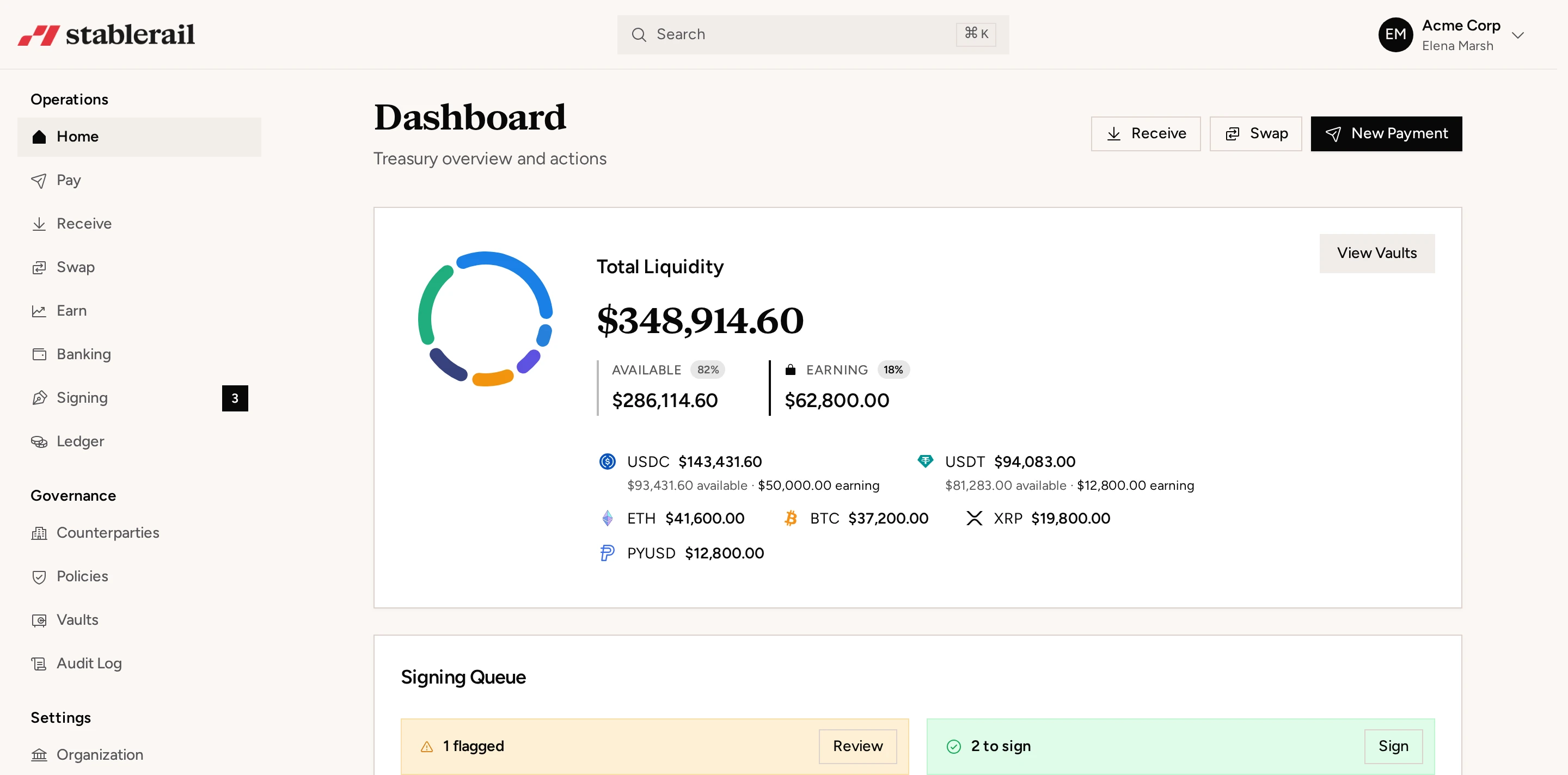
A company mainly managing its own USDC or USDT may not need broad institutional trading infrastructure. Stablerail is designed for corporate stablecoin treasury involving a company’s own funds, with approval and signing quorum, sanctions and address screening before sends, corporate cards, global payouts, fiat conversion and exportable audit evidence.
How to compare total cost
Public list pricing is uncommon, so request quotes using the same balance and transaction assumptions. Separate fixed platform costs from usage-sensitive charges. Include onboarding and implementation, custody charges, wallet or user fees, transaction fees, blockchain gas, trading commissions or spreads, fiat conversion, withdrawals, support and recovery services.
Model at least a normal month and a high-activity month. A low custody rate can be outweighed by platform minimums, implementation work or transaction charges, while a higher fixed fee may be economical for a treasury with many transfers.
Finance-team selection checklist
- Define the model: Decide whether assets will be held by a custodian or operated through company-controlled wallet infrastructure.
- Map every flow: Document fiat funding, stablecoin acquisition, storage, internal transfers, payouts, conversion and accounting.
- Verify legal terms: Identify each contracting entity, custody arrangement, segregation treatment and service jurisdiction.
- Test controls: Run maker-checker approvals, new-address onboarding, signer recovery and high-value payment scenarios.
- Confirm network support: Validate each token-and-chain combination needed in production.
- Calculate annual cost: Use expected balances, users, wallets, transactions, trading volume and fiat conversions.
- Collect audit evidence: Ensure records connect the business request, approvals, on-chain transaction and ledger entry.
Which provider belongs on your shortlist?
Choose Coinbase Prime when integrated institutional custody and trading are the priority. Consider Fireblocks when coordinating wallet operations and connections across multiple counterparties is central. Consider BitGo when custody and wallet services are both required. Taurus is most relevant to regulated institutions deploying infrastructure into an existing banking environment, while Dfns fits companies prepared to build around developer-focused wallet APIs.
The final decision should follow the complete operating workflow, not the longest feature list. A technically sophisticated wallet platform can still leave finance teams building fiat, payment, reconciliation and audit processes themselves. Conversely, an integrated custodian may simplify execution while offering less control over infrastructure and counterparties. Contract review, a controlled pilot and documented recovery testing should precede material funding.
Frequently asked questions
Is Coinbase Prime a custodian or an exchange?
Coinbase Prime is an institutional platform that combines custody and execution, but the precise arrangement depends on the product, asset, customer and jurisdiction. Finance teams should confirm where assets are held before, during and after trading, and which Coinbase entity provides each service.
Is Fireblocks a custodian like Coinbase Prime?
Fireblocks is primarily known for wallet, signing and transfer infrastructure connecting institutions with wallets and counterparties. Some custody-related services may be available depending on the offering and jurisdiction, but buyers should not assume every Fireblocks deployment creates the same legal custody relationship as a managed custody account.
What is the main difference between Fireblocks and Dfns?
Both provide wallet and threshold-signing infrastructure, but their common use cases differ. Fireblocks emphasizes institutional transfers and connectivity across counterparties, while Dfns is more developer-oriented and often requires customers to build more of the surrounding workflow and integrations.
Which Coinbase Prime alternative is best for stablecoin treasury?
The answer depends on whether the company needs custody, wallet infrastructure or a complete operational treasury workflow. For USDC or USDT, compare exact network support, signing approvals, screening, fiat conversion, payouts, reconciliation and audit exports rather than selecting a provider solely by custody technology.
What should a CFO ask an institutional crypto custody provider?
Ask which legal entity holds the assets, how assets are segregated, who controls signing, and what happens during insolvency or service disruption. Also request current network coverage, recovery procedures, a complete fee schedule and sample audit evidence for a transaction.
Finance writers covering stablecoin treasury, payments, compliance, and risk controls.
More about the Stablerail team- Stablecoin treasury managementApprovals, limits, yield and reporting on one balance.
- Stablecoin payoutsBatch contractor and vendor payments with screening.
- USDT vs USDCWhich stablecoin your company should settle in.
- Stablecoin finance glossaryMPC, off-ramp, travel rule and the rest, in plain English.
- Product updatesEverything we ship, month by month.