
Stablecoins vs Wire Transfers: Which Is Better for Business Payments?
Stablecoins offer continuous settlement and programmable treasury controls; wires offer broad acceptance and established banking workflows. Compare total cost, risk, reconciliation and recipient access before choosing.
Stablecoins are often better for time-sensitive, cross-border payments when both parties can use the same token and blockchain network. Wire transfers are usually better when recipients need bank money, local currency, or established banking documentation. The right choice depends on end-to-end cost, FX exposure, compliance, reconciliation, and recipient access—not transfer speed alone. Many businesses benefit from combining stablecoin settlement with fiat funding or payout.
%22%20x1%3D%220%22%20y1%3D%220%22%20x2%3D%221%22%20y2%3D%221%22%3E%0A%20%20%20%20%20%20%20%20%3Cstop%20offset%3D%220%25%22%20stop-color%3D%22%232E0709%22%20%2F%3E%0A%20%20%20%20%20%20%20%20%3Cstop%20offset%3D%2250%25%22%20stop-color%3D%22%234A0F14%22%20%2F%3E%0A%20%20%20%20%20%20%20%20%3Cstop%20offset%3D%22100%25%22%20stop-color%3D%22%236B181C%22%20%2F%3E%0A%20%20%20%20%20%20%3C%2FlinearGradient%3E%0A%20%20%20%20%20%20%3CradialGradient%20id%3D%22glow%22%20cx%3D%22191%22%20cy%3D%22105%22%20r%3D%22520%22%20gradientUnits%3D%22userSpaceOnUse%22%3E%0A%20%20%20%20%20%20%20%20%3Cstop%20offset%3D%220%25%22%20stop-color%3D%22%23FFB199%22%20stop-opacity%3D%220.45%22%20%2F%3E%0A%20%20%20%20%20%20%20%20%3Cstop%20offset%3D%2255%25%22%20stop-color%3D%22%23FFB199%22%20stop-opacity%3D%220.08%22%20%2F%3E%0A%20%20%20%20%20%20%20%20%3Cstop%20offset%3D%22100%25%22%20stop-color%3D%22%23FFB199%22%20stop-opacity%3D%220%22%20%2F%3E%0A%20%20%20%20%20%20%3C%2FradialGradient%3E%0A%20%20%20%20%20%20%3ClinearGradient%20id%3D%22glass%22%20x1%3D%220%22%20y1%3D%220%22%20x2%3D%221%22%20y2%3D%221%22%3E%0A%20%20%20%20%20%20%20%20%3Cstop%20offset%3D%220%25%22%20stop-color%3D%22%23F8D6D2%22%20stop-opacity%3D%220.26%22%20%2F%3E%0A%20%20%20%20%20%20%20%20%3Cstop%20offset%3D%22100%25%22%20stop-color%3D%22%23FFFFFF%22%20stop-opacity%3D%220.08%22%20%2F%3E%0A%20%20%20%20%20%20%3C%2FlinearGradient%3E%0A%20%20%20%20%20%20%3ClinearGradient%20id%3D%22accent%22%20x1%3D%220%22%20y1%3D%220%22%20x2%3D%221%22%20y2%3D%221%22%3E%0A%20%20%20%20%20%20%20%20%3Cstop%20offset%3D%220%25%22%20stop-color%3D%22%23FFB199%22%20%2F%3E%0A%20%20%20%20%20%20%20%20%3Cstop%20offset%3D%22100%25%22%20stop-color%3D%22%23E85D3A%22%20%2F%3E%0A%20%20%20%20%20%20%3C%2FlinearGradient%3E%0A%20%20%20%20%20%20%3Cfilter%20id%3D%22soft%22%3E%3CfeGaussianBlur%20stdDeviation%3D%2210%22%20%2F%3E%3C%2Ffilter%3E%0A%20%20%20%20%3C%2Fdefs%3E%0A%20%20%20%20%3Crect%20width%3D%221600%22%20height%3D%22900%22%20fill%3D%22url(%23bg)%22%20%2F%3E%0A%20%20%20%20%3Crect%20width%3D%221600%22%20height%3D%22900%22%20fill%3D%22url(%23glow)%22%20%2F%3E%0A%20%20%20%20%0A%20%20%3Crect%20x%3D%22500%22%20y%3D%22160%22%20width%3D%22600%22%20height%3D%22620%22%20rx%3D%2214%22%20fill%3D%22url(%23glass)%22%20stroke%3D%22%23F4CDC5%22%20stroke-opacity%3D%220.65%22%2F%3E%0A%20%20%3Crect%20x%3D%22540%22%20y%3D%22220%22%20width%3D%22351%22%20height%3D%2214%22%20rx%3D%223%22%20fill%3D%22%23F4CDC5%22%20opacity%3D%220.45%22%2F%3E%3Crect%20x%3D%22540%22%20y%3D%22280%22%20width%3D%22325%22%20height%3D%2214%22%20rx%3D%223%22%20fill%3D%22%23F4CDC5%22%20opacity%3D%220.45%22%2F%3E%3Crect%20x%3D%22540%22%20y%3D%22340%22%20width%3D%22422%22%20height%3D%2214%22%20rx%3D%223%22%20fill%3D%22%23F4CDC5%22%20opacity%3D%220.45%22%2F%3E%3Crect%20x%3D%22540%22%20y%3D%22400%22%20width%3D%22471%22%20height%3D%2214%22%20rx%3D%223%22%20fill%3D%22%23F4CDC5%22%20opacity%3D%220.45%22%2F%3E%3Crect%20x%3D%22540%22%20y%3D%22460%22%20width%3D%22385%22%20height%3D%2214%22%20rx%3D%223%22%20fill%3D%22%23F4CDC5%22%20opacity%3D%220.45%22%2F%3E%3Crect%20x%3D%22540%22%20y%3D%22520%22%20width%3D%22452%22%20height%3D%2214%22%20rx%3D%223%22%20fill%3D%22%23F4CDC5%22%20opacity%3D%220.45%22%2F%3E%0A%20%20%3Crect%20x%3D%22540%22%20y%3D%22640%22%20width%3D%22300%22%20height%3D%22100%22%20rx%3D%228%22%20fill%3D%22url(%23accent)%22%20opacity%3D%220.85%22%2F%3E%0A%20%20%3Cpath%20d%3D%22M560%20700%20C%20600%20660%2C%20640%20720%2C%20700%20680%20S%20800%20690%2C%20820%20670%22%20fill%3D%22none%22%20stroke%3D%22%23FFF1ED%22%20stroke-width%3D%225%22%20stroke-linecap%3D%22round%22%2F%3E%0A%0A%20%20%20%20%3Crect%20x%3D%2226%22%20y%3D%2226%22%20width%3D%221548%22%20height%3D%22848%22%20rx%3D%2218%22%20fill%3D%22none%22%20stroke%3D%22%23F2D0C8%22%20stroke-opacity%3D%220.12%22%2F%3E%0A%20%20%3C%2Fsvg%3E)
Stablecoins are often better for time-sensitive, cross-border payments when both parties can use the same token and blockchain network. Wire transfers are usually better when recipients need bank money, local currency, or established banking documentation. The right choice depends on end-to-end cost, FX exposure, compliance, reconciliation, and recipient access—not transfer speed alone. Many businesses benefit from combining stablecoin settlement with fiat funding or payout.
How stablecoin and wire payments work
A wire transfer moves bank money between financial institutions. Domestic wires may travel over a national high-value payment system, while cross-border wires can pass through correspondent banks. Each institution may screen the payment, convert currency, request documents, or deduct a fee.
A stablecoin payment transfers a blockchain-based token, such as USDC or USDT, between wallet addresses. The sender must first acquire the token through an available funding route. The recipient then needs a compatible wallet and a way to hold, spend, or redeem it.
The visible transfer is only one stage of either workflow. For a wire, the full journey includes bank submission, screening, correspondent routing and recipient credit. For a stablecoin, it includes funding, blockchain confirmation, compliance review, conversion and any bank payout. A transaction that confirms quickly onchain may still take longer to become usable local currency.
Stablecoins vs wire transfers: comparison table
| Decision factor | Stablecoin payment | Wire transfer |
|---|---|---|
| Operating hours | Public blockchains generally operate continuously, including weekends and holidays | Often affected by bank cut-offs, business days, holidays and currency-specific processing windows |
| Transfer timing | Blockchain confirmation can occur in seconds or minutes, depending on the network and confirmation policy | Domestic wires may arrive the same business day; cross-border wires can take several business days |
| Recipient access | Requires support for the exact token and network, plus a usable redemption route if fiat is needed | Funds arrive in a bank account and may already be in the recipient's required currency |
| Cost visibility | Network fees are visible, but funding, custody, conversion, redemption and withdrawal costs must be added | Sender fees may be known, but intermediary deductions, receiving fees and FX spreads can be less predictable |
| Payment errors | Confirmed transfers generally cannot be reversed unilaterally; wrong-address or wrong-network errors can be difficult to recover | Recalls and investigations may be possible, but recovery is not guaranteed |
| Compliance evidence | Provides an onchain transaction record, but wallet ownership and payment purpose require separate evidence | Fits established bank screening and payment-document workflows, although banks may request additional information |
| Best fit | Continuous settlement, compatible counterparties and corridors with inefficient banking routes | Fiat-only recipients, local-currency obligations and counterparties that rely on established bank processes |
Speed and availability
Wire transfer timing
Wire timing depends on the sending and receiving banks, payment currency, cut-off times, holidays and compliance checks. Cross-border payments may also depend on intermediary banks. A bank can accept an instruction without guaranteeing when the beneficiary will have available funds.
Some banking systems support instant or extended-hours payments, so teams should not assume every bank payment is slow. Coverage, transaction limits and eligibility differ by institution and market.
Stablecoin settlement timing
Public blockchains generally process transactions continuously. Finance teams must nevertheless define how many confirmations are required before treating a payment as complete. The appropriate threshold depends on the network, transaction value and internal risk policy.
Blockchain confirmation is not the same as fiat availability. An exchange, custodian or off-ramp may apply withdrawal limits, processing windows or compliance holds. Compare the time from approved payment instruction to recipient usability, not merely the block timestamp.
Calculate total cost, not just the transfer fee
Wire costs can include sending-bank fees, receiving-bank fees, correspondent deductions and FX spreads. Fixed fees can make lower-value payments disproportionately expensive, while deductions may cause the recipient to receive less than the invoiced amount.
A stablecoin network fee may be small relative to the payment, but it is only one component. Calculate stablecoin payment cost as:
Funding or minting cost + network fee + wallet or custody cost + conversion or redemption fee + bank withdrawal cost + FX spread + internal operating cost
Stablecoins tend to have a stronger cost case when both parties already use the same token and network. The advantage can narrow or disappear when the sender must buy the token and the recipient must immediately convert it back to fiat. Compare quotes on the same date and for the same amount, currency outcome and fee treatment.
FX exposure and invoice terms
A US dollar stablecoin reduces payment-value volatility relative to unbacked cryptoassets, but it does not eliminate currency risk. A supplier that reports or spends in euros, pesos or another currency remains exposed to the dollar until conversion. The token can also carry issuer, reserve, custody, liquidity and redemption risks distinct from ordinary bank deposits.
For either rail, the contract or invoice should identify the payment currency, who bears fees, when the exchange rate is fixed and what amount discharges the obligation. For stablecoins, also specify the accepted token and blockchain network. Avoid ambiguous wording such as “pay in crypto” when the commercial obligation is denominated in fiat.
Finality, fraud and payment errors
Once a stablecoin transfer is confirmed, the sender generally cannot reverse it unilaterally. That creates rapid operational finality but increases the consequences of a compromised wallet, incorrect address or network mismatch. Issuers may be able to freeze certain tokens, and blockchains can experience outages, reorganisations or other exceptional events, so “irreversible” should not be treated as an absolute legal or technical claim.
Wire transfers may sometimes be recalled, amended or investigated, but recovery is uncertain—particularly after the beneficiary has withdrawn or moved the funds. Independently verify any change to bank details using a known communication channel.
For stablecoins, use approved address records, sanctions and address screening before sending, and a small test transaction for a new destination when appropriate. Confirm that the recipient controls the address and supports the exact token-network combination; a valid-looking address alone is not enough.
Compliance and documentation
Stablecoins do not remove sanctions, anti-money-laundering, tax or recordkeeping obligations. A blockchain address does not identify its beneficial owner or explain the commercial purpose of a payment. Teams may need to verify the counterparty, establish wallet control, screen relevant addresses and retain supporting documents.
Blockchain analytics can identify exposure to sanctioned addresses, thefts or other risk indicators, but results require interpretation. A risk signal does not necessarily prove that the immediate counterparty participated in prohibited activity.
Banks also perform screening and may request invoices, contracts, ownership information or source-of-funds evidence. This can delay a wire, but it aligns with familiar compliance processes. For both rails, define approval thresholds, required evidence, escalation procedures and record-retention rules before the payment is initiated.
Reconciliation and accounting
Wires commonly feed into treasury and accounting systems, although references can be truncated or changed as a payment passes between banks. Stablecoins provide a timestamped blockchain record and transaction hash, but that record does not establish the invoice, legal counterparty or accounting treatment by itself.
Each payment record should connect:
- The approved invoice or payment request
- The legal counterparty and payment purpose
- The sending and receiving bank accounts or wallets
- The bank reference or blockchain transaction hash
- The token, network and wallet label for a stablecoin payment
- The valuation source, exchange rate and accounting date
- Network, banking, conversion and FX costs
- Approval, screening and exception evidence
Accounting and tax treatment can vary by jurisdiction and transaction structure. Finance teams should document their treatment with qualified advisers rather than assuming a dollar-denominated token is accounted for like cash.
Recipient readiness is often decisive
A wire is generally preferable when the recipient accepts only bank deposits, needs a specific local currency or is prohibited from holding digital assets. A stablecoin payment is practical only when the recipient supports the exact token and network and has an approved way to use or redeem it.
Before sending a stablecoin, obtain written confirmation of the wallet address, token, network, wallet ownership and redemption plan. Also confirm whether the recipient expects to receive a fixed token amount or a fiat-equivalent amount net of fees.
When to use each payment rail
Stablecoins may be the better choice when
- Both parties already accept the same stablecoin on the same network
- Payment is required outside bank operating hours
- The banking corridor is slow or depends on several intermediaries
- Frequent cross-border payments make fixed wire charges inefficient
- The recipient can retain or spend the stablecoin without immediate conversion
Wire transfers may be the better choice when
- The recipient requires bank money or a specific local currency
- Internal policies restrict digital-asset ownership or wallet use
- The counterparty relies on established bank references and documentation
- A dependable stablecoin funding or redemption route is unavailable
- The organisation's existing bank approval and reconciliation controls are materially stronger
When a hybrid workflow works better
The strongest workflow may combine both rails. A business can fund a stablecoin account from a bank, transfer value onchain and off-ramp into the recipient's local bank account. Another business may hold part of its working capital in USDC or USDT for continuous payments while using wires for fiat-only suppliers.
A hybrid model should be evaluated as one end-to-end process. Include every conversion, service provider, compliance checkpoint and reconciliation handoff. Moving value quickly between wallets offers little benefit if the final bank payout is unavailable or unpredictable.
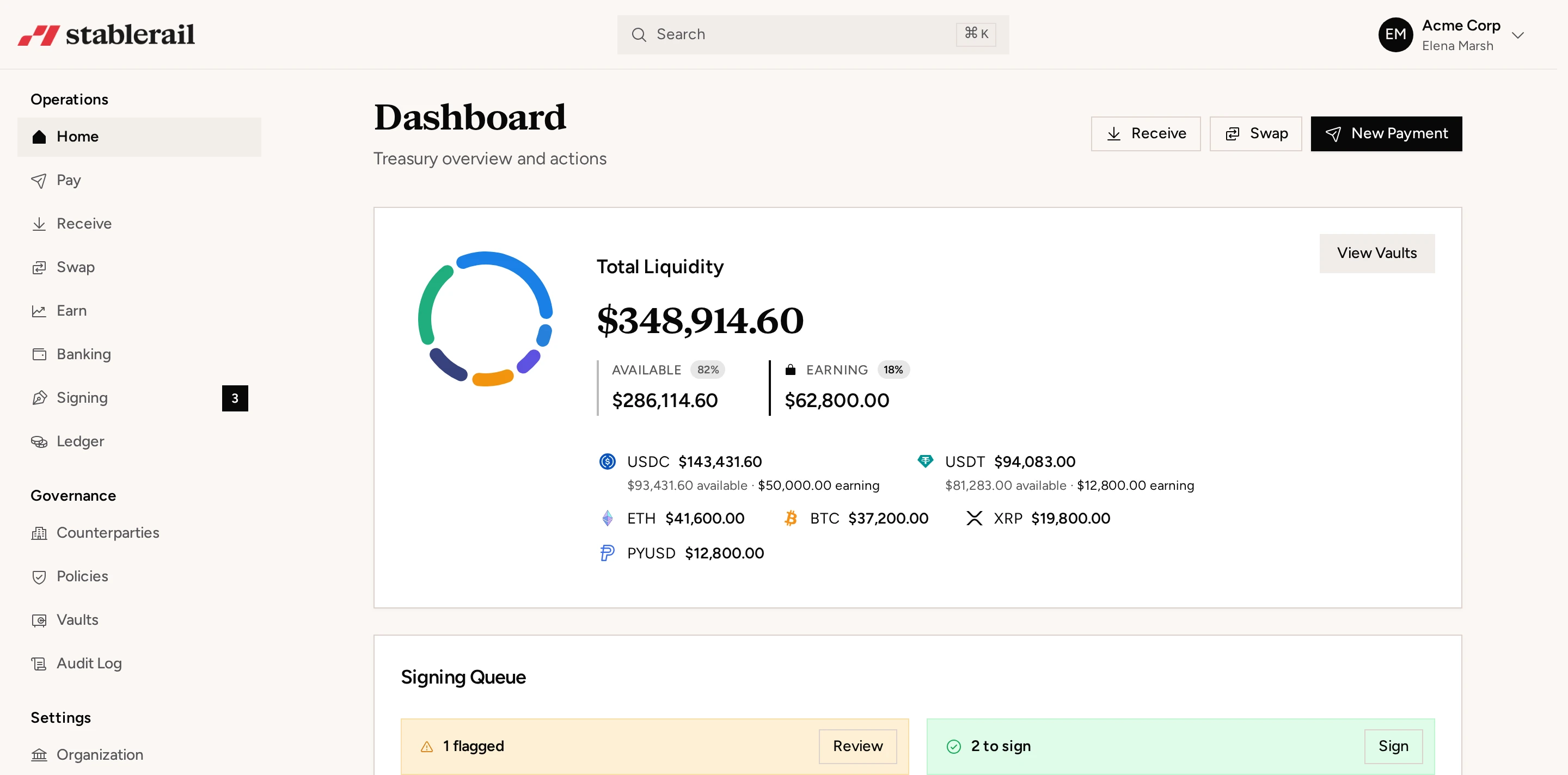
Stablerail supports a single business account for USDC and USDT treasury with approvals and signing quorum, sanctions and address screening before send, global payouts, fiat off-ramp, corporate cards and exportable audit evidence. Those controls can help finance teams operate a hybrid model without separating every stage into manual wallet and spreadsheet workflows.
Payment-rail decision checklist
- Define the required outcome: token, US dollars or a specific local-currency amount.
- Confirm recipient readiness: bank details or the exact stablecoin, network, wallet and redemption route.
- Compare end-to-end cost: include FX, intermediary, network, conversion and withdrawal charges.
- Estimate usable-funds timing: account for cut-offs, confirmations, compliance review and off-ramp processing.
- Apply controls: require approvals, independently verify instructions, screen destinations and test new wallets where appropriate.
- Preserve evidence: link the invoice, counterparty, approvals, screening result, payment reference and valuation record.
- Plan exceptions: document who responds to a bank hold, failed payout, frozen token, wrong network or suspected fraud.
The better rail is the one that delivers the required asset to the correct recipient with acceptable cost, timing, control and evidence. Evaluate stablecoins and wires payment by payment rather than adopting either as the default for every business transaction.
Frequently asked questions
Are stablecoin payments faster than wire transfers?
The blockchain portion of a stablecoin payment can confirm in seconds or minutes and generally operates around the clock. However, funding, compliance checks, conversion and bank withdrawal can extend the time before the recipient has usable fiat currency.
Are stablecoins cheaper than international wire transfers?
They can be cheaper when both parties already use the same stablecoin and network. A fair comparison must include funding, network, custody, conversion, redemption, withdrawal, FX and internal operating costs—not just the blockchain fee.
Can a business reverse a stablecoin payment sent to the wrong address?
A confirmed stablecoin transfer generally cannot be reversed unilaterally. Recovery may depend on the recipient, service providers or token issuer, so businesses should verify wallet ownership, screen the address and consider a test payment before sending a material amount.
What should a company confirm before paying a supplier in USDC or USDT?
Confirm the supplier's legal identity, wallet ownership, exact token, blockchain network and ability to redeem or use the funds. The invoice should also state the payment amount, currency obligation, fee treatment and when the obligation is considered satisfied.
How should stablecoin business payments be reconciled?
Link the blockchain transaction hash to the approved invoice, legal counterparty, wallet labels, token and network. Retain the exchange rate, valuation source, fees, accounting date, approvals and screening evidence so the transaction can be reconstructed for audit and reporting.
Can a company use stablecoins and wire transfers together?
Yes. A company can fund through a bank, transfer value using stablecoins and pay out to a recipient's local bank account, or retain stablecoins for compatible suppliers while using wires for fiat-only counterparties. The full workflow should be assessed for cost, timing, compliance and reconciliation.
Finance writers covering stablecoin treasury, payments, compliance, and risk controls.
More about the Stablerail team- Stablecoin treasury managementApprovals, limits, yield and reporting on one balance.
- Stablecoin payoutsBatch contractor and vendor payments with screening.
- USDT vs USDCWhich stablecoin your company should settle in.
- Stablecoin finance glossaryMPC, off-ramp, travel rule and the rest, in plain English.
- Product updatesEverything we ship, month by month.