
How to Onboard Your Business for Stablecoin Payments
A step-by-step stablecoin onboarding guide for finance teams, covering provider selection, KYB, wallet approvals, USDC and USDT funding, payment testing, screening and reconciliation.
To onboard a business for stablecoin payments, define the exact fiat-to-stablecoin route, complete KYB, confirm supported token and network combinations, configure wallet permissions and approvals, and document funding and counterparty checks. Before sending a material USDC or USDT payment, screen the destination address, make a small test transfer, confirm the recipient can access the funds, and reconcile the transaction hash, fees and conversion records.
%22%20x1%3D%220%22%20y1%3D%220%22%20x2%3D%221%22%20y2%3D%221%22%3E%0A%20%20%20%20%20%20%20%20%3Cstop%20offset%3D%220%25%22%20stop-color%3D%22%23360A0E%22%20%2F%3E%0A%20%20%20%20%20%20%20%20%3Cstop%20offset%3D%2250%25%22%20stop-color%3D%22%23551217%22%20%2F%3E%0A%20%20%20%20%20%20%20%20%3Cstop%20offset%3D%22100%25%22%20stop-color%3D%22%237A1D20%22%20%2F%3E%0A%20%20%20%20%20%20%3C%2FlinearGradient%3E%0A%20%20%20%20%20%20%3CradialGradient%20id%3D%22glow%22%20cx%3D%22518%22%20cy%3D%22551%22%20r%3D%22520%22%20gradientUnits%3D%22userSpaceOnUse%22%3E%0A%20%20%20%20%20%20%20%20%3Cstop%20offset%3D%220%25%22%20stop-color%3D%22%23FFA587%22%20stop-opacity%3D%220.45%22%20%2F%3E%0A%20%20%20%20%20%20%20%20%3Cstop%20offset%3D%2255%25%22%20stop-color%3D%22%23FFA587%22%20stop-opacity%3D%220.08%22%20%2F%3E%0A%20%20%20%20%20%20%20%20%3Cstop%20offset%3D%22100%25%22%20stop-color%3D%22%23FFA587%22%20stop-opacity%3D%220%22%20%2F%3E%0A%20%20%20%20%20%20%3C%2FradialGradient%3E%0A%20%20%20%20%20%20%3ClinearGradient%20id%3D%22glass%22%20x1%3D%220%22%20y1%3D%220%22%20x2%3D%221%22%20y2%3D%221%22%3E%0A%20%20%20%20%20%20%20%20%3Cstop%20offset%3D%220%25%22%20stop-color%3D%22%23F8D6D2%22%20stop-opacity%3D%220.26%22%20%2F%3E%0A%20%20%20%20%20%20%20%20%3Cstop%20offset%3D%22100%25%22%20stop-color%3D%22%23FFFFFF%22%20stop-opacity%3D%220.08%22%20%2F%3E%0A%20%20%20%20%20%20%3C%2FlinearGradient%3E%0A%20%20%20%20%20%20%3ClinearGradient%20id%3D%22accent%22%20x1%3D%220%22%20y1%3D%220%22%20x2%3D%221%22%20y2%3D%221%22%3E%0A%20%20%20%20%20%20%20%20%3Cstop%20offset%3D%220%25%22%20stop-color%3D%22%23FFA587%22%20%2F%3E%0A%20%20%20%20%20%20%20%20%3Cstop%20offset%3D%22100%25%22%20stop-color%3D%22%23DC4A38%22%20%2F%3E%0A%20%20%20%20%20%20%3C%2FlinearGradient%3E%0A%20%20%20%20%20%20%3Cfilter%20id%3D%22soft%22%3E%3CfeGaussianBlur%20stdDeviation%3D%2210%22%20%2F%3E%3C%2Ffilter%3E%0A%20%20%20%20%3C%2Fdefs%3E%0A%20%20%20%20%3Crect%20width%3D%221600%22%20height%3D%22900%22%20fill%3D%22url(%23bg)%22%20%2F%3E%0A%20%20%20%20%3Crect%20width%3D%221600%22%20height%3D%22900%22%20fill%3D%22url(%23glow)%22%20%2F%3E%0A%20%20%20%20%0A%20%20%3Cpath%20d%3D%22M800%20180%20L%201020%20260%20L%201020%20470%20C%201020%20600%2C%20920%20700%2C%20800%20740%20C%20680%20700%2C%20580%20600%2C%20580%20470%20L%20580%20260%20Z%22%20fill%3D%22url(%23glass)%22%20stroke%3D%22%23F4CDC5%22%20stroke-opacity%3D%220.7%22%20stroke-width%3D%223%22%2F%3E%0A%20%20%3Cpath%20d%3D%22M800%20220%20L%20980%20290%20L%20980%20460%20C%20980%20570%2C%20900%20660%2C%20800%20700%20C%20700%20660%2C%20620%20570%2C%20620%20460%20L%20620%20290%20Z%22%20fill%3D%22url(%23accent)%22%20opacity%3D%220.85%22%2F%3E%0A%20%20%3Cpath%20d%3D%22M710%20460%20L%20780%20530%20L%20900%20380%22%20fill%3D%22none%22%20stroke%3D%22%23FFF1ED%22%20stroke-width%3D%2222%22%20stroke-linecap%3D%22round%22%20stroke-linejoin%3D%22round%22%2F%3E%0A%0A%20%20%20%20%3Crect%20x%3D%2226%22%20y%3D%2226%22%20width%3D%221548%22%20height%3D%22848%22%20rx%3D%2218%22%20fill%3D%22none%22%20stroke%3D%22%23F2D0C8%22%20stroke-opacity%3D%220.12%22%2F%3E%0A%20%20%3C%2Fsvg%3E)
Stablecoin onboarding is complete only when the business can fund, approve, send and reconcile a payment through a controlled process. Finance teams should identify the transacting entity, complete KYB, verify each token and network combination, configure signing permissions, validate counterparties and test the entire accounting workflow before moving a material amount.
1. Define the complete payment flow
Start with the transaction you need to execute, not with a provider’s list of supported tokens. A platform may support USDT but not the network your contractor uses, or accept USD deposits without supporting withdrawals to the required country.
Document the following requirements:
- Direction: customer collections, vendor payments, payroll, treasury transfers or a combination.
- Assets: USDC, USDT or both.
- Networks: the exact blockchain required for each asset and counterparty.
- Fiat currencies: such as USD, EUR or GBP.
- Banking rails: ACH, Fedwire, SEPA, SEPA Instant, SWIFT, Faster Payments, CHAPS or BACS.
- Volume: expected monthly activity, normal transaction size and largest anticipated transfer.
- Counterparties: customers, vendors, employees, contractors or related entities.
- Records: invoice references, exchange rates, fees, transaction hashes and export formats.
Write the flow from beginning to end. For example: company USD bank account to provider account, conversion into USDC, withdrawal on the specified network, receipt by a vendor, and posting into the company’s functional-currency ledger.
Token and network must be treated as one instruction. USDC on one blockchain is not interchangeable at the point of deposit with USDC on another. Also confirm whether the recipient accepts the provider’s specific token contract and whether it accepts native or bridged versions. A correct wallet address does not make an unsupported deposit recoverable.
2. Compare providers using operational criteria
Provider selection should account for the entire route, including funding, conversion, custody or signing, blockchain transfer, fiat off-ramp and reporting. Compare the amount delivered and the controls available rather than relying on one headline fee.
| Area | What to verify | Why it matters |
|---|---|---|
| Assets and networks | Exact USDC or USDT network combinations, token contracts and treatment of bridged assets | Prevents deposits through an unsupported route |
| Fiat access | Supported currencies, account details, local rails, SWIFT access and third-party payment rules | Determines whether the business can fund and withdraw as planned |
| Total cost | Conversion fee, exchange-rate spread, blockchain fee, payout fee and possible bank charges | Shows the actual cost and expected amount delivered |
| Limits and timing | Minimums, transaction limits, balance limits, cut-off times and review steps | Identifies constraints before a time-sensitive payment |
| Wallet and approvals | Who controls signing, required quorum, user roles, recovery and signer replacement | Aligns the account with treasury segregation of duties |
| Risk controls | Address screening, beneficiary controls and escalation for flagged transfers | Supports pre-payment review and evidence retention |
| Reporting | Statements, transaction-level exports, timestamps, fees and conversion records | Reduces manual reconciliation work |
| Eligibility | Supported entities, jurisdictions, industries and transaction purposes | Avoids onboarding a route the provider cannot service |
Ask whether a quote is executable or indicative, how long it remains valid and which charges are included. For a fiat-to-stablecoin payment, compare the fiat sent with the stablecoin available for withdrawal. For an off-ramp, compare the stablecoin debited with the fiat expected in the beneficiary account.
3. Prepare a complete KYB file
Know Your Business, or KYB, verifies the company, its ownership and the people authorized to act for it. The provider may also review the source of funds, expected activity, jurisdictions and purpose of the account.
A typical file may include:
- Certificate of incorporation or a recent registry extract
- Articles of association or equivalent constitutional documents
- Registered and operating addresses
- An ownership chart showing parent entities and beneficial owners
- Identification and address evidence for directors or beneficial owners
- Board resolution, power of attorney or other proof of account-opening authority
- Business website, product description and evidence of operations
- Source-of-funds information and recent financial or banking records
- Expected currencies, countries, counterparties, volumes and transaction sizes
Requirements vary by jurisdiction, ownership complexity and business model. Use current, legible documents and make sure names and addresses are consistent across the application. If a holding company, subsidiary or affiliate will fund the account, disclose that relationship rather than assuming related-party transfers are accepted.
Describe the stablecoin use case precisely. “Monthly USDC payments to software contractors” or “conversion of customer receipts into USD” gives a reviewer more useful context than “general treasury.” Explain unusually large transactions before they occur if the provider’s process allows it.
4. Configure the account, wallet and signing controls
After approval, establish which legal entity owns the account and wallet. Record deposit addresses by token and network; never assume that one displayed address supports every asset.
The wallet model affects control and recovery. In a provider-controlled account, the provider may execute withdrawals after receiving authorized instructions. In a self-custodial or multiparty computation setup, transaction authorization may require a quorum of cryptographic key shares. Finance teams should understand who can initiate, approve and sign, and what happens if a signer leaves or loses access.
Map permissions to the existing payment process:
- Viewer: reviews balances, transactions and statements.
- Preparer: creates beneficiaries and drafts payments.
- Approver: checks the amount, purpose, token, network and counterparty.
- Signer: contributes a required authorization to release the transfer.
- Administrator: manages users and security settings without routinely preparing payments.
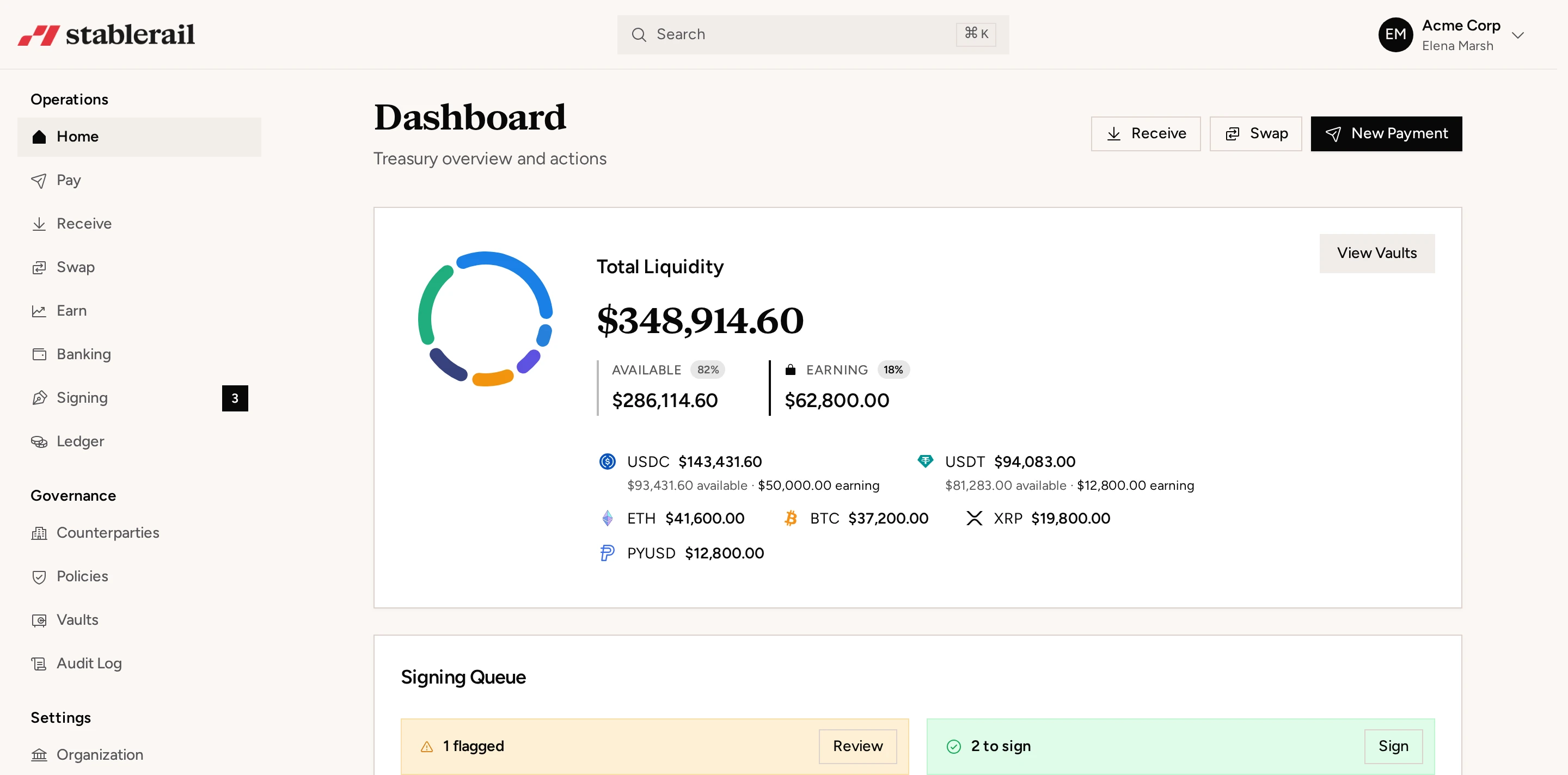
Require additional review for new beneficiaries, changed wallet addresses and payments above internal thresholds. Document signer replacement, recovery and emergency access procedures before they are needed. A business account such as Stablerail can combine USDC and USDT treasury activity with approvals and signing quorum, sanctions and address screening before send, corporate cards, global payouts, fiat off-ramp and exportable audit evidence.
5. Fund the account and document the conversion
A business can commonly fund its payment flow by depositing stablecoins from an existing wallet or sending fiat and converting through an on-ramp. For fiat funding, verify the beneficiary name, bank details, required reference, originating-account rules and whether third-party deposits are permitted.
Choose the banking rail according to the currency, destination and urgency. ACH and Fedwire are commonly used for USD, SEPA and SEPA Instant for EUR, and Faster Payments, CHAPS or BACS for GBP. SWIFT can support cross-border transfers, but intermediary banks, cut-off times and compliance reviews can affect receipt.
Before converting, capture the quote timestamp, exchange rate, provider charge, network fee, minimum amount and final stablecoin amount. Retain the bank confirmation, conversion receipt and internal authorization. This creates a traceable bridge between the fiat ledger entry and the resulting wallet balance.
6. Validate the counterparty and payment instructions
A usable stablecoin payment instruction needs more than a wallet address. Obtain the recipient’s legal or trading name, wallet address, token, exact network, amount, invoice reference and confirmation that its wallet or exchange accepts that route.
Verify new or changed instructions through a separate communication channel. An email account can be compromised, so a known phone number or previously authenticated channel provides a stronger check than replying to the same message.
Screen the destination address before sending and retain the result with the approval record. If screening returns a match or elevated concern, pause the payment and follow the company’s escalation process. Screening does not replace counterparty due diligence; it is an additional control focused on the blockchain address.
7. Run a test payment
Send a small test amount before a material transfer to a new address. Use the same token, network and destination planned for the main payment. A successful test on a different network does not validate the intended route.
Record the approval time, amount sent, blockchain fee, transaction hash, confirmation status and amount credited. Ask the recipient to confirm that the funds are available in its account, not merely visible on a block explorer. Exchanges and custodial wallets may require network confirmations or internal review before crediting a deposit.
Resolve any discrepancy before releasing the balance. Check whether the difference came from a fee, incorrect denomination, unsupported deposit route or recipient-side charge.
8. Reconcile the first live transfer
For each payment, retain the internal payment ID, invoice or payroll reference, token, network, destination address, transaction hash, blockchain fee, conversion record, approvers and recipient confirmation. The transaction hash identifies the blockchain transfer, but it does not by itself explain the business purpose or prove that the correct invoice was paid.
Post the principal amount separately from conversion and blockchain fees where required by the company’s accounting policy. Record the exchange rate and timestamp used to translate the transaction into the functional currency. Reconcile three points: the source fiat or stablecoin balance, the on-chain transfer and the recipient or off-ramp outcome.
Accounting treatment can depend on jurisdiction, reporting framework and how the stablecoin is used. Finance teams should establish a documented policy with their accounting and tax advisers rather than assuming stablecoins are recorded in the same way as bank cash.
9. Roll out in controlled stages
Begin with one legal entity, one asset, one network and a limited group of known counterparties. Expand only after funding, approvals, screening, recipient credit and ledger posting work consistently.
Use this launch checklist:
- Approve the end-to-end payment flow and responsible legal entity.
- Confirm provider eligibility, token-network support, limits and total costs.
- Complete KYB and disclose expected funding and counterparty activity.
- Configure user roles, signing quorum, recovery and beneficiary controls.
- Verify fiat instructions or source-wallet details.
- Authenticate and screen the recipient’s payment instructions.
- Complete and reconcile a small test transfer.
- Save the approval, conversion, transaction and accounting evidence.
- Update the treasury runbook before adding another corridor.
A finished onboarding process should produce a repeatable runbook, not just an active account. The runbook should state who can fund, convert, prepare, approve and sign; how addresses are verified; what evidence is retained; how exceptions are escalated; and how each payment reaches the ledger.
Frequently asked questions
What documents are required for stablecoin business onboarding?
Providers commonly request incorporation records, constitutional documents, ownership information, director and beneficial-owner identification, proof of authority, and source-of-funds information. Requirements vary by jurisdiction, industry, ownership complexity and expected transaction activity.
How long does KYB take for a stablecoin business account?
There is no universal timeline because review depends on the entity, jurisdiction, ownership structure and completeness of the submission. Current documents, a clear ownership chart and a specific explanation of the payment flow can reduce avoidable follow-up questions.
Should a business use USDC or USDT for payments?
Choose according to the token and network the recipient can accept, the available on-ramp or off-ramp, liquidity for the corridor and your internal risk policy. Confirm the exact token contract and network rather than selecting solely by ticker.
Why should a company send a test stablecoin payment first?
A test verifies the token, network, wallet address, approval process and recipient-crediting workflow before a material amount is exposed. The recipient should confirm that the funds are available, because visibility on a block explorer does not guarantee that a custodial platform has credited the deposit.
What records should be kept for a stablecoin payment?
Keep the invoice or business-purpose record, internal payment ID, destination address, token, network, transaction hash, fees, exchange rate, conversion receipt, approvers, screening result and recipient confirmation. Together, these records connect the on-chain movement to the company’s authorization and ledger entry.
Finance writers covering stablecoin treasury, payments, compliance, and risk controls.
More about the Stablerail team- Stablecoin treasury managementApprovals, limits, yield and reporting on one balance.
- Stablecoin payoutsBatch contractor and vendor payments with screening.
- USDT vs USDCWhich stablecoin your company should settle in.
- Stablecoin finance glossaryMPC, off-ramp, travel rule and the rest, in plain English.
- Product updatesEverything we ship, month by month.