
Stablecoin payroll: paying contractors and employees across borders
Learn how to pay international employees and contractors in USDC, USDT or fiat while managing local wage rules, approvals, network selection, fees and audit evidence.
Stablecoin payroll can make cross-border payments faster, but finance teams must choose the payout method recipient by recipient. Contractors can often receive USDC or USDT against approved invoices, while employee wages may need to be denominated or paid in local currency. A controlled process should verify local rules, wallet networks, exchange rates, approvals, taxes, fees and payment evidence before each payroll run.
%22%20x1%3D%220%22%20y1%3D%220%22%20x2%3D%221%22%20y2%3D%221%22%3E%0A%20%20%20%20%20%20%20%20%3Cstop%20offset%3D%220%25%22%20stop-color%3D%22%232A0608%22%20%2F%3E%0A%20%20%20%20%20%20%20%20%3Cstop%20offset%3D%2250%25%22%20stop-color%3D%22%23420D12%22%20%2F%3E%0A%20%20%20%20%20%20%20%20%3Cstop%20offset%3D%22100%25%22%20stop-color%3D%22%23621619%22%20%2F%3E%0A%20%20%20%20%20%20%3C%2FlinearGradient%3E%0A%20%20%20%20%20%20%3CradialGradient%20id%3D%22glow%22%20cx%3D%22674%22%20cy%3D%22460%22%20r%3D%22520%22%20gradientUnits%3D%22userSpaceOnUse%22%3E%0A%20%20%20%20%20%20%20%20%3Cstop%20offset%3D%220%25%22%20stop-color%3D%22%23FF9577%22%20stop-opacity%3D%220.45%22%20%2F%3E%0A%20%20%20%20%20%20%20%20%3Cstop%20offset%3D%2255%25%22%20stop-color%3D%22%23FF9577%22%20stop-opacity%3D%220.08%22%20%2F%3E%0A%20%20%20%20%20%20%20%20%3Cstop%20offset%3D%22100%25%22%20stop-color%3D%22%23FF9577%22%20stop-opacity%3D%220%22%20%2F%3E%0A%20%20%20%20%20%20%3C%2FradialGradient%3E%0A%20%20%20%20%20%20%3ClinearGradient%20id%3D%22glass%22%20x1%3D%220%22%20y1%3D%220%22%20x2%3D%221%22%20y2%3D%221%22%3E%0A%20%20%20%20%20%20%20%20%3Cstop%20offset%3D%220%25%22%20stop-color%3D%22%23F8D6D2%22%20stop-opacity%3D%220.26%22%20%2F%3E%0A%20%20%20%20%20%20%20%20%3Cstop%20offset%3D%22100%25%22%20stop-color%3D%22%23FFFFFF%22%20stop-opacity%3D%220.08%22%20%2F%3E%0A%20%20%20%20%20%20%3C%2FlinearGradient%3E%0A%20%20%20%20%20%20%3ClinearGradient%20id%3D%22accent%22%20x1%3D%220%22%20y1%3D%220%22%20x2%3D%221%22%20y2%3D%221%22%3E%0A%20%20%20%20%20%20%20%20%3Cstop%20offset%3D%220%25%22%20stop-color%3D%22%23FF9577%22%20%2F%3E%0A%20%20%20%20%20%20%20%20%3Cstop%20offset%3D%22100%25%22%20stop-color%3D%22%23D03B2D%22%20%2F%3E%0A%20%20%20%20%20%20%3C%2FlinearGradient%3E%0A%20%20%20%20%20%20%3Cfilter%20id%3D%22soft%22%3E%3CfeGaussianBlur%20stdDeviation%3D%2210%22%20%2F%3E%3C%2Ffilter%3E%0A%20%20%20%20%3C%2Fdefs%3E%0A%20%20%20%20%3Crect%20width%3D%221600%22%20height%3D%22900%22%20fill%3D%22url(%23bg)%22%20%2F%3E%0A%20%20%20%20%3Crect%20width%3D%221600%22%20height%3D%22900%22%20fill%3D%22url(%23glow)%22%20%2F%3E%0A%20%20%20%20%0A%20%20%20%20%3Cpath%20d%3D%22M%20500%20600%20A%20300%20300%200%200%201%201100%20600%22%20fill%3D%22none%22%20stroke%3D%22url(%23glass)%22%20stroke-width%3D%2260%22%2F%3E%0A%20%20%20%20%3Cpath%20d%3D%22M%20500%20600%20A%20300%20300%200%200%201%201015.8019401015954%20808.3975111376992%22%20fill%3D%22none%22%20stroke%3D%22url(%23accent)%22%20stroke-width%3D%2260%22%20stroke-linecap%3D%22round%22%2F%3E%0A%20%20%20%20%3Ccircle%20cx%3D%22800%22%20cy%3D%22600%22%20r%3D%2232%22%20fill%3D%22%233E090D%22%20stroke%3D%22url(%23accent)%22%20stroke-width%3D%226%22%2F%3E%0A%20%20%20%20%3Cline%20x1%3D%22800%22%20y1%3D%22600%22%20x2%3D%22972.6415520812762%22%20y2%3D%22766.7180089101594%22%20stroke%3D%22%23FFF1ED%22%20stroke-width%3D%2210%22%20stroke-linecap%3D%22round%22%2F%3E%0A%20%20%0A%20%20%20%20%3Crect%20x%3D%2226%22%20y%3D%2226%22%20width%3D%221548%22%20height%3D%22848%22%20rx%3D%2218%22%20fill%3D%22none%22%20stroke%3D%22%23F2D0C8%22%20stroke-opacity%3D%220.12%22%2F%3E%0A%20%20%3C%2Fsvg%3E)
Stablecoin payroll can shorten cross-border payment times and give recipients more control over how they hold or convert their money. It is not simply a matter of sending USDC or USDT to a list of wallets. Finance must determine whether each person is an employee or contractor, select a lawful payout route, validate payment instructions, calculate conversions, approve the batch and retain evidence that connects the underlying obligation to final receipt.
The best operating model is usually a mixed one: stablecoins for eligible recipients who want them, and local or foreign-currency bank transfers where employment law, recipient preference or banking requirements make fiat more appropriate.
Employees and contractors require different workflows
The first decision is the recipient’s legal relationship with the company. A contractor generally submits an invoice under a services agreement. An employee is paid through payroll and may be subject to wage, withholding, social contribution, benefits and payslip rules in the country where they work.
| Area | Employee | Contractor |
|---|---|---|
| Payment basis | Employment agreement and gross-to-net payroll calculation | Services agreement, approved invoice or fee schedule |
| Currency flexibility | May be restricted by local wage and legal-tender rules | Often more flexible if the contract and local law permit it |
| Tax handling | Employer withholding, reporting and social contributions may apply | Contractor commonly handles tax, although payer reporting or withholding can still apply |
| Core evidence | Payroll register, payslip, deductions, consent and payment confirmation | Contract, invoice, approval and payment confirmation |
| Primary risk | Unlawful wage payment or incorrect payroll reporting | Worker misclassification or payment outside contract terms |
Calling a worker a contractor does not determine their status. Authorities may consider control, working hours, exclusivity, integration into the business and economic dependence. Stablecoin payment does not change the underlying relationship or remove payroll obligations. Companies should obtain employment and tax advice for each hiring country rather than using crypto payroll as a substitute for compliant employment arrangements.
Check local law before choosing stablecoin
Some jurisdictions require wages to be denominated or paid in legal tender, deposited through particular channels or processed by a local payroll provider. Others may permit full or partial stablecoin payment with informed written consent. Minimum-wage tests may also require the company to establish a local-currency value at a prescribed point in time.
Before activating a country, confirm:
- Permitted payment form: whether employee wages or contractor fees may be settled in USDC or USDT.
- Salary denomination: whether contracts, payroll registers and payslips must show local currency.
- Valuation method: the exchange-rate source, timestamp and rounding convention used to determine the stablecoin amount.
- Consent: whether employee consent is required, what disclosures it must contain and whether it can be withdrawn.
- Payroll obligations: withholding, social contributions, benefits, reporting and payslip requirements.
- Foreign exchange restrictions: limits on receiving funds from abroad, holding stablecoins or converting them locally.
If stablecoin wages are not clearly permitted, the safer route is normally to deliver local fiat to the employee. The company may still use stablecoins within its treasury workflow and convert them before the final payroll payment.
Select the payout route recipient by recipient
A single payroll file does not require one universal payment method. The appropriate route depends on local law, recipient status, banking access, currency needs and the recipient’s ability to use a wallet safely.
| Payout route | Best suited to | Key checks | Operational trade-off |
|---|---|---|---|
| USDC or USDT to a wallet | Eligible contractors and employees where stablecoin wages are permitted | Asset, blockchain, address ownership, wallet support and local rules | Potentially fast settlement, but the recipient may bear conversion and withdrawal costs |
| Local fiat bank transfer | Employees subject to legal-tender rules or recipients who need local currency | Bank details, cut-offs, holidays, conversion rate and beneficiary checks | Familiar receipt method, but banking chains can add delays and charges |
| Split fiat and stablecoin | Eligible recipients who need fiat for expenses but want part in stablecoins | Consent, payroll calculation, allocation and separate reconciliation entries | More recipient choice, but additional accounting complexity |
| Foreign-currency bank transfer | Recipients with eligible USD, EUR or other currency accounts | Bank acceptance, correspondent charges and incoming-payment rules | Avoids on-chain handling, but the recipient bank may convert or deduct fees |
For an on-chain payment, the recipient must identify both the asset and the exact network. Addresses on Ethereum-compatible networks may have the same format, but that does not mean the recipient’s wallet or exchange supports deposits through every network. A transfer sent through an unsupported network can be difficult or impossible to recover. Use a small test payment for a new wallet, exchange deposit address or network.
Build a controlled payroll batch
A repeatable batch process reduces ad hoc transfers and gives finance a clear record of what was approved, sent, rejected and retried. A practical payroll run is:
- Lock the period. Finalise salaries, approved contractor invoices, bonuses, deductions, reimbursements and statutory items.
- Assign the route. Record fiat currency or stablecoin, blockchain network and destination for every recipient.
- Validate instructions. Check beneficiary names and bank fields or verify wallet addresses, network compatibility and ownership evidence. Apply allowlists to recurring destinations where appropriate.
- Calculate conversions. Preserve the source amount, exchange-rate source, valuation timestamp, stablecoin quantity and rounding adjustment.
- Fund the batch. Include principal, estimated conversion costs, bank charges and blockchain network fees. Keep a buffer for variable network fees without changing recipient entitlements.
- Approve and release. Separate batch preparation from approval and require the appropriate signing quorum. Screen sanctions exposure and destination addresses before sending.
- Monitor settlement. Capture bank references or transaction hashes and identify payments that are pending, rejected or returned.
- Reconcile exceptions. Record failed amounts, correct instructions, obtain any required reapproval and link retries to the original payroll item.
For fiat routes, submit early enough to account for local bank holidays, cut-off times, time zones and correspondent banks. For on-chain routes, do not treat transaction submission as receipt: confirm the transaction reached the intended network and achieved the team’s required confirmation status.
Compare the recipient’s total cost
The headline transfer fee does not reveal the recipient’s net proceeds. Depending on the route, total cost can include fiat conversion, an on-ramp or off-ramp fee, blockchain gas, payout charges, exchange withdrawal fees and deductions by intermediary or recipient banks.
Estimate both company cost and recipient cost before approving a corridor. A low-fee network is not necessarily the cheapest outcome if the recipient must transfer the stablecoin to another platform and pay again to convert or withdraw it. Record expected costs with the batch, then compare them with actual charges during reconciliation.
Keep records that connect payroll to payment
A blockchain transaction hash proves that an on-chain transfer occurred, but it does not explain why it occurred. It does not contain the employment period, invoice, gross pay, deductions, exchange-rate policy or business approval.
Each payment run should preserve:
- the approved payroll register or contractor invoice list;
- employment or services agreements, payout elections and required consent;
- gross-to-net calculations, deductions and statutory reports;
- the source currency, exchange-rate methodology, timestamp and rounding;
- validated bank details or wallet and network instructions;
- approval history, signing evidence and screening results;
- bank references or blockchain transaction hashes;
- fees, returned funds, failed payments and linked retries; and
- payslips, invoices and any required tax documentation.
An evidence pack should allow a controller or auditor to trace one line from the contract or invoice through calculation, approval, conversion and final payment. Access should be restricted because payroll files combine personal information, compensation data and sensitive payment instructions.
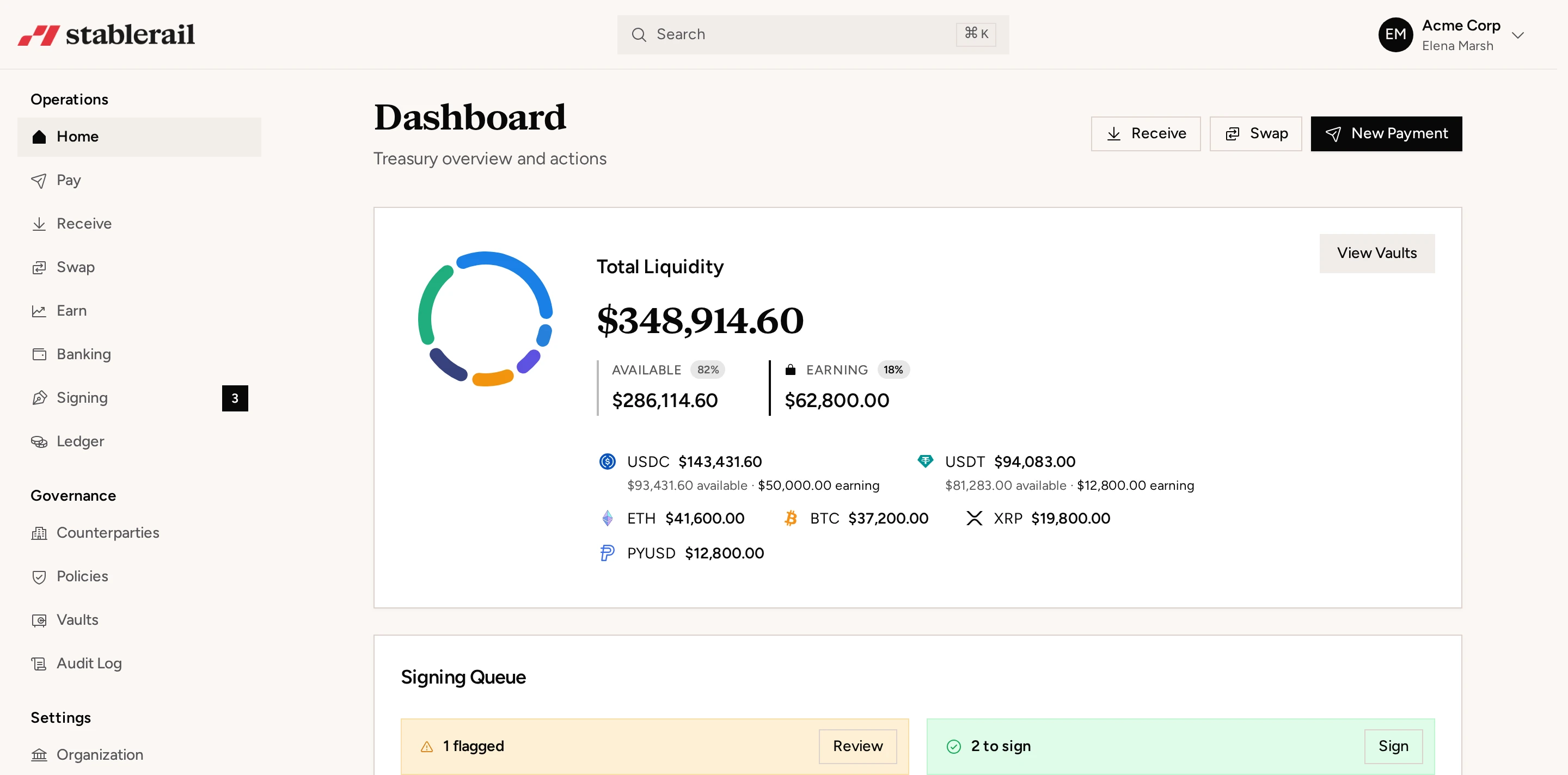
Stablerail brings USDC and USDT treasury, approval and signing quorum, sanctions and address screening, global payouts, fiat off-ramp and exportable audit evidence into one business account. Regardless of platform, finance should preserve segregation of duties and avoid relying on one person to prepare, approve and release payroll.
Roll out stablecoin payroll in stages
Begin with a small group of contractors in jurisdictions where stablecoin payments are clearly permitted. Document the supported asset and network, funding deadline, exchange-rate method, expected fees, approval path and exception owner. Test a complete cycle, including reconciliation and a failed-payment scenario, before increasing volume.
Add employees only after local advisers confirm wage, tax, consent and reporting requirements. Give recipients clear instructions about network selection, conversion risk, fees and the consequences of providing an incorrect address. Stablecoin payroll works best as an optional, controlled payout route—not as a requirement imposed on every international worker.
Frequently asked questions
Can employees legally be paid in stablecoins?
It depends on the employee’s country and employment terms. Some jurisdictions require wages to be denominated or paid in local legal tender, while others may permit full or partial stablecoin payment with informed consent and an appropriate local-currency valuation.
Is stablecoin payroll easier for contractors than employees?
Often, because contractor payments are generally made against a services agreement and invoice rather than through statutory payroll. However, the contract and local law must permit the payment method, and paying in stablecoins does not fix worker misclassification.
Should a company use USDC or USDT for payroll?
Choose based on legal permissibility, recipient preference, supported networks, liquidity and practical off-ramp access in the recipient’s market. The payment file must state both the stablecoin and blockchain network, and finance should confirm that the recipient’s wallet or exchange supports that exact combination.
How should stablecoin payroll be recorded in accounting?
Record the underlying salary or contractor expense separately from the payment asset and transaction fees. Preserve the source-currency obligation, exchange-rate source and timestamp, stablecoin quantity, approvals, transaction hash, fees and any gain or loss treatment required by the company’s accounting policy.
What happens if stablecoin payroll is sent to the wrong network?
Recovery may be difficult or impossible, particularly when the destination is an exchange or custodial wallet that does not support the selected network. Verify the asset and network independently, screen the address and use a small test transfer before the first full payment.
Finance writers covering stablecoin treasury, payments, compliance, and risk controls.
More about the Stablerail team- Stablecoin treasury managementApprovals, limits, yield and reporting on one balance.
- Stablecoin payoutsBatch contractor and vendor payments with screening.
- USDT vs USDCWhich stablecoin your company should settle in.
- Stablecoin finance glossaryMPC, off-ramp, travel rule and the rest, in plain English.
- Product updatesEverything we ship, month by month.