
Accounting for Stablecoin Yield: What Your Auditor Will Ask
A practical guide to classifying stablecoin yield positions, recognizing income, measuring balances and building an audit-ready onchain-to-ledger reconciliation.
Accounting for stablecoin yield starts with the legal instrument created when USDC or USDT is deployed. Determine whether the company holds a receivable, fund interest, deposit, protocol token or other asset; then document the income recognition trigger, measurement basis, fees and liquidity restrictions. Auditors will expect contracts, wallet-control evidence, transaction records, valuation support and a complete roll-forward from the blockchain or provider subledger to the general ledger.
%22%20x1%3D%220%22%20y1%3D%220%22%20x2%3D%221%22%20y2%3D%221%22%3E%0A%20%20%20%20%20%20%20%20%3Cstop%20offset%3D%220%25%22%20stop-color%3D%22%232E0709%22%20%2F%3E%0A%20%20%20%20%20%20%20%20%3Cstop%20offset%3D%2250%25%22%20stop-color%3D%22%234A0F14%22%20%2F%3E%0A%20%20%20%20%20%20%20%20%3Cstop%20offset%3D%22100%25%22%20stop-color%3D%22%236B181C%22%20%2F%3E%0A%20%20%20%20%20%20%3C%2FlinearGradient%3E%0A%20%20%20%20%20%20%3CradialGradient%20id%3D%22glow%22%20cx%3D%22641%22%20cy%3D%2283%22%20r%3D%22520%22%20gradientUnits%3D%22userSpaceOnUse%22%3E%0A%20%20%20%20%20%20%20%20%3Cstop%20offset%3D%220%25%22%20stop-color%3D%22%23FFB199%22%20stop-opacity%3D%220.45%22%20%2F%3E%0A%20%20%20%20%20%20%20%20%3Cstop%20offset%3D%2255%25%22%20stop-color%3D%22%23FFB199%22%20stop-opacity%3D%220.08%22%20%2F%3E%0A%20%20%20%20%20%20%20%20%3Cstop%20offset%3D%22100%25%22%20stop-color%3D%22%23FFB199%22%20stop-opacity%3D%220%22%20%2F%3E%0A%20%20%20%20%20%20%3C%2FradialGradient%3E%0A%20%20%20%20%20%20%3ClinearGradient%20id%3D%22glass%22%20x1%3D%220%22%20y1%3D%220%22%20x2%3D%221%22%20y2%3D%221%22%3E%0A%20%20%20%20%20%20%20%20%3Cstop%20offset%3D%220%25%22%20stop-color%3D%22%23F8D6D2%22%20stop-opacity%3D%220.26%22%20%2F%3E%0A%20%20%20%20%20%20%20%20%3Cstop%20offset%3D%22100%25%22%20stop-color%3D%22%23FFFFFF%22%20stop-opacity%3D%220.08%22%20%2F%3E%0A%20%20%20%20%20%20%3C%2FlinearGradient%3E%0A%20%20%20%20%20%20%3ClinearGradient%20id%3D%22accent%22%20x1%3D%220%22%20y1%3D%220%22%20x2%3D%221%22%20y2%3D%221%22%3E%0A%20%20%20%20%20%20%20%20%3Cstop%20offset%3D%220%25%22%20stop-color%3D%22%23FFB199%22%20%2F%3E%0A%20%20%20%20%20%20%20%20%3Cstop%20offset%3D%22100%25%22%20stop-color%3D%22%23E85D3A%22%20%2F%3E%0A%20%20%20%20%20%20%3C%2FlinearGradient%3E%0A%20%20%20%20%20%20%3Cfilter%20id%3D%22soft%22%3E%3CfeGaussianBlur%20stdDeviation%3D%2210%22%20%2F%3E%3C%2Ffilter%3E%0A%20%20%20%20%3C%2Fdefs%3E%0A%20%20%20%20%3Crect%20width%3D%221600%22%20height%3D%22900%22%20fill%3D%22url(%23bg)%22%20%2F%3E%0A%20%20%20%20%3Crect%20width%3D%221600%22%20height%3D%22900%22%20fill%3D%22url(%23glow)%22%20%2F%3E%0A%20%20%20%20%3Cline%20x1%3D%22200%22%20y1%3D%22250%22%20x2%3D%221400%22%20y2%3D%22250%22%20stroke%3D%22%23F4CDC5%22%20stroke-opacity%3D%220.12%22%2F%3E%3Cline%20x1%3D%22200%22%20y1%3D%22340%22%20x2%3D%221400%22%20y2%3D%22340%22%20stroke%3D%22%23F4CDC5%22%20stroke-opacity%3D%220.12%22%2F%3E%3Cline%20x1%3D%22200%22%20y1%3D%22430%22%20x2%3D%221400%22%20y2%3D%22430%22%20stroke%3D%22%23F4CDC5%22%20stroke-opacity%3D%220.12%22%2F%3E%3Cline%20x1%3D%22200%22%20y1%3D%22520%22%20x2%3D%221400%22%20y2%3D%22520%22%20stroke%3D%22%23F4CDC5%22%20stroke-opacity%3D%220.12%22%2F%3E%3Cline%20x1%3D%22200%22%20y1%3D%22610%22%20x2%3D%221400%22%20y2%3D%22610%22%20stroke%3D%22%23F4CDC5%22%20stroke-opacity%3D%220.12%22%2F%3E%3Cpolyline%20points%3D%22200%2C479%20350%2C253%20500%2C400%20650%2C383%20800%2C451%20950%2C459%201100%2C250%201250%2C434%201400%2C492%22%20fill%3D%22none%22%20stroke%3D%22url(%23accent)%22%20stroke-width%3D%2210%22%20stroke-linejoin%3D%22round%22%20stroke-linecap%3D%22round%22%2F%3E%3Ccircle%20cx%3D%22200%22%20cy%3D%22479%22%20r%3D%229%22%20fill%3D%22%23F8D6D2%22%2F%3E%3Ccircle%20cx%3D%22350%22%20cy%3D%22253%22%20r%3D%229%22%20fill%3D%22%23F8D6D2%22%2F%3E%3Ccircle%20cx%3D%22500%22%20cy%3D%22400%22%20r%3D%229%22%20fill%3D%22%23F8D6D2%22%2F%3E%3Ccircle%20cx%3D%22650%22%20cy%3D%22383%22%20r%3D%229%22%20fill%3D%22%23F8D6D2%22%2F%3E%3Ccircle%20cx%3D%22800%22%20cy%3D%22451%22%20r%3D%229%22%20fill%3D%22%23F8D6D2%22%2F%3E%3Ccircle%20cx%3D%22950%22%20cy%3D%22459%22%20r%3D%229%22%20fill%3D%22%23F8D6D2%22%2F%3E%3Ccircle%20cx%3D%221100%22%20cy%3D%22250%22%20r%3D%229%22%20fill%3D%22%23F8D6D2%22%2F%3E%3Ccircle%20cx%3D%221250%22%20cy%3D%22434%22%20r%3D%229%22%20fill%3D%22%23F8D6D2%22%2F%3E%3Ccircle%20cx%3D%221400%22%20cy%3D%22492%22%20r%3D%229%22%20fill%3D%22%23F8D6D2%22%2F%3E%0A%20%20%20%20%3Crect%20x%3D%2226%22%20y%3D%2226%22%20width%3D%221548%22%20height%3D%22848%22%20rx%3D%2218%22%20fill%3D%22none%22%20stroke%3D%22%23F2D0C8%22%20stroke-opacity%3D%220.12%22%2F%3E%0A%20%20%3C%2Fsvg%3E)
Stablecoin yield should be accounted for according to the substance of the arrangement, not the advertised annual percentage yield. A lending receivable, tokenized money market fund, deposit product and decentralized finance position can produce similar returns while requiring different classification, recognition, measurement and disclosure decisions.
The policy must reflect the company’s reporting framework, functional currency and contractual rights. Finance teams should agree the conclusion with their auditor before a material allocation is made, rather than trying to reconstruct it at year-end. This is an operational guide, not accounting advice.
Start with the instrument, not the yield rate
The first question is what the company receives after transferring USDC or USDT. The dashboard may describe the resulting balance as cash, savings or earned yield, but those labels do not establish its accounting treatment.
Retain the product documents that applied during each reporting period. Terms can change, so a current web page is not necessarily evidence of the rights that existed on the reporting date. The file should establish:
- Legal counterparty: Identify the entity, borrower, fund, custodian or protocol involved and which party owes an obligation to the company.
- Asset flow: Determine whether the stablecoins remain in a controlled wallet, are lent, are exchanged for units or are deposited into a smart contract.
- Redemption rights: Record notice periods, redemption windows, gates, lockups, minimums and any dependence on available liquidity.
- Return methodology: Establish whether the return is fixed, variable, discretionary, rebasing or reflected through a rising redemption value.
- Fees: Capture management, performance, platform, network and redemption charges, including fees deducted before a net distribution.
- Risk allocation: Document who bears counterparty, stablecoin, smart-contract, custody, liquidity and market risk.
Classify the position based on its substance
There is no universal accounting category called a yield-bearing stablecoin. Classification depends on the asset created by the transaction and the requirements of IFRS, US GAAP or the company’s other applicable framework.
| Structure | What the company may hold | Key accounting questions | Important evidence |
|---|---|---|---|
| Stablecoin lending | A contractual receivable from a borrower or platform | Is it a financial asset? How should interest, credit risk and impairment be treated? | Loan terms, borrower identity, balance statement and interest calculation |
| Tokenized money market fund | Shares or fund units represented by tokens | How is the investment classified and measured? Is a quoted or redeemable value available? | Offering documents, administrator statement, unit price and redemption terms |
| Bank or deposit product | A claim against a financial institution | Does the claim qualify as cash, a cash equivalent or another financial asset? | Account agreement, institution statement and withdrawal restrictions |
| DeFi lending or liquidity position | A protocol token, liquidity token or smart-contract claim | Is return separate from token price movement? How is fair value supported? | Protocol terms, contract addresses, transaction history and valuation method |
| Rewards on an unchanged balance | The original asset plus periodic rewards | When are rewards earned, receivable and controlled? How are they presented? | Reward rules, accrual report, claim records and wallet receipts |
Do not classify a position as a cash equivalent merely because it targets one dollar or is usually redeemable quickly. The analysis generally considers maturity, liquidity, convertibility to a known amount of cash and exposure to changes in value. Notice periods, withdrawal gates, counterparty exposure or variable redemption values may change the conclusion.
Define when yield is recognized
The accounting policy should name the event that creates recognizable income. That event may be the passage of time, the establishment of an enforceable receivable, the crediting of a reward or a change in the measured value of the instrument.
Contractual return earned over time
If a contractual return accrues over time, income may need to be recorded before tokens reach the company’s wallet. The exact calculation and account presentation depend on the instrument and applicable standard.
Illustrative accrual: debit the financial asset or an accrued-yield receivable; credit interest income or the approved income account. On payment, clear the receivable against the stablecoins or other asset received.
Maintain the principal balance, rate history, day-count convention and accrual period. If identifiable fees are material, record them according to the approved gross-versus-net policy rather than treating the net wallet increase as the entire return.
Variable or discretionary rewards
A reward that can be changed, cancelled or withheld before distribution may not support accrual on the same basis as contractual interest. Recognition may occur when the amount is credited, becomes claimable or enters a company-controlled wallet. The policy should define that trigger and explain how unclaimed rewards are tested at each close.
Increasing token or unit value
Some products do not distribute additional tokens. Instead, each token represents an increasing claim on an underlying pool. The change may therefore arise through measurement of the asset rather than a separate interest receipt. Finance teams should avoid automatically presenting every increase in redemption value as yield income.
Measure the balance and separate currency effects
At every close, capture both the quantity held and the value under the approved accounting policy. Depending on the instrument and framework, the basis could involve fair value, amortized cost or another measurement model.
The valuation memo should identify the reporting cut-off time and time zone, source market or administrator, price used, treatment of bid-ask spreads, and process for investigating stablecoin deviations from its reference currency. If the yield-bearing token lacks an active market, document how a redemption value, net asset value or other valuation input was obtained and why it is appropriate.
A company whose functional currency differs from the stablecoin’s reference currency may need to distinguish product return from foreign-exchange movement. For example, a EUR-functional entity holding a USD-denominated position can earn contractual yield while also experiencing a EUR/USD remeasurement gain or loss. Preserve both the native-unit calculation and the functional-currency translation.
Build an onchain-to-ledger roll-forward
A block explorer supports existence at an address, but it does not by itself prove that the reporting entity owns or controls that address. Audit evidence must connect the legal owner, wallet or provider account, product entitlement and general ledger.
| Reconciliation line | Primary support | Control or audit focus |
|---|---|---|
| Opening balance | Prior signed-off reconciliation and ledger balance | Agreement to the previous reporting period |
| Deposits or subscriptions | Transaction hash, addresses, timestamp and product confirmation | Authorization, cut-off and correct product account |
| Accrued or distributed yield | Daily balances, rate history, reward statement and calculation | Accuracy, recognition trigger and completeness |
| Fees | Fee schedule, invoice, transaction record or net-to-gross calculation | Complete expense capture and consistent presentation |
| Withdrawals or redemptions | Transaction hash, redemption confirmation and destination record | Authorization, cut-off and receipt by the company |
| Closing balance | Onchain balance or provider subledger, valuation file and ledger extract | Existence, rights, valuation and ledger agreement |
Use network timestamps consistently and document how transactions near period-end are assigned to the reporting period. Where a provider pools assets, the protocol’s wallet balance will not prove the company’s individual entitlement. Obtain a provider statement or subledger and reconcile credited yield, deposits and redemptions to the company’s records.
Prepare evidence for the auditor
Auditors commonly test existence, rights and obligations, completeness, accuracy, valuation, cut-off and presentation. A repeatable evidence pack should answer each assertion without relying only on screenshots, which can omit metadata and are difficult to reproduce.
- Maintain a wallet and account inventory with network, address, purpose, legal owner, custodian and control method.
- Retain complete transaction exports with hashes, timestamps, token contract addresses and originating and destination addresses.
- Archive signed contracts, dated terms, fee schedules, liquidity provisions and risk disclosures.
- Save provider statements, reward reports and independently reproducible yield calculations.
- Document the valuation source, observation time, functional-currency rate and treatment of unusual pricing.
- Reconcile opening balance, additions, income, fees, withdrawals, remeasurement and closing balance to the ledger.
- Retain approvals for allocations and redemptions, plus relevant sanctions or address-screening records.
Control evidence should demonstrate wallet authority without exposing private keys or recovery material. For an MPC or multisignature setup, useful support can include the authorized signer list, quorum configuration, approval logs and a controlled message-signing procedure agreed with the auditor.
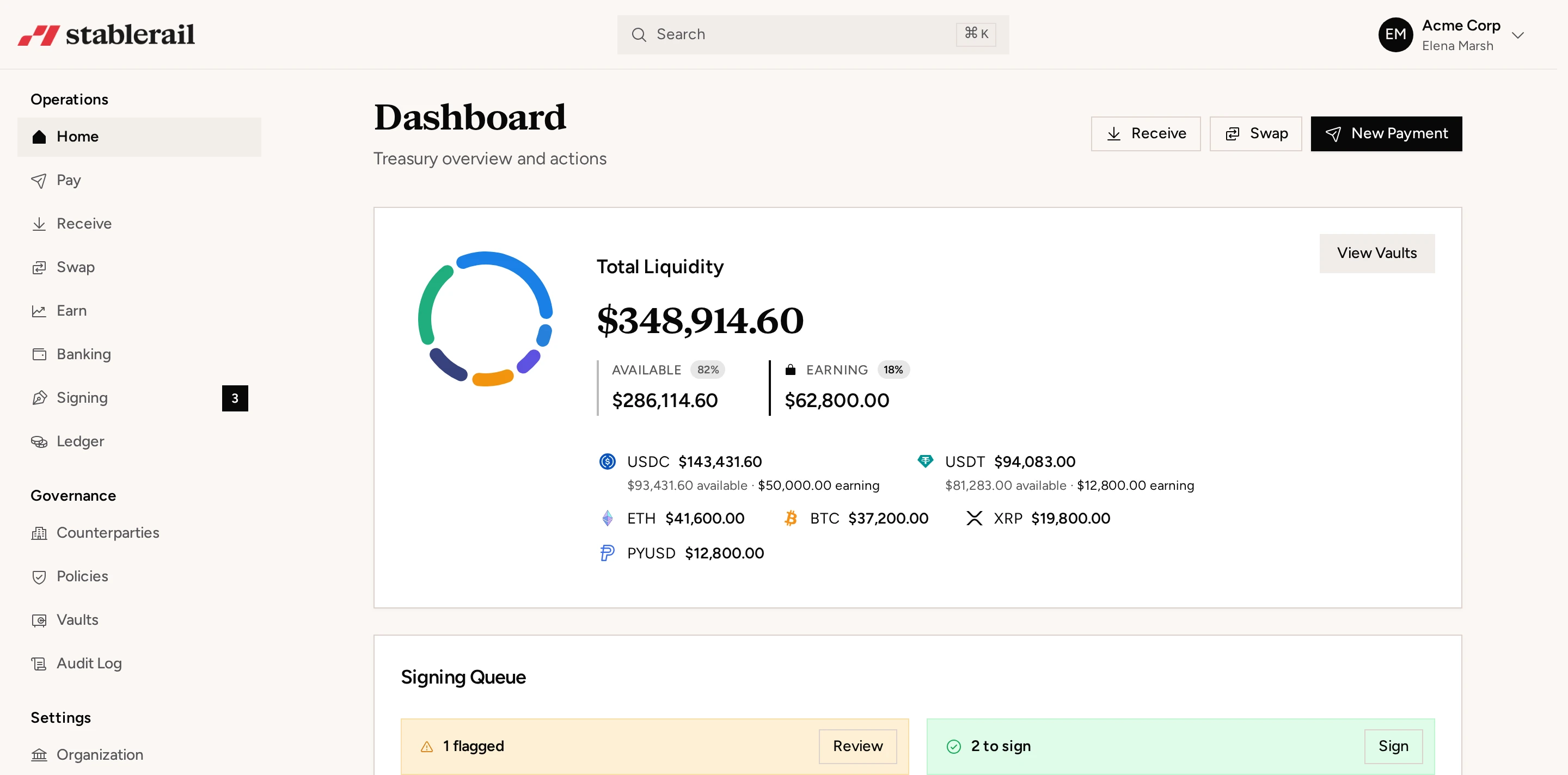
Systems should also preserve the separation between initiating, approving and signing a transfer. For example, Stablerail supports approvals and signing quorum, sanctions and address screening before send, and exportable audit evidence for USDC and USDT treasury activity. Whatever system is used, exports should be retained with the close file rather than reconstructed after staff or configurations change.
Resolve the policy before deploying funds
Before treasury moves stablecoins into a yield product, finance, legal and treasury should approve a short accounting memo. It should identify the instrument, legal owner, classification, recognition trigger, measurement basis, income and fee presentation, impairment or credit-risk considerations, liquidity restrictions and required disclosures.
The practical rule is simple: if finance cannot explain what the company owns, how it can redeem, when the return becomes enforceable and how the closing value can be independently reproduced, the position is not ready for an audit-efficient close.
Frequently asked questions
How should stablecoin yield be recorded in the general ledger?
The entry depends on the legal structure and recognition trigger. Contractual yield earned over time may be accrued as income and a receivable or addition to the financial asset, while discretionary rewards may be recognized only when credited, claimable or controlled.
Can a yield-bearing stablecoin be classified as a cash equivalent?
Not automatically. Finance must assess the applicable definition, including maturity, liquidity, convertibility to known amounts of cash and risk of value changes; redemption gates, counterparty exposure or variable values may prevent cash-equivalent treatment.
What evidence will auditors request for stablecoin yield?
Auditors will typically request contracts, wallet-control evidence, transaction exports, provider statements, yield calculations, fee support, valuation records and an onchain-to-ledger roll-forward. They may also test approvals, signing authority, transaction cut-off and ownership of the receiving wallet or account.
Is stablecoin yield recognized when it accrues or when it is paid?
That depends on whether the company has an enforceable contractual right as the return is earned. If rewards remain discretionary or contingent, recognition may instead occur when they are credited, become claimable or enter the company’s control.
How do you value a yield-bearing token with no active market?
Document the most appropriate observable input, such as an administrator’s net asset value or a supportable redemption value, under the applicable accounting policy. Retain the source, timestamp, redemption terms and calculations, and assess whether liquidity restrictions or credit risks affect the conclusion.
Finance writers covering stablecoin treasury, payments, compliance, and risk controls.
More about the Stablerail team- Stablecoin treasury managementApprovals, limits, yield and reporting on one balance.
- Stablecoin payoutsBatch contractor and vendor payments with screening.
- USDT vs USDCWhich stablecoin your company should settle in.
- Stablecoin finance glossaryMPC, off-ramp, travel rule and the rest, in plain English.
- Product updatesEverything we ship, month by month.