
Stablecoin Accounting Entries and Audit Evidence: A Practical Guide
A practical guide to stablecoin classification, journal entries, wallet reconciliation and audit evidence for USDC, USDT, fees, conversions and month-end close.
Stablecoin accounting requires a documented classification policy, separate ledger tracking by token and network, and journal entries that reflect the underlying transaction rather than merely the wallet transfer. For audit, retain transaction hashes, addresses, timestamps, valuation sources, approvals, invoices and fiat settlement records. Reconcile token units first, then functional-currency values, and connect every on-ramp or off-ramp across its blockchain and bank legs.
%22%20x1%3D%220%22%20y1%3D%220%22%20x2%3D%221%22%20y2%3D%221%22%3E%0A%20%20%20%20%20%20%20%20%3Cstop%20offset%3D%220%25%22%20stop-color%3D%22%23450B10%22%20%2F%3E%0A%20%20%20%20%20%20%20%20%3Cstop%20offset%3D%2250%25%22%20stop-color%3D%22%23681A1F%22%20%2F%3E%0A%20%20%20%20%20%20%20%20%3Cstop%20offset%3D%22100%25%22%20stop-color%3D%22%238A2A2D%22%20%2F%3E%0A%20%20%20%20%20%20%3C%2FlinearGradient%3E%0A%20%20%20%20%20%20%3CradialGradient%20id%3D%22glow%22%20cx%3D%22922%22%20cy%3D%22401%22%20r%3D%22520%22%20gradientUnits%3D%22userSpaceOnUse%22%3E%0A%20%20%20%20%20%20%20%20%3Cstop%20offset%3D%220%25%22%20stop-color%3D%22%23FF7A59%22%20stop-opacity%3D%220.45%22%20%2F%3E%0A%20%20%20%20%20%20%20%20%3Cstop%20offset%3D%2255%25%22%20stop-color%3D%22%23FF7A59%22%20stop-opacity%3D%220.08%22%20%2F%3E%0A%20%20%20%20%20%20%20%20%3Cstop%20offset%3D%22100%25%22%20stop-color%3D%22%23FF7A59%22%20stop-opacity%3D%220%22%20%2F%3E%0A%20%20%20%20%20%20%3C%2FradialGradient%3E%0A%20%20%20%20%20%20%3ClinearGradient%20id%3D%22glass%22%20x1%3D%220%22%20y1%3D%220%22%20x2%3D%221%22%20y2%3D%221%22%3E%0A%20%20%20%20%20%20%20%20%3Cstop%20offset%3D%220%25%22%20stop-color%3D%22%23F8D6D2%22%20stop-opacity%3D%220.26%22%20%2F%3E%0A%20%20%20%20%20%20%20%20%3Cstop%20offset%3D%22100%25%22%20stop-color%3D%22%23FFFFFF%22%20stop-opacity%3D%220.08%22%20%2F%3E%0A%20%20%20%20%20%20%3C%2FlinearGradient%3E%0A%20%20%20%20%20%20%3ClinearGradient%20id%3D%22accent%22%20x1%3D%220%22%20y1%3D%220%22%20x2%3D%221%22%20y2%3D%221%22%3E%0A%20%20%20%20%20%20%20%20%3Cstop%20offset%3D%220%25%22%20stop-color%3D%22%23FF7A59%22%20%2F%3E%0A%20%20%20%20%20%20%20%20%3Cstop%20offset%3D%22100%25%22%20stop-color%3D%22%23C73128%22%20%2F%3E%0A%20%20%20%20%20%20%3C%2FlinearGradient%3E%0A%20%20%20%20%20%20%3Cfilter%20id%3D%22soft%22%3E%3CfeGaussianBlur%20stdDeviation%3D%2210%22%20%2F%3E%3C%2Ffilter%3E%0A%20%20%20%20%3C%2Fdefs%3E%0A%20%20%20%20%3Crect%20width%3D%221600%22%20height%3D%22900%22%20fill%3D%22url(%23bg)%22%20%2F%3E%0A%20%20%20%20%3Crect%20width%3D%221600%22%20height%3D%22900%22%20fill%3D%22url(%23glow)%22%20%2F%3E%0A%20%20%20%20%0A%20%20%20%20%3Cpath%20d%3D%22M%20500%20600%20A%20300%20300%200%200%201%201100%20600%22%20fill%3D%22none%22%20stroke%3D%22url(%23glass)%22%20stroke-width%3D%2260%22%2F%3E%0A%20%20%20%20%3Cpath%20d%3D%22M%20500%20600%20A%20300%20300%200%200%201%201097.0804206224711%20558.2480697119804%22%20fill%3D%22none%22%20stroke%3D%22url(%23accent)%22%20stroke-width%3D%2260%22%20stroke-linecap%3D%22round%22%2F%3E%0A%20%20%20%20%3Ccircle%20cx%3D%22800%22%20cy%3D%22600%22%20r%3D%2232%22%20fill%3D%22%233E090D%22%20stroke%3D%22url(%23accent)%22%20stroke-width%3D%226%22%2F%3E%0A%20%20%20%20%3Cline%20x1%3D%22800%22%20y1%3D%22600%22%20x2%3D%221037.6643364979768%22%20y2%3D%22566.5984557695843%22%20stroke%3D%22%23FFF1ED%22%20stroke-width%3D%2210%22%20stroke-linecap%3D%22round%22%2F%3E%0A%20%20%0A%20%20%20%20%3Crect%20x%3D%2226%22%20y%3D%2226%22%20width%3D%221548%22%20height%3D%22848%22%20rx%3D%2218%22%20fill%3D%22none%22%20stroke%3D%22%23F2D0C8%22%20stroke-opacity%3D%220.12%22%2F%3E%0A%20%20%3C%2Fsvg%3E)
Stablecoin accounting begins with a documented asset-classification policy and a reliable path from wallets, payment records and bank accounts into the general ledger. The examples below use a USD functional currency and simplified figures. Actual treatment can differ under US GAAP, IFRS and local standards, so agree the classification, measurement basis and presentation with your accountant or auditor before posting material balances.
Set the accounting policy before posting entries
Do not assume one USDC or USDT must be accounted for as one US dollar. A token’s target price does not determine its accounting classification. The analysis may depend on the reporting framework, contractual redemption rights, issuer terms, the way the asset is held and the purpose for which it is held.
Under US GAAP, certain crypto assets are measured at fair value under the applicable crypto-asset guidance, but each stablecoin must meet the relevant scope criteria. A contractual claim against an issuer or another party may change the analysis. Under IFRS, a holding may fall within intangible-asset guidance or, for qualifying broker-traders, inventory guidance. Cash, cash-equivalent, financial-asset or receivable treatment should not be assumed without analyzing the holder’s enforceable rights and the relevant standard.
The written policy should specify:
- The general ledger account assigned to each stablecoin.
- Whether the asset is measured at cost, fair value or another permitted basis.
- The approved price source, market, timestamp and fallback procedure.
- How network, conversion, payout and provider fees are presented.
- How realized and unrealized gains or losses are calculated.
- How balances are separated by token, blockchain and controlled address.
- How internal transfers, wrapped assets and cross-chain bridge transactions are identified.
Operationally, USDC on Ethereum and USDC on Solana should remain distinguishable even if they share a ticker and target value. They use different transaction identifiers, addresses and settlement records, and may have different liquidity or operational risks.
Example stablecoin journal entries
These entries illustrate bookkeeping mechanics and exclude tax, revenue-recognition and foreign-currency complications unless noted. Account names should be adapted to the company’s chart of accounts.
1. Receiving stablecoins for an invoice
A customer settles a previously recognized $10,000 receivable with 10,000 USDC. The approved valuation source shows a value of $1.00 per USDC at the recognition timestamp.
| Account | Debit | Credit |
|---|---|---|
| USDC asset | $10,000 | |
| Accounts receivable | $10,000 |
If payment arrives before revenue is recognized, the credit may instead be deferred revenue, a contract liability or a customer deposit. The underlying commercial event determines the credit; the payment method does not.
Retain the invoice, payment request, transaction hash, blockchain, token contract, receiving address, token amount, block timestamp and valuation record. If the value at receipt differs from the receivable, apply the company’s policy for settlement differences rather than forcing the stablecoin balance to equal the invoice.
2. Paying a vendor in stablecoins
A company settles an approved $7,500 vendor bill and incurs a $3 network fee. Assume the carrying value of the stablecoins transferred is $7,503.
| Account | Debit | Credit |
|---|---|---|
| Accounts payable | $7,500 | |
| Network fee expense | $3 | |
| USDC asset | $7,503 |
If the carrying amount differs from the value used to settle the liability, record the resulting realized gain or loss in accordance with the accounting policy. Do not classify the entire wallet outflow as an expense when part of it settles an existing payable.
For a batch payout, preserve beneficiary-level detail. Each vendor bill, approved amount and destination address should map to the batch instruction and resulting on-chain distribution. The evidence should also show who prepared, reviewed and authorized the payout.
3. Converting stablecoins to fiat
A company converts 25,000 USDC to USD. Gross proceeds are $25,000, the provider charges $25, and $24,975 reaches the bank account. The stablecoins have a carrying amount of $24,950.
| Account | Debit | Credit |
|---|---|---|
| USD cash | $24,975 | |
| Conversion fee expense | $25 | |
| USDC asset | $24,950 | |
| Realized gain | $50 |
Record an explicit fee separately when the provider’s statement identifies it and the accounting policy requires separate presentation. This prevents conversion costs from disappearing into gains and losses.
The evidence package must connect the blockchain debit to the fiat credit. Keep the conversion order or quote, applied rate, fee breakdown, transaction identifier, settlement confirmation and bank statement entry. If stablecoins leave on the final day of the month but fiat arrives after month-end, assess whether a receivable, cash in transit or another clearing account is needed.
4. Recording a month-end valuation adjustment
Assume 100,000 USDT has a carrying amount of $99,900 and a fair value of $99,800 at the policy’s approved month-end timestamp. If fair-value measurement applies, the illustrative entry is:
| Account | Debit | Credit |
|---|---|---|
| Unrealized fair-value loss | $100 | |
| USDT asset | $100 |
A company applying another measurement model may not post this entry, although impairment analysis or disclosures may still be required. If the token trades away from its target value, document the observable market used, its relevance to the company’s holdings and any valuation adjustments required by the reporting framework.
Build a stablecoin month-end reconciliation
A wallet balance is not a complete accounting record. Reconcile each token by blockchain and controlled address using token units before translating the balance into the functional currency.
Opening token units + receipts − external payouts − conversion transfers − network fees = closing token units
Transfers between company-controlled addresses should appear on both sides of the address-level reconciliation but eliminate from the consolidated token balance. Bridge transactions need additional attention because the token may be locked, burned, minted or represented by a different asset on the destination network.
Use this close checklist:
- Export wallet activity through the reporting cutoff, including transaction status and network fees.
- Confirm closing balances independently using the relevant blockchain record or another reliable data source.
- Identify internal transfers and eliminate them from receipts, expenses and external payouts.
- Match every fiat on-ramp and off-ramp to the corresponding bank or provider statement.
- Investigate pending, failed, replaced, reversed or duplicated transactions.
- Review activity immediately before and after period-end for cutoff errors.
- Apply the approved valuation source and reconcile the adjustment to the general ledger.
- Have a reviewer sign off on exceptions and retain the completed reconciliation.
Audit evidence to retain
Audit evidence should allow a reviewer to test occurrence, completeness, rights and obligations, valuation, cutoff and authorization. A block explorer can prove that a transfer was recorded on a blockchain, but it does not prove the business purpose, accounting period, ownership of an address or approval of the payment.
| Evidence | Primary assertion or control supported | Operational detail to retain |
|---|---|---|
| Transaction record | Occurrence and cutoff | Hash, blockchain, token contract, block number, status and timestamp |
| Address register | Rights and control | Controlled addresses, purpose, network, activation date and responsible owner |
| Invoice, bill or payroll file | Business purpose and amount | Document identifier linked to the wallet transaction |
| Approval and signer log | Authorization | Preparer, approvers, signing quorum and release time |
| Screening result | Counterparty review | Address checked, result, timestamp and resolution of any alert |
| Conversion confirmation | Valuation and fees | Gross amount, rate, explicit fees and settlement identifier |
| Bank statement | Fiat settlement | Value date, net amount and reference matching the conversion |
| Month-end price record | Closing valuation | Source, market, timestamp, unit price and reviewer approval |
Wallet ownership evidence may include custody agreements, an approved address inventory, account records or a controlled verification procedure agreed with the auditor. Never disclose seed phrases or private signing material as audit evidence.
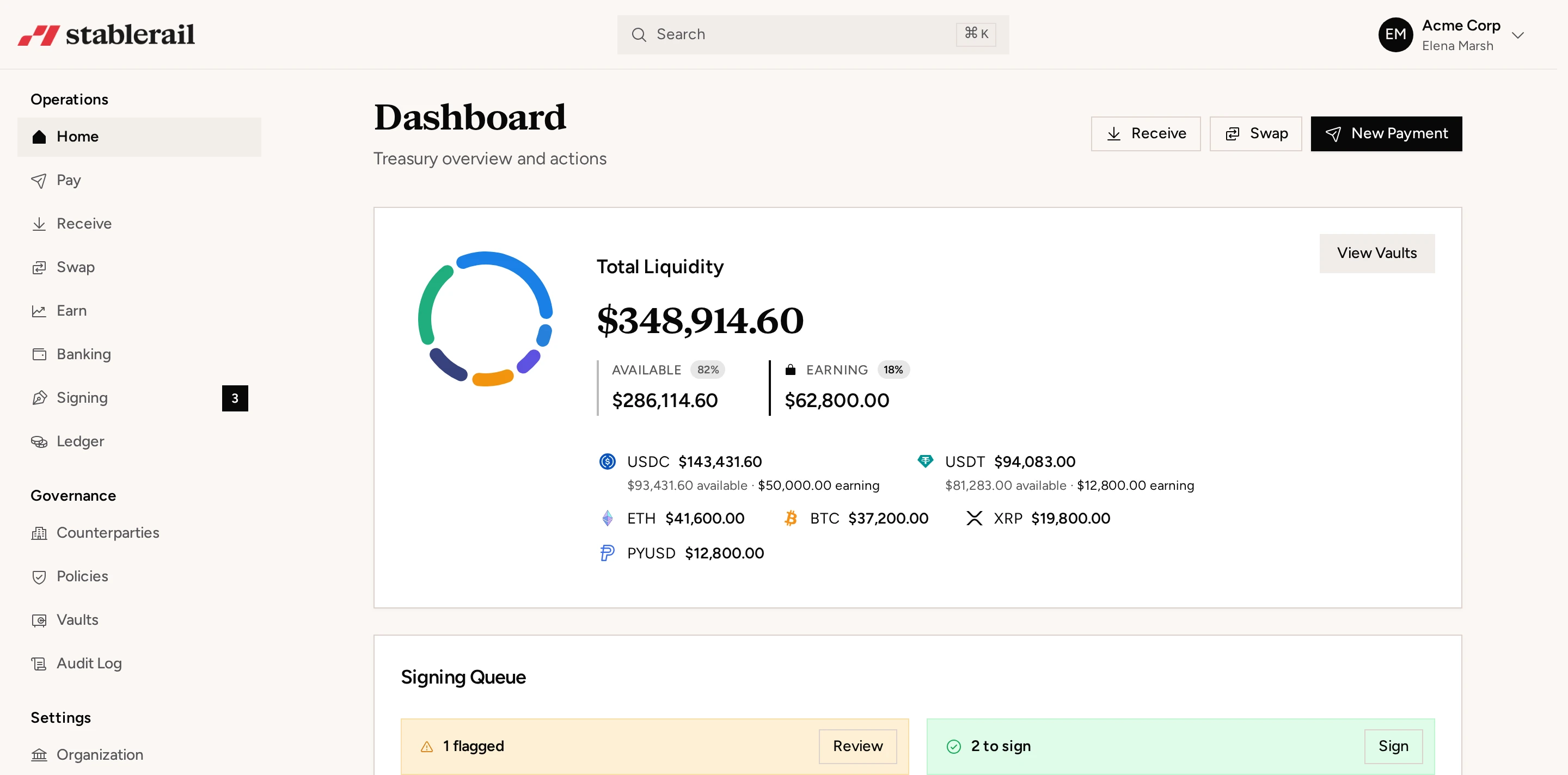
A stablecoin treasury account such as Stablerail can centralize USDC and USDT activity, approvals and signing quorum, pre-send sanctions and address screening, global payouts, fiat off-ramp records and exportable audit evidence. Finance should still retain the underlying invoice, contract, payroll file or other source document in its accounting system.
Common errors that create audit problems
- Netting fees against revenue: preserve the gross commercial transaction and separately record payment costs when required by policy.
- Treating every transfer as an expense: transfers between controlled wallets are balance-sheet movements.
- Combining networks: track the same token separately when it exists on different blockchains.
- Using the current price for an older transaction: apply the approved recognition timestamp consistently.
- Reconciling only in dollars: reconcile token units first, then carrying value and valuation adjustments.
- Relying on screenshots: retain exportable records and identifiers that can be independently reperformed.
- Ignoring failed transactions: a submitted instruction is not necessarily a completed settlement.
Make the process repeatable
Reliable stablecoin accounting does not require a unique workflow for every transfer. Use consistent ledger accounts, capture evidence when the transaction occurs, separate tokens by network, reconcile units before valuation and connect conversions across their blockchain and fiat legs.
Before the first audit, ask the auditor to review the classification memo, pricing methodology, address-control evidence and one sample transaction package. Resolving those questions early is more reliable than reconstructing wallet activity, approvals and valuation records after year-end.
Frequently asked questions
How should USDC and USDT be classified on the balance sheet?
Classification depends on the reporting framework, token terms, redemption rights and how the asset is held. A stablecoin should not automatically be classified as cash simply because it targets one US dollar; document the analysis under US GAAP, IFRS or the applicable local standard.
What journal entry records a stablecoin customer payment?
If the customer is settling an existing invoice, debit the stablecoin asset at the amount determined under the valuation policy and credit accounts receivable. If revenue has not yet been recognized, the credit may instead be deferred revenue, a contract liability or a customer deposit.
What evidence do auditors need for a stablecoin transaction?
Auditors typically need the transaction hash, blockchain, addresses, timestamp, token amount, valuation record and evidence of wallet control. They also need the underlying invoice or bill, approval history, screening record and any bank or conversion records needed to establish business purpose and settlement.
How do you reconcile stablecoins at month-end?
Reconcile opening units plus receipts, less payouts, conversions and network fees, to closing units for each token, network and controlled address. Then eliminate internal transfers, investigate exceptions, match fiat legs to bank statements and apply the approved closing valuation methodology.
Are stablecoin network fees expensed or added to the asset cost?
Treatment depends on the nature of the transaction and the company’s accounting policy under the applicable framework. Network fees for vendor payments are often tracked separately from the payable, while fees associated with acquiring or disposing of an asset may require different treatment; apply the policy consistently.
Finance writers covering stablecoin treasury, payments, compliance, and risk controls.
More about the Stablerail team- Stablecoin treasury managementApprovals, limits, yield and reporting on one balance.
- Stablecoin payoutsBatch contractor and vendor payments with screening.
- USDT vs USDCWhich stablecoin your company should settle in.
- Stablecoin finance glossaryMPC, off-ramp, travel rule and the rest, in plain English.
- Product updatesEverything we ship, month by month.