
How to Choose a Treasury Wallet for a Crypto Protocol
A practical framework for choosing a protocol treasury wallet, covering multisig versus MPC, signer design, governance execution, chain support, recovery, reporting and fiat access.
Choose a protocol treasury wallet based on governance structure, transaction types, signer controls, network coverage, recovery and finance reporting—not custody technology alone. Smart-contract multisig suits transparent, on-chain control, while MPC can provide standard account addresses and operational workflows across more networks. Before funding it, test governance execution, signer replacement, contract interactions, stablecoin payouts, evidence exports and recovery under realistic conditions.
%22%20x1%3D%220%22%20y1%3D%220%22%20x2%3D%221%22%20y2%3D%221%22%3E%0A%20%20%20%20%20%20%20%20%3Cstop%20offset%3D%220%25%22%20stop-color%3D%22%233E090D%22%20%2F%3E%0A%20%20%20%20%20%20%20%20%3Cstop%20offset%3D%2250%25%22%20stop-color%3D%22%235C1218%22%20%2F%3E%0A%20%20%20%20%20%20%20%20%3Cstop%20offset%3D%22100%25%22%20stop-color%3D%22%237B1F22%22%20%2F%3E%0A%20%20%20%20%20%20%3C%2FlinearGradient%3E%0A%20%20%20%20%20%20%3CradialGradient%20id%3D%22glow%22%20cx%3D%22230%22%20cy%3D%222%22%20r%3D%22520%22%20gradientUnits%3D%22userSpaceOnUse%22%3E%0A%20%20%20%20%20%20%20%20%3Cstop%20offset%3D%220%25%22%20stop-color%3D%22%23FF8E72%22%20stop-opacity%3D%220.45%22%20%2F%3E%0A%20%20%20%20%20%20%20%20%3Cstop%20offset%3D%2255%25%22%20stop-color%3D%22%23FF8E72%22%20stop-opacity%3D%220.08%22%20%2F%3E%0A%20%20%20%20%20%20%20%20%3Cstop%20offset%3D%22100%25%22%20stop-color%3D%22%23FF8E72%22%20stop-opacity%3D%220%22%20%2F%3E%0A%20%20%20%20%20%20%3C%2FradialGradient%3E%0A%20%20%20%20%20%20%3ClinearGradient%20id%3D%22glass%22%20x1%3D%220%22%20y1%3D%220%22%20x2%3D%221%22%20y2%3D%221%22%3E%0A%20%20%20%20%20%20%20%20%3Cstop%20offset%3D%220%25%22%20stop-color%3D%22%23F8D6D2%22%20stop-opacity%3D%220.26%22%20%2F%3E%0A%20%20%20%20%20%20%20%20%3Cstop%20offset%3D%22100%25%22%20stop-color%3D%22%23FFFFFF%22%20stop-opacity%3D%220.08%22%20%2F%3E%0A%20%20%20%20%20%20%3C%2FlinearGradient%3E%0A%20%20%20%20%20%20%3ClinearGradient%20id%3D%22accent%22%20x1%3D%220%22%20y1%3D%220%22%20x2%3D%221%22%20y2%3D%221%22%3E%0A%20%20%20%20%20%20%20%20%3Cstop%20offset%3D%220%25%22%20stop-color%3D%22%23FF8E72%22%20%2F%3E%0A%20%20%20%20%20%20%20%20%3Cstop%20offset%3D%22100%25%22%20stop-color%3D%22%23D94030%22%20%2F%3E%0A%20%20%20%20%20%20%3C%2FlinearGradient%3E%0A%20%20%20%20%20%20%3Cfilter%20id%3D%22soft%22%3E%3CfeGaussianBlur%20stdDeviation%3D%2210%22%20%2F%3E%3C%2Ffilter%3E%0A%20%20%20%20%3C%2Fdefs%3E%0A%20%20%20%20%3Crect%20width%3D%221600%22%20height%3D%22900%22%20fill%3D%22url(%23bg)%22%20%2F%3E%0A%20%20%20%20%3Crect%20width%3D%221600%22%20height%3D%22900%22%20fill%3D%22url(%23glow)%22%20%2F%3E%0A%20%20%20%20%3Crect%20x%3D%22260%22%20y%3D%22500%22%20width%3D%22100%22%20height%3D%22276%22%20rx%3D%226%22%20fill%3D%22url(%23glass)%22%20stroke%3D%22%23F4CDC5%22%20stroke-opacity%3D%220.4%22%2F%3E%3Crect%20x%3D%22420%22%20y%3D%22776%22%20width%3D%22100%22%20height%3D%22302%22%20rx%3D%226%22%20fill%3D%22url(%23glass)%22%20stroke%3D%22%23F4CDC5%22%20stroke-opacity%3D%220.4%22%2F%3E%3Crect%20x%3D%22580%22%20y%3D%221078%22%20width%3D%22100%22%20height%3D%22308%22%20rx%3D%226%22%20fill%3D%22url(%23glass)%22%20stroke%3D%22%23F4CDC5%22%20stroke-opacity%3D%220.4%22%2F%3E%3Crect%20x%3D%22740%22%20y%3D%221386%22%20width%3D%22100%22%20height%3D%22130%22%20rx%3D%226%22%20fill%3D%22url(%23glass)%22%20stroke%3D%22%23F4CDC5%22%20stroke-opacity%3D%220.4%22%2F%3E%3Crect%20x%3D%22900%22%20y%3D%221516%22%20width%3D%22100%22%20height%3D%22220%22%20rx%3D%226%22%20fill%3D%22url(%23glass)%22%20stroke%3D%22%23F4CDC5%22%20stroke-opacity%3D%220.4%22%2F%3E%3Crect%20x%3D%221060%22%20y%3D%221736%22%20width%3D%22100%22%20height%3D%22198%22%20rx%3D%226%22%20fill%3D%22url(%23glass)%22%20stroke%3D%22%23F4CDC5%22%20stroke-opacity%3D%220.4%22%2F%3E%3Crect%20x%3D%221220%22%20y%3D%221934%22%20width%3D%22100%22%20height%3D%22237%22%20rx%3D%226%22%20fill%3D%22url(%23glass)%22%20stroke%3D%22%23F4CDC5%22%20stroke-opacity%3D%220.4%22%2F%3E%3Cline%20x1%3D%22240%22%20y1%3D%22720%22%20x2%3D%221400%22%20y2%3D%22720%22%20stroke%3D%22%23F0BBAF%22%20stroke-opacity%3D%220.4%22%20stroke-width%3D%223%22%2F%3E%0A%20%20%20%20%3Crect%20x%3D%2226%22%20y%3D%2226%22%20width%3D%221548%22%20height%3D%22848%22%20rx%3D%2218%22%20fill%3D%22none%22%20stroke%3D%22%23F2D0C8%22%20stroke-opacity%3D%220.12%22%2F%3E%0A%20%20%3C%2Fsvg%3E)
Choose a protocol treasury wallet based on governance structure, transaction types, signer controls, network coverage, recovery and finance reporting—not custody technology alone. Smart-contract multisig suits transparent, on-chain control, while MPC can provide standard account addresses and operational workflows across more networks. Before funding it, test governance execution, signer replacement, contract interactions, stablecoin payouts, evidence exports and recovery under realistic conditions.
Start with the treasury’s operating model
A protocol treasury wallet must do more than hold tokens. It may need to execute governance decisions, pay contributors, distribute grants, manage vesting, fund liquidity, move stablecoins and convert assets into fiat for operating expenses.
The right design depends on who controls the treasury. Assets governed directly by token-holder votes have different requirements from assets managed by a foundation, operating company, security council or grants committee. Some protocols also separate long-term reserves from day-to-day working capital.
Before comparing providers, document who may propose, approve and execute each transaction type. Include what happens when an approval originates outside the wallet, such as an on-chain vote or signed committee resolution. A governance decision does not necessarily execute itself: a timelock, automation contract or treasury signer may still need to submit the transaction.
Inventory the transactions the wallet must handle
- Operating payments: contributor compensation, grants, vendor invoices, reimbursements and tax or legal expenses.
- Token management: vesting, emissions, market-maker allocations, liquidity provisioning, burns and contract upgrades.
- Stablecoin operations: receiving, holding and sending USDC or USDT on specific networks.
- Governance execution: transactions approved by token holders, delegates, a security council or an off-chain committee.
- Treasury deployment: swaps, bridges, staking, lending or other approved on-chain positions.
- Fiat conversion: converting stablecoins to operating currency and paying bank accounts.
Estimate frequency, value and urgency. A reserve wallet used for two governance transactions a month can tolerate a slower process. A wallet funding weekly payroll or a large grants programme needs efficient proposal creation, predictable approval coverage and, where appropriate, batch payouts.
Compare smart-contract multisig and MPC
The two common architectures are smart-contract multisig and multi-party computation, or MPC. A multisig is generally a smart contract that requires a threshold of blockchain addresses to approve a transaction. In a 3-of-5 configuration, any three of the five designated signers can approve.
MPC distributes the cryptographic signing process among multiple participants or systems without reconstructing a complete private key in one place. The resulting transaction may appear on-chain as coming from a standard account, while the quorum is enforced through the wallet’s signing system.
| Decision area | Smart-contract multisig | MPC wallet | What finance should verify |
|---|---|---|---|
| Approval model | On-chain signer threshold, such as 3-of-5 | Quorum enforced through distributed signing | Who can propose, approve, change rules and initiate recovery |
| On-chain visibility | Owners, threshold and approvals may be public | Internal signer structure is generally not visible on-chain | Whether transparency or signer privacy better fits governance |
| Network coverage | Requires a compatible contract deployment and tooling | May support several account models, subject to provider coverage | Every required asset-and-network combination |
| Transaction fees | Contract execution can consume more gas than a standard transfer | Often submitted as a standard account transaction | Actual fee estimates for transfers and contract calls |
| Contract interaction | Modules and applications must support the multisig | Compatibility depends on wallet and network integrations | Governance, bridge, vesting, staking and liquidity transactions |
| Signer changes | Executed through the multisig’s owner-change process | Handled through the provider’s share or participant process | Approval requirements, evidence produced and failure scenarios |
| Principal risk | Contract, module, interface and signer-device risk | Key-share implementation, service dependency and recovery risk | The complete control system, not only the cryptography |
Neither architecture is automatically safer. A carefully operated multisig can be stronger than a poorly configured MPC wallet, and vice versa. Assess signer devices, software dependencies, transaction review, recovery, change controls and evidence together.
Design signer management before depositing funds
A treasury should not depend on one founder, employee or device. Define the signer group, quorum and roles before moving significant assets. For example, five signers could include foundation directors, a finance lead and independent council members, with three approvals required. The correct structure depends on the protocol’s governing documents and risk tolerance.
Separate transaction proposal from approval where possible. Finance may prepare a payment, while directors or council members approve it. View-only access can help accounting and audit teams reconcile activity without granting signing authority.
Check whether the wallet supports adding and removing signers, suspending a compromised participant, separating proposers and approvers, and preserving records of approvals and configuration changes. Determine whether changing signers requires migrating assets to a new address.
A high threshold is not automatically a strong control. If routine payments repeatedly stall, teams may share devices, approve without review or create uncontrolled workarounds.
Test the quorum across time zones, weekends and planned absences. The treasury should remain operable when one signer is travelling, leaves the organisation or loses access to a device.
Map transaction controls to actual risks
Approval thresholds address unilateral signing, but they do not prevent an authorised group from sending the wrong asset to the wrong destination. Useful controls include transaction and daily limits, destination allowlists, extra review for new addresses, and differentiated approval rules for high-value transfers.
Sanctions and address screening should occur before funds are sent. A match or risk indicator should trigger review rather than an automatic assumption about the counterparty, because blockchain screening results can require interpretation and supporting context.
For contract calls, signers need more than a generic approval prompt. Confirm whether they can review the network, contract address, function, token approval amount and relevant parameters. Test governance execution, token approvals, bridges, vesting contracts and liquidity actions—not just simple stablecoin transfers.
Verify chain and asset support precisely
Do not accept “EVM compatible” as sufficient. Each network still has its own fee asset, token contracts, infrastructure and reporting requirements. Build a matrix for every required combination, such as USDC on Ethereum and Base, a protocol token on Arbitrum, or USDT on Tron.
Confirm the exact token contract and issuer. Native and bridged assets can share a ticker while having different issuers, liquidity and redemption paths. The wallet should also have an operating process for funding gas, identifying unsupported tokens and handling spam assets sent to a public treasury address.
Run a small transfer and a representative contract interaction on every required network. Verify that the transaction appears correctly in both the wallet and the accounting export before approving the network for production use.
Demand finance-grade reporting and evidence
Finance needs to connect each on-chain transfer to its business purpose. At minimum, exports should identify the transaction hash, timestamp, network, asset, quantity, fee, source, destination and approval history. Labels should remain consistent enough to distinguish vendor payments, grants, swaps and internal treasury transfers.
For each material transaction, retain the invoice or proposal, recipient verification, governance or corporate approval, screening result, wallet approval record and on-chain confirmation. If the system provides fiat values, document its price source and timestamp. Historical token values can vary by venue and methodology.
Test exports rather than relying on a feature list. Give accounting a sample period containing a stablecoin payment, gas fee, internal transfer and contract interaction. Ask the team to reconcile it to the ledger and identify any manual adjustments required.
Test recovery and business continuity
Ask the provider or internal wallet owner to demonstrate what happens when a signer loses a device, leaves the organisation, becomes incapacitated or cannot participate. Record the required people, approvals, documents and technical steps. Recovery should not create a hidden individual with unilateral control.
Run a controlled exercise before materially funding the wallet. Also define a migration path if the primary interface, contract integration or provider becomes unavailable. The plan should identify where essential operating funds can be held, how counterparties will be notified of address changes and how emergency actions will be approved.
Include stablecoin operations and fiat access
Protocols commonly need to turn USDC or USDT into fiat for payroll, legal bills and vendors. Moving funds from a wallet to an exchange and then to a bank introduces additional counterparties, approvals and reconciliation entries. Compare the complete workflow, not just the quoted exchange rate.
Review conversion spread or quoted price, blockchain fee, bank-transfer fee, supported beneficiary locations, cut-off rules, settlement path and transaction limits. Availability depends on the provider, corridor, jurisdiction and onboarding outcome.
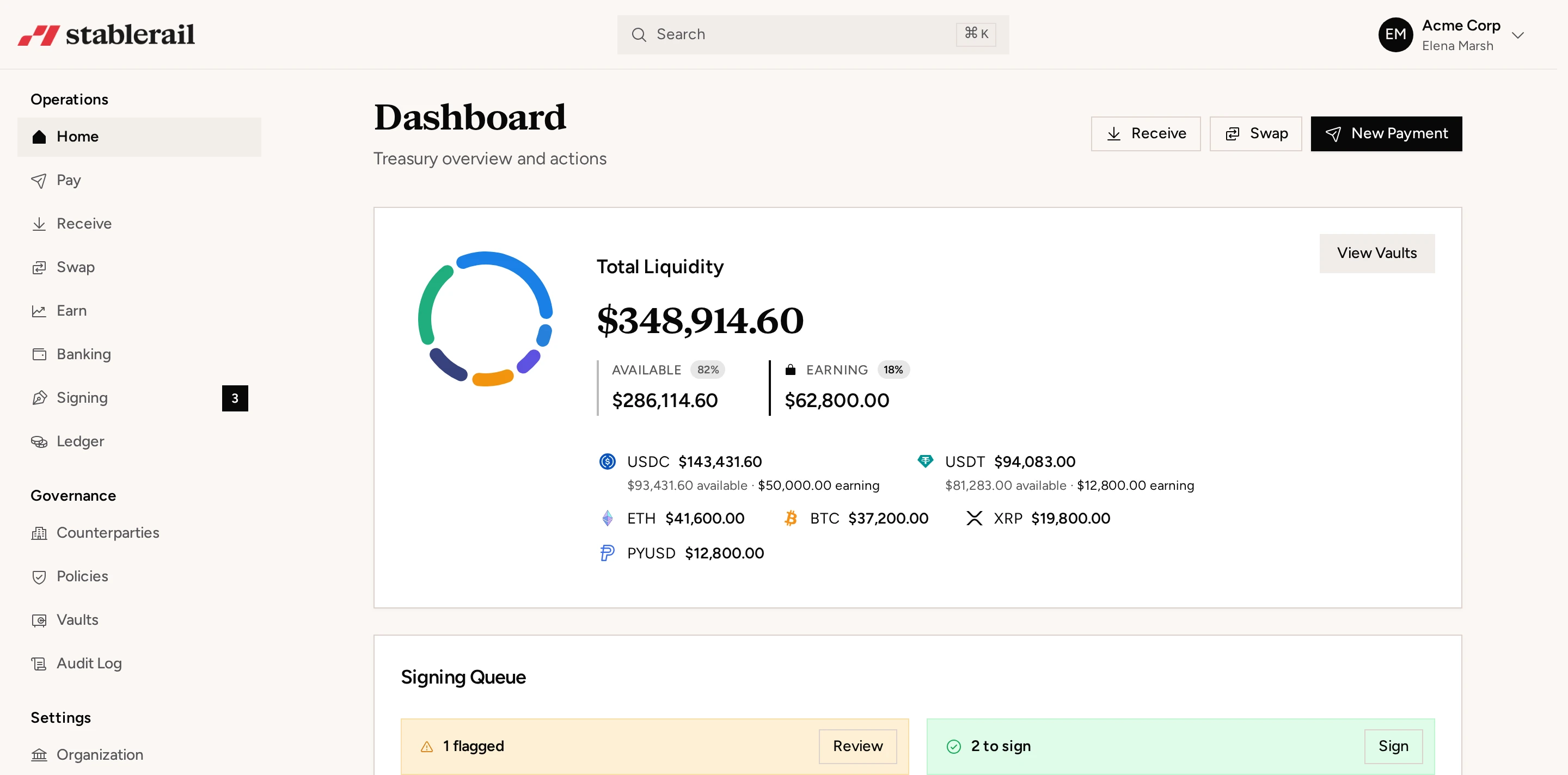
Where the operating model benefits from consolidation, Stablerail provides one business account for USDC and USDT treasury operations, with approvals and signing quorum, pre-send sanctions and address screening, global payouts, fiat off-ramp, corporate cards and exportable audit evidence. A protocol should still verify network, asset and corridor coverage against its own requirements.
Use a structured selection and testing process
- Map authority: document who proposes, approves and executes every transaction class.
- Build the coverage matrix: list exact assets, token contracts, networks, contract interactions and fiat corridors.
- Set signer rules: define quorum, role separation, signer replacement and emergency authority.
- Run realistic tests: execute a payment, contract call, signer change, export and recovery exercise.
- Reconcile the evidence: ensure accounting can connect approvals and business documents to on-chain activity.
- Fund in stages: start with limited balances and expand only after controls work under normal and failure conditions.
The best treasury wallet is not necessarily the product with the longest feature list. It is the system that fits the protocol’s governance, lets signers understand what they approve, supports every required chain and asset, produces usable finance evidence and remains recoverable when people or technology fail.
Frequently asked questions
Is multisig or MPC better for a protocol treasury?
Neither is universally better. Multisig can provide visible on-chain thresholds, while MPC can support distributed signing behind a standard account address. Compare the complete operating model, including signer devices, network coverage, contract interaction, recovery and reporting.
How many signers should a protocol treasury wallet have?
The signer count should prevent unilateral transfers while remaining usable during absences or emergencies. A protocol should model likely signer unavailability, conflicts of interest and time-zone coverage, then test its proposed quorum before depositing material funds.
What should a treasury wallet audit trail include?
It should connect each transaction to its hash, timestamp, network, asset, amount, fee, destination and approval history. Finance should also retain the invoice or proposal, recipient verification, governance or corporate approval, screening result and on-chain confirmation.
Can a protocol use one wallet for reserves and operating payments?
It can, but separating long-term reserves from working capital often makes approval rules and reporting clearer. Reserve assets may require a higher quorum, while an operating wallet can hold a limited balance for frequent, approved payments.
How should a protocol test wallet recovery?
Run a controlled exercise covering a lost device, departing signer and unavailable provider or interface. Document who authorises recovery, what evidence is required, whether the address changes and how essential payments continue during the process.
What stablecoin details should be checked before choosing a wallet?
Verify each exact stablecoin and network combination, including the token contract, issuer, gas asset and whether the token is native or bridged. Also test transaction exports, beneficiary workflows and any required fiat off-ramp rather than relying on a general claim of USDC or USDT support.
Finance writers covering stablecoin treasury, payments, compliance, and risk controls.
More about the Stablerail team- Stablecoin treasury managementApprovals, limits, yield and reporting on one balance.
- Stablecoin payoutsBatch contractor and vendor payments with screening.
- USDT vs USDCWhich stablecoin your company should settle in.
- Stablecoin finance glossaryMPC, off-ramp, travel rule and the rest, in plain English.
- Product updatesEverything we ship, month by month.