
How to Choose a Treasury Wallet for a Crypto Protocol
A practical framework for choosing a crypto protocol treasury wallet, including multisig versus MPC, signer controls, smart-contract testing, reporting, recovery and fiat conversion.
Choose a crypto protocol treasury wallet by matching its custody model to the treasury’s assets, chains, transaction frequency, governance actions and signer structure. Compare multisig and MPC based on control, transparency, recovery and contract support—not labels alone. Before funding it, test representative transactions, signer replacement, policy enforcement, audit exports, stablecoin conversions and recovery under realistic conditions.
%22%20x1%3D%220%22%20y1%3D%220%22%20x2%3D%221%22%20y2%3D%221%22%3E%0A%20%20%20%20%20%20%20%20%3Cstop%20offset%3D%220%25%22%20stop-color%3D%22%233E090D%22%20%2F%3E%0A%20%20%20%20%20%20%20%20%3Cstop%20offset%3D%2250%25%22%20stop-color%3D%22%235C1218%22%20%2F%3E%0A%20%20%20%20%20%20%20%20%3Cstop%20offset%3D%22100%25%22%20stop-color%3D%22%237B1F22%22%20%2F%3E%0A%20%20%20%20%20%20%3C%2FlinearGradient%3E%0A%20%20%20%20%20%20%3CradialGradient%20id%3D%22glow%22%20cx%3D%221245%22%20cy%3D%2296%22%20r%3D%22520%22%20gradientUnits%3D%22userSpaceOnUse%22%3E%0A%20%20%20%20%20%20%20%20%3Cstop%20offset%3D%220%25%22%20stop-color%3D%22%23FF8E72%22%20stop-opacity%3D%220.45%22%20%2F%3E%0A%20%20%20%20%20%20%20%20%3Cstop%20offset%3D%2255%25%22%20stop-color%3D%22%23FF8E72%22%20stop-opacity%3D%220.08%22%20%2F%3E%0A%20%20%20%20%20%20%20%20%3Cstop%20offset%3D%22100%25%22%20stop-color%3D%22%23FF8E72%22%20stop-opacity%3D%220%22%20%2F%3E%0A%20%20%20%20%20%20%3C%2FradialGradient%3E%0A%20%20%20%20%20%20%3ClinearGradient%20id%3D%22glass%22%20x1%3D%220%22%20y1%3D%220%22%20x2%3D%221%22%20y2%3D%221%22%3E%0A%20%20%20%20%20%20%20%20%3Cstop%20offset%3D%220%25%22%20stop-color%3D%22%23F8D6D2%22%20stop-opacity%3D%220.26%22%20%2F%3E%0A%20%20%20%20%20%20%20%20%3Cstop%20offset%3D%22100%25%22%20stop-color%3D%22%23FFFFFF%22%20stop-opacity%3D%220.08%22%20%2F%3E%0A%20%20%20%20%20%20%3C%2FlinearGradient%3E%0A%20%20%20%20%20%20%3ClinearGradient%20id%3D%22accent%22%20x1%3D%220%22%20y1%3D%220%22%20x2%3D%221%22%20y2%3D%221%22%3E%0A%20%20%20%20%20%20%20%20%3Cstop%20offset%3D%220%25%22%20stop-color%3D%22%23FF8E72%22%20%2F%3E%0A%20%20%20%20%20%20%20%20%3Cstop%20offset%3D%22100%25%22%20stop-color%3D%22%23D94030%22%20%2F%3E%0A%20%20%20%20%20%20%3C%2FlinearGradient%3E%0A%20%20%20%20%20%20%3Cfilter%20id%3D%22soft%22%3E%3CfeGaussianBlur%20stdDeviation%3D%2210%22%20%2F%3E%3C%2Ffilter%3E%0A%20%20%20%20%3C%2Fdefs%3E%0A%20%20%20%20%3Crect%20width%3D%221600%22%20height%3D%22900%22%20fill%3D%22url(%23bg)%22%20%2F%3E%0A%20%20%20%20%3Crect%20width%3D%221600%22%20height%3D%22900%22%20fill%3D%22url(%23glow)%22%20%2F%3E%0A%20%20%20%20%3Cline%20x1%3D%221037.383543319108%22%20y1%3D%22510.6139700173581%22%20x2%3D%22958.6308833233797%22%20y2%3D%22670.9530331451556%22%20stroke%3D%22%23FFD2C8%22%20stroke-opacity%3D%220.5%22%20stroke-width%3D%223%22%2F%3E%3Cline%20x1%3D%22958.6308833233797%22%20y1%3D%22670.9530331451556%22%20x2%3D%22778.4368981966527%22%20y2%3D%22735.1859615069061%22%20stroke%3D%22%23FFD2C8%22%20stroke-opacity%3D%220.5%22%20stroke-width%3D%223%22%2F%3E%3Cline%20x1%3D%22778.4368981966527%22%20y1%3D%22735.1859615069061%22%20x2%3D%22623.2252758846529%22%20y2%3D%22630.996400278964%22%20stroke%3D%22%23FFD2C8%22%20stroke-opacity%3D%220.5%22%20stroke-width%3D%223%22%2F%3E%3Cline%20x1%3D%22623.2252758846529%22%20y1%3D%22630.996400278964%22%20x2%3D%22525.3532306294887%22%20y2%3D%22477.2974737721496%22%20stroke%3D%22%23FFD2C8%22%20stroke-opacity%3D%220.5%22%20stroke-width%3D%223%22%2F%3E%3Cline%20x1%3D%22525.3532306294887%22%20y1%3D%22477.2974737721496%22%20x2%3D%22595.1860466140996%22%20y2%3D%22310.1599324283693%22%20stroke%3D%22%23FFD2C8%22%20stroke-opacity%3D%220.5%22%20stroke-width%3D%223%22%2F%3E%3Cline%20x1%3D%22595.1860466140996%22%20y1%3D%22310.1599324283693%22%20x2%3D%22736.7736452682909%22%20y2%3D%22224.70368829619048%22%20stroke%3D%22%23FFD2C8%22%20stroke-opacity%3D%220.5%22%20stroke-width%3D%223%22%2F%3E%3Cline%20x1%3D%22736.7736452682909%22%20y1%3D%22224.70368829619048%22%20x2%3D%22893.5002134755495%22%20y2%3D%22243.1505134644355%22%20stroke%3D%22%23FFD2C8%22%20stroke-opacity%3D%220.5%22%20stroke-width%3D%223%22%2F%3E%3Cline%20x1%3D%22893.5002134755495%22%20y1%3D%22243.1505134644355%22%20x2%3D%221037.0309003186637%22%20y2%3D%22336.0467100337874%22%20stroke%3D%22%23FFD2C8%22%20stroke-opacity%3D%220.5%22%20stroke-width%3D%223%22%2F%3E%3Cline%20x1%3D%221037.0309003186637%22%20y1%3D%22336.0467100337874%22%20x2%3D%221037.383543319108%22%20y2%3D%22510.6139700173581%22%20stroke%3D%22%23FFD2C8%22%20stroke-opacity%3D%220.5%22%20stroke-width%3D%223%22%2F%3E%3Ccircle%20cx%3D%221037.383543319108%22%20cy%3D%22510.6139700173581%22%20r%3D%2218%22%20fill%3D%22url(%23glass)%22%20stroke%3D%22%23F4CDC5%22%20stroke-opacity%3D%220.6%22%2F%3E%3Ccircle%20cx%3D%22958.6308833233797%22%20cy%3D%22670.9530331451556%22%20r%3D%2218%22%20fill%3D%22url(%23glass)%22%20stroke%3D%22%23F4CDC5%22%20stroke-opacity%3D%220.6%22%2F%3E%3Ccircle%20cx%3D%22778.4368981966527%22%20cy%3D%22735.1859615069061%22%20r%3D%2218%22%20fill%3D%22url(%23glass)%22%20stroke%3D%22%23F4CDC5%22%20stroke-opacity%3D%220.6%22%2F%3E%3Ccircle%20cx%3D%22623.2252758846529%22%20cy%3D%22630.996400278964%22%20r%3D%2218%22%20fill%3D%22url(%23glass)%22%20stroke%3D%22%23F4CDC5%22%20stroke-opacity%3D%220.6%22%2F%3E%3Ccircle%20cx%3D%22525.3532306294887%22%20cy%3D%22477.2974737721496%22%20r%3D%2218%22%20fill%3D%22url(%23glass)%22%20stroke%3D%22%23F4CDC5%22%20stroke-opacity%3D%220.6%22%2F%3E%3Ccircle%20cx%3D%22595.1860466140996%22%20cy%3D%22310.1599324283693%22%20r%3D%2218%22%20fill%3D%22url(%23glass)%22%20stroke%3D%22%23F4CDC5%22%20stroke-opacity%3D%220.6%22%2F%3E%3Ccircle%20cx%3D%22736.7736452682909%22%20cy%3D%22224.70368829619048%22%20r%3D%2228%22%20fill%3D%22url(%23accent)%22%20stroke%3D%22%23F4CDC5%22%20stroke-opacity%3D%220.6%22%2F%3E%3Ccircle%20cx%3D%22893.5002134755495%22%20cy%3D%22243.1505134644355%22%20r%3D%2218%22%20fill%3D%22url(%23glass)%22%20stroke%3D%22%23F4CDC5%22%20stroke-opacity%3D%220.6%22%2F%3E%3Ccircle%20cx%3D%221037.0309003186637%22%20cy%3D%22336.0467100337874%22%20r%3D%2218%22%20fill%3D%22url(%23glass)%22%20stroke%3D%22%23F4CDC5%22%20stroke-opacity%3D%220.6%22%2F%3E%3Ccircle%20cx%3D%22800%22%20cy%3D%22450%22%20r%3D%2248%22%20fill%3D%22url(%23accent)%22%2F%3E%0A%20%20%20%20%3Crect%20x%3D%2226%22%20y%3D%2226%22%20width%3D%221548%22%20height%3D%22848%22%20rx%3D%2218%22%20fill%3D%22none%22%20stroke%3D%22%23F2D0C8%22%20stroke-opacity%3D%220.12%22%2F%3E%0A%20%20%3C%2Fsvg%3E)
Start with the treasury’s operating requirements
A protocol treasury wallet must do more than hold tokens. It may need to fund contributors, manage stablecoins, delegate voting power, claim vested assets, stake tokens, execute governance decisions, interact with timelocks and convert crypto into fiat. A wallet suitable for long-term reserves may be a poor operating account for weekly payouts.
Document the treasury’s requirements before comparing providers:
- Assets: Record protocol tokens, USDC, USDT, native gas tokens, vested positions, staked assets and liquidity-provider positions.
- Networks: List every current and planned chain, including layer-2 networks and non-EVM chains. Do not assume support on one network implies equivalent support elsewhere.
- Transactions: Estimate transfers, batch payouts, swaps, staking actions, governance votes and contract calls.
- Signers: Identify who can propose, approve and execute transactions, including directors, employees, delegates and external service providers.
- Fiat needs: Define required currencies, banking rails, conversion routes and payment purposes such as payroll, tax and vendor invoices.
- Evidence: Specify the statements, valuations, approval histories and transaction records required by finance, auditors and governance participants.
This inventory separates essential capabilities from features that add cost or complexity without solving an operating requirement.
Compare multisig and MPC treasury wallets
Multisignature wallets and multi-party computation both reduce dependence on one private key, but their transaction mechanics, recovery models and on-chain visibility differ. The relevant comparison is the complete control design, not whether a provider uses the word “multisig” or “MPC.”
| Decision area | Smart-contract multisig | MPC wallet |
|---|---|---|
| Approval mechanism | Multiple independent keys authorize execution through a wallet contract or chain-specific program. | Key shares jointly create a valid signature without reconstructing the complete private key. |
| On-chain visibility | The wallet contract, threshold and execution history may be publicly visible. | The completed transaction can resemble a standard single-signature transaction; approval evidence is generally maintained off-chain. |
| Chain coverage | Requires a compatible and reviewed implementation on each chain. | Can use a chain’s native signature scheme where the provider supports it. |
| Contract interaction | Often well suited to governance and DeFi actions on supported smart-contract networks. | Depends on the provider’s transaction-building, simulation and contract-call support. |
| Network cost | Contract execution can consume more gas than a standard transfer. | Usually broadcasts a standard network transaction, although separate provider fees may apply. |
| Signer changes | Members and thresholds can often be changed through an authorized on-chain transaction. | Depends on the provider’s key-share replacement and recovery process. |
| Service dependency | Signers may be able to use alternative interfaces if the contract remains accessible. | Continuity depends on share ownership, backup design and the ability to operate or recover without the provider. |
| Typical fit | Transparent governance reserves concentrated on compatible networks. | Multi-chain operating accounts with frequent transfers and structured approval workflows. |
When multisig fits
A smart-contract multisig can fit a protocol that values on-chain transparency and primarily operates on supported networks. A three-of-five threshold, for example, prevents any one signer from moving funds while allowing two signers to be unavailable.
Confirm that the wallet can execute the protocol’s actual governance, staking and timelock calls. Also test signer replacement, module or plugin risk, transaction simulation and any upgrade mechanism. A wallet that handles token transfers but cannot safely execute a governance proposal is incomplete.
When MPC fits
MPC can fit a multi-chain treasury or operating account that makes frequent payments. It may provide a consistent signing quorum across different native signature schemes without deploying the same multisig contract on every chain.
Ask who controls each key share, whether the provider can move funds independently, how a lost share is replaced and what happens if the service becomes unavailable. An approval screen is not proof of distributed control; the legal, technical and recovery design must support the claimed quorum.
Separate reserves, governance and operating funds
One wallet does not need to serve every purpose. Protocols can reduce operational risk by separating long-term reserves, governance execution and routine payments. The reserve wallet can use a higher threshold and slower process, while an operating wallet holds a limited balance for approved expenses.
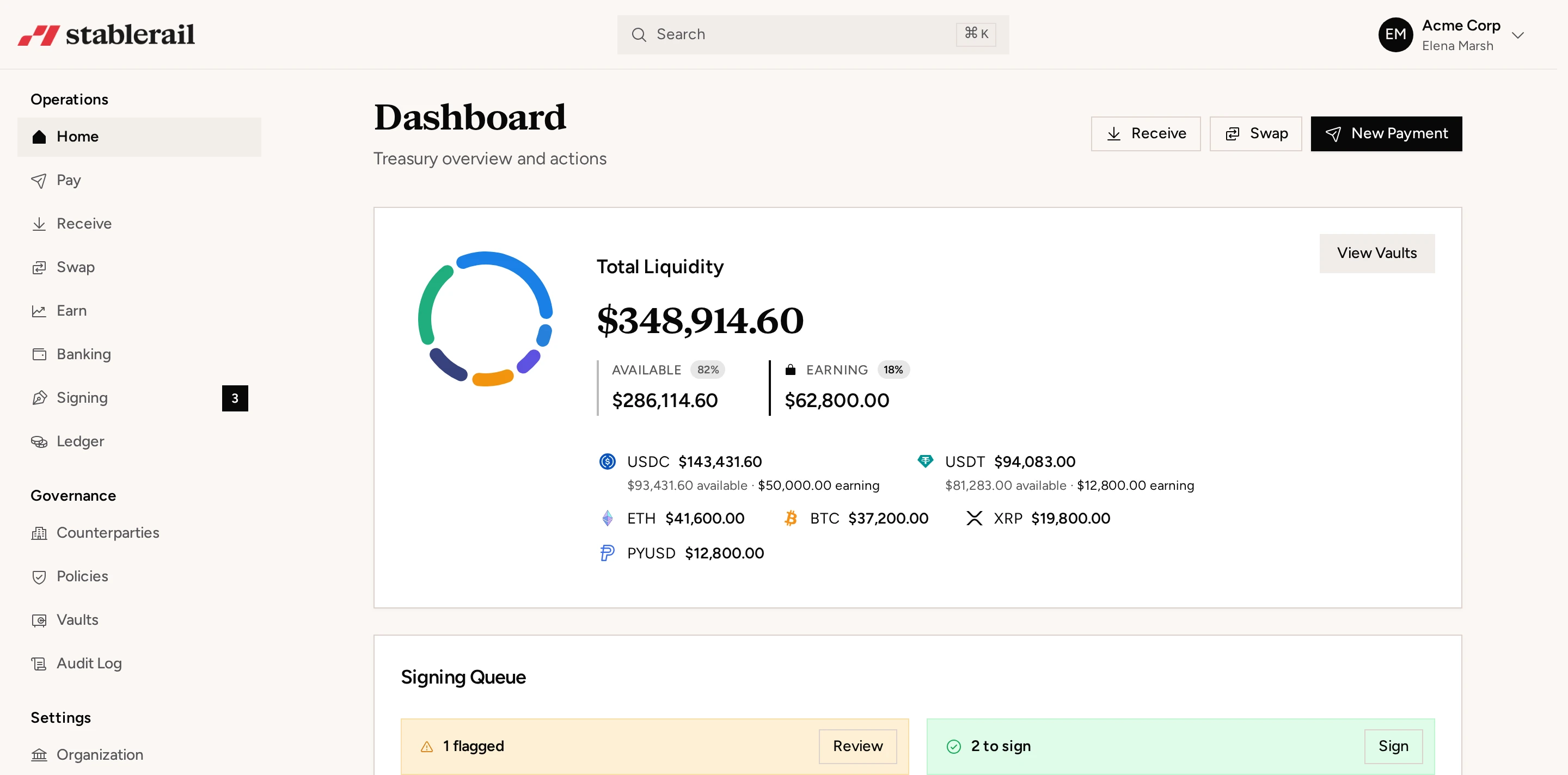
Define replenishment rules between accounts and record which body can authorize each transfer. Where an incorporated operating entity controls its own USDC or USDT, a corporate stablecoin treasury platform such as Stablerail can support signing quorum, sanctions and address screening before send, global payouts, fiat conversion and exportable audit evidence. That operating account should remain distinct from community-controlled or client funds.
Test token and smart-contract support
“Supports Ethereum” or “supports Solana” is not specific enough. A provider may support custody and basic transfers without supporting batch payouts, staking, transaction simulation or arbitrary contract calls on that network.
Test representative actions with a small amount before depositing a material balance. Signers should be able to identify the destination contract, method, token approvals, amounts, network fees and expected balance changes. Avoid routine blind signing, where approvers cannot interpret the transaction they are authorizing.
Record stablecoins by issuer, contract address, network and form. Native USDC on one chain is not automatically interchangeable with bridged USDC elsewhere. Bridged tokens can have different contracts, liquidity, bridge dependencies and redemption paths. Apply the same discipline to USDT and wrapped assets.
Evaluate signer controls and payment operations
A secure cryptographic design can still fail if roles and procedures are unclear. Determine whether transaction creation, approval and execution can be separated, and whether a departing signer can be removed promptly without weakening the required quorum.
Review these operational controls:
- Different approval thresholds for reserve and operating accounts
- Additional approval requirements for larger or unusual transactions
- Destination allowlists and controlled changes to saved beneficiaries
- Restrictions on unsupported assets, networks or contract interactions
- Sanctions and address screening before signing or sending
- Named records of proposals, approvals, rejections and execution
- Clear handling of failed, replaced, dropped or duplicated transactions
Distinguish preventive controls from alerts. A warning delivered after signing does not stop a transfer. Address screening also does not prove that a destination is legitimate; teams must independently verify beneficiary ownership, especially when payment instructions change.
For batch payouts, confirm recipient limits, token support, gas funding, approval mechanics and reconciliation output. Determine whether one failed recipient blocks the whole batch or can be retried separately. Finance should be able to connect each recipient and invoice to a transaction hash without rebuilding the payment history from chat messages.
Review reporting, recovery and business continuity
Finance records should connect an approved purpose to its on-chain result. Useful exports include wallet and destination addresses, transaction hashes, assets, token amounts, network fees, timestamps, status, fiat valuations and named approvers. Confirm how valuations are sourced and whether historical reports preserve the rate used at the time.
Recovery must be tested rather than accepted as a sales assurance. Obtain written answers covering lost devices, unavailable signers, key-share replacement, provider shutdown and asset migration. Determine whether recovery changes the wallet address and whether the treasury can move funds without the provider’s discretionary approval.
A recovery plan is credible only when the treasury knows who acts, what evidence is required, how quorum is restored and which functions remain available during an outage.
Include fiat connectivity and total operating cost
Protocols often convert stablecoins to pay salaries, taxes, legal bills and other off-chain expenses. Assess supported currencies and rails, account ownership, beneficiary requirements, settlement timing and the documents required for each transaction. Availability may depend on KYB, jurisdiction, asset and industry eligibility.
Request a complete cost schedule. Compare platform charges, blockchain fees, conversion spreads, bank transfer fees and withdrawal fees. Also consider operational cost: maintaining gas on several networks, transferring through an exchange, collecting approvals in separate systems and reconciling multiple statements can matter more than a single quoted fee.
Run a controlled selection process
- Map requirements: List every asset, chain, transaction type, signer and reporting obligation.
- Choose account boundaries: Separate reserves, governance execution and routine operations where appropriate.
- Verify control: Document key or share ownership, quorum rules, signer replacement and provider dependencies.
- Test real workflows: Complete a transfer, contract call, batch payment, failed transaction and report export using small values.
- Exercise recovery: Simulate a lost signer or device and confirm the documented process works.
- Approve funding limits: Set initial balances and replenishment procedures before moving material assets.
The best protocol treasury wallet is not simply the one with the longest asset list. It is the design that executes the treasury’s real transactions, preserves control through staff and provider changes, and produces evidence that finance and governance stakeholders can independently verify.
Frequently asked questions
Is multisig or MPC better for a crypto protocol treasury?
Multisig often fits on-chain governance reserves where public thresholds and contract interaction are priorities. MPC can fit multi-chain operating accounts with frequent payments, but the decision depends on share ownership, provider dependency, recovery and support for the protocol’s actual transactions.
How many signers should a protocol treasury wallet have?
There is no universal number, but the threshold should prevent unilateral transfers while tolerating reasonable signer unavailability. A protocol should model departures, travel, device loss and conflicts of interest before selecting arrangements such as two-of-three or three-of-five.
What should a protocol test before funding a treasury wallet?
Test token transfers, required governance or staking calls, transaction simulation, signer replacement, failed payments, reporting exports and recovery. Use small values and verify every supported asset and network separately, including the exact stablecoin contract.
Should a protocol keep reserves and operating funds in the same wallet?
Usually, separating them creates clearer limits and reduces exposure from frequent transactions. A reserve wallet can use a slower, higher approval threshold, while an operating wallet holds a controlled balance for payroll, grants and vendors.
What records should a crypto treasury wallet export for an audit?
Exports should include transaction hashes, addresses, assets, amounts, network fees, timestamps, status and approval history. Finance teams should also retain the business purpose, supporting invoice or proposal, and the valuation method used for accounting.
Finance writers covering stablecoin treasury, payments, compliance, and risk controls.
More about the Stablerail team- Stablecoin treasury managementApprovals, limits, yield and reporting on one balance.
- Stablecoin payoutsBatch contractor and vendor payments with screening.
- USDT vs USDCWhich stablecoin your company should settle in.
- Stablecoin finance glossaryMPC, off-ramp, travel rule and the rest, in plain English.
- Product updatesEverything we ship, month by month.