
How Automated Stablecoin Treasury Management Works
See how finance teams automate stablecoin funding, conversions, balance monitoring, controlled payouts and reconciliation without removing human oversight.
Automated stablecoin treasury management connects funding, USDC or USDT conversion, balance monitoring, payouts and reconciliation in one controlled workflow. Software handles repetitive tasks such as importing transactions, validating payment batches and issuing balance alerts, while finance retains approval over new beneficiaries, conversions and fund releases. Effective automation combines settled-balance controls, sanctions and address screening, signing quorum, exception queues and exportable accounting evidence.

How automated stablecoin treasury management works
Automated stablecoin treasury management turns a series of disconnected actions across bank accounts, wallets and accounting records into a repeatable operating process. The system detects settled funds, updates balances, prepares conversions or payments, routes requests for approval, records execution and sends completed transactions to reconciliation.
Automation does not mean allowing software to move every dollar without review. For a corporate treasury, the stronger model is automated preparation with controlled execution. Routine data collection, validation and routing happen automatically; material conversions, beneficiary changes, payroll releases and exceptions remain subject to human approval.
A typical setup connects corporate fiat accounts, USDC or USDT balances, blockchain networks, conversion providers, payment instructions and the general ledger. Each transaction moves through defined states such as draft, validated, awaiting approval, approved, submitted, confirmed, reconciled or failed. This state model gives finance a more reliable view than a spreadsheet that simply lists transfers.
What the workflow should cover
The process begins before a stablecoin payment is sent and ends only when the transaction is reconciled. The following table shows where automation is useful and where treasury controls should remain.
| Workflow stage | What can be automated | Control finance should retain | Evidence to capture |
|---|---|---|---|
| Funding | Import deposits, identify references and update balances | Do not spend pending or unidentified funds | Bank reference, wallet transaction hash, value date and source |
| Conversion | Calculate requirements and prepare fiat-to-stablecoin or reverse conversions | Approve rate, fees, amount, provider and destination | Quote, delivered amount, exchange rate, fees and timestamps |
| Balance management | Monitor balances and issue threshold alerts | Set reserves by entity, currency, token and network | Opening balance, inflows, reserved funds and available balance |
| Payout preparation | Import files, detect duplicates and validate required fields | Approve beneficiaries, batches and exceptions | Source file, validation results, invoice or payroll reference |
| Execution | Build transactions and route them for signing | Require the configured approval and signing quorum | Approvers, signers, destination, token, network and transaction hash |
| Reconciliation | Match confirmed transfers to source records | Investigate returns, failures and unmatched entries | Confirmation status, fees, ledger mapping and exception notes |
1. Funding the treasury
A company can fund its treasury through a bank transfer, an on-chain transfer or operating receipts. Automation should identify the source, currency, amount, legal entity and settlement status before making the funds available for another transaction.
The distinction between pending, settled, reserved and available is essential. A bank transfer shown as pending should not fund an approved payout. Likewise, stablecoins allocated to payroll should not appear as freely available for a vendor batch. Available balance should equal settled funds less reservations, pending outgoing payments and any operational buffer.
Settlement depends on the payment rail, sending institution, cut-off time, holidays and compliance review. Rather than treating an estimated arrival time as guaranteed, the workflow should alert finance when an expected transfer has not settled, when the sender cannot be identified or when the amount differs from the funding instruction.
2. Converting fiat into USDC or USDT
Once fiat has settled, it can be converted into USDC or USDT through an on-ramp. An off-ramp performs the reverse operation. Before approving either conversion, finance should review the quoted rate, fees, amount to be delivered, destination account or wallet and quote expiry.
A forecast can trigger a recommendation without automatically committing funds. For example, the system may prepare a conversion when confirmed stablecoin balances fall below approved payments plus the treasury's minimum operating buffer. It may also identify excess stablecoins after receipts exceed forecast obligations.
Large amounts, a newly entered bank destination, an unusual currency corridor or a material difference from forecast should move to an exception queue. This prevents stale forecasts or incorrect beneficiary details from causing an unnecessary conversion. The resulting record should preserve both sides of the trade so accounting can distinguish principal, conversion cost and any separate fee.
3. Monitoring balances across entities and networks
Stablecoin balances are network-specific. USDC held on one supported blockchain cannot be sent directly to an address expecting USDC on another. The token symbol alone is therefore insufficient: treasury records must identify the legal entity, wallet, token contract or recognized asset, network and custody location.
A useful balance view includes:
- Settled fiat by currency, bank account and legal entity.
- USDC and USDT by wallet and blockchain network.
- Amounts reserved for approved or pending transactions.
- Network fee assets needed to submit on-chain transfers.
- Expected inflows and dated payment obligations.
- Funds involved in failed, replaced or unresolved transactions.
Alerts should identify insufficient funds, a missing network fee asset, an approaching minimum balance or concentration above an internal limit. An alert should create an accountable review task rather than silently moving assets between networks. Cross-network transfers introduce additional execution, counterparty and reconciliation considerations that deserve explicit approval.
4. Preparing and approving payouts
Payout automation usually begins with an invoice record, payroll file or batch containing the beneficiary, amount, token, network, wallet address, legal entity and payment reference. Validation should occur before approvers spend time reviewing the batch.
Basic checks include required fields, positive amounts, supported token and network combinations, sufficient available balance, duplicate invoice or payment references, duplicate destination and amount combinations, and consistency with the beneficiary's approved payment instructions. Sanctions and address screening should occur before send, with a flagged result stopping release until an authorized person resolves it.
Approval and signing are separate concepts. An approval records the business decision to pay; signing authorizes the blockchain transaction. A controlled workflow can require different people to prepare and approve a batch, followed by the required signing quorum. No single employee should be able to create a new beneficiary and release a material payment alone.
Human approval should normally be required for:
- Adding or changing a beneficiary wallet or bank account.
- Releasing payroll or a material vendor batch.
- Using a different token or network than previously approved.
- Overriding a duplicate, sanctions or address-screening alert.
- Changing approval limits, user access or signing quorum.
- Resubmitting a failed payment or replacing a pending transaction.
5. Executing and confirming on-chain payments
After approval, the system builds the transaction using the approved token, network, amount and destination. The required signers authorize it, and the signed transaction is submitted to the network. The workflow should immediately retain the transaction hash and submission time.
Submission is not the same as settlement. Finance should distinguish between submitted, pending, confirmed and failed transactions. The number of confirmations required before treating a payment as final should reflect the network and the company's risk tolerance. A transaction that remains pending, runs out of fee assets or fails should enter an exception queue rather than being marked paid.
Stablecoins can move outside banking hours, but round-the-clock technical availability does not eliminate corporate controls. Payment calendars, approver coverage and escalation procedures must account for weekends and holidays if the business intends to release urgent payments during those periods.
6. Reconciling transactions and producing audit evidence
Reconciliation links the executed transfer back to its commercial purpose. For an on-chain payment, the record should include the transaction hash, network, token amount, destination, fee, confirmation status, payment reference, preparer, approvers and signers. Fiat transactions require equivalent information, including the bank reference, account, currency, value date and return status.
Matching should not rely only on amount. Repeated contractor or payroll payments may have identical values. Strong matching uses the entity, beneficiary, source instruction, currency or token, network, amount and transaction identifier. Unmatched transfers, returned bank payments, failed transactions and unexpected receipts should remain open until assigned and resolved.
At month-end, finance should be able to export opening and closing balances, conversions, payouts, fees, transaction status and approval history. The evidence must support ledger entries and allow a reviewer to trace each movement from instruction through approval, execution and reconciliation.
A controlled implementation sequence
Finance teams should introduce automation in stages rather than beginning with unattended execution:
- Map accounts and ownership. Document every bank account, wallet, token, network and legal entity.
- Define balance states. Separate pending, settled, reserved and available funds.
- Automate visibility first. Import transactions, monitor balances and create alerts.
- Add payment validation. Check files, destinations, duplicates, balances and screening results.
- Configure approvals and signing. Separate preparation, business approval and transaction authorization.
- Connect reconciliation. Preserve references and export evidence for the ledger and close.
- Test exceptions. Rehearse failed payments, changed beneficiaries, absent approvers and delayed funding.
Automatic release, if used at all, should be limited to narrow and predictable cases with approved beneficiaries, bounded amounts, sufficient settled funds and a clear stop condition. Material or unusual activity should always return to human review.
What good automation achieves
Effective automation reduces manual copying without concealing judgment. Treasury should always be able to see why a transaction was created, which balance funded it, who approved it, how it was signed and whether it reconciled.
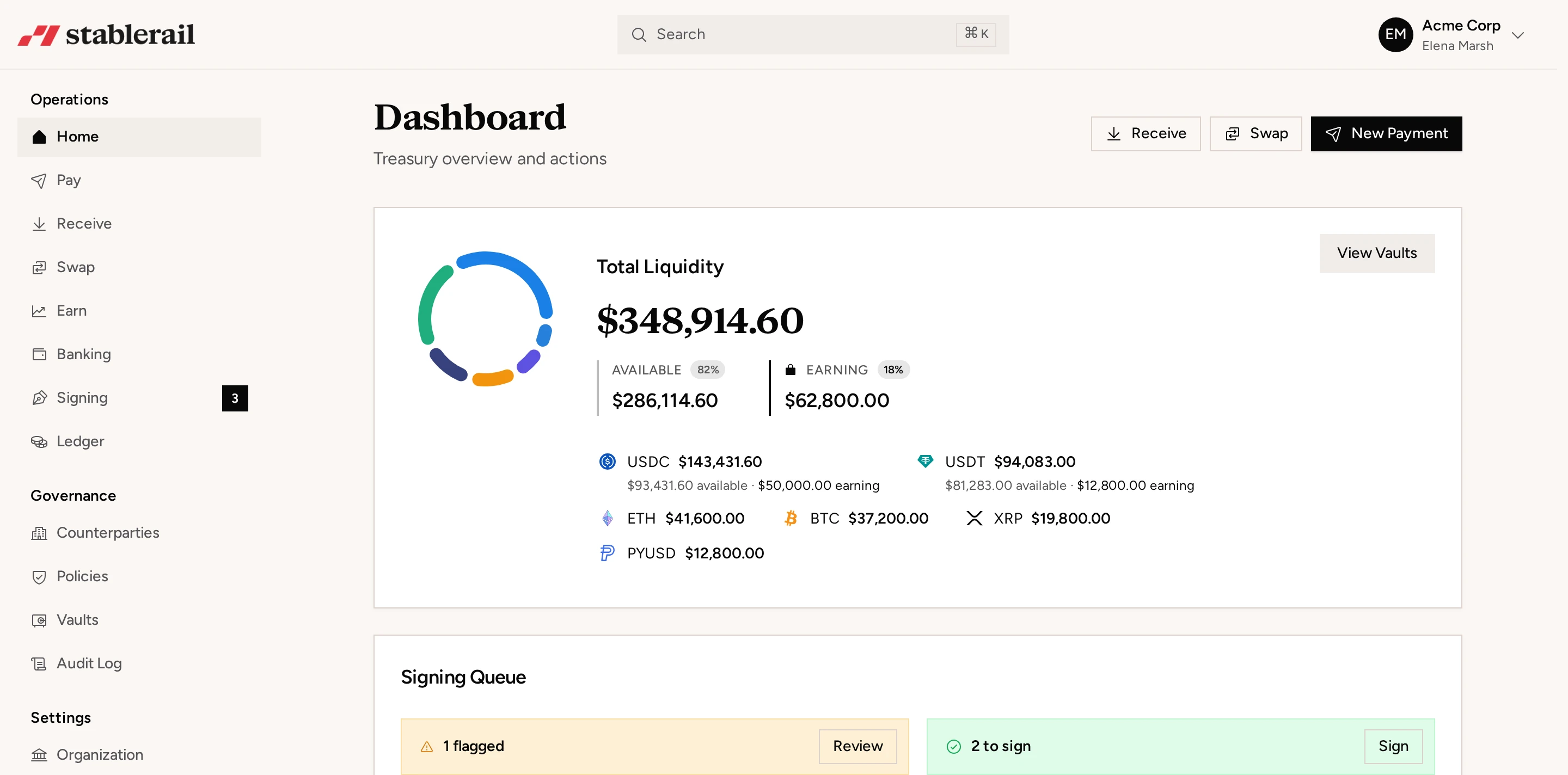
Platforms such as Stablerail can bring approvals, signing quorum, pre-send sanctions and address screening, corporate cards, global payouts, fiat conversion and exportable audit evidence into a corporate stablecoin treasury workflow for a company's own funds. The operating model still belongs to finance: the company must define authority, liquidity buffers, accounting treatment and escalation procedures.
The practical objective is not maximum automation. It is a controlled flow in which routine work is fast, exceptions are visible and every movement of USDC, USDT or fiat has an accountable business record.
Frequently asked questions
What is automated stablecoin treasury management?
It is the use of connected workflows to manage corporate fiat, USDC and USDT funding, conversions, balances, payouts and reconciliation. Routine data collection and validation can be automated while finance retains control over approvals, signing and exceptions.
Can stablecoin payouts be fully automated?
Technically, some execution steps can be automated, but unattended release is rarely appropriate for every payment. New beneficiaries, material batches, payroll, screening alerts and changes to payment instructions should require human review and the configured signing quorum.
How should a company reconcile stablecoin transactions?
Match each confirmed blockchain transaction to its invoice, payroll record or payment instruction using the entity, beneficiary, token, network, amount and transaction hash. Record network fees separately and keep failed, pending or unmatched transactions open as exceptions until resolved.
What controls are needed for corporate stablecoin payments?
Core controls include segregation of duties, approved beneficiaries, amount limits, settled-balance checks, sanctions and address screening before send, and quorum-based signing. Finance should also preserve approval history and transaction evidence for accounting and audit review.
How do treasury teams manage USDC or USDT across networks?
Track balances by token, blockchain network, wallet and legal entity rather than relying on the token symbol alone. Payment validation should confirm that the sender and beneficiary use the same supported network and that enough native fee asset is available.
Finance writers covering stablecoin treasury, payments, compliance, and risk controls.
More about the Stablerail team- Stablecoin treasury managementApprovals, limits, yield and reporting on one balance.
- Stablecoin payoutsBatch contractor and vendor payments with screening.
- USDT vs USDCWhich stablecoin your company should settle in.
- Stablecoin finance glossaryMPC, off-ramp, travel rule and the rest, in plain English.
- Product updatesEverything we ship, month by month.