
How to Evaluate Compliance Policy Enforcement in Crypto Intent Protocols
A procurement framework for testing policy enforcement in crypto intent protocols, including signing controls, solver routes, wallet screening, simulation and audit evidence.
Evaluate a crypto intent protocol by testing whether prohibited activity is technically prevented at signing or settlement, not merely detected. Map every party, contract and route involved; identify which controls are enforced on-chain versus externally; and test stale approvals, restricted assets, blocked addresses, solver changes and concurrent limits. Approval should depend on repeatable adverse tests and exportable evidence linking the intent, policy decision, signatures, route and settled transaction.
%22%20x1%3D%220%22%20y1%3D%220%22%20x2%3D%221%22%20y2%3D%221%22%3E%0A%20%20%20%20%20%20%20%20%3Cstop%20offset%3D%220%25%22%20stop-color%3D%22%233E090D%22%20%2F%3E%0A%20%20%20%20%20%20%20%20%3Cstop%20offset%3D%2250%25%22%20stop-color%3D%22%235C1218%22%20%2F%3E%0A%20%20%20%20%20%20%20%20%3Cstop%20offset%3D%22100%25%22%20stop-color%3D%22%237B1F22%22%20%2F%3E%0A%20%20%20%20%20%20%3C%2FlinearGradient%3E%0A%20%20%20%20%20%20%3CradialGradient%20id%3D%22glow%22%20cx%3D%22805%22%20cy%3D%22119%22%20r%3D%22520%22%20gradientUnits%3D%22userSpaceOnUse%22%3E%0A%20%20%20%20%20%20%20%20%3Cstop%20offset%3D%220%25%22%20stop-color%3D%22%23FF8E72%22%20stop-opacity%3D%220.45%22%20%2F%3E%0A%20%20%20%20%20%20%20%20%3Cstop%20offset%3D%2255%25%22%20stop-color%3D%22%23FF8E72%22%20stop-opacity%3D%220.08%22%20%2F%3E%0A%20%20%20%20%20%20%20%20%3Cstop%20offset%3D%22100%25%22%20stop-color%3D%22%23FF8E72%22%20stop-opacity%3D%220%22%20%2F%3E%0A%20%20%20%20%20%20%3C%2FradialGradient%3E%0A%20%20%20%20%20%20%3ClinearGradient%20id%3D%22glass%22%20x1%3D%220%22%20y1%3D%220%22%20x2%3D%221%22%20y2%3D%221%22%3E%0A%20%20%20%20%20%20%20%20%3Cstop%20offset%3D%220%25%22%20stop-color%3D%22%23F8D6D2%22%20stop-opacity%3D%220.26%22%20%2F%3E%0A%20%20%20%20%20%20%20%20%3Cstop%20offset%3D%22100%25%22%20stop-color%3D%22%23FFFFFF%22%20stop-opacity%3D%220.08%22%20%2F%3E%0A%20%20%20%20%20%20%3C%2FlinearGradient%3E%0A%20%20%20%20%20%20%3ClinearGradient%20id%3D%22accent%22%20x1%3D%220%22%20y1%3D%220%22%20x2%3D%221%22%20y2%3D%221%22%3E%0A%20%20%20%20%20%20%20%20%3Cstop%20offset%3D%220%25%22%20stop-color%3D%22%23FF8E72%22%20%2F%3E%0A%20%20%20%20%20%20%20%20%3Cstop%20offset%3D%22100%25%22%20stop-color%3D%22%23D94030%22%20%2F%3E%0A%20%20%20%20%20%20%3C%2FlinearGradient%3E%0A%20%20%20%20%20%20%3Cfilter%20id%3D%22soft%22%3E%3CfeGaussianBlur%20stdDeviation%3D%2210%22%20%2F%3E%3C%2Ffilter%3E%0A%20%20%20%20%3C%2Fdefs%3E%0A%20%20%20%20%3Crect%20width%3D%221600%22%20height%3D%22900%22%20fill%3D%22url(%23bg)%22%20%2F%3E%0A%20%20%20%20%3Crect%20width%3D%221600%22%20height%3D%22900%22%20fill%3D%22url(%23glow)%22%20%2F%3E%0A%20%20%20%20%3Crect%20x%3D%22260%22%20y%3D%22405%22%20width%3D%22100%22%20height%3D%2295%22%20rx%3D%226%22%20fill%3D%22url(%23accent)%22%20stroke%3D%22%23F4CDC5%22%20stroke-opacity%3D%220.4%22%2F%3E%3Crect%20x%3D%22420%22%20y%3D%22405%22%20width%3D%22100%22%20height%3D%2294%22%20rx%3D%226%22%20fill%3D%22url(%23glass)%22%20stroke%3D%22%23F4CDC5%22%20stroke-opacity%3D%220.4%22%2F%3E%3Crect%20x%3D%22580%22%20y%3D%22450%22%20width%3D%22100%22%20height%3D%2249%22%20rx%3D%226%22%20fill%3D%22url(%23accent)%22%20stroke%3D%22%23F4CDC5%22%20stroke-opacity%3D%220.4%22%2F%3E%3Crect%20x%3D%22740%22%20y%3D%22450%22%20width%3D%22100%22%20height%3D%22106%22%20rx%3D%226%22%20fill%3D%22url(%23glass)%22%20stroke%3D%22%23F4CDC5%22%20stroke-opacity%3D%220.4%22%2F%3E%3Crect%20x%3D%22900%22%20y%3D%22465%22%20width%3D%22100%22%20height%3D%2291%22%20rx%3D%226%22%20fill%3D%22url(%23accent)%22%20stroke%3D%22%23F4CDC5%22%20stroke-opacity%3D%220.4%22%2F%3E%3Crect%20x%3D%221060%22%20y%3D%22465%22%20width%3D%22100%22%20height%3D%2250%22%20rx%3D%226%22%20fill%3D%22url(%23glass)%22%20stroke%3D%22%23F4CDC5%22%20stroke-opacity%3D%220.4%22%2F%3E%3Crect%20x%3D%221220%22%20y%3D%22410%22%20width%3D%22100%22%20height%3D%22105%22%20rx%3D%226%22%20fill%3D%22url(%23accent)%22%20stroke%3D%22%23F4CDC5%22%20stroke-opacity%3D%220.4%22%2F%3E%3Cline%20x1%3D%22240%22%20y1%3D%22720%22%20x2%3D%221400%22%20y2%3D%22720%22%20stroke%3D%22%23F0BBAF%22%20stroke-opacity%3D%220.4%22%20stroke-width%3D%223%22%2F%3E%0A%20%20%20%20%3Crect%20x%3D%2226%22%20y%3D%2226%22%20width%3D%221548%22%20height%3D%22848%22%20rx%3D%2218%22%20fill%3D%22none%22%20stroke%3D%22%23F2D0C8%22%20stroke-opacity%3D%220.12%22%2F%3E%0A%20%20%3C%2Fsvg%3E)
Crypto intent protocols let a treasury specify an outcome—such as exchanging 500,000 USDC for USDT on Arbitrum—without prescribing every execution step. Solvers or executors then compete to find and settle a route that satisfies the signed conditions. This can improve execution flexibility, but it expands the compliance boundary beyond the final recipient.
The decisive procurement question is: Can a transaction that violates policy still obtain a valid signature or settle? A warning, dashboard alert or screening response is not enforcement unless a failed result reliably blocks execution or triggers a controlled exception process.
Map the complete intent lifecycle
Require each provider to diagram the lifecycle from request through reconciliation. At minimum, the map should show:
- The treasury user creates an intent with an input asset, output conditions, destination, chain and expiry.
- An approval system evaluates the request against limits, permissions and counterparty controls.
- A wallet, multisignature account or MPC vault produces a signature after the required quorum approves.
- Solvers inspect the intent and propose or execute routes.
- A solver interacts with contracts, liquidity pools, exchanges or bridges.
- A settlement contract verifies the signature and the conditions encoded in the intent.
- Funds arrive at the destination, potentially after intermediate swaps or cross-chain steps.
- Approvals, screening results, route data and transaction hashes are retained for review.
For every step, identify the controlling entity, the data it sees and the action it can prevent. A settlement contract may enforce the recipient and minimum output while relying entirely on an external wallet for sanctions screening, approval limits and destination allowlists.
Separate hard enforcement from monitoring
On-chain controls are deterministic when they are encoded correctly: settlement outside the signed conditions should revert. External controls can incorporate richer risk data and change faster, but they depend on configuration, system availability and intervention before a usable signature is issued. Strong designs layer both rather than treating them as substitutes.
| Control | Possible enforcement point | Critical procurement test | Required evidence |
|---|---|---|---|
| Destination allowlist | Wallet blocks signing; settlement contract rejects another recipient | Remove a recipient after signing but before settlement | Policy decision, revocation result and failed transaction or unusable signature |
| Asset and chain restrictions | Signed intent and contract bind token addresses and chain IDs | Substitute a similarly named or bridged token | Decoded signed fields and settlement revert |
| Transaction limits | Wallet or policy service applies limits before signing | Submit concurrent intents that collectively exceed a limit | Limit calculation, pending-intent treatment and blocked request |
| Sanctions screening | External screening blocks approval or signing | Use a test address configured to return a blocking result | Timestamped result, disposition and proof that no signature was produced |
| Solver restrictions | Contract accepts registered executors or approved route components | Attempt execution through an unauthorized solver or intermediary | Solver identity, route trace and rejection record |
| Approval quorum | Multisignature contract or MPC wallet requires designated approvers | Attempt signing with an insufficient or unauthorized quorum | Requester, approvers, roles and failed signing event |
| Expiry and replay protection | Intent includes deadline, nonce or consumed-order state | Resubmit an expired or previously settled intent | Signed payload and contract rejection |
Test what the approval actually binds
Approvers should see and authorize the material economic terms: input asset and maximum amount, output asset and minimum amount, source and destination chains, recipient, fees, expiry and any permitted executor or settlement contract. Assets should be identified by chain and contract address, not ticker alone. “USDC” is insufficient because native, bridged and counterfeit tokens can share a symbol.
Compare the approval screen with the exact signed payload. Determine which fields a solver may change without invalidating the signature. If the solver can materially alter the recipient, chain, amount, fee ceiling or expiry after approval, the approval does not control the resulting exposure.
Review per-transaction and cumulative limits by user, asset, recipient, legal entity and time period. Test boundary amounts, split transactions and multiple pending intents. A daily limit is ineffective if five intents can each pass independently before any of them settles.
Examine cancellation, expiry and policy changes
A signed intent can remain executable even after an external policy changes. Ask whether cancellation is on-chain, maintained in an off-chain order system or dependent on solvers honoring a revocation message. Establish who can cancel, how quickly cancellation becomes effective and what happens if settlement and cancellation compete.
Short expiries reduce the window for stale screening and permissions, but they do not replace revocation. Test whether a removed allowlist address, disabled user or newly blocked counterparty can still use an earlier signature.
Evaluate wallet screening in the execution context
Wallet screening commonly uses off-chain data to assess sanctions designations and categories such as theft, scams, mixers or other illicit-finance exposure. The evaluation must cover more than whether the provider has an API.
- List every address screened: recipient, solver, settlement contract, bridge and known route intermediaries.
- Record when screening runs: creation, approval, signing, route selection or immediately before submission.
- Document which results block, warn, require review or permit an override.
- Inspect how direct and indirect exposure thresholds are configured and versioned.
- Confirm how false positives, escalation decisions and overrides are attributed.
- Determine whether updated risk data is applied to pending intents.
If the route is selected only after signing, some intermediate addresses may be unknown when the initial screening occurs. The protocol must either constrain execution to approved route components, screen the route later at an enforceable point, or clearly disclose the residual risk.
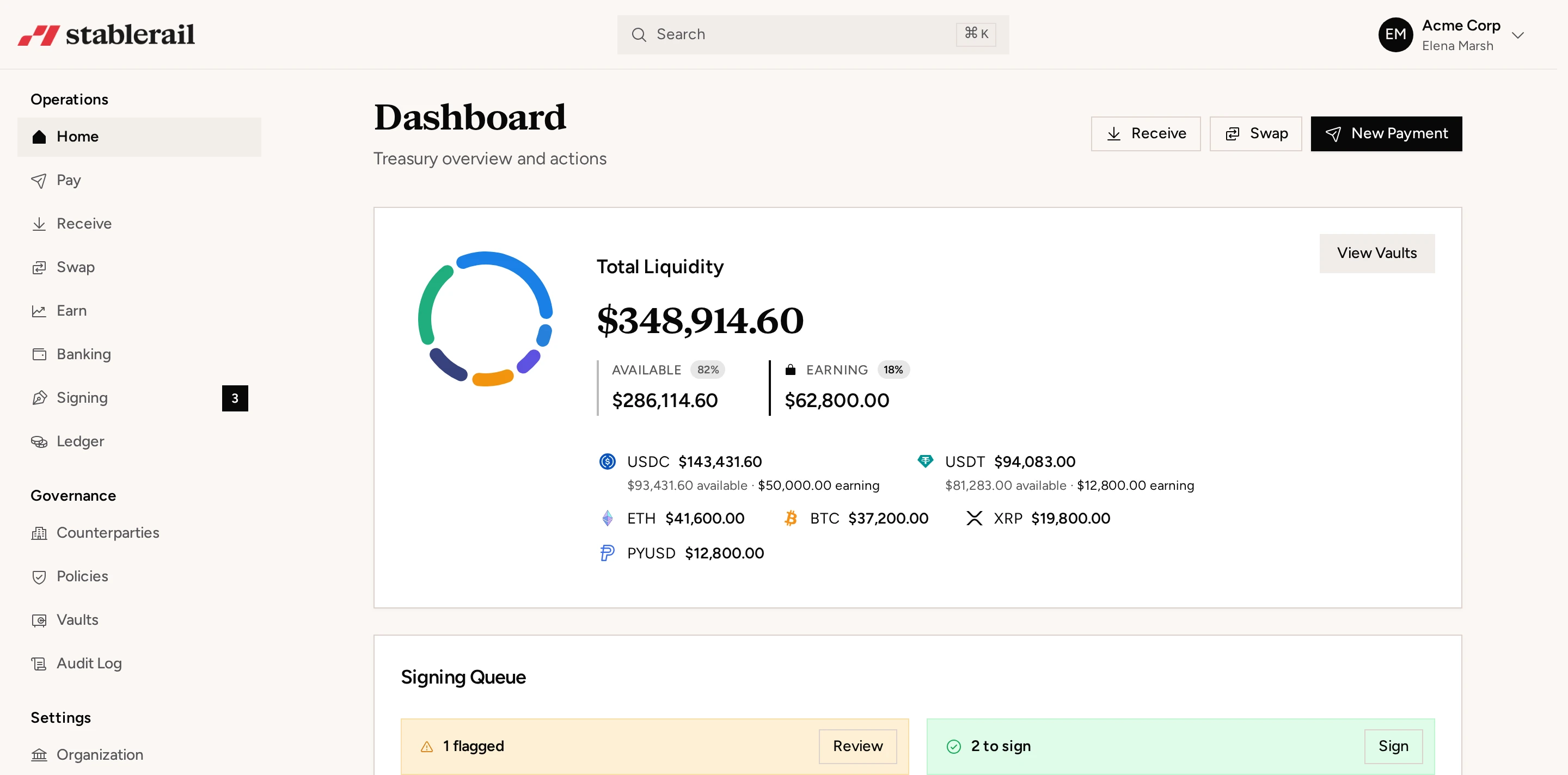
An external treasury account can provide an additional control layer. For example, Stablerail supports approvals and signing quorum, sanctions and address screening before send, and exportable audit evidence for USDC and USDT movements. Finance teams still need to verify which protocol-level fields and downstream routes remain outside that account’s control.
Inspect solver permissions and route transparency
Solvers influence where and how execution occurs. Determine whether participation is permissionless, registered or restricted. For restricted models, review how solver keys are authorized, rotated and suspended, whether delegation is possible, and whether the executor identity is recoverable from settlement records.
Do not assume that an approved solver makes every downstream venue acceptable. Request route-level data showing contracts, pools, bridges and intermediate tokens. If this information is unavailable before execution, ask whether the signed intent or settlement contract limits routing to approved components.
Cross-chain intents need additional scrutiny. Identify the bridge, message verification model, expected finality conditions and response if the source-chain transaction succeeds but the destination leg is delayed or fails. Compliance evidence should link all related transaction hashes rather than recording only the final transfer.
Use simulation without treating it as a guarantee
Transaction simulation executes proposed calldata against a recent blockchain state without broadcasting it. It can reveal expected token movements, contract calls, reverts, unexpected approvals and output below the authorized threshold. The review should show balance changes for relevant addresses and flag delegate calls, unlimited token approvals and interactions with unidentified contracts.
Ask whether simulation is performed on the actual transaction immediately before signing or submission. Then compare the simulated calldata with the signed payload and settled transaction. Simulation cannot guarantee the outcome because blockchain state may change, cross-chain results depend on later events, and a broad signature may permit the solver to submit a different route.
Demand evidence that explains the decision
A blockchain transaction proves that an action occurred; it does not identify the employee who requested it, the policy version evaluated, the screening response received or the reason for an override. The evidence pack for each intent should contain:
- Intent identifier, creation time, expiry, nonce and related transaction hashes.
- Requester, approvers, roles and signing quorum.
- Input and output assets identified by chain and contract address.
- Amounts, recipients, fee constraints and permitted settlement contracts.
- Policy version, evaluation results and limit calculations.
- Screening provider timestamp, result, disposition and any override.
- Solver identity, route details, simulation output and final execution data.
- Cancellations, failed attempts, exceptions and reconciliation status.
Test whether records can be exported in a structured format and matched to the general ledger, counterparty records and blockchain transaction hashes. Screenshots alone are difficult to reconcile and do not support consistent control testing.
Run adverse tests before approval
A product demonstration is not sufficient. Finance, compliance and security teams should execute a controlled test plan and preserve the results.
- Attempt a blocked recipient, unsupported token contract and prohibited chain.
- Exceed a limit using both one large intent and several concurrent intents.
- Try to sign with an insufficient quorum and an unauthorized approver.
- Settle an expired, cancelled or previously consumed intent.
- Remove an allowlisted destination after signature but before execution.
- Use an unauthorized solver or a route containing a prohibited intermediary.
- Change a material field after approval and compare the resulting signature.
- Reconcile the exported decision record to every resulting transaction hash.
Classify each outcome as a hard block, controlled exception, warning or detection after settlement. Procurement approval should depend on the prohibited cases failing at a technically enforceable point, with evidence showing why. Where only monitoring is available, document the residual exposure, compensating control and accountable owner rather than describing detection as prevention.
Frequently asked questions
How do crypto intent protocols enforce compliance policies?
They can enforce policy before signing through a wallet or approval system, during execution through solver restrictions, or at settlement through smart-contract checks. The strongest design combines external screening and organizational approvals with on-chain conditions that make noncompliant settlement invalid.
What is the difference between wallet screening and policy enforcement?
Wallet screening produces information about an address or its transaction exposure. It becomes enforcement only when a blocking result reliably prevents approval, signature creation or settlement, with exceptions requiring an attributable and recorded process.
Can a signed crypto intent be cancelled after approval?
It depends on the protocol’s design. Cancellation may use an on-chain nonce or revocation state, an off-chain order service, or solver cooperation, so finance teams should test whether a signed intent remains executable after cancellation or a policy change.
What should approvers see before signing a crypto intent?
Approvers should see the exact assets and contract addresses, amounts, chains, recipient, expiry, fee constraints and relevant settlement permissions. These details should match the signed payload so a solver cannot materially change the approved transaction.
What audit evidence should an intent protocol retain?
Evidence should connect the intent, requester, approvers, signing quorum, policy version, screening result, solver route, simulation and settled transaction hashes. It should also capture cancellations, overrides, failed attempts and exceptions in an exportable format suitable for reconciliation.
Finance writers covering stablecoin treasury, payments, compliance, and risk controls.
More about the Stablerail team- Stablecoin treasury managementApprovals, limits, yield and reporting on one balance.
- Stablecoin payoutsBatch contractor and vendor payments with screening.
- USDT vs USDCWhich stablecoin your company should settle in.
- Stablecoin finance glossaryMPC, off-ramp, travel rule and the rest, in plain English.
- Product updatesEverything we ship, month by month.