
Stablecoin Risk Monitoring Platforms: Audit Logs, RBAC and Evidence Compared
Compare stablecoin risk monitoring vendors on wallet screening, transaction monitoring, audit logs, role-based access, case management, evidence exports and integrations.
%22%20x1%3D%220%22%20y1%3D%220%22%20x2%3D%221%22%20y2%3D%221%22%3E%0A%20%20%20%20%20%20%20%20%3Cstop%20offset%3D%220%25%22%20stop-color%3D%22%232E0709%22%20%2F%3E%0A%20%20%20%20%20%20%20%20%3Cstop%20offset%3D%2250%25%22%20stop-color%3D%22%234A0F14%22%20%2F%3E%0A%20%20%20%20%20%20%20%20%3Cstop%20offset%3D%22100%25%22%20stop-color%3D%22%236B181C%22%20%2F%3E%0A%20%20%20%20%20%20%3C%2FlinearGradient%3E%0A%20%20%20%20%20%20%3CradialGradient%20id%3D%22glow%22%20cx%3D%22781%22%20cy%3D%22-114%22%20r%3D%22520%22%20gradientUnits%3D%22userSpaceOnUse%22%3E%0A%20%20%20%20%20%20%20%20%3Cstop%20offset%3D%220%25%22%20stop-color%3D%22%23FFB199%22%20stop-opacity%3D%220.45%22%20%2F%3E%0A%20%20%20%20%20%20%20%20%3Cstop%20offset%3D%2255%25%22%20stop-color%3D%22%23FFB199%22%20stop-opacity%3D%220.08%22%20%2F%3E%0A%20%20%20%20%20%20%20%20%3Cstop%20offset%3D%22100%25%22%20stop-color%3D%22%23FFB199%22%20stop-opacity%3D%220%22%20%2F%3E%0A%20%20%20%20%20%20%3C%2FradialGradient%3E%0A%20%20%20%20%20%20%3ClinearGradient%20id%3D%22glass%22%20x1%3D%220%22%20y1%3D%220%22%20x2%3D%221%22%20y2%3D%221%22%3E%0A%20%20%20%20%20%20%20%20%3Cstop%20offset%3D%220%25%22%20stop-color%3D%22%23F8D6D2%22%20stop-opacity%3D%220.26%22%20%2F%3E%0A%20%20%20%20%20%20%20%20%3Cstop%20offset%3D%22100%25%22%20stop-color%3D%22%23FFFFFF%22%20stop-opacity%3D%220.08%22%20%2F%3E%0A%20%20%20%20%20%20%3C%2FlinearGradient%3E%0A%20%20%20%20%20%20%3ClinearGradient%20id%3D%22accent%22%20x1%3D%220%22%20y1%3D%220%22%20x2%3D%221%22%20y2%3D%221%22%3E%0A%20%20%20%20%20%20%20%20%3Cstop%20offset%3D%220%25%22%20stop-color%3D%22%23FFB199%22%20%2F%3E%0A%20%20%20%20%20%20%20%20%3Cstop%20offset%3D%22100%25%22%20stop-color%3D%22%23E85D3A%22%20%2F%3E%0A%20%20%20%20%20%20%3C%2FlinearGradient%3E%0A%20%20%20%20%20%20%3Cfilter%20id%3D%22soft%22%3E%3CfeGaussianBlur%20stdDeviation%3D%2210%22%20%2F%3E%3C%2Ffilter%3E%0A%20%20%20%20%3C%2Fdefs%3E%0A%20%20%20%20%3Crect%20width%3D%221600%22%20height%3D%22900%22%20fill%3D%22url(%23bg)%22%20%2F%3E%0A%20%20%20%20%3Crect%20width%3D%221600%22%20height%3D%22900%22%20fill%3D%22url(%23glow)%22%20%2F%3E%0A%20%20%20%20%0A%20%20%3Crect%20x%3D%22480%22%20y%3D%22200%22%20width%3D%22640%22%20height%3D%22500%22%20rx%3D%2232%22%20fill%3D%22url(%23glass)%22%20stroke%3D%22%23F4CDC5%22%20stroke-opacity%3D%220.6%22%20stroke-width%3D%223%22%2F%3E%0A%20%20%3Ccircle%20cx%3D%22800%22%20cy%3D%22450%22%20r%3D%22180%22%20fill%3D%22none%22%20stroke%3D%22%23F4CDC5%22%20stroke-opacity%3D%220.6%22%20stroke-width%3D%226%22%2F%3E%0A%20%20%3Ccircle%20cx%3D%22800%22%20cy%3D%22450%22%20r%3D%22130%22%20fill%3D%22url(%23glass)%22%20stroke%3D%22%23F4CDC5%22%20stroke-opacity%3D%220.5%22%2F%3E%0A%20%20%3Ccircle%20cx%3D%22800%22%20cy%3D%22450%22%20r%3D%2236%22%20fill%3D%22url(%23accent)%22%2F%3E%0A%20%20%3Crect%20x%3D%22966.9733466523685%22%20y%3D%22435.05417112652464%22%20width%3D%2216%22%20height%3D%2236%22%20rx%3D%223%22%20fill%3D%22%23F4CDC5%22%20opacity%3D%220.7%22%20transform%3D%22rotate(1%20974.9733466523685%20453.05417112652464)%22%2F%3E%3Crect%20x%3D%22913.5652148303245%22%20y%3D%22557.8844650592639%22%20width%3D%2216%22%20height%3D%2236%22%20rx%3D%223%22%20fill%3D%22%23F4CDC5%22%20opacity%3D%220.7%22%20transform%3D%22rotate(46%20921.5652148303245%20575.8844650592639)%22%2F%3E%3Crect%20x%3D%22788.9458288734754%22%20y%3D%22606.9733466523685%22%20width%3D%2216%22%20height%3D%2236%22%20rx%3D%223%22%20fill%3D%22%23F4CDC5%22%20opacity%3D%220.7%22%20transform%3D%22rotate(91%20796.9458288734754%20624.9733466523685)%22%2F%3E%3Crect%20x%3D%22666.1155349407361%22%20y%3D%22553.5652148303245%22%20width%3D%2216%22%20height%3D%2236%22%20rx%3D%223%22%20fill%3D%22%23F4CDC5%22%20opacity%3D%220.7%22%20transform%3D%22rotate(136%20674.1155349407361%20571.5652148303245)%22%2F%3E%3Crect%20x%3D%22617.0266533476315%22%20y%3D%22428.9458288734754%22%20width%3D%2216%22%20height%3D%2236%22%20rx%3D%223%22%20fill%3D%22%23F4CDC5%22%20opacity%3D%220.7%22%20transform%3D%22rotate(181%20625.0266533476315%20446.9458288734754)%22%2F%3E%3Crect%20x%3D%22670.4347851696755%22%20y%3D%22306.1155349407361%22%20width%3D%2216%22%20height%3D%2236%22%20rx%3D%223%22%20fill%3D%22%23F4CDC5%22%20opacity%3D%220.7%22%20transform%3D%22rotate(226%20678.4347851696755%20324.1155349407361)%22%2F%3E%3Crect%20x%3D%22795.0541711265246%22%20y%3D%22257.0266533476315%22%20width%3D%2216%22%20height%3D%2236%22%20rx%3D%223%22%20fill%3D%22%23F4CDC5%22%20opacity%3D%220.7%22%20transform%3D%22rotate(271%20803.0541711265246%20275.0266533476315)%22%2F%3E%3Crect%20x%3D%22917.8844650592639%22%20y%3D%22310.4347851696754%22%20width%3D%2216%22%20height%3D%2236%22%20rx%3D%223%22%20fill%3D%22%23F4CDC5%22%20opacity%3D%220.7%22%20transform%3D%22rotate(316%20925.8844650592639%20328.4347851696754)%22%2F%3E%0A%0A%20%20%20%20%3Crect%20x%3D%2226%22%20y%3D%2226%22%20width%3D%221548%22%20height%3D%22848%22%20rx%3D%2218%22%20fill%3D%22none%22%20stroke%3D%22%23F2D0C8%22%20stroke-opacity%3D%220.12%22%2F%3E%0A%20%20%3C%2Fsvg%3E)
Stablecoin risk monitoring platforms help finance and compliance teams screen wallets, monitor transactions and document how alerts were resolved. For companies moving USDC or USDT, the right platform should do more than return a risk score: it should preserve the evidence behind payment decisions.
Enterprise evaluations therefore need to cover operational controls as well as blockchain data. Important questions include whether the platform supports role based access, records a complete audit history, manages alert investigations and exports regulatory evidence in a usable format.
The platforms below are credible candidates for a shortlist. Capabilities, blockchain coverage, commercial terms and feature availability can vary by product tier and jurisdiction, so every item should be verified directly with the vendor.
What a monitoring platform should do
A typical stablecoin transaction monitoring workflow has five stages:
- Pre-transaction screening: Check a destination wallet before releasing USDC or USDT.
- Transaction monitoring: Apply rules after a transfer is submitted or confirmed, including thresholds, counterparty exposure and behavioral patterns.
- Alert triage: Assign alerts to an analyst, add notes and decide whether to clear, escalate or restrict activity.
- Case management: Group related addresses, transfers and alerts into one investigation.
- Evidence capture: Retain screening results, rule versions, decisions, approvers and supporting documents.
Wallet screening and transaction monitoring are related but not identical. Screening usually evaluates an address at a point in time. Monitoring continuously evaluates activity and can identify changes after the initial check, such as later exposure to a sanctioned service.
Platforms to consider
| Platform | Core strengths | Enterprise capabilities to verify |
|---|---|---|
| Chainalysis | KYT transaction monitoring, address screening, investigations and broad blockchain intelligence. | RBAC granularity, audit-log access, case workflow, evidence exports, alert APIs and coverage for each stablecoin-network combination. |
| TRM Labs | Wallet screening, transaction monitoring, sanctions exposure analysis and investigation tools. | Case assignment, approval workflows, export formats, user activity history, data retention and integration options. |
| Elliptic | Wallet and transaction risk analytics, cross-chain screening and configurable monitoring rules. | Role permissions, case management, historical audit records, reporting templates and support for required chains. |
| Scorechain | Blockchain analytics, address screening, transaction monitoring and compliance reporting. | Workflow depth, rule customization, evidence packaging, API limits, audit-log controls and regional support. |
| Merkle Science | Risk intelligence, transaction monitoring, wallet screening and investigation workflows. | Chain-specific attribution, case controls, report exports, RBAC, log retention and alert integration. |
This is not a ranking. Results depend on the networks, transaction volumes and investigation requirements involved. A vendor with strong Bitcoin coverage, for example, is not automatically the best choice for USDT on Tron or USDC on Base and Solana.
How to evaluate audit logs
An audit log should show who performed an action, what changed and when it happened. For stablecoin monitoring, useful events include:
- The original screening request and result.
- The risk model, rule or policy version applied.
- Changes to alert thresholds and allowlists.
- Alert assignment, comments, attachments and status changes.
- Overrides, escalations and final disposition.
- User, role and permission changes.
- Evidence exports and administrative access.
Do not assume that “audit logging” means an immutable audit log. Ask whether records are append-only or tamper-evident, whether administrators can alter or delete them, and whether logs can be sent to an external security information and event management system. An exported PDF is useful evidence, but it does not by itself prove that the source history could not be changed.
Retention also matters. Confirm whether records remain searchable for the period required by your legal, audit and regulatory obligations, and what happens to them when the contract ends.
Test role based access in the product
Role based access should limit each user to the information and actions needed for their job. A finance team may need to initiate a payment and see whether a wallet passed screening without receiving permission to change monitoring rules.
Ask vendors to demonstrate at least four practical roles:
- Payment operator: Submits an address or transaction for screening.
- Compliance analyst: Reviews alerts and adds investigation evidence.
- Compliance approver: Clears or escalates higher-risk cases.
- Administrator or auditor: Manages access or reviews activity without editing cases.
Test whether permissions can be limited by legal entity, workspace, region or case type. Also check support for single sign-on, multi-factor authentication, automated user provisioning and prompt access revocation. These controls are especially relevant when treasury operations and compliance are split across different teams.
Assess regulatory evidence and reporting
Regulator-ready reporting is not a single file format or certification. A useful evidence pack should let an independent reviewer reconstruct the decision from the original alert to its resolution.
For a sample case, request an export containing the wallet address, blockchain, token, transaction hash, timestamp, risk indicators, exposure paths, analyst notes, attachments and approvals. The report should also identify the policy or rule used at the time. Confirm whether exports are available as PDF, CSV, JSON or through an API.
Check how the platform handles changing intelligence. If a wallet is reclassified three months later, the system should distinguish the original result from the new information rather than silently rewriting history.
Run a proof of concept with real workflows
A product demonstration is not enough. Use a controlled sample of 25 to 50 historical transactions covering normal counterparties, exchanges, self-hosted wallets, high-risk exposure and previously investigated alerts.
The test should cover the exact assets and networks used by the business. USDC and USDT exist across multiple chains, and support can differ by token contract and network. Verify Ethereum, Base, Arbitrum, Polygon, Tron, BNB Chain, Optimism and Solana individually where relevant.
Measure the following:
- False positives and alerts that the team considers materially useful.
- Time needed to investigate and close a case.
- Whether analysts can understand why an alert fired.
- API response behavior, rate limits and failure handling.
- Completeness of exported evidence and audit records.
- Integration with payment, identity, ticketing and data systems.
Most enterprise vendors use quote-based pricing. Request separate figures for onboarding, platform access, screening volume, monitored transactions, API calls, user seats, data retention and investigation modules. This makes proposals easier to compare.
Connecting monitoring to treasury execution
A blockchain analytics platform identifies and documents risk; it does not necessarily control the treasury account that releases funds. Companies should also connect screening results to payment approvals, wallet allowlists and transaction records.
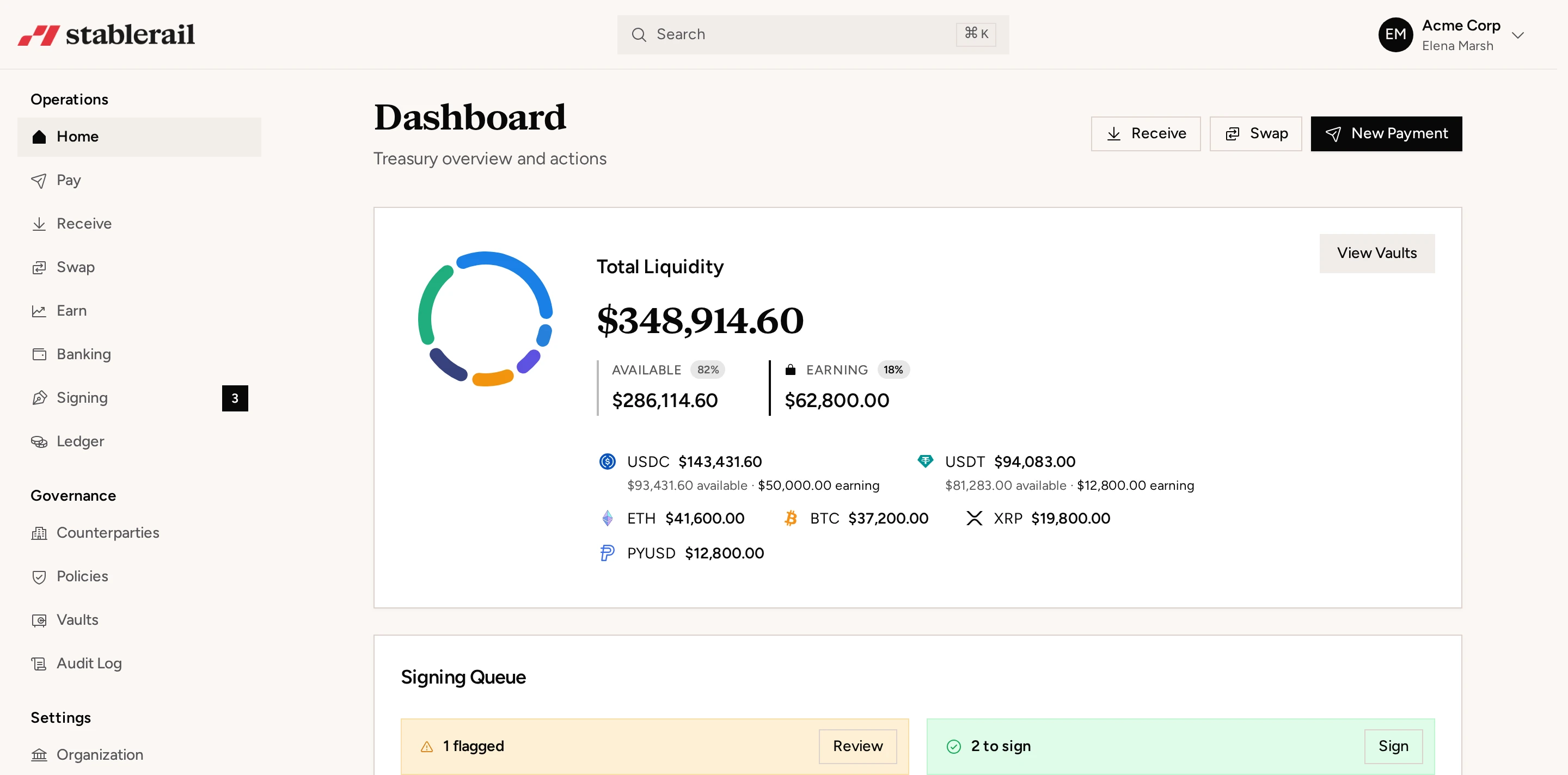
Stablerail supports corporate USDC and USDT operations through self-custodial MPC vaults, quorum signing, approval limits, allowlists, wallet screening and an audit log. Finance teams can use these controls alongside batch payouts across supported networks and generate evidence around the payment workflow. See stablecoin payouts or use the wallet checker for address-level checks.
For higher-risk or regulated operations, specialist analytics may still be required for deeper attribution, continuous monitoring and formal investigations. The practical objective is to connect both layers: risk intelligence from the monitoring provider and payment evidence from the treasury system.
Final selection checklist
- Confirm coverage for every required stablecoin, token contract and network.
- Test wallet screening before payment and monitoring after settlement.
- Inspect audit logs instead of relying on a checklist response.
- Demonstrate role based access using real treasury and compliance roles.
- Export a complete case and assess the regulatory evidence.
- Review APIs, webhooks, uptime terms, retention and data portability.
- Verify current features, availability and pricing with each vendor.
The best stablecoin risk monitoring platform is the one that produces consistent decisions and preserves enough context to explain them later. Risk scores matter, but defensible workflows, accessible evidence and reliable integrations determine whether the system works in day-to-day treasury operations.
Finance writers covering stablecoin treasury, payments, compliance, and risk controls.
More about the Stablerail team- Stablecoin treasury managementApprovals, limits, yield and reporting on one balance.
- Stablecoin payoutsBatch contractor and vendor payments with screening.
- USDT vs USDCWhich stablecoin your company should settle in.
- Stablecoin finance glossaryMPC, off-ramp, travel rule and the rest, in plain English.
- Product updatesEverything we ship, month by month.