
How Cobre Supports Stablecoin Payments and What Businesses Should Compare
Cobre supports business payments in Latin America, with stablecoins used in some cross-border flows. Compare asset access, custody, corridors, conversion costs, settlement and finance controls before choosing a provider.
Cobre supports business payments, collections and cross-border transfers in Latin America, with stablecoins such as USDC used in some payment flows. Businesses should verify whether stablecoins are customer-held assets or only an internal settlement rail. That distinction affects withdrawal rights, custody, accounting and risk. Finance teams should also compare corridor coverage, conversion spreads, blockchain networks, payout timing, approvals and reconciliation evidence.

Cobre supports business payments, collections and cross-border transfers in Latin America, with stablecoins such as USDC used in some payment flows. Businesses should verify whether stablecoins are customer-held assets or only an internal settlement rail. That distinction affects withdrawal rights, custody, accounting and risk. Finance teams should also compare corridor coverage, conversion spreads, blockchain networks, payout timing, approvals and reconciliation evidence.
How Cobre’s stablecoin payment model appears to work
Cobre positions its platform around business payments, collections, treasury operations and money movement within and across Latin America. Its public materials have associated USDC, the US dollar stablecoin issued by Circle, with moving value between markets.
That does not necessarily mean every Cobre customer can maintain a USDC balance, deposit tokens from an external wallet or withdraw them to an address of its choice. Stablecoins can play two very different roles in a payment product:
- Customer-facing asset: The business can hold, receive, convert or withdraw stablecoins as part of its own treasury operations.
- Internal settlement rail: The provider or its partners use stablecoins between fiat collection and payout, while the customer sends and receives conventional currency.
Both models can support cross-border payments, but they create different operational and accounting requirements. A company that only wants to pay a supplier in local currency may not need direct stablecoin access. A company managing its own USDC or USDT needs documented ownership, supported wallet addresses, network selection, transaction authorization and exportable records.
The four stages of a stablecoin-enabled payment
A Cobre transaction involving stablecoins may include four stages, depending on the corridor and product configuration:
- Funding: The business sends fiat from a bank account, uses an available account balance or, if supported for that product, deposits stablecoins.
- Conversion: Fiat is converted into a stablecoin such as USDC. This may be visible to the customer or performed within the provider’s settlement process.
- Transfer: The stablecoin moves over a supported blockchain between wallets, liquidity providers or payment partners.
- Payout: The recipient receives stablecoins or local fiat through an available bank or payment rail.
This structure can reduce reliance on correspondent banks during the middle stage of a cross-border transfer. It does not eliminate the need for banking partners, compliance reviews or local liquidity at the fiat entry and exit points. Consequently, fast blockchain confirmation should not be interpreted as guaranteed instant delivery to a beneficiary’s bank account.
Cobre comparison table for finance teams
| Area | What to confirm | Why it matters |
|---|---|---|
| Stablecoin role | Is USDC visible in the company’s account, or is it only used by Cobre for settlement? | Determines whether the company records a stablecoin asset and has direct control over it. |
| Deposits and withdrawals | Can the company send from or withdraw to an external wallet? Are addresses restricted or pre-approved? | A payment rail does not automatically provide stablecoin treasury access. |
| Networks | Which blockchain is supported for each token and transaction type? Can the business select the network? | Tokens on different networks are not interchangeable at the deposit address. A network mismatch can delay or prevent recovery of funds. |
| Markets | Where may the sender be incorporated, and where can beneficiaries receive funds? | Regional coverage statements may not reflect the availability of a specific legal-entity and destination-country combination. |
| Fiat rails | Which currencies and local payment rails are available? What beneficiary information appears on the payment? | The rail affects cut-off times, traceability, return handling and recipient reconciliation. |
| Conversion | Is the rate fixed when quoted or at execution? How long is the quote valid? Is a spread included? | The exchange rate may represent more of the total cost than the separately stated fee. |
| Custody | Who controls transaction authorization, and are balances held in a dedicated or pooled arrangement? | Custody structure affects access, counterparty exposure and the evidence available to auditors. |
| Approvals | Can initiation and approval be separated? Are multiple approvers or a signing quorum available? | Payment controls should reflect the company’s bank-account controls and segregation-of-duties policy. |
| Settlement | When is the payment final at each stage? What happens outside banking hours or during compliance review? | Blockchain settlement, provider processing and beneficiary-bank credit are separate events. |
| Reconciliation | Can the company export transaction IDs, timestamps, fees, rates, wallet addresses and payment status? | Finance teams need evidence that connects the bank movement, blockchain transfer and final payout. |
How to compare settlement times
Do not ask only whether a provider offers “instant” stablecoin payments. Request an end-to-end timeline for the exact funding currency, destination, beneficiary type and delivery method you plan to use.
For example, a USDC-funded payout to a Colombian peso bank account can involve deposit detection, required blockchain confirmations, sanctions or address review, conversion, local payment submission and processing by the beneficiary’s bank. Each stage can have a different operating window.
Ask providers to separate timing estimates for:
- Fiat funding to a stablecoin balance or withdrawal.
- Stablecoin deposit to a local-currency bank payout.
- Local-currency funding to an external stablecoin wallet.
- A stablecoin-funded batch of payments to multiple bank beneficiaries.
The written response should identify banking cut-offs, expected blockchain confirmations, manual-review conditions, payout windows and the point at which a transaction can no longer be cancelled. It should also explain how failed or returned fiat payments are handled after the stablecoin leg has settled.
Calculate the all-in payment cost
Compare identical transactions rather than headline fees. Give each provider the same amount, funding method, currency pair, destination, beneficiary type and requested delivery time. Record both the amount debited from the company and the amount the beneficiary is expected to receive.
The all-in cost may include:
- A bank wire, local transfer or fiat deposit fee.
- A foreign-exchange spread relative to the reference rate.
- A fiat-to-stablecoin or stablecoin-to-fiat conversion charge.
- A blockchain network or withdrawal fee.
- A local payout fee.
- Intermediary or beneficiary-bank deductions.
- Charges for failed, returned or amended payments.
Some costs may be embedded in the quoted exchange rate. Capture the quote timestamp, quote validity period and market reference used by your treasury policy. Then calculate effective cost from the company’s total debit to the beneficiary’s net receipt. This produces a more meaningful comparison than reviewing a provider’s listed transfer fee in isolation.
Custody, controls and accounting treatment
If stablecoins are only an internal settlement mechanism, the company may account for a fiat receivable, payable or payment-in-transit rather than a directly controlled token balance. If the company can hold and withdraw USDC or USDT, finance must determine when it recognizes the asset, how it values it, where wallet activity is recorded and how balances are substantiated.
Ask who can initiate a transfer, who can approve it and what evidence remains after execution. Appropriate controls may include separate initiator and approver roles, multiple approvals, a signing quorum, controlled beneficiary creation, sanctions or address screening, and periodic access reviews.
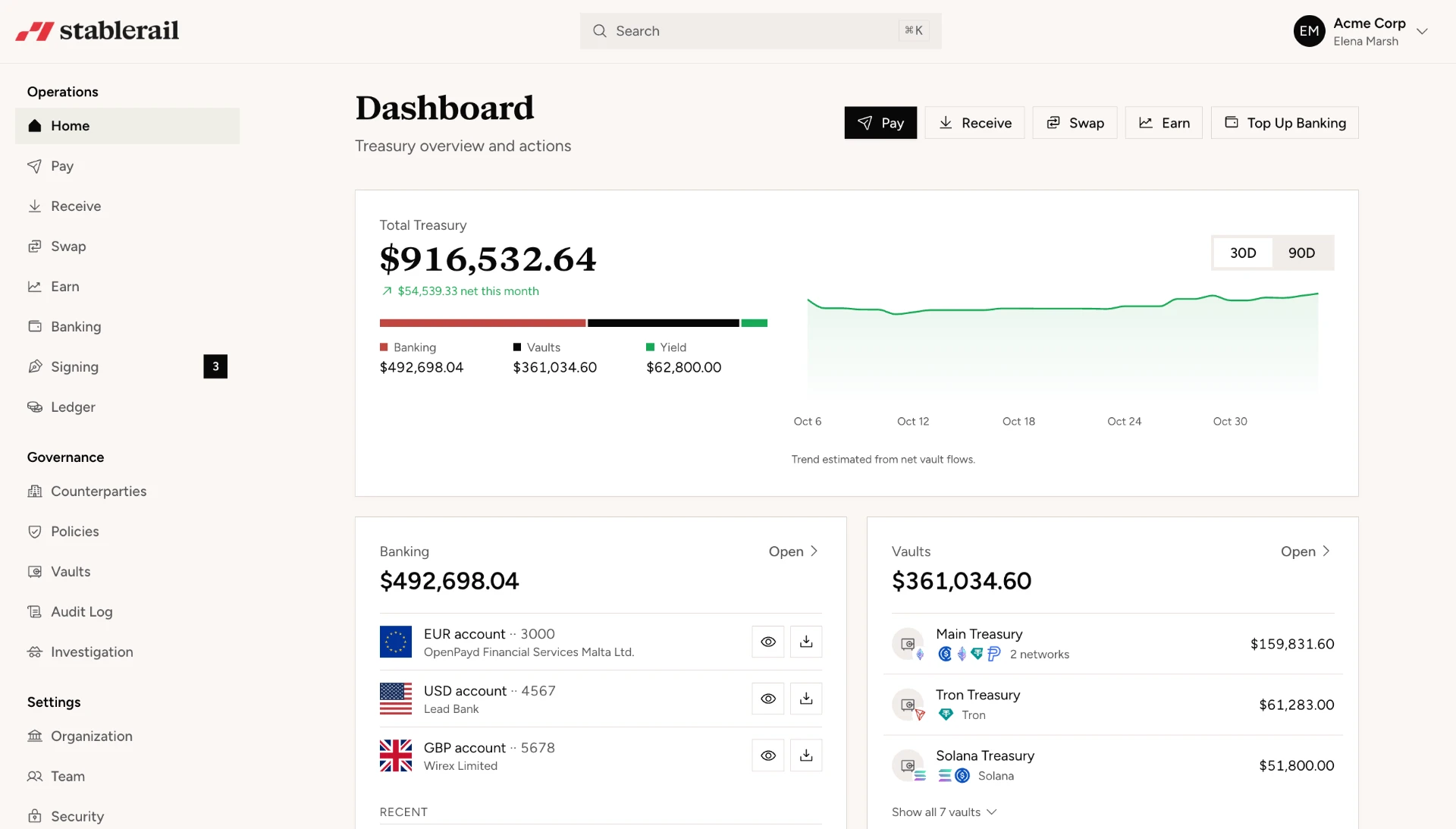
The operating model should also define who investigates unmatched deposits, payments sent on the wrong network, beneficiary returns and transactions paused for review. Stablerail represents a different model from an internal stablecoin settlement rail: it is designed for companies managing their own USDC or USDT and provides approvals and signing quorum, pre-send sanctions and address screening, fiat conversion, global payouts, corporate cards and exportable audit evidence.
Documents to request before approving Cobre
Product coverage can change by country, entity and payment purpose. Before relying on Cobre or another provider for a production corridor, obtain current written documentation rather than treating a general product page as confirmation.
- Confirm eligible company jurisdictions, industries, transaction purposes and beneficiary countries.
- Obtain supported fiat currencies, stablecoins, blockchain networks and official token contract details.
- Request the fee schedule plus sample quotes for representative transaction sizes and corridors.
- Document funding instructions, payment cut-offs, payout windows, limits and return procedures.
- Review custody terms, balance treatment, withdrawal rights and transaction approval controls.
- Test exports for rates, fees, blockchain transaction hashes, payout references and status history.
- Run a small payment through funding, conversion, payout, reconciliation and any return workflow before increasing limits.
If the company will receive stablecoins from customers, add invoice matching, payer identification, wallet screening, overpayment handling and refund controls. Refunds should follow an approved process rather than automatically returning funds to the originating blockchain address, which may belong to an exchange or payment intermediary.
When Cobre may fit, and when to compare another model
Cobre is relevant for businesses evaluating collections, treasury connectivity and stablecoin-enabled payments involving Latin America. It may be a practical fit when the desired outcome is a local fiat collection or payout and the stablecoin primarily improves settlement between markets.
Compare a direct stablecoin treasury platform when the company needs to hold USDC or USDT, control external wallet transfers, apply corporate approval rules or maintain detailed wallet-level audit evidence. Neither model is inherently better: the right choice depends on whether the business needs a payment outcome, direct control of the stablecoin asset, or both.
The final decision should be made corridor by corridor. Confirm the legal entity served, exact funding and payout rails, stablecoin visibility, conversion economics, operational controls and evidence available for reconciliation. Those details determine whether the advertised stablecoin capability matches the finance team’s actual use case.
Frequently asked questions
Does Cobre let businesses hold and withdraw USDC?
Cobre’s public materials associate USDC with some payment and cross-border flows, but that alone does not confirm direct holding or withdrawal rights for every customer. Businesses should ask whether USDC appears as a customer balance, whether external wallet deposits and withdrawals are supported, and which networks are available.
Is Cobre a stablecoin wallet or a payment platform?
Cobre is positioned primarily as a business payments, collections and treasury platform focused on Latin America. Stablecoins may support certain flows, but finance teams should verify whether they receive direct wallet functionality or whether Cobre uses stablecoins behind the scenes for settlement.
How should a business compare Cobre’s stablecoin payment costs?
Request a quote for a defined amount, currency pair, corridor, funding method and payout method. Compare the company’s total debit with the beneficiary’s expected net receipt, including conversion spreads, network costs, payout fees and possible bank deductions.
Are stablecoin cross-border payments instant?
Blockchain transfers can settle quickly, but end-to-end payment time also includes funding, compliance review, conversion and local bank processing. Ask for separate timing estimates for each stage and confirm what happens outside banking hours or when a payment is held for review.
What records are needed to reconcile a stablecoin payment?
Finance teams should retain funding references, quote timestamps, exchange rates, fees, wallet addresses, blockchain transaction hashes, payout references and final status. The records should connect the bank movement and blockchain leg to the beneficiary payment and general ledger entry.
Finance writers covering stablecoin treasury, payments, compliance, and risk controls.
More about the Stablerail team- Stablecoin treasury managementApprovals, limits, yield and reporting on one balance.
- Stablecoin payoutsBatch contractor and vendor payments with screening.
- USDT vs USDCWhich stablecoin your company should settle in.
- Stablecoin finance glossaryMPC, off-ramp, travel rule and the rest, in plain English.
- Product updatesEverything we ship, month by month.