
How to Choose a Bridge for Cross-Border Stablecoin Payments
Learn how to compare blockchain bridges and fiat-to-stablecoin infrastructure by coverage, speed, total fees, liquidity, custody and counterparty risk.

“Bridge” can mean two different things in cross-border payments. A blockchain bridge moves a digital asset from one blockchain to another. Fiat-to-stablecoin infrastructure moves value between bank accounts and stablecoins through an on-ramp or off-ramp.
The distinction matters. If a supplier wants euros in a bank account, moving USDC from Ethereum to Base does not complete the payment. You still need conversion, banking access and a local payout rail. Conversely, if the recipient wants USDT on Tron but your treasury holds USDT on Ethereum, the cross-chain leg may be the main problem.
Finance teams should define the complete route before comparing providers: source currency and account, stablecoin and network, destination currency, payout method and required arrival time.
Blockchain bridge versus payment infrastructure
| Option | What it does | Typical use | Main risks |
|---|---|---|---|
| Blockchain bridge | Transfers or recreates an asset across blockchains | Move stablecoins between Ethereum, Base, Arbitrum, Polygon or other networks | Smart-contract failure, bridge operator risk, wrapped-asset risk and limited liquidity |
| Fiat on-ramp | Converts bank money into USDC or USDT | Fund a stablecoin treasury from EUR, USD or GBP | Banking delays, conversion spread, provider custody and eligibility restrictions |
| Fiat off-ramp | Converts stablecoins into bank money | Pay a vendor that wants local currency | Local payout coverage, beneficiary checks, liquidity and intermediary bank fees |
| Integrated payment platform | Combines fiat accounts, conversion, wallet infrastructure and payouts | Run repeatable cross-border routes from one treasury workflow | Provider concentration, corridor availability and dependence on banking partners |
Some stablecoins also have issuer-supported cross-chain transfer mechanisms. These generally burn tokens on the source chain and mint native tokens on the destination chain. This can avoid wrapped assets, but support is chain-specific and should not be assumed for every stablecoin or route.
A traditional blockchain bridge may lock tokens on one network and issue a representation on another. That representation is often called a wrapped asset. It depends on the bridge’s contracts, validators or custodians as well as the underlying stablecoin issuer.
Start with destination coverage
Coverage should be evaluated at both ends of the payment. A provider saying it supports “USD” or “USDC” is not enough. Ask for the exact combinations it can process.
- Fiat currencies: Which currencies can you fund, convert and pay out?
- Fiat rails: Does the route use SEPA, SEPA Instant, ACH, Fedwire, SWIFT, Faster Payments, CHAPS or BACS?
- Stablecoins: Is USDC or USDT available for the corridor?
- Networks: Is the asset native and supported on the recipient’s required chain?
- Beneficiary types: Can the provider pay companies and individuals, or only one category?
- Jurisdictions: Are the sender’s industry and both parties’ countries eligible?
Stablerail combines multi-currency fiat access, stablecoin on/off-ramps and payouts across Ethereum, Base, Arbitrum, Polygon, Tron, BNB Chain, Optimism and Solana. Coverage still depends on the specific jurisdiction, asset and recipient route, so it should be confirmed during KYB and corridor review. See the stablecoin payouts overview for the operating model.
Compare settlement speed correctly
Providers often quote blockchain confirmation time while excluding funding, conversion, screening and bank delivery. For commercial comparisons, measure from funds released by your finance team to funds usable by the beneficiary.
| Payment leg | Indicative timing | Important qualification |
|---|---|---|
| SEPA Instant | Usually seconds; the scheme is designed for availability within 10 seconds | Both banks must support the service, and screening can add time |
| Standard SEPA | Usually one business day | Cut-off times and holidays apply |
| ACH | Same day or one to three business days | Depends on submission window, bank and ACH service used |
| Fedwire | Same business day | Must be accepted during operating hours and before relevant cut-offs |
| UK Faster Payments | Often seconds or minutes | Bank checks and transaction limits can delay or reject a payment |
| CHAPS | Same business day | Operating hours and bank cut-offs apply |
| BACS | Typically three working days | Best suited to scheduled rather than urgent payments |
| SWIFT cross-border | Often one to five business days | Correspondent banks, time zones and beneficiary checks affect timing |
| Stablecoin transfer | Seconds to minutes for many networks | Finality, congestion, provider confirmation policies and off-ramp processing still matter |
For blockchain bridges, also distinguish between destination-chain receipt and final withdrawal. Optimistic rollup bridges, for example, can have substantially longer withdrawal periods when moving assets back to Ethereum through the canonical route. Third-party liquidity providers may offer faster delivery in exchange for fees and additional counterparty exposure.
Calculate the all-in delivered cost
Do not compare only the visible bridge or blockchain fee. The relevant number is the cost to deliver the amount the beneficiary can actually use.
All-in cost = funding fee + FX spread + on-ramp fee + network or bridge fee + off-ramp fee + payout fee + intermediary deductions.
Ask each provider for a quote showing the source amount, exchange rate, every fee and the guaranteed or estimated beneficiary amount. Obtain quotes at representative sizes because pricing and slippage can change materially with volume. Published corridor pricing is more useful than a single headline percentage, but confirm whether bank and network charges are included.
Gas fees also vary by network and demand. A low-cost chain may reduce the blockchain component without improving the cost of the fiat off-ramp. If a recipient ultimately needs EUR in a SEPA account, local conversion and payout pricing may matter more than saving a small amount on gas.
Test liquidity, not just stated limits
Liquidity is the ability to convert or transfer the required amount without excessive delay or price movement. A provider may support a corridor but have limited capacity at your payment size.
Request executable or time-stamped quotes at several representative amounts. Ask whether the quote is firm, how long it remains valid, whether larger orders are split and what happens if liquidity disappears after approval. For batch payments, confirm whether pricing is set for the complete batch or separately for each beneficiary.
Where possible, avoid an unnecessary blockchain bridge. A payment provider that can source native USDC or USDT on the destination network may offer a simpler route than bridging treasury assets first.
Review custody and counterparty risk
Custody determines who controls the assets while the payment is pending. With an omnibus provider wallet, the provider controls pooled funds and records your balance internally. With self-custody, your company retains signing authority over its wallets.
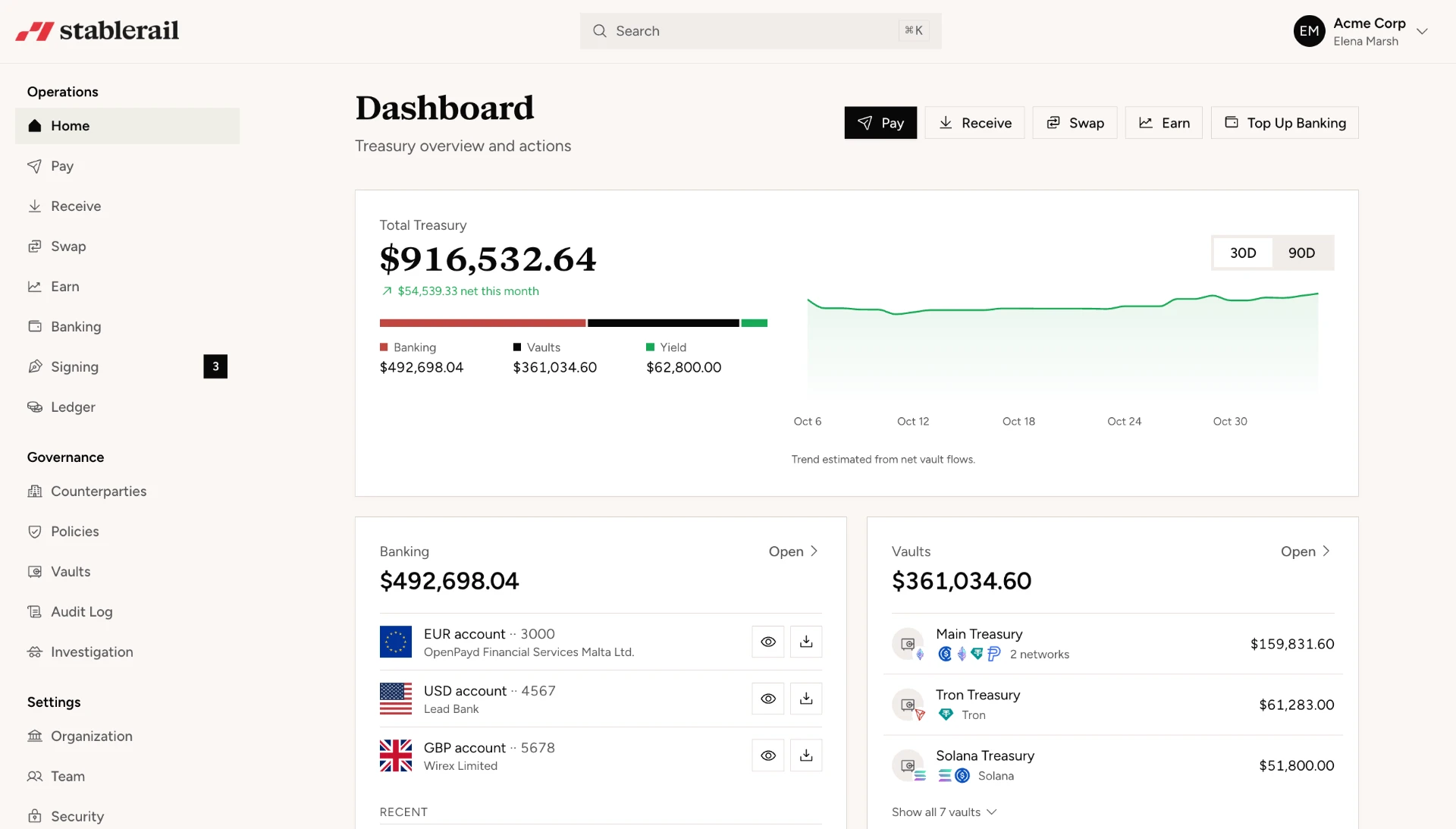
Stablerail uses self-custodial MPC vaults with quorum signing. MPC, or multi-party computation, divides signing authority so that no single key holder can move funds alone. Finance teams can apply approval limits and beneficiary allowlists while using fiat accounts, conversions and payout workflows.
Counterparty review should cover every dependency in the route:
- The stablecoin issuer and its redemption terms.
- The payment provider and its banking or liquidity partners.
- The blockchain bridge’s contracts, validators and administrators.
- Any wrapped stablecoin or liquidity token received.
- The destination bank or off-ramp provider.
Ask who bears a loss if a bridge is exploited, a bank transfer is returned or an off-ramp freezes a transaction. Review contractual liability rather than relying on a technical claim that a route is “non-custodial.”
A practical selection process
- Map the route: Record the source account, funding rail, stablecoin, network, destination currency and beneficiary method.
- Confirm eligibility: Complete KYB and check jurisdiction, industry and beneficiary restrictions before relying on a corridor.
- Request all-in quotes: Compare the amount received, not only the advertised fee.
- Run a small test: Verify wallet compatibility, beneficiary details, arrival time and reconciliation records.
- Test normal volume: A nominal transfer does not demonstrate liquidity for payroll or supplier batches.
- Prepare evidence: Retain approvals, invoices, wallet screening results, transaction hashes, exchange records and bank confirmations.
For recurring contractor or salary routes, batch processing and reconciliation can be as important as the conversion rate. Review the available stablecoin payroll workflow if payments involve multiple recipients.
The decision rule
Choose a blockchain bridge only when you genuinely need to move assets between networks and have assessed the bridge’s contracts, asset structure and liquidity. Choose fiat-to-stablecoin infrastructure when the commercial objective is moving money between a bank account and USDC or USDT.
For most cross-border stablecoin payments, the best route is the one with the fewest unnecessary conversions and counterparties while still meeting the recipient’s currency, network and timing requirements. Compare the complete corridor—not one transaction leg—and document the delivered cost, settlement time, custody model and failure process before moving production volume.
Finance writers covering stablecoin treasury, payments, compliance, and risk controls.
More about the Stablerail team- Stablecoin treasury managementApprovals, limits, yield and reporting on one balance.
- Stablecoin payoutsBatch contractor and vendor payments with screening.
- USDT vs USDCWhich stablecoin your company should settle in.
- Stablecoin finance glossaryMPC, off-ramp, travel rule and the rest, in plain English.
- Product updatesEverything we ship, month by month.