
How Cobre Supports Stablecoin Payments—and What Businesses Should Compare
Cobre uses stablecoins within Latin America-focused payment infrastructure. Learn what finance teams should verify about direct asset access, pricing, settlement, custody and local payouts.
Cobre supports stablecoin-enabled cross-border business payments, particularly in Latin America, by using digital dollars as a settlement and conversion layer between fiat markets. Businesses should confirm whether they can directly hold, deposit or withdraw USDC or USDT, or whether Cobre manages stablecoins behind the scenes. The right comparison depends on corridor coverage, total delivered cost, settlement timing, custody, controls and reconciliation evidence.

Cobre supports stablecoin-enabled business payments by using digital dollars as a settlement and conversion layer between fiat markets, with a focus on Latin America. That does not necessarily mean every customer receives a wallet or directly controls USDC or USDT. Finance teams should determine whether stablecoins are customer-accessible assets or provider-managed infrastructure, then compare corridor availability, total cost, timing, controls and reconciliation.
How Cobre uses stablecoins for business payments
Cobre’s public positioning connects stablecoins primarily with domestic and cross-border payment infrastructure for businesses. In this model, stablecoins can transfer value between markets without requiring the payer or recipient to interact directly with a blockchain.
A stablecoin-enabled payment may follow these steps:
- The business funds the payment in an available fiat currency.
- The provider or its partners perform the required foreign-exchange and stablecoin conversions.
- A stablecoin moves across a supported blockchain network.
- The value is converted into the destination currency when required.
- The recipient receives a bank payment through an available local or international rail.
This structure may remove some correspondent-banking steps, but it does not make every payment immediate. Funding confirmation, compliance review, conversion liquidity, bank cutoffs, weekends, holidays and the recipient bank’s posting process can still affect delivery.
Stablecoins may remain behind the scenes
The central question is whether the customer uses stablecoins directly. In an infrastructure-led model, the customer can submit a fiat payment instruction while the provider manages wallets, blockchain transfers and conversion. The business receives a familiar payment experience and does not need to select networks or maintain operational cryptocurrency balances.
A direct stablecoin treasury model is different. The company holds a USDC or USDT balance, sends to blockchain addresses, controls approvals and decides when to convert between stablecoins and fiat. This provides more control, but it also creates responsibilities around network selection, address verification, signing authority, accounting and transaction monitoring.
Finance teams evaluating Cobre should obtain written confirmation of whether their specific account can deposit, hold and withdraw stablecoins. Product availability can depend on the customer’s jurisdiction, legal entity, industry, transaction profile and requested corridor.
What public product information does and does not establish
Cobre publicly presents itself as business payment and treasury infrastructure with a significant Latin American focus. Its materials describe domestic payments, international money movement, account connectivity and payment automation, with stablecoins supporting cross-border settlement.
Public product pages are not a substitute for binding terms. They may not provide a single standardized schedule for every customer country, destination, asset, network, limit and fee. Any evaluation should therefore separate publicly described capabilities from features confirmed for the company’s own account.
| Decision area | What the model may provide | What finance teams should confirm |
|---|---|---|
| Primary use | Domestic and cross-border business payments | Whether each required origin-to-destination corridor is live |
| Stablecoin role | A settlement or conversion layer between fiat markets | Whether customers can directly hold, deposit or withdraw USDC or USDT |
| Recipient experience | Fiat delivery through a supported banking rail | Currency, bank type, beneficiary requirements and payout cutoff |
| Customer access | Business-facing payment and automation tools | Portal, file upload, approval and integration options included in the contract |
| Pricing | Pricing based on corridor and business requirements | Transfer fee, FX spread, conversion cost, network cost and return fee |
| Control model | Provider-managed execution may reduce blockchain operations | Who controls funds at each stage and which entity is the contractual counterparty |
Nine points to compare before choosing a provider
1. Eligible entities and markets
Start with the countries where the company is incorporated, funds payments and pays beneficiaries. Regional coverage does not always mean that entities in every country can onboard or originate every advertised corridor. Request a written matrix of eligible customer jurisdictions, origin currencies, destination currencies and restricted industries.
2. Fiat currencies and stablecoin access
Confirm each funding, conversion and payout currency. Support for a dollar-denominated stablecoin does not automatically include a USD bank balance or USD withdrawal. If direct access matters, ask separately about USDC and USDT, including whether the company can deposit from and withdraw to an external address.
3. Funding and payout rails
Identify how funds enter and leave the service. Ask whether a recipient receives a local bank payment or an international wire, which entity appears as the sender and what information appears on the bank statement. These details affect fees, beneficiary acceptance and reconciliation.
4. Custody and transaction authority
Map who controls the funds at each stage. In a provider-managed payment, the provider or a partner may execute the stablecoin transfer. With direct stablecoin treasury, the company needs defined initiators, approvers and a signing quorum so one compromised credential cannot unilaterally move corporate funds.
5. Conversion and rate locking
Request a sample quote that starts with the amount funded and ends with the amount delivered. It should identify platform charges, foreign-exchange spreads, stablecoin conversion costs, network fees and payout charges. Confirm when the rate becomes binding, how long it remains valid and what happens if funding arrives late.
6. Blockchain networks
If direct deposits or withdrawals are available, verify each supported asset-and-network combination. The same ticker can exist on multiple networks, but deposits are not operationally interchangeable. Ask how the provider detects an unsupported network, whether recovery is possible and what evidence is required for a manual investigation.
7. Settlement stages and exceptions
Request separate timing estimates for funding confirmation, compliance review, blockchain settlement, conversion and bank payout. A blockchain transfer can operate continuously while the fiat leg waits for a banking window. The operating procedure should also cover rejected beneficiaries, returned transfers, compliance holds and stale conversion quotes.
8. Total delivered cost and limits
Compare how much the beneficiary receives for the same amount funded, not only the advertised transfer fee. Document minimum and maximum transaction amounts, daily or monthly limits, advance-notice requirements and any enhanced source-of-funds review needed for larger payments.
9. Reconciliation and audit evidence
A finance team should be able to connect the approved payment instruction to the funding debit, conversion, blockchain transaction where applicable and final payout. Request exportable records containing timestamps, currencies, rates, fees, beneficiary details, statuses and transaction references. Also establish whether statements identify the legal entity holding or transferring funds.
Provider-managed payments versus direct stablecoin treasury
| Requirement | Provider-managed payment model | Direct stablecoin treasury model |
|---|---|---|
| Main objective | Deliver fiat to a beneficiary without managing blockchain operations | Hold and deploy USDC or USDT as company treasury funds |
| Blockchain interaction | Usually handled by the provider or its partners | Company selects addresses and supported networks |
| Operational controls | Provider workflow and contracted approval features | Internal approvals, signing quorum and address screening |
| Cost comparison | Total funded amount versus fiat amount delivered | Conversion, network and withdrawal costs by transaction |
| Best fit | Local-currency vendor or business payments | Stablecoin balances, direct wallet payments and treasury operations |
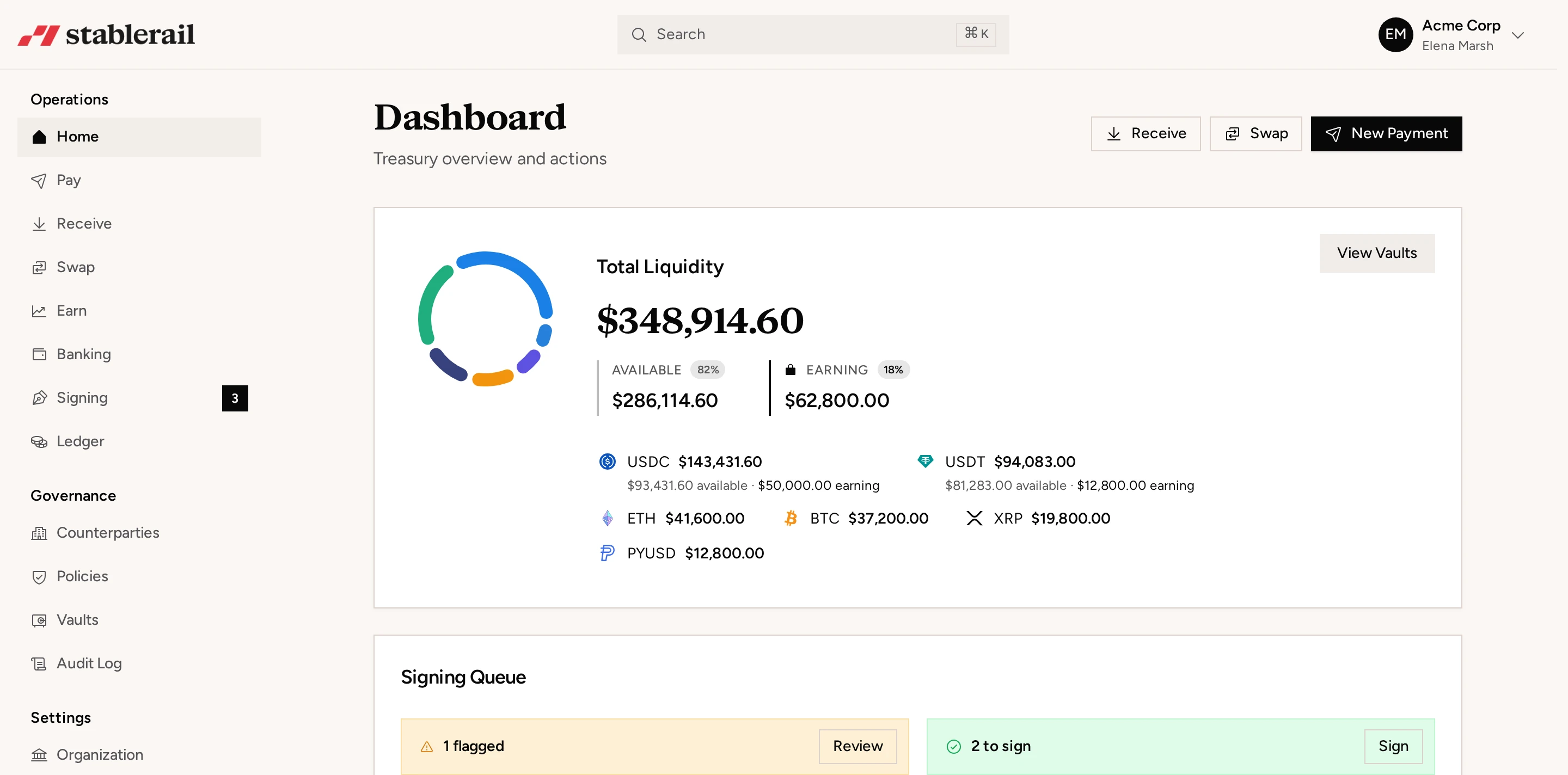
Cobre may fit a company seeking payment infrastructure with a Latin American focus and a stablecoin-enabled route between fiat markets. A corporate stablecoin treasury platform addresses a different requirement. For example, Stablerail is designed for companies managing their own USDC or USDT and provides approvals and signing quorum, sanctions and address screening before sending, global payouts, fiat conversion, corporate cards and exportable audit evidence.
Finance-team due diligence checklist
- Define the exact corridor: customer entity, funding currency, destination country, payout currency and beneficiary type.
- Request a complete quote: record every fee, spread, rate-lock condition and the final amount delivered.
- Confirm asset access: determine whether stablecoins are internal settlement technology or a customer-held balance.
- Map fund control: identify the provider, partner or company employee authorized at each stage.
- Test a low-value payment: measure actual timing and capture the resulting bank and blockchain references.
- Review exceptions: document procedures for holds, failed payouts, returns and unsupported network deposits.
- Validate reporting: confirm exports support accounting, approval evidence and period-end reconciliation.
The choice should not rest on a general promise of faster or cheaper payments. Ask Cobre and alternative providers for corridor-specific availability, a total-cost example, the contractual flow of funds and a settlement schedule. That evidence will show whether the service solves a payment-routing need or the broader requirement to control stablecoins as a treasury asset.
Frequently asked questions
Does Cobre let businesses hold USDC or USDT directly?
Cobre’s public positioning describes stablecoins as part of its business payment and cross-border settlement infrastructure. A company should confirm during onboarding whether its specific account can directly deposit, hold and withdraw USDC or USDT, rather than assuming those functions are included.
How does Cobre use stablecoins for cross-border payments?
Stablecoins can act as an intermediate settlement asset between the payer’s fiat currency and the recipient’s currency. The provider or its partners may manage conversion and blockchain transfer before delivering funds through a supported bank rail.
Are Cobre stablecoin payments instant?
Not necessarily. The blockchain leg may settle continuously, but funding confirmation, compliance checks, conversion, banking cutoffs, holidays and the recipient bank can extend the end-to-end delivery time.
What fees should a business compare for a stablecoin payment?
Compare the total amount funded with the amount the beneficiary receives. Include platform fees, FX spreads, stablecoin conversion costs, blockchain network fees, payout charges and any fees for returned or failed payments.
When should a company use direct stablecoin treasury instead?
Direct stablecoin treasury is more suitable when the company needs to hold USDC or USDT, pay external wallet addresses, control approvals and signing, or choose when to convert into fiat. A provider-managed model may be simpler when the objective is local-currency delivery without operating blockchain transactions.
Finance writers covering stablecoin treasury, payments, compliance, and risk controls.
More about the Stablerail team- Stablecoin treasury managementApprovals, limits, yield and reporting on one balance.
- Stablecoin payoutsBatch contractor and vendor payments with screening.
- USDT vs USDCWhich stablecoin your company should settle in.
- Stablecoin finance glossaryMPC, off-ramp, travel rule and the rest, in plain English.
- Product updatesEverything we ship, month by month.