
Best Bridge Alternatives for Stablecoin Infrastructure
Compare Bridge alternatives for stablecoin infrastructure, including BVNK, Circle, Conduit, Zero Hash and Stablerail, across APIs, fiat rails, custody, payouts and treasury use cases.

Bridge is one option for businesses building stablecoin payments, wallets and cross-border money movement. It is not the only one, and the best alternative depends on whether you are embedding payments into a product or managing your company’s own USDC and USDT treasury.
The practical differences are in the details: supported fiat rails, settlement times, stablecoins and networks, custody structure, API model, payout destinations and the legal entity serving each market. Pricing also needs to be compared component by component rather than as a single headline fee.
Bridge alternatives at a glance
| Provider | Primary fit | API model | Fiat and stablecoin scope | Custody approach |
|---|---|---|---|---|
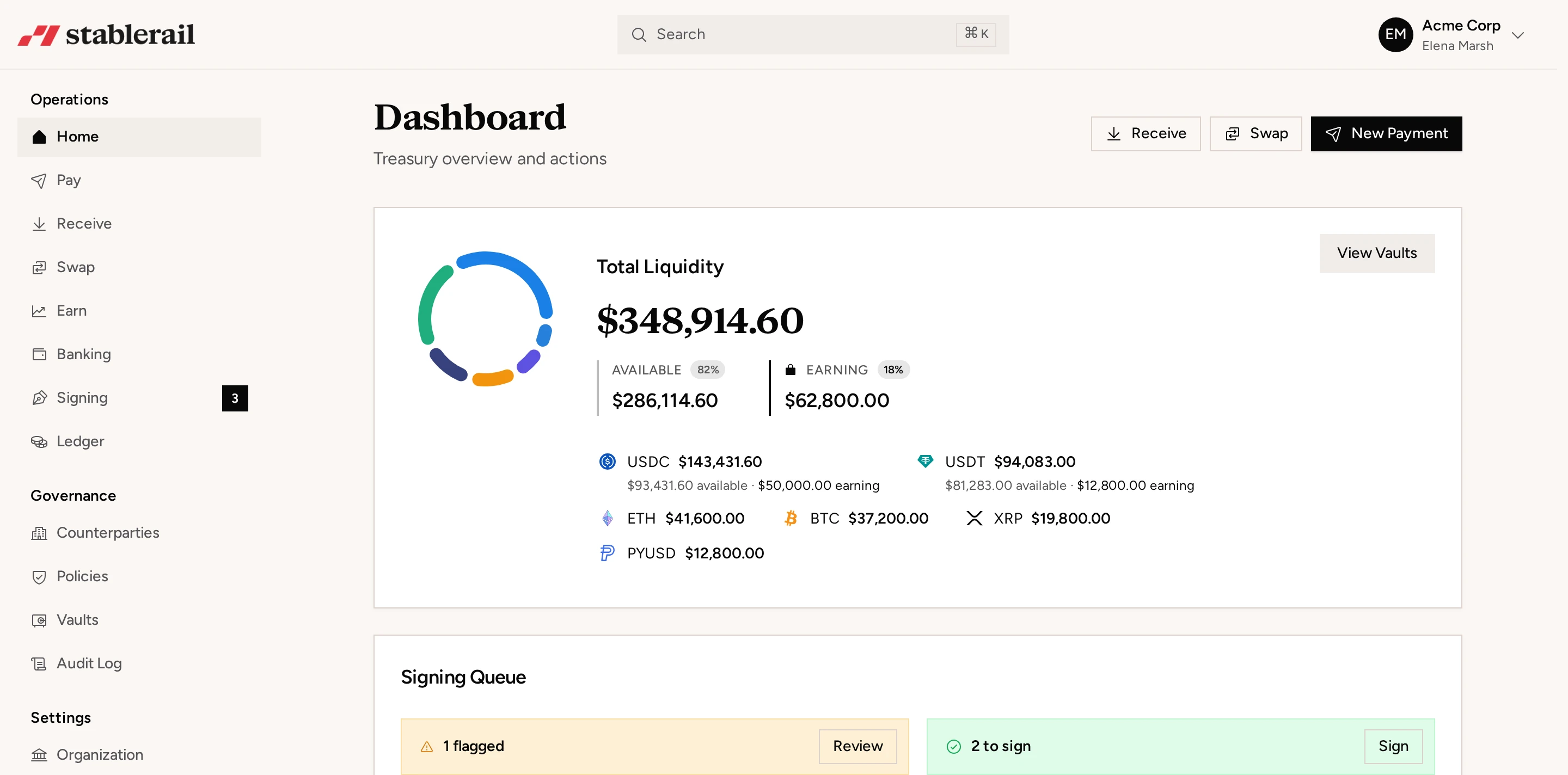
| Stablerail | Companies managing their own stablecoin treasury, payouts and spending | Treasury operations platform | USDC, USDT, multi-currency fiat rails and multiple blockchain networks | Self-custodial MPC vaults with quorum signing |
| BVNK | Businesses embedding stablecoin collection, conversion and payouts | API-led payments infrastructure | Stablecoin and fiat payment corridors, subject to market availability | Provider-managed infrastructure; structure varies by product and entity |
| Circle | USDC-centric minting, redemption, wallets and blockchain transfers | Institutional accounts and developer APIs | Strong USDC coverage across supported chains; fiat access depends on account eligibility | Issuer and platform-managed services, depending on product |
| Conduit | Cross-border B2B payments and treasury movement | API and operations-led payment orchestration | Selected fiat-to-stablecoin and stablecoin-to-fiat corridors | Uses a mix of platform infrastructure and regulated partners |
| Zero Hash | Embedded stablecoin and digital-asset features for platforms | B2B2C APIs | Coverage depends on asset, product, jurisdiction and contracting entity | Provider-led custody and settlement infrastructure |
| Bridge | Embedded stablecoin wallets, orchestration and money movement | Developer-first APIs | Fiat and stablecoin support varies by corridor and product | Platform and partner-led infrastructure |
This comparison is directional. Geographic availability, licensing coverage and supported corridors change regularly. Before choosing a provider, confirm the exact contracting entity, customer type, destination countries, assets and transaction flow in writing.
1. Stablerail: for managing a company’s own treasury
Stablerail is most relevant when the finance team is moving its own corporate funds rather than embedding wallets or payment accounts for end customers.
Companies can hold USDC and USDT in self-custodial MPC vaults. MPC, or multi-party computation, divides signing authority so that one person or device does not control the entire private key. Quorum signing lets the company require multiple approvals before a transfer is released.
Fiat connectivity includes SEPA and SEPA Instant for euros, ACH and Fedwire for US dollars, SWIFT for cross-border transfers, and Faster Payments, CHAPS and BACS for pounds. Virtual IBANs and multi-currency balances support collection and reconciliation. On- and off-ramps connect those balances to stablecoins, with corridor pricing published for the relevant route.
For outbound payments, finance teams can create batch vendor, contractor and payroll payouts across Ethereum, Base, Arbitrum, Polygon, Tron, BNB Chain, Optimism and Solana. Corporate cards can be funded from the treasury balance with card limits and merchant category code controls. See stablecoin payouts or the corporate card workflow for more detail.
Best suited to: finance teams that need bank rails, stablecoin custody, approvals, payouts and spending in one operating environment. It is less suitable when the main requirement is a white-label API for creating thousands of end-customer wallets.
2. BVNK: for API-led payment orchestration
BVNK is a close Bridge alternative for businesses that want to collect, convert and pay using both fiat and stablecoins. Its model is aimed at payment companies, marketplaces and global businesses that need stablecoins integrated into payment flows.
The main evaluation point is corridor-level availability. Ask which legal entity will contract with your company, which fiat accounts are available in your jurisdiction, whether named or virtual accounts are provided, and which stablecoin-network combinations can be used for deposits and withdrawals.
Best suited to: embedded payment flows and businesses that want a provider-managed API layer spanning fiat and stablecoins.
3. Circle: for USDC-first infrastructure
Circle is the issuer of USDC and is a natural candidate when the required flow is predominantly USDC minting, redemption and blockchain transfers. Its products include institutional account services and developer infrastructure, but access depends on jurisdiction, business model and onboarding approval.
Circle may reduce the number of intermediaries in a USDC-specific flow. However, it should not automatically be treated as a complete replacement for local bank accounts, broad fiat rails or multi-stablecoin payouts. Teams needing extensive USDT coverage, local beneficiary payments or treasury approval workflows may need additional providers.
Best suited to: USDC-centric products that value direct issuer connectivity and supported-chain transfers.
4. Conduit: for cross-border B2B settlement
Conduit focuses on cross-border business payments that use stablecoins as a settlement layer. This can be useful when a company wants to send fiat in one market and deliver fiat or stablecoins in another without building the conversion and routing stack internally.
Evaluate it corridor by corridor. Local payout availability, beneficiary requirements, cut-off times and settlement currencies matter more than the total number of countries shown in a network map.
Best suited to: B2B cross-border payments and treasury transfers across supported routes.
5. Zero Hash: for embedded customer products
Zero Hash provides business-to-business-to-customer infrastructure. Platforms can use its APIs to add digital-asset and stablecoin capabilities to their own user experience while relying on Zero Hash’s infrastructure for parts of custody, settlement and regulatory coverage.
This model is materially different from a corporate treasury account. Due diligence should cover who holds customer assets, how balances are recorded, what disclosures end users receive and which entity is responsible for compliance in each jurisdiction.
Best suited to: fintechs, brokers and payment platforms launching customer-facing stablecoin features.
How to compare pricing, timing and limits
Stablecoin infrastructure pricing usually has several layers. Request a worked example for each important corridor rather than comparing one advertised percentage.
- Fiat receipt fee: the cost of receiving ACH, wire, SEPA or another bank transfer.
- Conversion spread: the difference between the reference rate and the rate used to buy or sell USDC or USDT.
- Platform fee: a fixed or percentage charge for orchestration, accounts or API usage.
- Network fee: the blockchain fee for transferring stablecoins.
- Fiat payout fee: the cost of delivering funds to a beneficiary’s bank account.
- Minimums and limits: transaction, daily and monthly limits may vary by entity, corridor and risk review.
Timings also depend on the rail. SEPA Instant and Faster Payments can settle within seconds when both banks support the service. Fedwire and CHAPS are generally same-business-day systems subject to operating hours and cut-offs. ACH may take one or more business days, while SWIFT transfers can take longer when intermediary banks are involved. Blockchain transfers often confirm within seconds or minutes, but conversion and compliance reviews can extend the end-to-end time.
Documents to prepare before onboarding
Most providers conduct know-your-business checks before enabling fiat rails or higher limits. Prepare:
- Certificate of incorporation and current company registry extract
- Ownership chart and details of ultimate beneficial owners
- Director and authorized signer identification
- Business model, website and expected transaction activity
- Source-of-funds or source-of-wealth evidence where requested
- Target countries, currencies, stablecoins and blockchain networks
- Sample invoices, customer contracts or vendor payment records
Eligibility can depend on jurisdiction and industry. Obtain approval for the intended use case—not just a generic account—before committing engineering resources.
Which Bridge alternative should you choose?
Choose based on the operating model first. For embedded wallets or customer-facing payment APIs, shortlist API-led providers such as BVNK, Zero Hash, Circle or Bridge itself. For cross-border B2B corridors, compare Conduit and similar routing providers on the exact origin and destination pair.
For a finance team managing the company’s own USDC or USDT, Stablerail offers a treasury-oriented model: self-custodial MPC vaults, quorum approvals, fiat rails, on- and off-ramps, multi-network payouts, cards and an audit log. Approval limits, allowlists, sanctions and wallet screening, and downloadable evidence packs support day-to-day finance operations without turning the treasury into an embedded customer product.
The best bridge alternatives are therefore not interchangeable. Start with one real flow—for example, receiving USD by ACH, converting to USDC and paying 50 contractors on Base—and ask every provider for the total fee, expected timing, limits, required documents, custody structure and responsible legal entity. That test usually reveals more than a broad feature checklist.
Finance writers covering stablecoin treasury, payments, compliance, and risk controls.
More about the Stablerail team- Stablecoin treasury managementApprovals, limits, yield and reporting on one balance.
- Stablecoin payoutsBatch contractor and vendor payments with screening.
- USDT vs USDCWhich stablecoin your company should settle in.
- Stablecoin finance glossaryMPC, off-ramp, travel rule and the rest, in plain English.
- Product updatesEverything we ship, month by month.