
USDC Business Account: Setup, Treasury Controls and Reporting
A practical guide to choosing and operating a USDC business account, including KYB, custody, blockchain networks, approvals, fiat conversion and ledger-ready reporting.
A USDC business account is a corporate treasury setup for receiving, holding, converting and paying USDC with controls that a standalone wallet may not provide. Finance teams should require clear custody terms, verified network support, segregated user roles, multi-person approvals, pre-send address screening and exports that connect each blockchain transaction to its invoice, approvers, fees, fiat value and general ledger entry.
%22%20x1%3D%220%22%20y1%3D%220%22%20x2%3D%221%22%20y2%3D%221%22%3E%0A%20%20%20%20%20%20%20%20%3Cstop%20offset%3D%220%25%22%20stop-color%3D%22%233E090D%22%20%2F%3E%0A%20%20%20%20%20%20%20%20%3Cstop%20offset%3D%2250%25%22%20stop-color%3D%22%235C1218%22%20%2F%3E%0A%20%20%20%20%20%20%20%20%3Cstop%20offset%3D%22100%25%22%20stop-color%3D%22%237B1F22%22%20%2F%3E%0A%20%20%20%20%20%20%3C%2FlinearGradient%3E%0A%20%20%20%20%20%20%3CradialGradient%20id%3D%22glow%22%20cx%3D%22860%22%20cy%3D%22-34%22%20r%3D%22520%22%20gradientUnits%3D%22userSpaceOnUse%22%3E%0A%20%20%20%20%20%20%20%20%3Cstop%20offset%3D%220%25%22%20stop-color%3D%22%23FF8E72%22%20stop-opacity%3D%220.45%22%20%2F%3E%0A%20%20%20%20%20%20%20%20%3Cstop%20offset%3D%2255%25%22%20stop-color%3D%22%23FF8E72%22%20stop-opacity%3D%220.08%22%20%2F%3E%0A%20%20%20%20%20%20%20%20%3Cstop%20offset%3D%22100%25%22%20stop-color%3D%22%23FF8E72%22%20stop-opacity%3D%220%22%20%2F%3E%0A%20%20%20%20%20%20%3C%2FradialGradient%3E%0A%20%20%20%20%20%20%3ClinearGradient%20id%3D%22glass%22%20x1%3D%220%22%20y1%3D%220%22%20x2%3D%221%22%20y2%3D%221%22%3E%0A%20%20%20%20%20%20%20%20%3Cstop%20offset%3D%220%25%22%20stop-color%3D%22%23F8D6D2%22%20stop-opacity%3D%220.26%22%20%2F%3E%0A%20%20%20%20%20%20%20%20%3Cstop%20offset%3D%22100%25%22%20stop-color%3D%22%23FFFFFF%22%20stop-opacity%3D%220.08%22%20%2F%3E%0A%20%20%20%20%20%20%3C%2FlinearGradient%3E%0A%20%20%20%20%20%20%3ClinearGradient%20id%3D%22accent%22%20x1%3D%220%22%20y1%3D%220%22%20x2%3D%221%22%20y2%3D%221%22%3E%0A%20%20%20%20%20%20%20%20%3Cstop%20offset%3D%220%25%22%20stop-color%3D%22%23FF8E72%22%20%2F%3E%0A%20%20%20%20%20%20%20%20%3Cstop%20offset%3D%22100%25%22%20stop-color%3D%22%23D94030%22%20%2F%3E%0A%20%20%20%20%20%20%3C%2FlinearGradient%3E%0A%20%20%20%20%20%20%3Cfilter%20id%3D%22soft%22%3E%3CfeGaussianBlur%20stdDeviation%3D%2210%22%20%2F%3E%3C%2Ffilter%3E%0A%20%20%20%20%3C%2Fdefs%3E%0A%20%20%20%20%3Crect%20width%3D%221600%22%20height%3D%22900%22%20fill%3D%22url(%23bg)%22%20%2F%3E%0A%20%20%20%20%3Crect%20width%3D%221600%22%20height%3D%22900%22%20fill%3D%22url(%23glow)%22%20%2F%3E%0A%20%20%20%20%0A%20%20%3Crect%20x%3D%22480%22%20y%3D%22200%22%20width%3D%22640%22%20height%3D%22500%22%20rx%3D%2232%22%20fill%3D%22url(%23glass)%22%20stroke%3D%22%23F4CDC5%22%20stroke-opacity%3D%220.6%22%20stroke-width%3D%223%22%2F%3E%0A%20%20%3Ccircle%20cx%3D%22800%22%20cy%3D%22450%22%20r%3D%22180%22%20fill%3D%22none%22%20stroke%3D%22%23F4CDC5%22%20stroke-opacity%3D%220.6%22%20stroke-width%3D%226%22%2F%3E%0A%20%20%3Ccircle%20cx%3D%22800%22%20cy%3D%22450%22%20r%3D%22130%22%20fill%3D%22url(%23glass)%22%20stroke%3D%22%23F4CDC5%22%20stroke-opacity%3D%220.5%22%2F%3E%0A%20%20%3Ccircle%20cx%3D%22800%22%20cy%3D%22450%22%20r%3D%2236%22%20fill%3D%22url(%23accent)%22%2F%3E%0A%20%20%3Crect%20x%3D%22956.446208637534%22%20y%3D%22491.853525081992%22%20width%3D%2216%22%20height%3D%2236%22%20rx%3D%223%22%20fill%3D%22%23F4CDC5%22%20opacity%3D%220.7%22%20transform%3D%22rotate(20%20964.446208637534%20509.853525081992)%22%2F%3E%3Crect%20x%3D%22865.9581958046224%22%20y%3D%22590.6038627314138%22%20width%3D%2216%22%20height%3D%2236%22%20rx%3D%223%22%20fill%3D%22%23F4CDC5%22%20opacity%3D%220.7%22%20transform%3D%22rotate(65%20873.9581958046224%20608.6038627314138)%22%2F%3E%3Crect%20x%3D%22732.1464749180079%22%20y%3D%22596.446208637534%22%20width%3D%2216%22%20height%3D%2236%22%20rx%3D%223%22%20fill%3D%22%23F4CDC5%22%20opacity%3D%220.7%22%20transform%3D%22rotate(110%20740.1464749180079%20614.446208637534)%22%2F%3E%3Crect%20x%3D%22633.3961372685862%22%20y%3D%22505.9581958046224%22%20width%3D%2216%22%20height%3D%2236%22%20rx%3D%223%22%20fill%3D%22%23F4CDC5%22%20opacity%3D%220.7%22%20transform%3D%22rotate(155%20641.3961372685862%20523.9581958046224)%22%2F%3E%3Crect%20x%3D%22627.553791362466%22%20y%3D%22372.146474918008%22%20width%3D%2216%22%20height%3D%2236%22%20rx%3D%223%22%20fill%3D%22%23F4CDC5%22%20opacity%3D%220.7%22%20transform%3D%22rotate(200%20635.553791362466%20390.146474918008)%22%2F%3E%3Crect%20x%3D%22718.0418041953775%22%20y%3D%22273.3961372685863%22%20width%3D%2216%22%20height%3D%2236%22%20rx%3D%223%22%20fill%3D%22%23F4CDC5%22%20opacity%3D%220.7%22%20transform%3D%22rotate(245%20726.0418041953775%20291.3961372685863)%22%2F%3E%3Crect%20x%3D%22851.853525081992%22%20y%3D%22267.553791362466%22%20width%3D%2216%22%20height%3D%2236%22%20rx%3D%223%22%20fill%3D%22%23F4CDC5%22%20opacity%3D%220.7%22%20transform%3D%22rotate(290%20859.853525081992%20285.553791362466)%22%2F%3E%3Crect%20x%3D%22950.6038627314138%22%20y%3D%22358.0418041953775%22%20width%3D%2216%22%20height%3D%2236%22%20rx%3D%223%22%20fill%3D%22%23F4CDC5%22%20opacity%3D%220.7%22%20transform%3D%22rotate(335%20958.6038627314138%20376.0418041953775)%22%2F%3E%0A%0A%20%20%20%20%3Crect%20x%3D%2226%22%20y%3D%2226%22%20width%3D%221548%22%20height%3D%22848%22%20rx%3D%2218%22%20fill%3D%22none%22%20stroke%3D%22%23F2D0C8%22%20stroke-opacity%3D%220.12%22%2F%3E%0A%20%20%3C%2Fsvg%3E)
A USDC business account should be operated as a controlled treasury system, not simply as a wallet address. The finance team needs to know who controls the assets, which blockchain networks are approved, how fiat enters and leaves the workflow, who can authorize payments and what evidence will support reconciliation and audit.
What is a USDC business account?
A USDC business account is a corporate arrangement for holding and moving USD Coin on one or more supported blockchains. USDC is designed to track the US dollar, but the balance is recorded on a blockchain rather than in a conventional bank deposit account. Transfers use blockchain addresses and token contracts instead of bank account numbers.
The term is not a standardized product category. It may refer to an exchange account, a wallet, a custody service or a broader treasury platform. Those options can expose the company to different custody, access, conversion and reporting arrangements.
| Account model | Primary strength | Main finance-team concern | Best fit |
|---|---|---|---|
| Exchange account | Buying, selling and trading supported assets | Approval workflows, withdrawal controls and accounting detail may be limited | Occasional conversion where the company accepts the provider's custody model |
| Standalone corporate wallet | Direct blockchain access and greater control over signing | Fiat rails, beneficiary records and ledger exports may require separate systems | Teams with established wallet security and blockchain operations |
| Custody service | Specialist safeguarding and institutional transaction processes | The company must understand asset control, withdrawal authorization and service dependencies | Organizations prioritizing delegated custody |
| Corporate treasury platform | Combines stablecoin operations, approvals, conversion and reporting | Network, jurisdiction, currency and feature availability still need verification | Finance teams seeking one operating workflow for company funds |
Circle is the issuer of USDC, but the issuer, wallet provider, banking partner, conversion provider and treasury platform may be different entities. A company searching for a Circle or USDC business account should identify which party performs each function and which terms govern the relationship.
How to set up a USDC business account
1. Complete business verification
Corporate onboarding normally begins with know-your-business checks. Requirements vary by jurisdiction, ownership structure, industry and expected activity. Finance teams should be ready to provide incorporation documents, registered and operating addresses, director and authorized signatory details, ultimate beneficial owner information, identity documents, a business description, expected transaction activity and evidence of source of funds. Regulated businesses may also need to provide relevant licences.
Nominate one owner for the onboarding process and check documents for consistent legal names, addresses and ownership percentages before submission. Complex holding structures, expired identity documents and unexplained differences between registry records and the application commonly create additional questions.
2. Confirm custody and signing arrangements
Document who legally owns the account, who controls transaction signing and what happens if an authorized user leaves or loses access. Do not assume that terms such as wallet, vault or MPC answer the custody question.
Multi-party computation can distribute signing authority across protected components rather than relying on one conventional private key. It does not by itself establish good governance. The company still needs named administrators, payment creators, approvers, access-recovery procedures and an offboarding process.
3. Approve each asset and network combination
USDC exists across multiple blockchain networks. A matching token symbol is not enough to make two transfers compatible. For every approved route, verify the blockchain, token contract or mint, whether the token is native or bridged, the asset required for network fees and the destination provider's support for that exact combination.
| Network decision | Evidence to retain | Risk if missed |
|---|---|---|
| Blockchain network | Provider support record and recipient confirmation | Funds arrive on a network the recipient cannot credit |
| Token identity | Verified contract or mint address | A similarly named or bridged token is sent instead of the intended asset |
| Network fee | Required fee asset and funding responsibility | The transaction cannot be submitted when needed |
| Settlement policy | Required confirmations and internal crediting rule | Finance treats an unconfirmed transfer as final |
| Destination details | Address, network, beneficiary and independent verification | An irreversible payment is sent to the wrong address |
Use a small test transaction for a new route, particularly when paying an external wallet or exchange. A test can reveal network or crediting problems, but it does not replace independent address verification or beneficiary approval.
4. Test fiat funding and conversion
If the operating model includes conversion between fiat and USDC, confirm which entity receives the fiat, the account name that must appear on the bank transfer, supported currencies, cut-off times, conversion method and withdrawal process. Review the quoted exchange rate or spread, explicit fees, bank charges, minimum or maximum transaction size and expected processing steps before committing material funds.
Run a complete test from the originating bank account through conversion and onward transfer, then test the reverse path back to fiat. Reconcile the amount sent, USDC received, network fee, conversion charge and fiat proceeds. General payment-rail descriptions are not delivery guarantees; bank reviews, intermediaries, weekends and provider checks can affect timing.
Controls for day-to-day USDC treasury operations
The control design should reflect transaction size, frequency and team structure. A payment creator should not normally be able to add a beneficiary, approve the payment and release it without independent review.
- Separate roles: distinguish account administrators, payment creators, approvers and read-only reviewers.
- Require approval and signing quorum: use more than one authorized person for material transfers and sensitive account changes.
- Verify beneficiaries: confirm the wallet address and network through a channel independent of the original payment request.
- Screen before sending: perform sanctions and address screening while a transaction can still be stopped, then retain the result with the payment record.
- Control changes: apply additional review when adding a new wallet, changing a recurring beneficiary or modifying user access.
- Prepare incident procedures: document how to pause activity, revoke access, escalate suspicious requests and investigate delayed or misdirected transfers.
For recurring beneficiaries, store the legal or trading name, payment purpose, invoice or contract reference, wallet address, blockchain network and date of verification together. Re-verify details when a beneficiary requests a change; compromised email accounts are a material payment risk regardless of the technology used to settle.
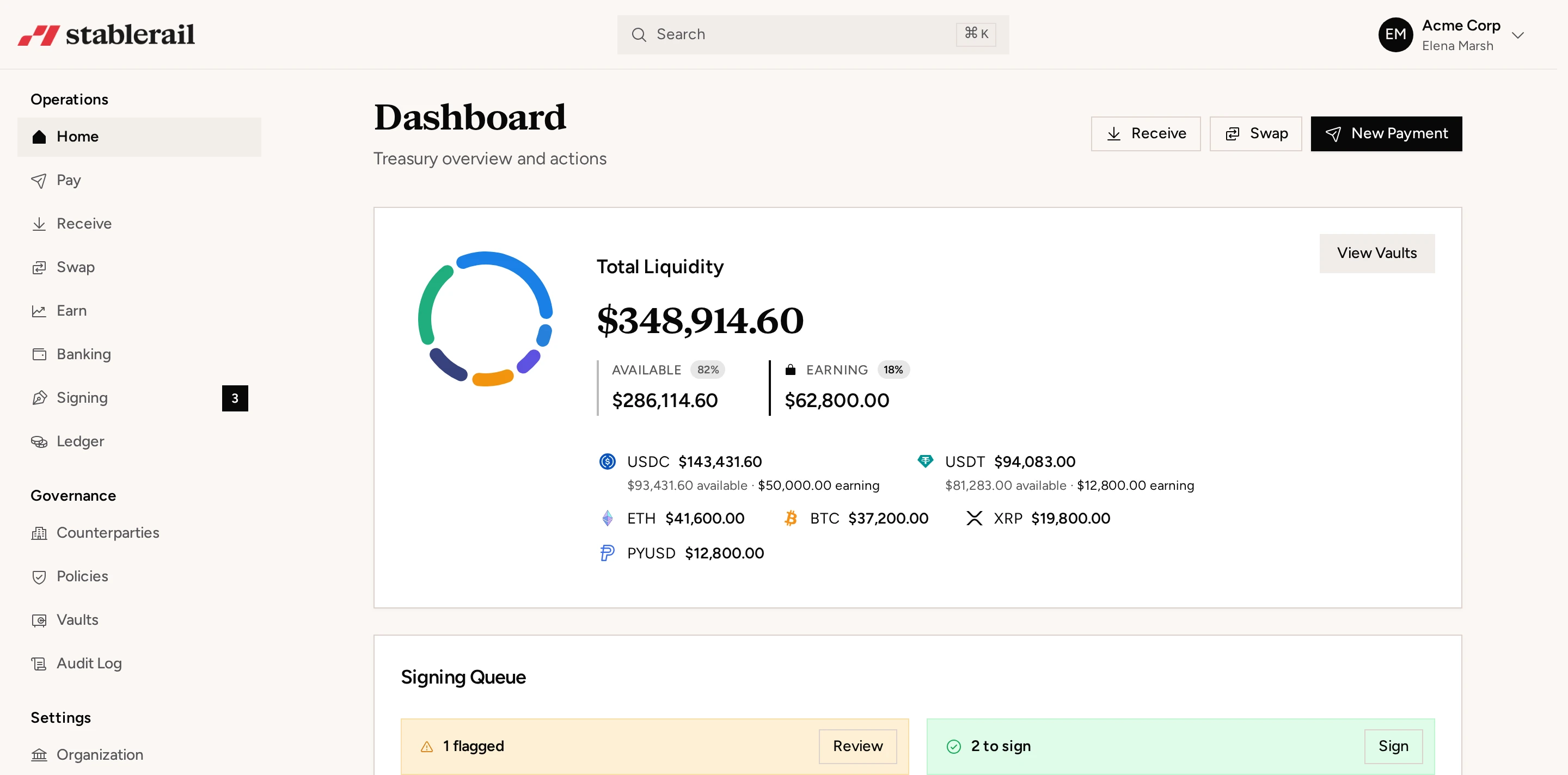
Stablerail is designed for companies managing their own USDC or USDT treasury funds. Its relevant finance controls include approvals and signing quorum, sanctions and address screening before send, fiat conversion, global payouts, corporate cards and exportable audit evidence.
Reporting and reconciliation requirements
A block explorer proves that a transaction was recorded on a network, but it does not normally explain its business purpose, invoice, department or approval history. Finance-ready reporting must join blockchain evidence to internal accounting context.
For every movement, retain the transaction and accounting dates, asset amount, fiat value under the company's accounting policy, origin and destination addresses, network, transaction hash, network fee, beneficiary, invoice or internal reference, creator and approvers. For conversions, also retain the fiat amount, conversion rate, provider fee and bank charges.
The ledger should distinguish the USDC principal from blockchain fees, conversion fees and any foreign-exchange differences. USDC is designed to track USD, but that does not automatically determine its accounting classification or carrying value. The finance team should document its treatment under the applicable accounting framework, particularly when the functional currency is not US dollars.
At month-end, reconcile opening balance, receipts, payments, conversions, fees and closing balance for each wallet, provider account, asset and network. Investigate transactions that appear on-chain but not in the ledger, internal transfers counted as expenses, unposted network fees and timing differences between blockchain settlement and the accounting date.
A useful evidence pack connects the general ledger entry to the payment request, beneficiary details, approval history, screening result, conversion record and blockchain transaction hash.
Practical launch checklist
- Confirm jurisdiction, industry, currency and network eligibility.
- Document custody, signing authority, recovery and user offboarding.
- Assign administrators, payment creators, approvers and reviewers.
- Approve exact USDC token and network combinations.
- Set beneficiary-verification, approval and pre-send screening procedures.
- Test fiat funding, conversion, external transfer and redemption with small amounts.
- Map transaction exports and fees to the chart of accounts.
- Complete a trial month-end reconciliation before increasing transaction volume.
- Record escalation steps for rejected, delayed or misdirected payments.
The right USDC business account makes stablecoin activity understandable and reviewable by finance, accounting and audit teams. Selection should turn on custody clarity, supported routes, approval design, conversion mechanics and complete transaction evidence—not merely the ability to generate a wallet address.
Frequently asked questions
Can a business open a USDC account?
Yes, subject to the provider's jurisdiction, industry and onboarding requirements. The company will typically complete KYB checks and provide ownership, director, business activity and source-of-funds information before activation.
Is a USDC business account the same as a bank account?
No. USDC is a blockchain-based digital asset, while a bank account records a deposit claim against a bank. Some platforms connect USDC wallets with fiat balances and payment rails, but the legal terms, safeguards and service providers can differ.
What controls should a company use for USDC payments?
Use separate administrator, creator and approver roles, with multi-person approval for material transfers. Verify wallet addresses and networks independently, screen addresses before sending, control beneficiary changes and retain an audit trail for every transaction.
How should USDC transactions be reconciled?
Reconcile each wallet, account, asset and network from opening to closing balance. Match blockchain hashes to internal references and record USDC principal, network fees, conversion charges, fiat values and approval evidence separately.
Can USDC be sent on any blockchain network?
No. The sender, recipient and service providers must support the same blockchain and the same USDC token version. Confirm the network and contract or mint address before sending because transfers to unsupported routes may be difficult or impossible to recover.
Finance writers covering stablecoin treasury, payments, compliance, and risk controls.
More about the Stablerail team- Stablecoin treasury managementApprovals, limits, yield and reporting on one balance.
- Stablecoin payoutsBatch contractor and vendor payments with screening.
- USDT vs USDCWhich stablecoin your company should settle in.
- Stablecoin finance glossaryMPC, off-ramp, travel rule and the rest, in plain English.
- Product updatesEverything we ship, month by month.