
Brale Alternatives: A Finance Team’s Guide to Corporate Stablecoin Infrastructure
A neutral framework for comparing Brale alternatives across corporate accounts, stablecoins, chains, fiat rails, custody, conversion, payouts, APIs, controls and geographic eligibility.

Companies reviewing Brale alternatives should start with the operating workflow, not a list of vendor features. The right provider depends on where money originates, which stablecoin and network counterparties require, how funds are held, and where fiat must ultimately arrive.
This is especially important because “stablecoin infrastructure” can describe several different products: a corporate treasury account, a stablecoin issuance API, an exchange, a self-custody wallet, or a payout service. These products can overlap, but they are not interchangeable.
Brale’s services and availability may change over time, so confirm its current capabilities directly. The framework below is designed to help finance teams compare any shortlist consistently, including Stablerail and other providers.
Define the workflow before comparing providers
Document one or two representative money flows. For example:
- Receive USD by Fedwire, convert it to USDC, and pay contractors on Base.
- Receive USDT on Tron, convert it to EUR, and send suppliers SEPA payments.
- Hold USDC in a corporate treasury, fund employee cards, and keep a portion available for same-day redemptions.
- Collect stablecoin invoices from customers and reconcile each payment against an invoice or payment link.
For each flow, record the expected monthly volume, transaction count, currencies, countries, legal entities, stablecoins and blockchain networks. A provider that works well for USDC on Ethereum may not support USDT on Tron or fiat settlement to the countries you need.
Comparison framework for Brale alternatives
| Area | Questions to ask | Why it matters |
|---|---|---|
| Corporate accounts | Are fiat accounts held in the company’s name? Are virtual IBANs or named account details available? Which currencies can remain as balances? | Account ownership affects reconciliation, counterparty instructions and the evidence available to auditors. |
| Stablecoins and chains | Are USDC and USDT supported on the exact networks required? How are unsupported deposits handled? | USDC on Ethereum and USDC on Base are operationally different assets. Sending to the wrong network can delay or permanently lose funds. |
| Fiat payment rails | Does the provider support ACH, Fedwire, SEPA, SEPA Instant, SWIFT, Faster Payments, CHAPS or BACS? What are the cut-off times? | “USD support” does not necessarily include both ACH and wires. Each rail has different timing, cost and recall characteristics. |
| Conversion | Is pricing fixed, quoted or spread-based? Are network, provider and correspondent-bank fees separated? How long is a quote valid? | A narrow headline spread can still produce a higher total cost if withdrawal and network fees are added later. |
| Custody | Who controls the private keys? Is the model custodial, self-custodial or based on multi-party computation? | The custody model determines how transactions are approved, how assets are recovered and what appears in the company’s risk register. |
| Payouts | Are batch payments, payroll, invoices, payment links and address allowlists supported? What are the batch and transaction limits? | A basic wallet transfer is not the same as an operational payout workflow with references, approvals and exportable records. |
| APIs | Which actions can be automated? Are webhooks idempotent and signed? Is there a sandbox, versioning policy and reconciliation export? | API coverage determines whether the provider can fit into an ERP, treasury management system or internal payment application. |
| Controls | Are there approval thresholds, quorum signing, role separation, wallet screening and immutable logs? | Finance teams need to prevent an individual user from creating and approving a material payment alone. |
| Eligibility | Which jurisdictions, entity types and industries are accepted? Are all products available to every approved entity? | Passing initial KYB does not guarantee access to every fiat rail, stablecoin, card or yield product. |
How the main provider models differ
Corporate stablecoin treasury platforms
Platforms in this category combine fiat accounts, stablecoin conversion, treasury storage and payments. They are generally the closest fit for a finance team managing its company’s own money rather than embedding stablecoins into a customer-facing product.
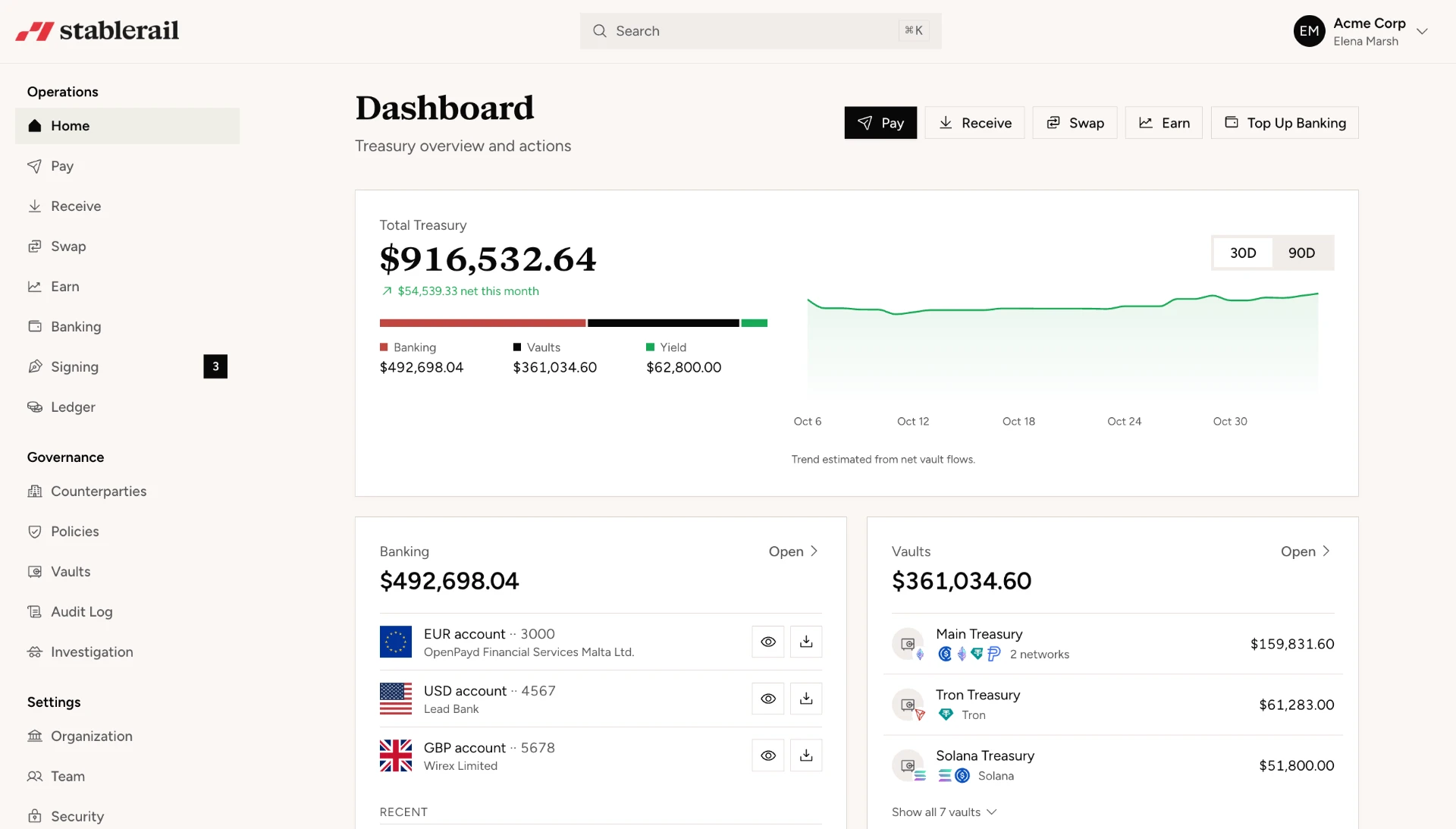
Stablerail fits this model. It supports corporate USDC and USDT treasury operations through self-custodial multi-party computation vaults. Multi-party computation, or MPC, distributes key control so that a complete private key is not held in one place. Quorum signing can require multiple authorised approvals before a transaction is released.
Its fiat connectivity includes SEPA and SEPA Instant for EUR; ACH and Fedwire for USD; SWIFT for cross-border transfers; and Faster Payments, CHAPS and BACS for GBP. Available account details can include virtual IBANs and multi-currency balances, subject to onboarding and eligibility.
Stablecoin transfers and payouts can operate across Ethereum, Base, Arbitrum, Polygon, Tron, BNB Chain, Optimism and Solana. Teams can use batch vendor or contractor payments, payroll, invoices and payment links. See the stablecoin payouts overview for the relevant workflow.
Before selecting Stablerail, confirm the specific legal entity that provides each fiat account, current corridor pricing, transaction limits, API coverage and product availability in your jurisdiction. Do not assume every rail or blockchain is available to every company.
Stablecoin and payment APIs
API-led providers can be a better fit when a company wants to embed wallets, conversion or payouts into its own product. Vendors commonly assessed in this broader market include Bridge, BVNK, Circle and Zero Hash. Their product scopes, licensing arrangements and regional availability differ, and not every vendor provides a full corporate treasury interface.
Evaluate these services at the endpoint level. Confirm whether an API can create beneficiaries, request quotes, execute conversions, send payouts and return final settlement status. Ask how duplicate requests are prevented and what happens when a blockchain transaction succeeds but the internal ledger update is delayed.
Exchanges and modular provider stacks
An exchange may offer deep liquidity and broad asset support, but treasury workflows can require separate banking, custody, screening and approval tools. A modular stack might combine a bank account, an exchange, an MPC wallet provider such as Fireblocks, and a payout processor.
This approach can provide flexibility, but finance teams must reconcile several ledgers and contracts. Calculate the operating cost of integrations, exception handling and month-end evidence—not only trading fees.
Compare total conversion and payment cost
Ask each provider for a worked quote using the same scenario. For example: receive €100,000 by SEPA, convert it to USDC, and send 20 Base payouts. The cost sheet should separate:
- Incoming fiat payment fees.
- Foreign-exchange costs, if currencies differ.
- Stablecoin conversion spread or fee.
- Blockchain network fees.
- Payout or withdrawal charges.
- Intermediary or correspondent-bank fees.
Also compare timing. SEPA Instant and Faster Payments can arrive within seconds when both institutions support the service, while standard ACH commonly takes one or more business days. Fedwire and CHAPS are typically same-day services before applicable cut-offs. SWIFT timing varies by route and intermediary banks. These are rail characteristics, not provider guarantees.
Stablerail publishes corridor pricing for supported on- and off-ramp routes. Finance teams should still check the live quote and included fees before approving a conversion.
Check custody, approvals and evidence
Custody should match the company’s operating model. A custodial provider controls asset movement under its account terms. A self-custodial model gives the company key authority but also creates responsibilities around signer access and recovery.
For material balances, test the complete approval process. Stablerail supports approval limits, quorum signing, beneficiary allowlists, sanctions and wallet screening, audit logs and evidence packs. Ask any provider to demonstrate these functions rather than relying on a checklist response.
Evidence should connect the original invoice or payroll file to approvals, conversion records, transaction hashes and final payment status. This reduces manual work during close and audit.
Confirm eligibility before committing integration work
Geographic coverage maps can be misleading because onboarding depends on the company’s incorporation, operating countries, beneficial owners and industry. KYB—Know Your Business—typically requires incorporation records, ownership details, director identification, business activity evidence and expected transaction volumes.
Request written confirmation covering the applicant entity, intended currencies, payment rails, stablecoins, networks and counterparties. If cards or yield are part of the plan, confirm them separately. Stablerail offers virtual and physical corporate cards with limits and merchant category controls, as well as an earn product for eligible idle balances. Liquidity terms and risks should be reviewed before treasury funds are allocated.
Use a scored pilot, not a feature count
A practical selection process is to score each provider against mandatory workflows, then run a low-value pilot. Test an inbound fiat transfer, conversion, stablecoin payout, failed or rejected payment, statement export and approval change.
The best Brale alternatives are not necessarily those with the longest feature list. For a corporate treasury, the stronger fit is the provider that supports the required payment rails and networks, makes total cost visible, provides an acceptable custody model, and produces records finance can reconcile without building a parallel operating system.
Finance writers covering stablecoin treasury, payments, compliance, and risk controls.
More about the Stablerail team- Stablecoin treasury managementApprovals, limits, yield and reporting on one balance.
- Stablecoin payoutsBatch contractor and vendor payments with screening.
- USDT vs USDCWhich stablecoin your company should settle in.
- Stablecoin finance glossaryMPC, off-ramp, travel rule and the rest, in plain English.
- Product updatesEverything we ship, month by month.