
BitGo vs Fireblocks: A Practical Institutional Comparison
Compare BitGo and Fireblocks across qualified custody, MPC wallets, policy controls, settlement, asset support, integrations, insurance and operational overhead.

BitGo and Fireblocks solve overlapping but different institutional problems. BitGo is commonly evaluated as a custody-led platform offering regulated custody, wallet infrastructure and trading or settlement services. Fireblocks is commonly evaluated as an infrastructure-led platform built around MPC wallets, transaction policy controls and connectivity between exchanges, custodians and counterparties.
The better option depends on whether the institution primarily needs a qualified custodian, technology for operating its own wallets, or an orchestration layer spanning several custodians and trading venues. Product availability, supported assets and regulated entities can vary by jurisdiction, so every comparison should be confirmed in the vendor’s current proposal and legal documentation.
BitGo vs Fireblocks at a glance
| Area | BitGo | Fireblocks |
|---|---|---|
| Typical starting point | Institutional custody and wallet services | Wallet and transfer infrastructure |
| Qualified custody | Available through relevant regulated BitGo trust entities, subject to jurisdiction and asset eligibility | Available through relevant Fireblocks custody entities or connected custody partners, depending on region and service structure |
| Wallet architecture | Supports multiple wallet models, including multisignature and MPC-based products | Primarily associated with MPC-based wallet infrastructure |
| Policy controls | User roles, approvals, allowlists and transaction policies | Granular policy engine covering users, assets, destinations and transaction thresholds |
| Settlement connectivity | Go Network and connections to supported venues and counterparties | Fireblocks Network and broad connectivity to venues, custodians and counterparties |
| Deployment emphasis | Custody-led services plus wallet and API infrastructure | Infrastructure deployment across self-managed and third-party custody arrangements |
| Pricing | Generally quote-based | Generally quote-based |
Neither vendor publishes a single price that captures the full cost of an institutional deployment. Quotes can include platform fees, custody charges, implementation work, transaction fees, network fees and optional services. Compare the complete annual cost against expected wallet counts, transaction volume, assets and connected venues.
Qualified custody: identify the contracting entity
“Qualified custody” is not a feature that automatically applies to every account or wallet. It depends on the contracting entity, governing jurisdiction, client type, asset and service agreement.
BitGo offers institutional custody through regulated trust entities in applicable markets. This can make it a natural candidate for institutions seeking a direct relationship with a custodian alongside wallets, settlement and related services.
Fireblocks began as wallet infrastructure rather than a conventional custodian. It now provides custody through relevant regulated entities in some markets and also connects clients to third-party custodians. Institutions must distinguish between using Fireblocks technology to access a custodian and placing assets with a Fireblocks custody entity.
Before treating either arrangement as qualified custody, obtain:
- The full legal name and regulator of the entity holding the assets.
- A list of assets and networks covered by that arrangement.
- The account structure and treatment of client assets.
- Terms covering insolvency, subcustodians and asset recovery.
- Written confirmation from counsel that the arrangement meets the institution’s obligations.
MPC and wallet architecture
Multi-party computation, or MPC, divides the process of creating a blockchain signature among multiple components. No single device needs to hold a complete private key. MPC can reduce single-key risk, but the security outcome still depends on access controls, endpoint security, recovery procedures and policy design.
Fireblocks is strongly associated with MPC wallets. Its architecture is designed to combine distributed signing with secure execution environments and a configurable transaction policy engine. This is useful for institutions that need many wallets, automated transfers or connections to several venues.
BitGo has a longer history with institutional multisignature wallets, where multiple blockchain keys authorize a transaction, and it also supports MPC-based offerings. The available architecture depends on the chosen product, asset and custody model. A buyer should therefore avoid reducing the comparison to “multisig versus MPC” and instead map the exact wallet product proposed by each vendor.
For both platforms, test what happens when an employee leaves, an approver loses a device, a signing component becomes unavailable or the vendor experiences an outage. Recovery ceremonies and continuity procedures matter as much as the cryptography.
Policy controls and daily operations
Both platforms can support institutional controls such as role-based access, approval thresholds, destination allowlists and transaction limits. Fireblocks is often selected for its granular policy engine and ability to apply rules across connected wallets and venues. BitGo can combine transaction controls with its custody and wallet services, potentially reducing the number of vendors involved.
During a proof of concept, finance and security teams should configure real workflows rather than review screenshots. Test:
- A routine transfer below an approval threshold.
- A large transfer requiring additional signers.
- A first payment to a new wallet address.
- A rejected transaction involving an unsupported destination.
- An emergency policy change with appropriate segregation of duties.
- Export of transaction, approval and user-activity records for audit.
Settlement networks and asset support
BitGo’s Go Network and the Fireblocks Network are designed to connect institutions with participating exchanges, liquidity providers, custodians and other counterparties. Depending on the service and counterparty, these networks may reduce the need to send every movement directly over a public blockchain.
Coverage is more important than the headline number of connected institutions. Ask each vendor to identify which of your actual exchanges, banks, custodians and liquidity providers can use the required workflow in your jurisdiction.
Apply the same discipline to digital assets. “USDC supported” is incomplete without the network. USDC on Ethereum, Base, Arbitrum, Polygon, Optimism and Solana represents separate operational paths. USDT support must likewise be checked for each required network, including Ethereum or Tron. Confirm deposit, withdrawal, custody and policy support for every asset-network pair.
Integrations and deployment model
Both vendors provide APIs and institutional integrations, but implementation effort depends on the operating model. Review sandbox availability, webhook reliability, address creation, transaction status handling, reconciliation exports and integrations with identity or security systems.
Fireblocks can suit an institution building a connected operating layer across multiple exchanges and custodians. That flexibility may require more internal ownership of policy configuration, integration monitoring and incident response.
BitGo can suit teams that prefer custody and wallet operations within a more consolidated vendor relationship. Institutions using separate custodians or highly customized execution stacks should still test whether its integration model covers all required counterparties.
Insurance is not a substitute for controls
Digital-asset insurance terms can change and may differ by custody product, wallet type and jurisdiction. Do not compare vendors using a headline coverage figure alone.
Request the policy summary and examine:
- Whether coverage is aggregate or allocated per client.
- Which regulated entity, wallets and assets are insured.
- Whether hot, warm and cold wallets receive different treatment.
- Exclusions for compromised credentials, employee actions or client-controlled systems.
- Deductibles, claim procedures and the insurer’s role.
Insurance may reduce the impact of specific covered events. It does not eliminate market losses, smart-contract failures, incorrect transfers or every form of cyber incident.
Which platform fits which institution?
BitGo may be the stronger shortlist candidate when the priority is a direct institutional custody relationship, established custody operations and wallet or settlement services from one provider.
Fireblocks may be the stronger shortlist candidate when the priority is MPC wallet infrastructure, granular transaction policy and connectivity across multiple custodians, exchanges and counterparties.
Either may fit a bank, asset manager, trading firm or corporate treasury, but the deployment model can differ substantially. Some institutions also use both categories: a qualified custodian holds long-term assets while an MPC wallet layer supports controlled operational transfers.
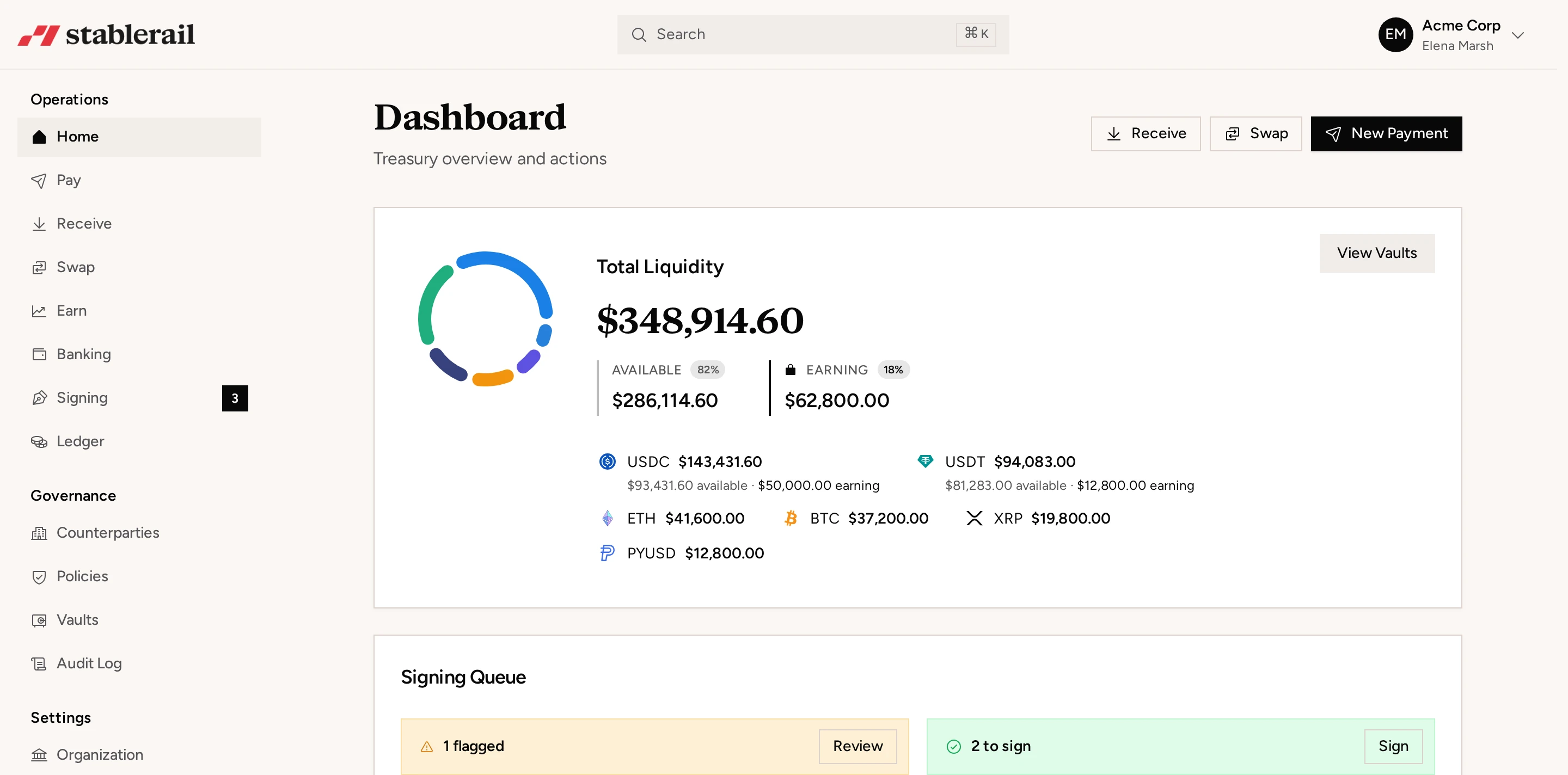
For companies focused specifically on holding and moving stablecoins rather than building general-purpose institutional infrastructure, a corporate treasury platform may reduce implementation work. Stablerail provides self-custodial MPC vaults with quorum signing, fiat rails and operational workflows for USDC and USDT. Finance teams can review the USDC business account and stablecoin payout capabilities as part of that comparison.
Final evaluation checklist
- Confirm the contracting and custody entities for every jurisdiction.
- Map each required asset to its exact blockchain network.
- Document whether assets are custodied, self-managed or held through a partner.
- Run recovery, employee departure and vendor outage exercises.
- Test approval policies using representative transaction values.
- Verify connectivity to every required exchange and counterparty.
- Compare total costs, including implementation and internal staffing.
- Review insurance wording rather than relying on marketing summaries.
There is no universal winner in BitGo versus Fireblocks. The practical decision is whether the institution wants custody-led consolidation or a flexible wallet and connectivity layer—and how much operational responsibility it is prepared to retain.
Finance writers covering stablecoin treasury, payments, compliance, and risk controls.
More about the Stablerail team- Stablecoin treasury managementApprovals, limits, yield and reporting on one balance.
- Stablecoin payoutsBatch contractor and vendor payments with screening.
- USDT vs USDCWhich stablecoin your company should settle in.
- Stablecoin finance glossaryMPC, off-ramp, travel rule and the rest, in plain English.
- Product updatesEverything we ship, month by month.