
Best Dashboards for Tracking Stablecoin Reserves and Attestations
The best stablecoin monitoring setup combines issuer reserve disclosures, independent supply dashboards and block explorers. Compare leading sources and build an evidence-based USDC and USDT review process.
The best dashboards for tracking stablecoin reserves are Circle’s official transparency reporting for USDC and Tether’s transparency reporting for USDT. Use DefiLlama or RWA.xyz to compare supply across issuers and networks, Dune for custom on-chain analysis, and block explorers for transaction verification. No dashboard proves everything: reserve reports cover off-chain assets at a measurement date, while on-chain tools track token activity more frequently.

The best dashboards for tracking stablecoin reserves are Circle’s official transparency reporting for USDC and Tether’s transparency reporting for USDT. Use DefiLlama or RWA.xyz to compare supply across issuers and networks, Dune for custom on-chain analysis, and block explorers for transaction verification. No dashboard proves everything: reserve reports cover off-chain assets at a measurement date, while on-chain tools track token activity more frequently.
Best stablecoin dashboards by monitoring task
Finance teams should use a monitoring stack rather than search for one all-purpose reserve screen. Issuer disclosures are the primary source for claims about backing assets. Independent dashboards help compare supply across issuers and chains. Block explorers provide transaction-level evidence but cannot verify bank deposits, Treasury holdings or other off-chain reserves.
| Source | Best for | Typical timing | Main limitation |
|---|---|---|---|
| Circle transparency reporting | USDC circulation, reserve composition and assurance reports | Circulation data and reserve disclosures can follow different schedules; assurance reports have generally been monthly | Does not provide live access to reserve bank or custody accounts |
| Tether transparency reporting | USDT assets, liabilities, reserve categories and tokens by network | Dashboard data may be newer than formal assurance reports, which have generally been quarterly | Reserve categories may be broader than a treasury team needs for liquidity analysis |
| DefiLlama Stablecoins | Comparing stablecoin supply by issuer and blockchain | Based on periodically indexed on-chain data | Tracks token supply, not the assets held in reserve |
| RWA.xyz | Market trends, issuer concentration and historical comparisons | Depends on indexed sources and methodology | Aggregated figures still require reconciliation to issuer disclosures |
| Dune | Custom analysis of mints, burns, transfers, holders and networks | Varies by blockchain, query and dashboard refresh | Community dashboards may omit contracts or use incorrect assumptions |
| Block explorers | Confirming transfers, token contracts and on-chain mint or burn events | After network confirmation and explorer indexing | Cannot prove off-chain reserves or the business purpose of a transaction |
Update schedules, report providers and methodologies can change. Before relying on any source, check its reporting period, last refresh time and methodology rather than assuming the newest-looking figure is current.
Why reserve and supply data must be separated
A stablecoin dashboard may place current token circulation beside reserve information measured weeks earlier. That presentation does not make the reserve figure real time. Finance teams should capture three dates for every review:
- Dashboard date: when the displayed figure was last refreshed.
- Measurement date: the date on which assets, liabilities or circulating tokens were measured.
- Publication date: when the issuer or accounting firm released the report.
These dates are not interchangeable. An assurance report published in April may cover balances as of March 31. It provides evidence about March 31, subject to the report’s scope, rather than continuous confirmation throughout April.
This also creates a denominator problem. A reserve value from one date should not be divided by token supply from a later date and presented as a current reserve coverage ratio. Either align both figures to the same measurement date or clearly label the comparison as an approximation with mismatched periods.
1. Circle transparency reporting for USDC
Circle’s official reporting is the starting point for USDC reserve analysis. It presents information about USDC in circulation, the assets held in reserve, issuance and redemption activity, and assurance reports from an independent accounting firm.
For treasury analysis, review both the reserve composition and the report itself. Note which assets are held as cash, short-dated government obligations or interests in a government money market fund, as applicable to the reporting period. Then record the named entity, USDC liabilities, measurement date, engagement standard and any exclusions in the assurance report.
Circle’s disclosures can help a finance team assess the reserve’s stated composition and liquidity profile. They are not a live view into bank statements or securities custody systems. A company holding USDC should therefore maintain issuer exposure limits and avoid treating frequent circulation updates as frequent independent verification of reserves.
2. Tether transparency reporting for USDT
Tether’s official transparency materials are the primary source for reported USDT assets, liabilities and reserve categories. Its reporting also provides network-level information, which matters because USDT operates across multiple blockchains and a company’s practical exposure includes the chain it uses.
Tether’s formal assurance reports have generally been quarterly, although teams should verify the current publication schedule. Read the measurement date, scope and subsequent-events language instead of treating the newest PDF as a current balance sheet. A dashboard can contain newer token figures without the reserve assets having been independently examined at the same frequency.
Record more than a binary “attested” status. Review:
- Reported assets relative to token-related liabilities at the measurement date.
- The mix of cash, cash equivalents, Treasury bills and other investments.
- Any secured loans, precious metals, digital assets or other less-liquid categories.
- Changes in USDT supply since the assurance measurement date.
- The networks on which the company holds and transfers USDT.
Also distinguish authorized tokens from circulating supply. Tokens held in an issuer-controlled treasury may be authorized for future issuance without being part of public circulation. Dashboard methodology determines how those balances are classified.
3. Independent stablecoin market dashboards
DefiLlama Stablecoins
DefiLlama is useful for comparing stablecoin supply across issuers and blockchains. It can show whether supply is concentrated on a particular chain, how USDC or USDT distribution is changing, and whether the broader stablecoin market is expanding or contracting.
Its value is primarily on-chain supply analysis, not reserve verification. Review how a dashboard treats native issuance, bridged assets and tokens locked in bridge contracts. Without consistent treatment, the same economic unit can appear on both its origin chain and destination chain.
RWA.xyz
RWA.xyz provides market-level comparisons, historical charts and issuer concentration data for stablecoins and tokenized real-world assets. It is useful for trend research and as a cross-check against other aggregators.
Aggregated data should not replace an issuer’s underlying disclosure. If the figures differ, document the timestamp, chain coverage, supply definition and treatment of bridged or non-circulating tokens before concluding that either source is wrong.
Dune
Dune allows analysts to query blockchain data for mints, burns, transfers, holders and contract activity. It is particularly useful when a treasury team needs a chain-specific view that an issuer dashboard does not provide.
Dashboard quality varies. Before using a result, check the author, token contracts, chain coverage, query logic and last execution time. A polished chart may still omit a major contract, use stale labels or count transfers as issuance.
4. Block explorers for transaction evidence
Explorers such as Etherscan, Basescan, Arbiscan, Tronscan and Solscan provide direct on-chain evidence. They can confirm whether a transaction settled, which token contract was used, how much was transferred and which addresses participated.
Explorers cannot independently prove the existence of reserve assets or establish why a mint or burn occurred. A burn may relate to redemption, chain migration, inventory management or another contract operation. Likewise, a transfer to an issuer-controlled address is not conclusive evidence that a customer received fiat.
Use block explorers for transaction facts, independent dashboards for market aggregation, and issuer disclosures for reserve claims.
Attestation is not the same as an audit
An attestation or assurance engagement evaluates specified information or management assertions under a defined standard. It commonly addresses balances at a particular date. A financial statement audit is broader and covers financial statements, related disclosures and additional audit procedures.
When reviewing a stablecoin assurance report, capture:
- The accounting firm and engagement standard.
- The legal entity and stablecoin covered.
- The exact measurement date and publication date.
- Whether assets, liabilities and token supply are all in scope.
- Any qualifications, exclusions or restricted-use language.
- The time elapsed between measurement and publication.
A dashboard label such as “fully backed” is not a substitute for reading the underlying report. The conclusion only means what the report’s scope, definitions and measurement date support.
A practical monitoring checklist for finance teams
- Daily: reconcile company USDC and USDT balances by wallet and network; review large transfers and failed or delayed settlements.
- Weekly: compare issuer supply figures with an independent aggregator and investigate material differences in timing or methodology.
- On publication: archive each reserve disclosure and assurance report with its URL, file, measurement date, publication date and reviewer.
- Monthly or quarterly: review reserve composition, liquidity, issuer concentration and compliance with approved exposure limits.
- Before a payment: verify the token contract, destination chain and recipient address; screen the destination before signing.
- Retain evidence: preserve approvals, transaction hashes, explorer records and the source data used for each treasury conclusion.
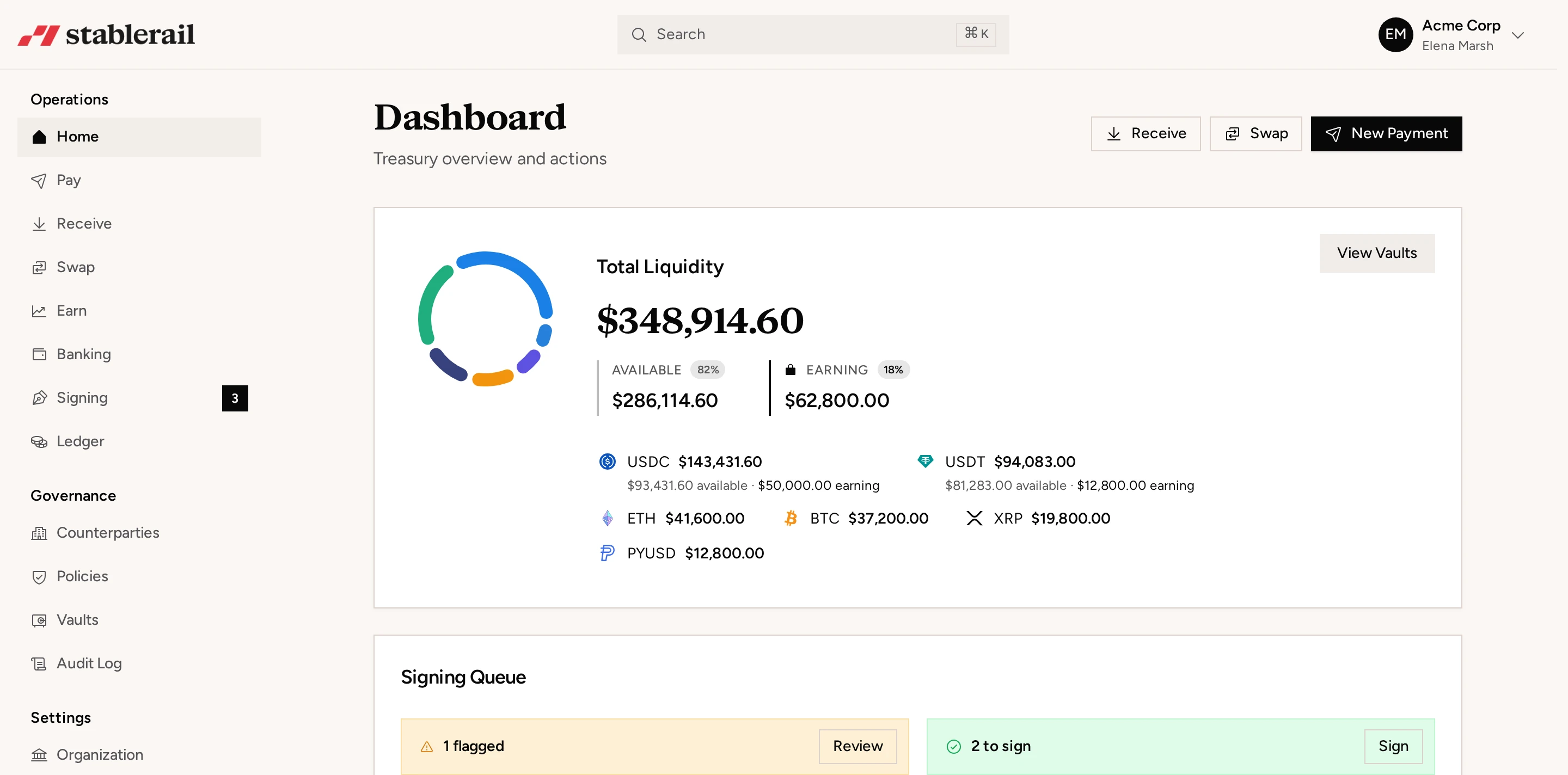
Stablerail can support this operational layer with signing quorum and approvals, sanctions and address screening before send, global payouts, fiat conversion and exportable audit evidence for a company’s own USDC or USDT. Those controls complement issuer due diligence; they do not turn on-chain monitoring into proof of reserves.
The best reserve dashboard is therefore a small, controlled evidence stack. Keeping reserve claims, market estimates and transaction facts separate prevents a fast-moving supply chart from being mistaken for real-time proof of backing.
Frequently asked questions
What is the best dashboard for checking USDC reserves?
Circle’s official transparency reporting is the primary source for USDC reserve composition, circulation data and assurance reports. Check the measurement date and publication date because circulation figures may be newer than the independently examined reserve balances.
Where can I check whether USDT is fully backed?
Start with Tether’s official transparency dashboard and its latest assurance report. Review reported assets, token-related liabilities, reserve categories, the measurement date and the report’s scope rather than relying only on a “fully backed” label.
Are stablecoin reserve dashboards updated in real time?
On-chain supply data can update frequently, but reserve assets are reported on a separate schedule. A dashboard that combines current supply with an older reserve disclosure does not provide real-time proof of backing.
Is a stablecoin attestation the same as an audit?
No. An attestation evaluates specified information or assertions under a defined engagement, often at one measurement date. A financial statement audit is broader and includes additional procedures and disclosures.
Can Etherscan or another block explorer prove stablecoin reserves?
No. A block explorer can verify transfers, token contracts, balances, mints and burns on its blockchain. It cannot verify cash, Treasury bills or other off-chain assets held in reserve, and it cannot always determine the business purpose of an on-chain event.
How often should a company monitor USDC and USDT reserves?
Monitor company balances and transactions daily, compare issuer and independent supply figures weekly, and review each reserve report when published. Reassess reserve composition, issuer concentration and internal exposure limits monthly or quarterly.
Finance writers covering stablecoin treasury, payments, compliance, and risk controls.
More about the Stablerail team- Stablecoin treasury managementApprovals, limits, yield and reporting on one balance.
- Stablecoin payoutsBatch contractor and vendor payments with screening.
- USDT vs USDCWhich stablecoin your company should settle in.
- Stablecoin finance glossaryMPC, off-ramp, travel rule and the rest, in plain English.
- Product updatesEverything we ship, month by month.