
Best Stablecoin Tools for Managing a Multi-Chain Treasury
The best multi-chain treasury stack combines secure payment execution, exact USDC and USDT network coverage, fiat rails and accounting-ready records. Use this framework to compare business accounts, MPC wallets, multisigs, exchanges and
The best stablecoin tool for a multi-chain treasury is the one that covers the exact USDC and USDT contracts you use while enforcing approval controls, supporting fiat conversion and producing accounting-ready records. Many finance teams need a business stablecoin account or controlled wallet for execution, specialist accounting software for reconciliation and, where necessary, an exchange or liquidity provider for conversions.
%22%20x1%3D%220%22%20y1%3D%220%22%20x2%3D%221%22%20y2%3D%221%22%3E%0A%20%20%20%20%20%20%20%20%3Cstop%20offset%3D%220%25%22%20stop-color%3D%22%23360A0E%22%20%2F%3E%0A%20%20%20%20%20%20%20%20%3Cstop%20offset%3D%2250%25%22%20stop-color%3D%22%23551217%22%20%2F%3E%0A%20%20%20%20%20%20%20%20%3Cstop%20offset%3D%22100%25%22%20stop-color%3D%22%237A1D20%22%20%2F%3E%0A%20%20%20%20%20%20%3C%2FlinearGradient%3E%0A%20%20%20%20%20%20%3CradialGradient%20id%3D%22glow%22%20cx%3D%22343%22%20cy%3D%22-66%22%20r%3D%22520%22%20gradientUnits%3D%22userSpaceOnUse%22%3E%0A%20%20%20%20%20%20%20%20%3Cstop%20offset%3D%220%25%22%20stop-color%3D%22%23FFA587%22%20stop-opacity%3D%220.45%22%20%2F%3E%0A%20%20%20%20%20%20%20%20%3Cstop%20offset%3D%2255%25%22%20stop-color%3D%22%23FFA587%22%20stop-opacity%3D%220.08%22%20%2F%3E%0A%20%20%20%20%20%20%20%20%3Cstop%20offset%3D%22100%25%22%20stop-color%3D%22%23FFA587%22%20stop-opacity%3D%220%22%20%2F%3E%0A%20%20%20%20%20%20%3C%2FradialGradient%3E%0A%20%20%20%20%20%20%3ClinearGradient%20id%3D%22glass%22%20x1%3D%220%22%20y1%3D%220%22%20x2%3D%221%22%20y2%3D%221%22%3E%0A%20%20%20%20%20%20%20%20%3Cstop%20offset%3D%220%25%22%20stop-color%3D%22%23F8D6D2%22%20stop-opacity%3D%220.26%22%20%2F%3E%0A%20%20%20%20%20%20%20%20%3Cstop%20offset%3D%22100%25%22%20stop-color%3D%22%23FFFFFF%22%20stop-opacity%3D%220.08%22%20%2F%3E%0A%20%20%20%20%20%20%3C%2FlinearGradient%3E%0A%20%20%20%20%20%20%3ClinearGradient%20id%3D%22accent%22%20x1%3D%220%22%20y1%3D%220%22%20x2%3D%221%22%20y2%3D%221%22%3E%0A%20%20%20%20%20%20%20%20%3Cstop%20offset%3D%220%25%22%20stop-color%3D%22%23FFA587%22%20%2F%3E%0A%20%20%20%20%20%20%20%20%3Cstop%20offset%3D%22100%25%22%20stop-color%3D%22%23DC4A38%22%20%2F%3E%0A%20%20%20%20%20%20%3C%2FlinearGradient%3E%0A%20%20%20%20%20%20%3Cfilter%20id%3D%22soft%22%3E%3CfeGaussianBlur%20stdDeviation%3D%2210%22%20%2F%3E%3C%2Ffilter%3E%0A%20%20%20%20%3C%2Fdefs%3E%0A%20%20%20%20%3Crect%20width%3D%221600%22%20height%3D%22900%22%20fill%3D%22url(%23bg)%22%20%2F%3E%0A%20%20%20%20%3Crect%20width%3D%221600%22%20height%3D%22900%22%20fill%3D%22url(%23glow)%22%20%2F%3E%0A%20%20%20%20%3Ccircle%20cx%3D%22800%22%20cy%3D%22450%22%20r%3D%22280%22%20fill%3D%22url(%23glass)%22%20stroke%3D%22%23F4CDC5%22%20stroke-opacity%3D%220.45%22%2F%3E%3Cellipse%20cx%3D%22800%22%20cy%3D%22450%22%20rx%3D%22280%22%20ry%3D%22280%22%20fill%3D%22none%22%20stroke%3D%22%23F4CDC5%22%20stroke-opacity%3D%220.35%22%2F%3E%3Cellipse%20cx%3D%22800%22%20cy%3D%22450%22%20rx%3D%22224%22%20ry%3D%22280%22%20fill%3D%22none%22%20stroke%3D%22%23F4CDC5%22%20stroke-opacity%3D%220.35%22%2F%3E%3Cellipse%20cx%3D%22800%22%20cy%3D%22450%22%20rx%3D%22168%22%20ry%3D%22280%22%20fill%3D%22none%22%20stroke%3D%22%23F4CDC5%22%20stroke-opacity%3D%220.35%22%2F%3E%3Cellipse%20cx%3D%22800%22%20cy%3D%22450%22%20rx%3D%22112%22%20ry%3D%22280%22%20fill%3D%22none%22%20stroke%3D%22%23F4CDC5%22%20stroke-opacity%3D%220.35%22%2F%3E%3Cellipse%20cx%3D%22800%22%20cy%3D%22450%22%20rx%3D%2256%22%20ry%3D%22280%22%20fill%3D%22none%22%20stroke%3D%22%23F4CDC5%22%20stroke-opacity%3D%220.35%22%2F%3E%3Cellipse%20cx%3D%22800%22%20cy%3D%22240%22%20rx%3D%22107.15136106222515%22%20ry%3D%2214%22%20fill%3D%22none%22%20stroke%3D%22%23F4CDC5%22%20stroke-opacity%3D%220.3%22%2F%3E%3Cellipse%20cx%3D%22800%22%20cy%3D%22380%22%20rx%3D%22258.68626910316027%22%20ry%3D%2214%22%20fill%3D%22none%22%20stroke%3D%22%23F4CDC5%22%20stroke-opacity%3D%220.3%22%2F%3E%3Cellipse%20cx%3D%22800%22%20cy%3D%22520%22%20rx%3D%22258.68626910316027%22%20ry%3D%2214%22%20fill%3D%22none%22%20stroke%3D%22%23F4CDC5%22%20stroke-opacity%3D%220.3%22%2F%3E%3Cellipse%20cx%3D%22800%22%20cy%3D%22660%22%20rx%3D%22107.15136106222515%22%20ry%3D%2214%22%20fill%3D%22none%22%20stroke%3D%22%23F4CDC5%22%20stroke-opacity%3D%220.3%22%2F%3E%3Cpath%20d%3D%22M%20550%20530%20Q%20800%20250%201050%20410%22%20fill%3D%22none%22%20stroke%3D%22url(%23accent)%22%20stroke-width%3D%228%22%20stroke-dasharray%3D%2214%2012%22%2F%3E%3Ccircle%20cx%3D%22680%22%20cy%3D%22490%22%20r%3D%2214%22%20fill%3D%22url(%23accent)%22%2F%3E%3Ccircle%20cx%3D%22980%22%20cy%3D%22330%22%20r%3D%2214%22%20fill%3D%22url(%23accent)%22%2F%3E%0A%20%20%20%20%3Crect%20x%3D%2226%22%20y%3D%2226%22%20width%3D%221548%22%20height%3D%22848%22%20rx%3D%2218%22%20fill%3D%22none%22%20stroke%3D%22%23F2D0C8%22%20stroke-opacity%3D%220.12%22%2F%3E%0A%20%20%3C%2Fsvg%3E)
Managing a multi-chain treasury requires more than choosing a wallet with a long list of supported networks. Finance teams need to receive and hold the correct versions of USDC and USDT, control who can release payments, fund network fees, convert assets, reach bank accounts and reconcile every movement to a business purpose.
The best setup may be one integrated business account or a connected stack of specialist tools. The right choice depends on actual payment routes, approval requirements, transaction volume, fiat currencies and the accounting evidence required at month-end.
Start with treasury workflows, not product features
Map how funds enter, move through and leave the company before comparing providers. A useful map identifies each token, blockchain, sending wallet, destination, approver, conversion step and accounting record.
- Hold: Maintain USDC and USDT on the networks used by customers, vendors and trading partners.
- Move: Send individual or batch payments to the correct address and network, with sufficient native tokens available for gas where required.
- Convert: Swap between stablecoins, change networks or convert into fiat without losing the relationship between the original funds and final payment.
- Control: Separate payment creation from approval and require the appropriate signing quorum.
- Reconcile: Connect transaction hashes, fees, counterparties, invoices and ledger entries.
A specialist product can perform one of these jobs well. The operational risk appears at the handoffs: copying an address from one system to another, downloading incomplete files, approving a conversion outside the normal process or reconstructing a bridge transaction after month-end.
Compare the main types of stablecoin treasury tools
| Tool type | Best suited to | Main strengths | Typical gaps to test |
|---|---|---|---|
| Business stablecoin account | Finance teams combining stablecoins, fiat and payments | Wallet operations, approvals, payouts, off-ramp and reporting in one workflow | Token, chain, corridor, jurisdiction and industry eligibility |
| MPC wallet platform | Companies needing controlled wallets or API-based execution | Distributed signing, role controls and broad asset support | Fiat rails, beneficiary workflows and accounting may require integrations |
| Smart-contract multisig | On-chain teams operating on compatible networks | Transparent approvals and configurable signer thresholds | Chain coverage, gas management, fiat access and usability for finance staff |
| Centralised exchange | Treasuries requiring trading liquidity or asset conversion | Order books, stablecoin conversion and selected bank withdrawals | Custodial exposure, account restrictions and payment-level reconciliation |
| Crypto accounting platform | Controllers handling classification and period-end close | Wallet imports, fee capture, transaction matching and ledger exports | Usually cannot hold funds, approve payments or execute transfers |
For many companies, the practical structure is a business account or controlled wallet for execution, connected to accounting software for reconciliation. An exchange may provide liquidity, but it does not automatically make a good operating treasury: trading records often lack invoice references, beneficiary context and payment approvals.
Prioritise wallet controls over raw chain count
A provider supporting many networks is not useful if one employee can release a material transfer without review. Test controls with realistic scenarios: a recurring vendor batch, an urgent refund, a first payment to a new wallet and a transfer to an exchange deposit address.
- Quorum signing: A specified number of authorised people must approve a transaction, such as two of three signers.
- Role separation: The person creating a payment should not be its only approver.
- Approval thresholds: Larger payments should receive additional review where the product supports tiered approvals.
- Address controls: New or changed wallet addresses should receive more scrutiny than established destinations.
- Pre-send screening: Destination addresses should be checked for sanctions exposure before funds leave.
- Audit history: Records should show who created, reviewed, approved, rejected and signed each payment.
Also document how signers are added or removed, what happens when an approver is unavailable and how access is revoked after an employee leaves. Do not treat an informal chat approval as a substitute for evidence recorded in the transaction workflow.
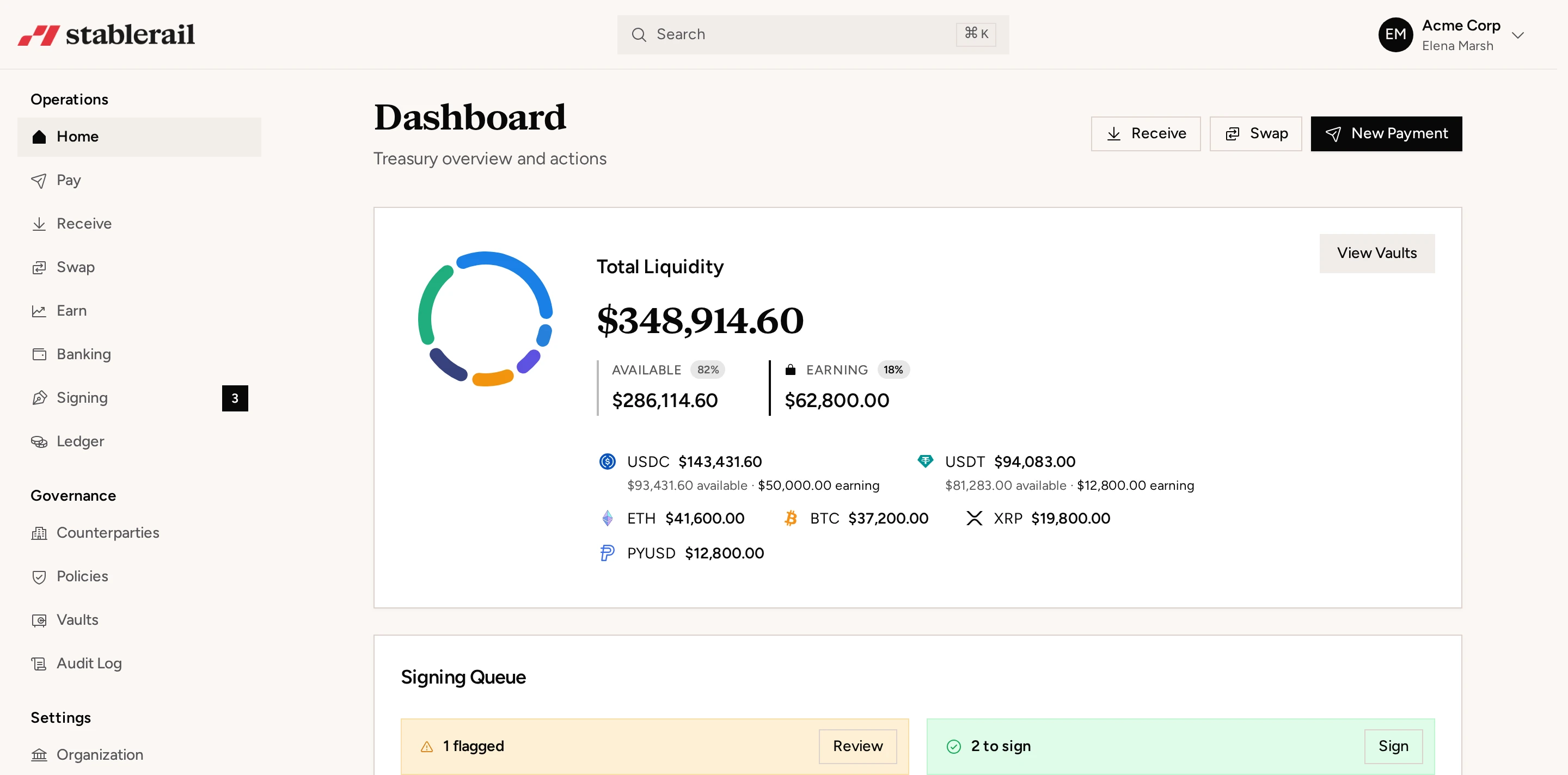
Stablerail provides one business account for USDC and USDT treasury, with approvals and signing quorum, sanctions and address screening before send, global payouts, fiat off-ramp, corporate cards and exportable audit evidence. Finance teams should still verify that their required networks, currencies and counterparties are eligible before changing workflows.
Verify the exact token contract on every network
“Supports USDC” or “supports USDT” is not precise enough. Record the blockchain, token contract and whether the asset is native to that network or bridged by a third party. Assets with the same ticker can have different issuers, contract addresses, liquidity and platform support.
| Coverage question | Why it matters | Evidence to request |
|---|---|---|
| Which token contract is accepted? | An unsupported version may not be credited automatically | Contract address and deposit documentation |
| Are deposit and withdrawal networks identical? | A provider may accept a deposit but not permit withdrawal on that chain | Network-by-network deposit and withdrawal matrix |
| Are batch payouts supported? | Manual entry increases effort and address-selection risk | Sample batch workflow and resulting export |
| How are gas fees funded? | A stablecoin balance alone may not pay the blockchain fee | Fee currency, funding method and transaction record |
| What happens during a chain pause? | Maintenance or congestion can delay urgent payments | Status process and available alternative route |
Coverage should follow counterparties rather than market fashion. USDT recipients may prefer different networks from USDC recipients. Supporting Ethereum, Base, Arbitrum, Polygon, Tron, BNB Chain, Optimism or Solana only matters when the tool supports the required token contract and the receiving party can use that same route.
Calculate the total cost of a complete route
Do not compare tools using a single transfer fee. The total cost can include blockchain gas, platform charges, trading spread, withdrawal fees, bridge costs and fiat off-ramp fees. Minimum charges can make a route economical for large transfers but expensive for small payouts.
Ask each provider to quote representative workflows. One useful example is receiving USDT on the network used by a customer, converting it to USDC or fiat, and paying a EUR supplier through SEPA. Record both the amount sent and the amount received at each step.
- Capture the stablecoin amount and network fee at receipt.
- Record any transfer needed to reach the conversion venue.
- Compare the quoted exchange rate with the completed rate and amount.
- Add platform, withdrawal, bridge and off-ramp charges.
- Confirm the final fiat amount credited to the beneficiary.
Price is only one part of route quality. A bridge introduces smart-contract and operational dependencies. An exchange deposit adds an external account and may require confirmations before trading. A fiat conversion can be delayed by compliance review or banking cut-off times. Compare the cost, expected timing, control evidence and failure process together.
Test fiat off-ramps end to end
A displayed fiat balance is not the same as usable bank access. Confirm how converted funds can leave the platform, which beneficiary types are accepted and what references appear on bank statements.
Relevant rails may include SEPA or SEPA Instant for EUR, ACH or Fedwire for USD, SWIFT for cross-border transfers, and Faster Payments, CHAPS or BACS for GBP. Availability and timing depend on the provider, currency, beneficiary bank, cut-off time and compliance review, so avoid treating a rail name as a guaranteed settlement time.
Run a controlled test from stablecoin deposit through conversion, beneficiary payment and statement export. Include a rejected or amended payment scenario in the review: the team needs to know where returned funds appear, how fees are recorded and whether the original invoice reference survives.
Make reconciliation a buying requirement
A blockchain explorer proves that a transaction occurred, but not why it occurred or who approved it. Accounting-ready data should include the network, token, contract where relevant, amount, transaction hash, timestamp, fee, source, destination, internal reference and status.
Test how exports represent failed transactions, gas fees, internal wallet transfers, swaps, bridges and fiat conversions. A conversion may create several records, but the export should preserve a link between the original asset, fees and resulting balance. Consistent identifiers are essential for mapping records to invoices, vendors and general-ledger entries.
Exportable audit evidence should also retain approvals, signing activity and screening results. That is more reliable than rebuilding a payment history from chat messages, spreadsheets and blockchain explorers during an audit.
Use a controlled selection and rollout process
- List every required token, contract, network, destination currency and payment rail.
- Confirm deposit and withdrawal support separately for each route.
- Test quorum signing, role separation, new-address review and signer removal.
- Price at least three real workflows using total delivered cost.
- Complete a stablecoin-to-bank test, including the accounting export.
- Reconcile a sample month containing transfers, fees, swaps and failed payments.
- Confirm KYB, jurisdiction, industry and counterparty eligibility before migration.
- Send a small-value test on every required network before moving treasury balances.
The best stablecoin tools reduce handoffs without hiding operational detail. For a multi-chain treasury, the winning setup is the one that combines exact token coverage, enforceable controls, transparent conversion routes and records the controller can close without manually reconstructing the story.
Frequently asked questions
What is the best wallet for a multi-chain stablecoin treasury?
There is no single best wallet for every treasury. Choose based on exact USDC and USDT contract support, signing and approval controls, fiat access, transaction exports and the ability to reconcile payments to invoices—not the number of advertised chains.
Should a company use an exchange as its main stablecoin treasury account?
An exchange can be useful for liquidity and conversion, but it may be a poor system for everyday treasury operations. Finance teams should assess custodial exposure, withdrawal controls, account restrictions and whether transaction records preserve beneficiary, approval and invoice details.
How should finance teams compare stablecoin transaction costs?
Compare the total delivered cost of a complete route, including blockchain fees, platform charges, trading spread, withdrawal fees, bridge costs and fiat off-ramp fees. Use representative transactions and compare the expected amount with what the beneficiary actually receives.
What data is needed to reconcile USDC and USDT transactions?
At minimum, retain the network, token, amount, transaction hash, timestamp, fee, source wallet, destination wallet, status and internal reference. Approval records, screening results and links between swaps, bridge movements and fiat conversions make period-end review and audit support substantially easier.
What is the difference between native and bridged USDC?
Native USDC is issued directly for a supported blockchain, while bridged USDC is moved or represented through bridge infrastructure. They may use different contracts and have different platform support, liquidity and operational risks, so finance teams must verify the exact contract before transferring funds.
Finance writers covering stablecoin treasury, payments, compliance, and risk controls.
More about the Stablerail team- Stablecoin treasury managementApprovals, limits, yield and reporting on one balance.
- Stablecoin payoutsBatch contractor and vendor payments with screening.
- USDT vs USDCWhich stablecoin your company should settle in.
- Stablecoin finance glossaryMPC, off-ramp, travel rule and the rest, in plain English.
- Product updatesEverything we ship, month by month.