
Best Crypto Cards for Companies in 2026: Features, Fees and Controls to Compare
A practical guide to comparing corporate crypto cards in 2026, including stablecoin funding, fees, limits, employee controls, accounting exports and geographic coverage.

The best crypto cards for a company are not necessarily the cards with the highest retail rewards. Finance teams need reliable treasury funding, clear fees, employee-level controls, usable accounting data and coverage in the countries where staff operate.
This guide focuses on corporate cards funded from a stablecoin treasury, rather than personal cards linked to an exchange account. It explains what to compare in 2026 and which questions to put to each provider before committing company funds.
How corporate crypto cards work
A corporate crypto card connects card spending to a treasury that holds assets such as USDC or USDT. When an employee pays a merchant, the card programme authorises the transaction and deducts or reserves the corresponding amount from the company balance.
The exact conversion point varies. Some providers convert stablecoins into fiat before funds reach the card balance. Others convert at authorisation or settlement. Card authorisation usually happens in seconds, but final settlement and the amount posted to the ledger may change when tips, deposits, offline transactions or foreign exchange are involved.
Before selecting a card, confirm:
- Whether cards spend directly from a shared treasury or require prefunding of a separate card wallet.
- Which assets can fund cards, including USDC, USDT, EUR, USD and GBP.
- Which exchange rate applies and when it is fixed.
- Whether unused card funds remain available to the main treasury.
- Who holds the assets while they are waiting to be spent.
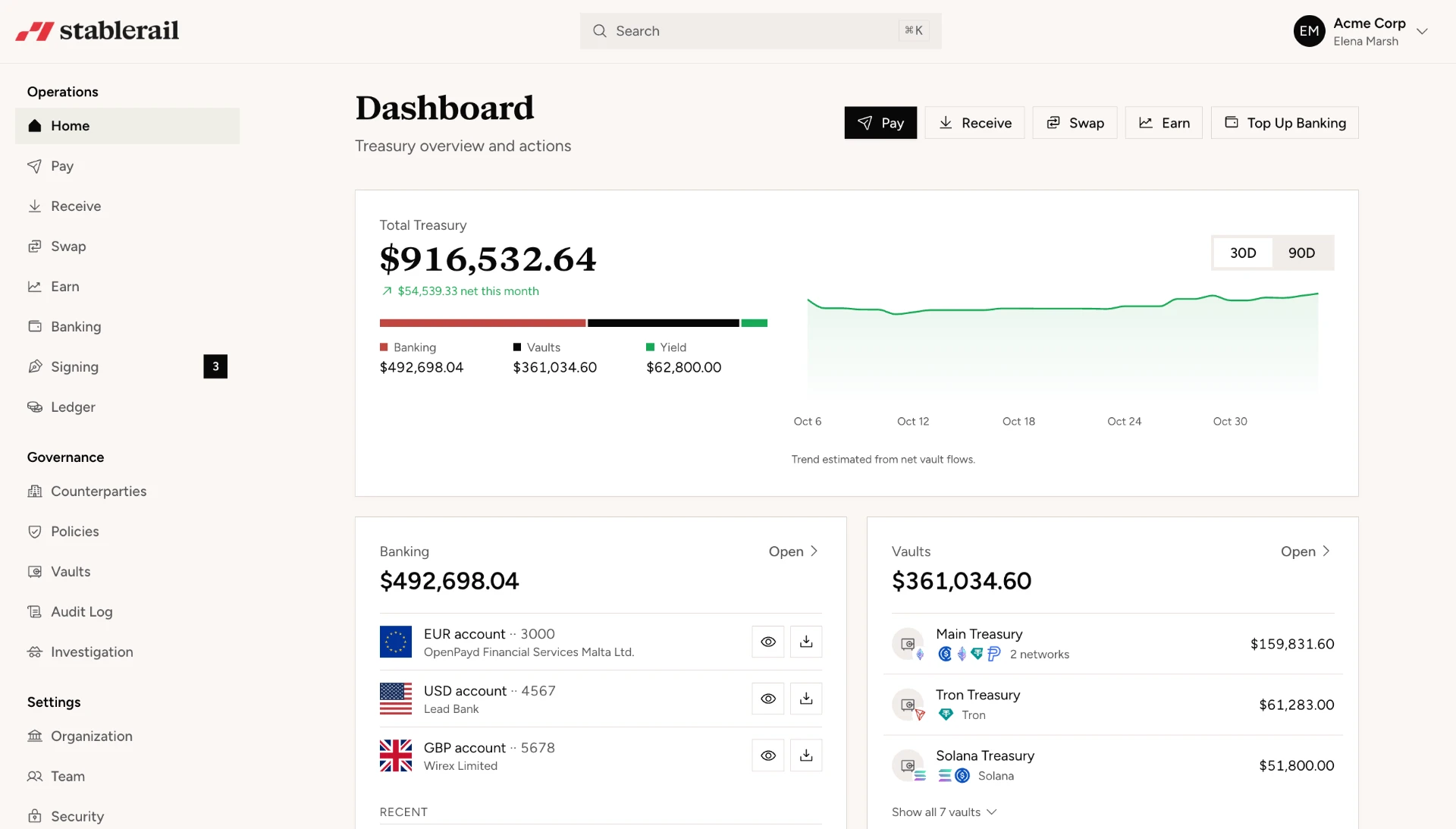
Stablerail provides virtual and physical corporate cards funded from the company treasury balance, with spending limits and merchant category code controls. Companies holding USDC or USDT can manage cards alongside fiat accounts, stablecoin conversions and treasury approvals.
Corporate cards versus retail crypto cards
| Area | Corporate crypto card | Retail crypto card |
|---|---|---|
| Account owner | Legal entity | Individual |
| Funding | Company treasury or dedicated business balance | Personal wallet or exchange account |
| Cardholders | Employees and approved contractors | Usually the account holder |
| Controls | Per-card limits, merchant restrictions and card freezing | Basic personal limits |
| Accounting | Exports, receipts and transaction references may be available | Consumer statements |
| Governance | Role-based issuance and approval processes | Controlled by one person |
Using a personal rewards card for company expenses can create ownership, reconciliation and audit problems. A business should be the contracted customer, complete KYB checks in its own name and retain administrative control when an employee leaves.
Seven features to compare
1. Company and cardholder availability
Card availability is determined by more than where the company is incorporated. Providers may separately restrict the company jurisdiction, cardholder residence, delivery address and countries where cards can be used.
Ask for a current eligibility matrix covering legal entities, beneficial owners and cardholders. Also check whether virtual and physical cards have different availability. Onboarding normally requires company registration documents, ownership information, director identification and a description of business activity. Higher-risk industries may be excluded or require additional review.
2. Settlement assets and conversion
Confirm the supported stablecoins and networks. “USDC supported” is incomplete if the provider only accepts USDC on one chain while your treasury uses another. Sending an asset over an unsupported network can delay recovery or result in loss.
For stablecoin spending, compare the conversion spread, any explicit conversion fee and the reference rate used. Check whether refunds return as fiat, the original stablecoin or a converted amount. This matters when exchange rates move between the purchase and refund dates.
3. Complete fee schedule
Do not compare cards using only the monthly subscription. Request a schedule covering:
- Card issuance, delivery and replacement fees.
- Monthly platform or per-card charges.
- Stablecoin-to-fiat conversion fees and spreads.
- Foreign exchange markups.
- ATM, cash withdrawal and balance inquiry fees.
- Chargeback, declined transaction or inactivity charges.
- Funding, withdrawal and network fees.
A card advertised as having no annual fee may still be expensive if most spending requires stablecoin conversion or cross-currency settlement. Model costs using the company’s expected transaction count, currencies and monthly spend rather than one headline rate.
4. Spending and funding limits
Providers can apply limits per transaction, cardholder, day, month or company account. There may also be separate limits for contactless payments, cash withdrawals and particular merchant categories.
Ask whether limits are hard caps or can be raised after review. Finance teams should also establish what happens when the treasury balance is insufficient: the transaction may be declined, or another configured balance may be used if the programme supports it.
5. Employee card controls
Useful card controls should operate at the individual card level. Look for:
- Per-transaction, daily and monthly limits.
- Merchant category code controls, which restrict categories such as gambling or cash withdrawals.
- Country or region restrictions.
- Instant freeze, unfreeze and termination.
- Separate policies for teams, projects or cost centres.
- Administrative roles that separate card issuance from treasury approval.
Controls should be tested before rollout. Some merchant category codes are broader than their labels suggest, and offline transactions may behave differently from ordinary online authorisations.
6. Expense management and accounting exports
Card issuance is only half the workflow. Effective expense management requires a clean path from transaction to ledger.
Check whether the platform captures merchant name, cardholder, transaction date, settlement date, original currency, billing currency, fees and refunds. Ask about CSV exports, accounting integrations, receipt collection and cost-centre tagging. If the provider offers an API, confirm whether pending, reversed and settled transactions have distinct statuses.
7. Geographic and merchant coverage
Confirm the card network, supported transaction countries and any blocked merchant types. A globally recognised card brand does not mean every country or merchant is permitted by the issuing programme.
Companies with distributed teams should also compare physical card delivery times, replacement options and support hours. Virtual cards can be issued more quickly, but they may not work for merchants requiring a physical card, deposits or certain offline terminals.
A practical comparison scorecard
| Category | Evidence to request | Suggested priority |
|---|---|---|
| Eligibility | Current company and cardholder country list | Essential |
| Funding | Supported assets, networks and conversion process | Essential |
| Fees | Full contractual fee schedule and worked examples | Essential |
| Limits | Default and maximum account and card limits | Essential |
| Card controls | Product demonstration and policy documentation | High |
| Accounting | Sample export or API documentation | High |
| Support | Lost-card and disputed-payment process | High |
How to run a controlled card pilot
Start with a small group of cardholders and representative spending categories. Issue virtual cards first where practical, set conservative limits and test transactions in the currencies the company uses most often.
During the pilot, reconcile authorisations, reversals, refunds, conversion charges and final settlement amounts. Test how quickly administrators can freeze a card and export transaction data. Finance should also document who can issue cards, change limits and move treasury funds.
For companies already managing stablecoins, the card programme should fit the wider treasury workflow rather than become another disconnected balance. Stablerail combines cards with self-custodial MPC vaults, quorum signing, fiat rails and on/off-ramps. Eligibility, fees, limits and geographic availability should be confirmed during KYB and before funds are committed.
Choosing the best crypto card for your company
There is no single best provider for every business. The right choice depends on entity location, cardholder countries, settlement assets, transaction currencies and the quality of required card controls.
Shortlist providers only after confirming eligibility. Then compare the total cost of stablecoin spending, not just card issuance fees. Finally, test expense data and administrative workflows with a limited pilot. A corporate card should make company spending easier to control and reconcile without weakening how the underlying treasury is managed.
Finance writers covering stablecoin treasury, payments, compliance, and risk controls.
More about the Stablerail team- Stablecoin treasury managementApprovals, limits, yield and reporting on one balance.
- Stablecoin payoutsBatch contractor and vendor payments with screening.
- USDT vs USDCWhich stablecoin your company should settle in.
- Stablecoin finance glossaryMPC, off-ramp, travel rule and the rest, in plain English.
- Product updatesEverything we ship, month by month.