
Best Corporate Crypto Card in 2026: How to Evaluate Providers
A practical framework for choosing a corporate crypto card based on stablecoin funding, conversion costs, controls, custody, coverage and reconciliation.
The best corporate crypto card in 2026 is the one that converts USDC or USDT into ordinary business spending with transparent costs, enforceable employee controls and complete accounting records. Compare providers by funding and settlement model, conversion spread, foreign-exchange charges, cardholder coverage, custody, refunds and export quality. Before rollout, test real transactions from treasury funding through authorization, settlement, refund and ledger reconciliation.

The best corporate crypto card is not necessarily the product with the highest rewards rate or longest list of supported tokens. For a company holding USDC or USDT, the better choice is the card that provides a clear funding path, predictable conversion costs, enforceable spending controls and evidence the accounting team can reconcile. The entire workflow matters: treasury funding, card authorization, settlement, refunds, fees and ledger export.
Start with the funding and settlement model
The label corporate crypto card can describe materially different products. Some cards require the company to convert stablecoins into fiat and pre-fund a card account. Others accept stablecoins but convert them before spending. A third structure draws against a treasury balance and converts assets as card transactions are processed.
| Funding model | How it works | Main advantage | Main finance concern |
|---|---|---|---|
| Fiat-prefunded card | The company converts USDC or USDT separately, then transfers fiat into the card programme. | Card spending and statements are usually denominated in fiat. | Finance must manage conversion timing, transfers and idle prefunded cash. |
| Stablecoin deposit with pre-conversion | The company sends stablecoins to the provider, which converts them into a spendable fiat balance. | Fewer operational steps than arranging conversion independently. | The provider’s rate, spread, custody terms and withdrawal process determine the real cost. |
| Conversion around card settlement | Spending is supported by a stablecoin treasury balance, with conversion linked to authorization or settlement. | Less money may need to sit in a separate card balance. | Authorization holds, rate timing and final settlement adjustments can complicate reconciliation. |
Ask each provider for a written flow covering the asset, blockchain network, wallet or account, conversion event and final settlement currency. USDC on one network is not operationally interchangeable with USDC on another unless the provider explicitly supports both. Sending an asset over an unsupported network can delay recovery or make funds unrecoverable.
Establish whether conversion occurs when funds are loaded, when a purchase is authorized or when it settles. Card authorizations and final settlement are separate events, and the final amount can change because of tips, partial fulfilment, foreign exchange or merchant adjustments. Hotels, vehicle rental companies and some online services may also place temporary holds above the expected purchase amount.
Finance should document how the provider treats expired authorizations, partial reversals, refunds and chargebacks. Confirm whether released funds return to the card balance, treasury balance or a separate provider account, and identify the transaction references used to connect each event.
Compare total cost, not one advertised fee
A card with no issuance fee can still be expensive to operate. Request the complete fee schedule and model it against the company’s expected number of cards, transaction currencies, stablecoin networks and monthly purchase volume.
| Cost area | Evidence to request | What to test |
|---|---|---|
| Stablecoin conversion | Rate source, spread, quote timing and any minimum charge | Compare the executed rate with a consistent reference rate recorded at the same time. |
| Foreign exchange | Markup by billing currency, purchase currency and transaction type | Check whether a cross-border purchase incurs both stablecoin conversion and card-network FX costs. |
| Card administration | Platform, issuance, replacement, shipping and per-card charges | Calculate cost at the expected employee count, including inactive and temporary cards. |
| Blockchain transfers | Network fees, deposit fees and withdrawal fees | Determine whether charges are passed through, bundled into the spread or billed separately. |
| Exceptions | ATM, cash advance, decline, chargeback and account closure fees | Review scenarios likely to fall outside normal purchasing activity. |
Keep visible fees separate from exchange-rate costs. If USDC ultimately funds a euro purchase, record the stablecoin amount removed, the fiat value applied to the card transaction, the provider fee and any network or foreign-exchange charge. A single net amount is difficult to audit and can hide the largest part of the cost.
Test whether controls prevent spending
Good controls should stop prohibited transactions rather than merely notify finance afterward. Depending on the provider, useful controls may include per-transaction and periodic limits, merchant category restrictions, cash withdrawal permissions, international usage settings, card freezing and start or expiry dates for temporary cards.
Ask the provider to demonstrate where each control is enforced. A dashboard alert is not equivalent to an authorization rule. Test how quickly a changed limit takes effect and whether administrators can distinguish between an employee requesting a card, a manager approving it and finance changing the available limit.
Card controls also need to fit the wider treasury process. Funding transfers should use defined approvals and signing quorum rather than depending on one employee. Where stablecoins move to an external address, the workflow should support sanctions and address screening before the transfer is sent.
Verify company and cardholder eligibility
“Global” availability does not mean every legal entity or employee qualifies. Eligibility can depend on the company’s incorporation country, operating address, industry, ownership, directors, expected activity and the issuing bank’s rules. Cardholder residence and physical shipping destinations can create separate restrictions.
Before beginning onboarding, obtain written confirmation of:
- Eligible company jurisdictions and restricted business activities
- Permitted cardholder countries and physical-card shipping locations
- Supported billing currencies and transaction currencies
- Availability of virtual cards, physical cards and mobile wallets
- Any limits on active cards, cardholders or transaction types
- The issuing network and rules for online, international, offline and cash transactions
Corporate onboarding generally requires incorporation records, ownership and control information, director identification, business addresses and an explanation of expected activity. A provider may also request evidence showing the source of stablecoins. Prepare wallet records, exchange statements and transaction histories that connect the assets to the company.
Inspect accounting data before signing
A card can make checkout easier while creating substantial month-end work. Request sample statements and exports before procurement is complete. Each settled transaction should identify the cardholder, merchant, date, original purchase currency, settlement currency, exchange rate, fees and status. Refunds and reversals should remain traceable to the original transaction.
Test whether authorization, settlement and refund records share stable identifiers. The export should also make employee notes, receipts, cost centres, projects and tax fields available where the product supports them. If there is no direct accounting integration, import a sample CSV into a test ledger rather than judging the export by appearance.
The accounting treatment of stablecoin-funded spending depends on the company’s jurisdiction and adopted policies. Conversion or disposal of USDC or USDT may need to be recorded separately from the underlying business expense, together with fees and any resulting gain or loss. Finance should agree the entries with its accounting advisers before cards are widely issued.
Understand custody and withdrawal risk
Determine where assets sit at every stage. Funds may remain under company control until conversion, move to a provider-controlled wallet or become an attributed balance inside an omnibus arrangement. Ask who controls signing authority, what legal terms apply to deposited assets and how unused balances can be withdrawn.
Also test the failure path. What happens if onboarding is reviewed again, a card programme is suspended or a withdrawal requires manual approval? A prefunded card account should normally be sized for expected operating spend rather than used as long-term treasury storage.
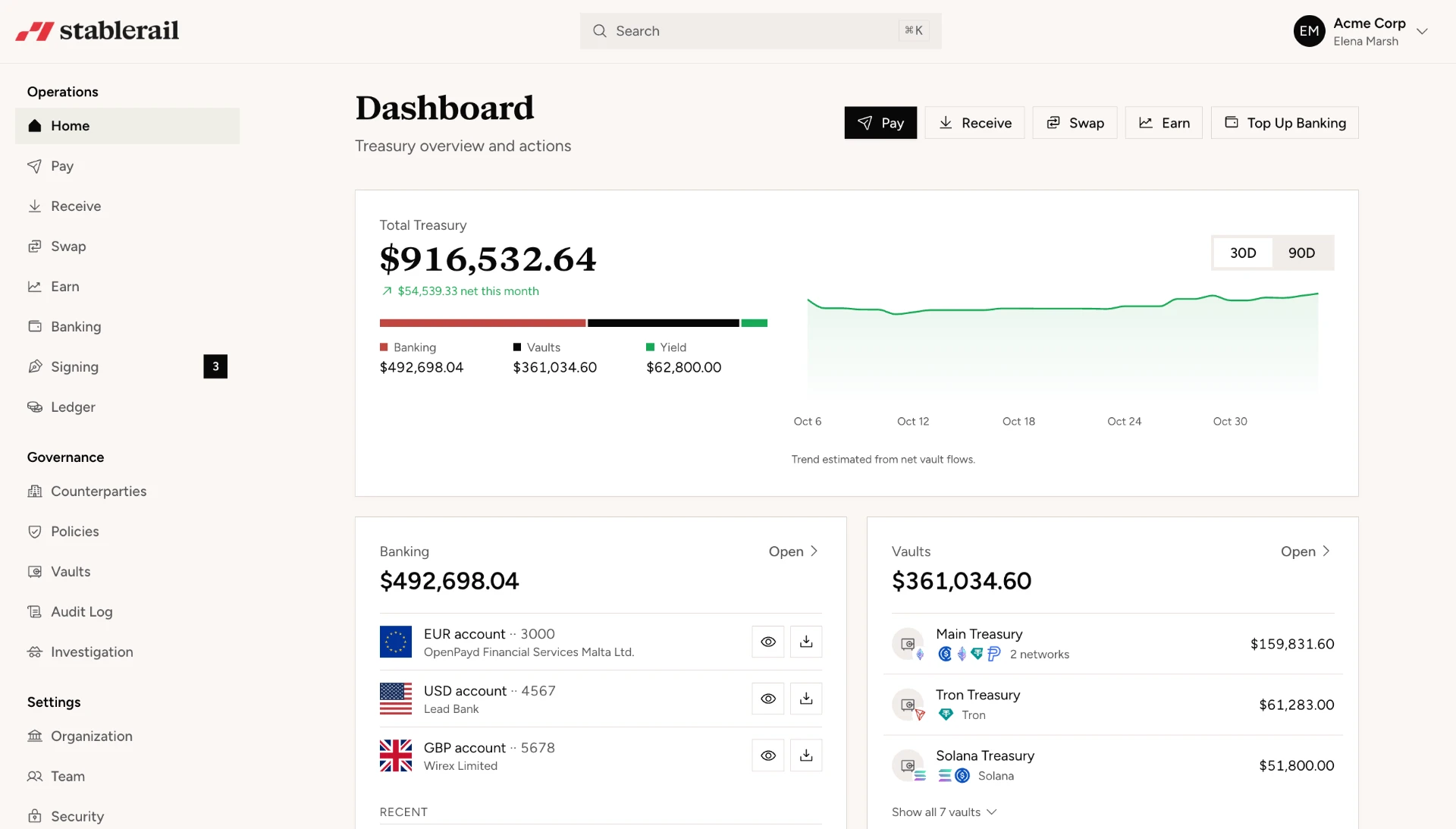
Stablerail connects corporate cards with USDC and USDT treasury operations, including approvals and signing quorum, pre-send sanctions and address screening, fiat conversion and exportable audit evidence. Whatever platform is considered, procurement should verify each capability against the company’s required workflow.
Use a scorecard tied to the actual use case
| Category | Suggested starting weight | Evidence to collect |
|---|---|---|
| Funding and settlement | 25% | End-to-end flow, supported assets and networks, conversion event and settlement terms |
| Fees and exchange rates | 20% | Full fee schedule, rate methodology and sample transaction calculations |
| Spending controls | 20% | Live demonstration and results from attempted out-of-policy transactions |
| Eligibility and coverage | 15% | Written entity, cardholder and shipping eligibility |
| Accounting evidence | 10% | Sample statements, CSV exports and refund records |
| Custody and withdrawals | 10% | Terms, wallet flow and tested withdrawal procedure |
These weights are a starting point, not a universal ranking. A distributed workforce may place more weight on cardholder coverage, while a procurement team may prioritize merchant controls. A company making frequent cross-currency purchases may give fees and rate transparency the greatest weight.
Run a controlled pilot before rollout
Use company-approved test spending rather than relying only on a sales demonstration. A short pilot should include the following steps:
- Fund the card workflow with a limited amount using the intended stablecoin and network.
- Make domestic and foreign-currency purchases, including one recurring payment where appropriate.
- Attempt an out-of-policy transaction to verify that controls decline it at authorization.
- Test a refund, reversal, temporary hold and changed card limit.
- Withdraw unused funds using the normal approval process.
- Reconcile every event from the treasury record through the card statement and accounting export.
The best corporate crypto card in 2026 is therefore the provider that performs cleanly across this full operating cycle. Rewards and token support can be useful tie-breakers, but funding clarity, total cost, preventive controls, geographic eligibility, custody terms and reliable audit evidence should determine the decision.
Frequently asked questions
What is the best corporate crypto card for a company holding USDC?
The best option depends on how the company wants USDC converted, controlled and accounted for. Prefer a provider that supports the correct USDC network, discloses conversion and FX costs, enforces employee limits at authorization and exports complete settlement records.
How do corporate crypto cards convert stablecoins into fiat?
Some providers convert stablecoins when the company funds a card balance, while others link conversion to authorization or settlement. The timing matters because it determines the applicable rate, the treatment of authorization holds and how finance records the conversion.
What fees should a company compare when choosing a crypto card?
Compare platform and card charges, stablecoin conversion spreads, blockchain transfer fees, foreign-exchange markups, replacement or shipping costs and exception fees. Model the total using the company’s expected currencies, transaction volume and cardholder count rather than one advertised rate.
Are corporate crypto cards available to employees worldwide?
Not necessarily. Eligibility can depend on the company’s jurisdiction, industry and ownership as well as each cardholder’s residence and the locations where physical cards can be shipped. Obtain written coverage confirmation before starting onboarding.
How should a business account for purchases funded with USDC or USDT?
The business expense and the stablecoin conversion or disposal may require separate accounting entries, including fees and any gain or loss. The correct treatment depends on the jurisdiction and the company’s accounting policy, so finance should confirm it with qualified advisers.
Finance writers covering stablecoin treasury, payments, compliance, and risk controls.
More about the Stablerail team- Stablecoin treasury managementApprovals, limits, yield and reporting on one balance.
- Stablecoin payoutsBatch contractor and vendor payments with screening.
- USDT vs USDCWhich stablecoin your company should settle in.
- Stablecoin finance glossaryMPC, off-ramp, travel rule and the rest, in plain English.
- Product updatesEverything we ship, month by month.