
AI-Agent Treasury: How Autonomous Workflows Can Manage Cash and Stablecoins
A practical guide to using AI agents for cash positioning, reconciliation, stablecoin conversions, payouts and risk monitoring—with approval controls and human oversight.

An AI-agent treasury uses software agents to monitor financial data, recommend actions and, within defined limits, execute treasury tasks. For a company managing bank balances alongside USDC or USDT, that could mean reconciling transactions, forecasting a funding gap, proposing a conversion or preparing a batch of vendor payments.
The important distinction is authority. An agent can identify what should happen without being allowed to move funds. More advanced autonomous workflows may execute routine actions, but only within approval policies, wallet allowlists, transaction limits and other controls set by the finance team.
This makes AI-agent treasury an extension of treasury automation, not a replacement for accountable decision-makers.
What an AI treasury agent actually does
A treasury agent combines instructions, financial data and access to approved tools. Its inputs might include bank balances, stablecoin wallets, accounts payable files, invoices, exchange rates, transaction histories and internal cash policies.
It can then perform a sequence of tasks:
- Collect balances across fiat accounts and blockchain wallets.
- Match incoming and outgoing transactions to invoices or ledger entries.
- Estimate liquidity requirements by currency and due date.
- Recommend transfers or conversions to cover expected obligations.
- Prepare payments on an approved network and from an approved vault.
- Flag unusual transactions, failed payouts or policy breaches.
The agent does not need unrestricted access to be useful. In many finance teams, the safest starting point is read-only access and recommendations. Execution rights can be added later for narrow, repetitive workflows.
Recommendations versus autonomous execution
| Operating model | What the agent does | Typical human role |
|---|---|---|
| Monitoring | Collects data and raises alerts | Investigates and decides |
| Recommendation | Proposes a transfer, conversion or payout batch | Reviews and approves the action |
| Prepared execution | Builds the transaction with amount, recipient and network | Provides the required signatures |
| Limited autonomy | Executes actions inside preset limits | Reviews exceptions and periodic reports |
| Broad autonomy | Optimizes and moves funds across several accounts | Sets policy and intervenes when needed |
Most corporate teams should progress through these stages rather than begin with broad autonomy. A recommendation-only agent can already reduce manual work without receiving authority to move cash. Prepared execution can save more time while retaining quorum signing, where multiple authorized people must approve a transaction.
Five practical use cases
1. Cash positioning
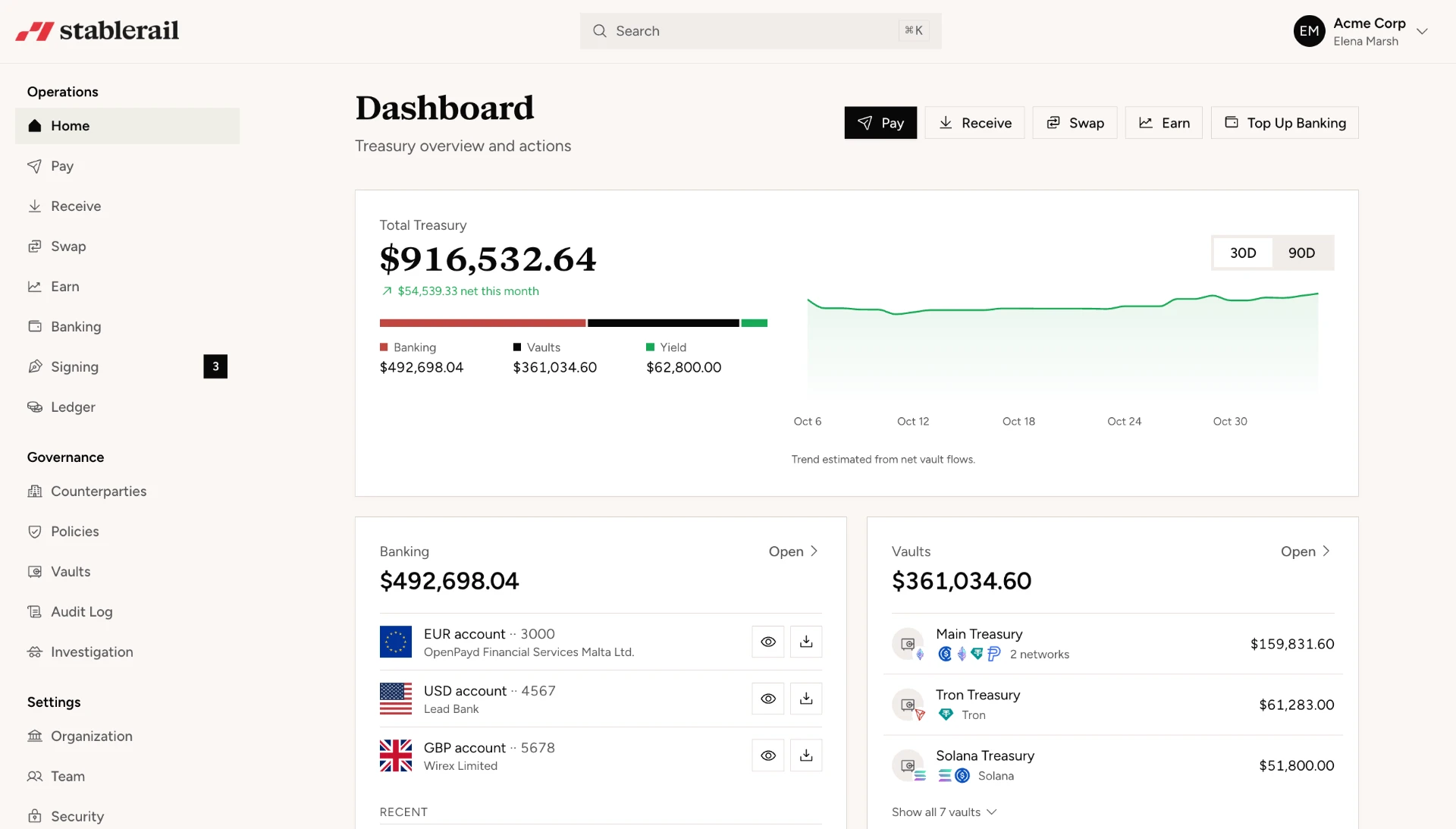
An agent can produce a consolidated view of EUR, USD and GBP bank balances alongside USDC and USDT held in self-custodial MPC vaults. MPC, or multi-party computation, distributes signing authority so that no single person or device holds the complete private key.
The agent can compare available funds with payroll, invoices, card spending and vendor payment schedules. If a USD account is expected to fall below a finance team’s minimum balance, it could recommend funding through ACH, Fedwire or a stablecoin conversion. The appropriate rail depends on cut-off times, cost and urgency.
SEPA Instant and Faster Payments may settle in seconds or minutes when both institutions support the transaction. Fedwire and CHAPS are generally same-day services subject to operating hours and cut-offs. ACH, BACS and standard SEPA transfers commonly take one or more business days. Actual availability, limits and settlement times vary by bank, provider, currency and compliance review.
2. Reconciliation
Stablecoin reconciliation is difficult when a ledger description, blockchain transaction hash and invoice reference live in separate systems. An agent can match these records using amount, currency, timestamp, wallet address and payment reference.
It can also identify exceptions such as a duplicated transfer, an invoice paid on the wrong network or a customer payment received without a reference. The output should include the source records used for each match so the finance team can verify the conclusion and preserve evidence for month-end close.
3. Fiat and stablecoin conversions
An AI-agent treasury can identify when a conversion is needed, compare the available corridor with the payment deadline and prepare an on-ramp or off-ramp instruction. For example, it might recommend converting EUR to USDC before a Base payout batch, or selling USDT into USD to fund a Fedwire payment.
The decision should account for the quoted conversion price, platform fees, blockchain network fees, minimum and maximum transaction sizes, settlement time and the risk of using the wrong token or network. Pricing should come from the executable corridor quote or published pricing available at the time, not from a generic market price.
4. Payouts and payroll
Agents can turn approved accounts payable data into a batch of stablecoin payments. A workflow could validate recipient names, wallet addresses, tokens and networks before preparing payouts across Ethereum, Base, Arbitrum, Polygon, Tron, BNB Chain, Optimism or Solana.
Before release, the workflow should confirm that each wallet is allowlisted, screen addresses for sanctions and risk indicators, check the available balance and estimate network fees. High-value or first-time recipients can be routed for additional review. Stablerail’s stablecoin payout workflows can support batch vendor and contractor payments, while crypto payroll workflows can separate payroll preparation from final approval.
5. Risk and exception monitoring
An agent can monitor wallet activity, failed bank transfers, unusual payment sizes, changes to beneficiary details and concentration in one stablecoin or network. It can also track operational issues, such as insufficient gas tokens for blockchain fees or a payout waiting beyond its expected confirmation window.
These alerts are most useful when they explain the trigger and recommend a specific next step. A vague risk score is less actionable than an alert stating that a new wallet is requesting a payment above the first-payment limit.
Approval controls for autonomous workflows
Autonomy should be constrained by explicit approval controls rather than broad instructions such as “optimize liquidity.” A corporate stablecoin treasury can define:
- Transaction limits: maximum amounts by agent, currency, token, network or time period.
- Quorum signing: multiple authorized signers for transactions above a threshold.
- Allowlists: payments only to verified bank accounts and wallet addresses.
- Role separation: an agent may prepare a payment but cannot approve its own work.
- Network restrictions: USDC on Base may be allowed while unsupported token contracts are blocked.
- Screening: sanctions and wallet checks before execution, with exceptions held for review.
- Audit evidence: a record of inputs, recommendations, approvals, signatures and final transaction identifiers.
Human oversight remains necessary because agents can receive incomplete data, interpret an ambiguous invoice incorrectly or recommend an action based on an outdated policy. Legal obligations, counterparty disputes and unusual liquidity events also require judgment that should not be delegated automatically.
How to introduce AI-agent treasury safely
Start with one frequent, measurable workflow. Daily cash positioning or reconciliation is usually lower risk than autonomous payments. Give the agent read-only access, compare its output with the existing process and record error types.
Next, allow the agent to prepare actions without executing them. Finance staff can review conversion instructions, payout batches and funding recommendations. Once performance is consistent, consider limited execution for low-value transfers to existing recipients, with hard daily limits and automatic escalation.
Use a sandbox or test transaction where available, and verify token contract, network and recipient details before moving production funds. Onboarding to treasury infrastructure will still require KYB checks and confirmation that the company’s jurisdiction and industry are eligible.
Stablerail provides the underlying treasury mechanics: fiat accounts and payment rails, USDC and USDT conversion corridors, self-custodial MPC vaults, multi-network payouts, cards, approval policies, screening and audit records. Finance teams evaluating integration or workflow requirements can consult the help centre.
The practical objective
The goal of treasury automation is not to remove people from every decision. It is to reduce time spent collecting balances, matching records and rebuilding routine transactions while preserving accountability for material fund movements.
A well-designed AI-agent treasury knows both what it can do and when it must stop. Recommendations, narrow permissions, approval controls and complete evidence allow autonomous workflows to assist with cash and stablecoins without turning treasury management into an uncontrolled black box.
Finance writers covering stablecoin treasury, payments, compliance, and risk controls.
More about the Stablerail team- Stablecoin treasury managementApprovals, limits, yield and reporting on one balance.
- Stablecoin payoutsBatch contractor and vendor payments with screening.
- USDT vs USDCWhich stablecoin your company should settle in.
- Stablecoin finance glossaryMPC, off-ramp, travel rule and the rest, in plain English.
- Product updatesEverything we ship, month by month.