
How to Automate Stablecoin Payments, From Approval to Reconciliation
A practical workflow for automating USDC and USDT payments from beneficiary validation and approvals through blockchain confirmation and accounting reconciliation.
To automate stablecoin payments, connect each approved obligation to a verified beneficiary, supported token-network pair, screened wallet, approval workflow and unique payment reference. Submit instructions by batch file or API, track them through blockchain confirmation, and reconcile the obligation, payment record and transaction hash. Keep exceptions—such as changed addresses, screening flags, insufficient balances and failed transactions—outside the automatic path for manual review.
%22%20x1%3D%220%22%20y1%3D%220%22%20x2%3D%221%22%20y2%3D%221%22%3E%0A%20%20%20%20%20%20%20%20%3Cstop%20offset%3D%220%25%22%20stop-color%3D%22%23450B10%22%20%2F%3E%0A%20%20%20%20%20%20%20%20%3Cstop%20offset%3D%2250%25%22%20stop-color%3D%22%23681A1F%22%20%2F%3E%0A%20%20%20%20%20%20%20%20%3Cstop%20offset%3D%22100%25%22%20stop-color%3D%22%238A2A2D%22%20%2F%3E%0A%20%20%20%20%20%20%3C%2FlinearGradient%3E%0A%20%20%20%20%20%20%3CradialGradient%20id%3D%22glow%22%20cx%3D%22937%22%20cy%3D%22-4%22%20r%3D%22520%22%20gradientUnits%3D%22userSpaceOnUse%22%3E%0A%20%20%20%20%20%20%20%20%3Cstop%20offset%3D%220%25%22%20stop-color%3D%22%23FF7A59%22%20stop-opacity%3D%220.45%22%20%2F%3E%0A%20%20%20%20%20%20%20%20%3Cstop%20offset%3D%2255%25%22%20stop-color%3D%22%23FF7A59%22%20stop-opacity%3D%220.08%22%20%2F%3E%0A%20%20%20%20%20%20%20%20%3Cstop%20offset%3D%22100%25%22%20stop-color%3D%22%23FF7A59%22%20stop-opacity%3D%220%22%20%2F%3E%0A%20%20%20%20%20%20%3C%2FradialGradient%3E%0A%20%20%20%20%20%20%3ClinearGradient%20id%3D%22glass%22%20x1%3D%220%22%20y1%3D%220%22%20x2%3D%221%22%20y2%3D%221%22%3E%0A%20%20%20%20%20%20%20%20%3Cstop%20offset%3D%220%25%22%20stop-color%3D%22%23F8D6D2%22%20stop-opacity%3D%220.26%22%20%2F%3E%0A%20%20%20%20%20%20%20%20%3Cstop%20offset%3D%22100%25%22%20stop-color%3D%22%23FFFFFF%22%20stop-opacity%3D%220.08%22%20%2F%3E%0A%20%20%20%20%20%20%3C%2FlinearGradient%3E%0A%20%20%20%20%20%20%3ClinearGradient%20id%3D%22accent%22%20x1%3D%220%22%20y1%3D%220%22%20x2%3D%221%22%20y2%3D%221%22%3E%0A%20%20%20%20%20%20%20%20%3Cstop%20offset%3D%220%25%22%20stop-color%3D%22%23FF7A59%22%20%2F%3E%0A%20%20%20%20%20%20%20%20%3Cstop%20offset%3D%22100%25%22%20stop-color%3D%22%23C73128%22%20%2F%3E%0A%20%20%20%20%20%20%3C%2FlinearGradient%3E%0A%20%20%20%20%20%20%3Cfilter%20id%3D%22soft%22%3E%3CfeGaussianBlur%20stdDeviation%3D%2210%22%20%2F%3E%3C%2Ffilter%3E%0A%20%20%20%20%3C%2Fdefs%3E%0A%20%20%20%20%3Crect%20width%3D%221600%22%20height%3D%22900%22%20fill%3D%22url(%23bg)%22%20%2F%3E%0A%20%20%20%20%3Crect%20width%3D%221600%22%20height%3D%22900%22%20fill%3D%22url(%23glow)%22%20%2F%3E%0A%20%20%20%20%3Cpath%20d%3D%22M180%20280%20C%20600%20280%2C%20600%20380%2C%201420%20380%22%20stroke%3D%22url(%23accent)%22%20stroke-width%3D%2247%22%20fill%3D%22none%22%20opacity%3D%220.75%22%2F%3E%3Cpath%20d%3D%22M180%20440%20C%20600%20440%2C%20600%20520%2C%201420%20520%22%20stroke%3D%22%23F8D6D2%22%20stroke-width%3D%2212%22%20fill%3D%22none%22%20opacity%3D%220.4%22%2F%3E%3Cpath%20d%3D%22M180%20600%20C%20600%20600%2C%20600%20660%2C%201420%20660%22%20stroke%3D%22url(%23accent)%22%20stroke-width%3D%2210%22%20fill%3D%22none%22%20opacity%3D%220.55%22%2F%3E%3Crect%20x%3D%22140%22%20y%3D%22240%22%20width%3D%2240%22%20height%3D%22420%22%20rx%3D%226%22%20fill%3D%22%23F8D6D2%22%20opacity%3D%220.7%22%2F%3E%3Crect%20x%3D%221420%22%20y%3D%22340%22%20width%3D%2240%22%20height%3D%22360%22%20rx%3D%226%22%20fill%3D%22url(%23accent)%22%2F%3E%0A%20%20%20%20%3Crect%20x%3D%2226%22%20y%3D%2226%22%20width%3D%221548%22%20height%3D%22848%22%20rx%3D%2218%22%20fill%3D%22none%22%20stroke%3D%22%23F2D0C8%22%20stroke-opacity%3D%220.12%22%2F%3E%0A%20%20%3C%2Fsvg%3E)
Reliable stablecoin payment automation covers the entire control chain: beneficiary setup, instruction validation, address screening, approvals, signing, submission, confirmation and accounting reconciliation. Automating only the blockchain transfer leaves finance teams exposed to duplicate payments, wrong-network errors, weak segregation of duties and incomplete ledger evidence.
Choose batch files, an API or a hybrid workflow
The best submission method depends on where payment instructions originate, how often they run and whether status updates must return automatically to the source system. Batch files are often the fastest controlled starting point; APIs are better suited to frequent or system-generated disbursements.
| Method | Best fit | Implementation | Main control consideration |
|---|---|---|---|
| Batch file | Weekly payroll, monthly contractors and scheduled vendor runs | Export a CSV from an ERP, payroll system or controlled spreadsheet, then upload it for validation | Use a locked template, unique references and documented preparation and review ownership |
| API | Daily payouts, platform disbursements and higher transaction volumes | Create instructions from an ERP, treasury platform or internal application | Use authentication, idempotency, access separation and reliable status handling |
| Hybrid | Teams migrating from manual operations or managing exceptions | Use an API for routine flows and files for approved edge cases | Apply the same beneficiary, approval and reconciliation controls to both channels |
Choose the asset and network before building the integration. USDC or USDT on one blockchain is operationally separate from the same ticker on another blockchain. Confirm the exact token contract, network and destination support rather than relying on the asset symbol alone.
1. Build a controlled beneficiary record
Every payment should begin with an approved beneficiary record, not an address pasted into a payment screen. The record should include the legal or contractor name, internal beneficiary ID, wallet address, blockchain network, stablecoin, country, payment purpose and relevant tax or accounting details.
Record when, how and by whom the wallet instructions were verified. Beneficiaries should confirm the address and network through an authenticated channel. Treat address changes like bank-detail changes: require a second-channel check or callback and independent approval before the new destination becomes active.
An allowlist can restrict routine payments to approved destinations. A strong segregation rule prevents the same employee from creating a beneficiary, changing its wallet and authorising its first payment.
2. Validate and screen before approval
Run mechanical checks before sending a payment to approvers. Each instruction should have a positive amount, valid decimal precision, active beneficiary, unique internal reference and supported asset-network pair. Confirm that the treasury has enough stablecoin on the correct network and, when required, enough native network currency to pay transaction fees.
Duplicate detection should compare more than the wallet address. Check the invoice or payroll reference, beneficiary, amount, asset and payment period. A contractor can legitimately receive several payments to one address, while the same invoice submitted twice is usually an error.
Screen destination addresses before signing or sending. A screening flag should create an exception rather than an automatic rejection or approval. Preserve the result and route it to the designated finance or compliance owner, who can reject the payment, request additional information or document a decision under the company’s procedures.
3. Separate preparation, approval and signing
Creating an instruction is not the same as authorising an on-chain transfer. A controlled workflow separates the operator who prepares the run from the people who approve or sign it. Signing quorum can require more than one authorised participant before funds move, reducing dependence on any one employee or device.
A typical approval sequence is:
- An operator imports or creates the payment run.
- Automated checks validate beneficiaries, references, balances and asset-network pairs.
- A finance manager reviews the total, supporting documents and exception report.
- An additional treasury approver signs payments that meet the company’s escalation criteria.
- The approved transaction is submitted to the selected blockchain.
Approval requirements can vary by legal entity, payment type, amount or destination risk. Keep emergency payments outside the routine batch path and require a documented reason plus retrospective review. The evidence retained for each payment should include the source instruction, supporting obligation, screening record, approvals, timestamps and final transaction identifier.
4. Fund and schedule the payment run
Stablecoin transfers are not limited to banking hours, but payroll and vendor runs still need cutoffs. Leave time to resolve changed addresses, screening exceptions, missing approvals and treasury shortfalls before the promised payment date.
Calculate funding separately for every asset-network pair. A USDC balance on one network cannot directly satisfy a USDC obligation on another without an additional transfer, conversion or bridge step. The treasury requirement may include the beneficiary amount, blockchain fees, service charges, conversion costs and any planned fiat funding or off-ramp costs.
5. Submit without creating duplicates
For batch files, assign a unique payment reference to every row and a separate identifier to the overall run. Useful line fields include beneficiary ID, destination address, network, asset, amount, invoice or payroll reference and requested execution time. Reject malformed or duplicate rows before approval.
For API submissions, use an idempotency key or immutable external reference for each instruction. If a request times out, the source system can safely retry or query the existing payment instead of creating another one. Store the returned payment identifier against the originating ERP or payroll record.
Do not mark an obligation as paid when an API accepts the instruction. Acceptance means the request entered the workflow; it does not prove that it was approved, broadcast or confirmed on-chain.
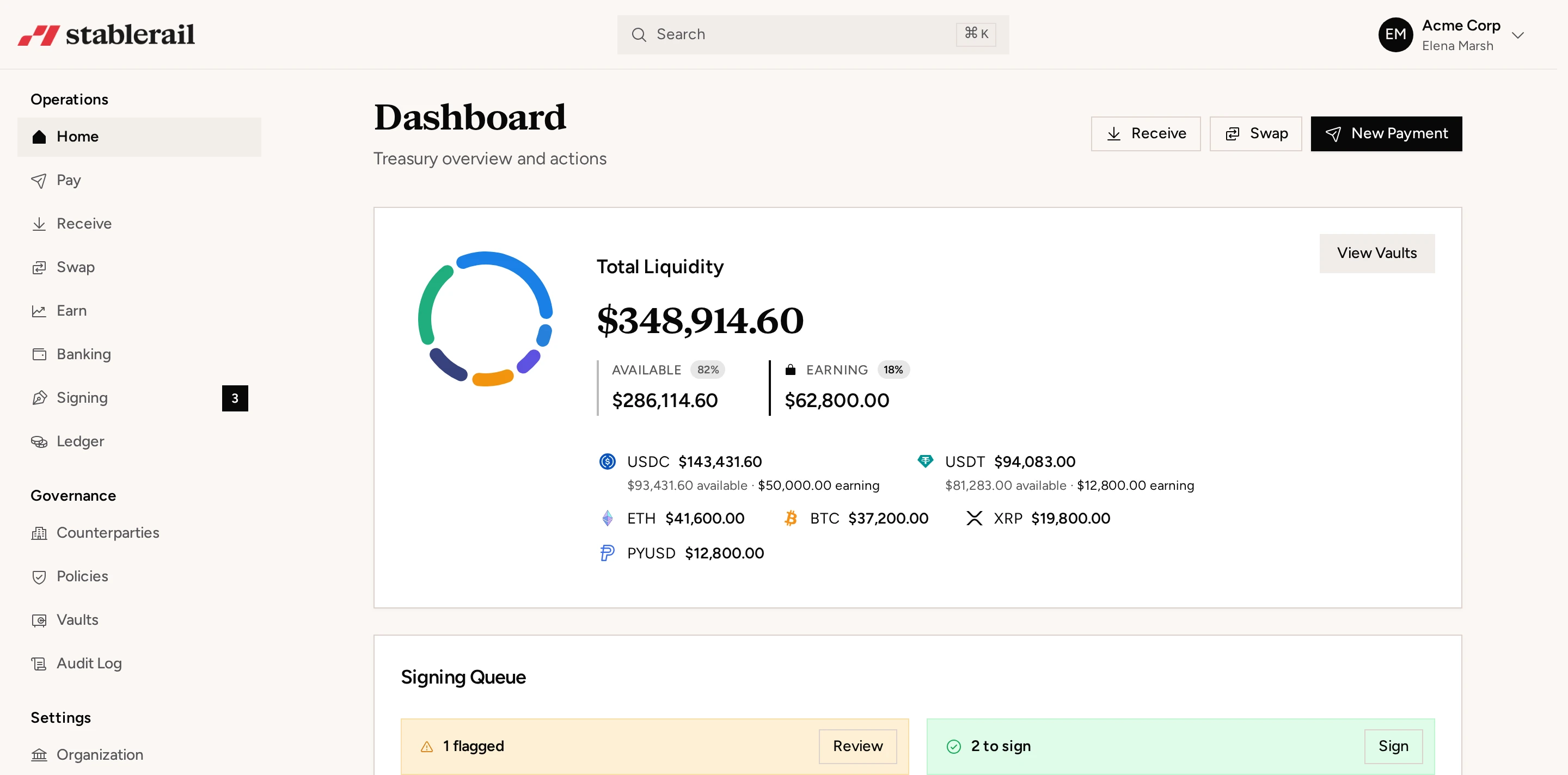
Stablerail provides one business account for USDC and USDT treasury, with approvals and signing quorum, sanctions and address screening before send, global payouts, fiat off-ramp and exportable audit evidence.
6. Track payments to a terminal status
Map provider and blockchain events into a small internal status model. The accounting system should respond to business meaning rather than every technical event emitted by an integration.
| Internal status | Meaning | Finance action |
|---|---|---|
| Pending approval | The instruction exists but lacks required authorisation | Route it to the correct approvers; do not post settlement |
| Scheduled | Approved for a future execution time | Confirm the required balance remains available |
| Submitted | Broadcast to the blockchain | Store the transaction hash and monitor confirmation |
| Confirmed | The defined blockchain confirmation criterion is met | Post settlement and close the obligation |
| Failed or rejected | The instruction did not complete | Review the reason and create a controlled replacement if needed |
Use documented webhooks or polling to update the source system. Design webhook processing to tolerate repeated or out-of-order events, and periodically query unresolved payments so a missed event does not leave the ledger stale. Confirmation time varies with the network and confirmation policy, so avoid promising a fixed settlement time without support for that commitment.
7. Reconcile the obligation, payment and blockchain record
Reconciliation should connect three records: the approved business obligation, the payment platform record and the on-chain transaction. Retain the internal invoice or payroll reference, payment identifier, stablecoin amount, network, destination address, transaction hash, confirmation time, fees and final status.
Record the fiat book value using the company’s approved accounting policy and exchange-rate source. Post the principal separately from network, service and conversion fees so accounts payable, payroll expense and transaction costs remain visible. If a blockchain transaction represents several beneficiary payments, retain line-level mappings so each invoice can be closed independently.
A daily exception report should identify accepted instructions that remain unconfirmed, failed transfers without a controlled replacement, duplicate references, screening exceptions, insufficient balances, changed addresses and ledger entries missing a transaction hash. Normal payments should reconcile automatically; people should spend their time on a short, owned exception queue.
Implementation checklist
- Start with one stablecoin, one network and one recurring payment type.
- Define beneficiary creation, address-change and deactivation controls.
- Separate payment preparation, approval and signing responsibilities.
- Test duplicate submissions, timeouts, insufficient balances and rejected addresses.
- Run low-value transfers and verify recipient receipt before production rollout.
- Confirm accounting exports include references, hashes, fees and timestamps.
- Document who owns every exception and when it must be escalated.
Once the first workflow is stable, add API creation, automated status updates and additional payment corridors in stages. Preserve the same control model as volume grows: verified beneficiaries, pre-send screening, independent approvals, unique references and evidence that ties every ledger entry to its final on-chain outcome.
Frequently asked questions
How do you automate USDC or USDT payments safely?
Use a controlled beneficiary master, validate the exact token-network pair, screen the destination address and require independent approval before signing. Submit each payment with a unique reference, track it through confirmation and reconcile the transaction hash to the original obligation.
Should stablecoin payouts use a batch file or an API?
Batch files are usually suitable for scheduled payroll, contractor and vendor runs that finance prepares periodically. An API is better for frequent or system-generated payouts, especially when payment status must flow back automatically to an ERP or internal platform.
When should a stablecoin payment be marked as paid?
Do not mark it paid merely because a file or API request was accepted. Close the obligation only after the transaction reaches the company’s required confirmed status and the transaction hash, amount, asset, network and destination match the approved instruction.
How do finance teams prevent duplicate stablecoin payments?
Assign an immutable external reference or idempotency key to every payment and check invoice, beneficiary, amount, asset and period before approval. Retries should query or reuse the original instruction rather than create a new payment.
What records are needed to reconcile a stablecoin payment?
Retain the source invoice or payroll reference, beneficiary, payment identifier, asset, network, amount, destination address, transaction hash, confirmation time and fees. Also preserve approvals, screening evidence and the exchange-rate source used for fiat book value.
Finance writers covering stablecoin treasury, payments, compliance, and risk controls.
More about the Stablerail team- Stablecoin treasury managementApprovals, limits, yield and reporting on one balance.
- Stablecoin payoutsBatch contractor and vendor payments with screening.
- USDT vs USDCWhich stablecoin your company should settle in.
- Stablecoin finance glossaryMPC, off-ramp, travel rule and the rest, in plain English.
- Product updatesEverything we ship, month by month.